The embedded software industry is undergoing a fundamental shift in how code moves from a developer’s workstation to a shipping product. Continuous development, the practice of automating build, test, and deployment cycles so that every code change is validated immediately, has become standard in web and enterprise software. Embedded teams have been slower to adopt it, but the gap is closing rapidly, and Indian engineering organisations are leading that change in Asia.
What Continuous Development Actually Means
In a traditional waterfall workflow, code is written for weeks or months, then handed to a separate test team for validation. Defects discovered late in this cycle are expensive to fix because they require rework across multiple subsystems that were developed in parallel under untested assumptions.
Continuous development inverts this model. Every commit triggers an automated pipeline that builds the software, runs static analysis, executes unit and integration tests, and produces a deployable artefact. Failures are caught within minutes of the commit that introduced them, when the context is still fresh in the developer’s mind.
The numbers are striking. Industry data shows that organisations practising continuous delivery achieve 208 times more frequent deployments, 106 times faster lead time from commit to production, and 7 times lower change failure rate compared to low-performing peers. These are not marginal improvements. They represent a fundamentally different operating model.
Why Embedded Teams Struggle
Embedded development introduces challenges that do not exist in server-side or mobile software. Cross-compilation toolchains are complex and slow. Builds may target multiple hardware variants simultaneously. Testing often requires physical hardware or cycle-accurate simulators that are expensive and scarce. Flashing firmware to a target board takes time that cannot be parallelised away.
These constraints make it tempting to conclude that CI/CD is impractical for embedded work. That conclusion is wrong, but it does mean that embedded CI/CD pipelines must be designed differently. The key is identifying which validation steps can run on every commit in seconds, and which should run on a scheduled or gated basis.
Static Analysis as the First Quality Gate
This is where static analysis becomes the cornerstone of an embedded CI/CD strategy. Unlike unit tests, which require execution infrastructure, or hardware-in-the-loop tests, which require physical targets, static analysis runs on the source code itself. It needs nothing more than the build configuration and the source tree.
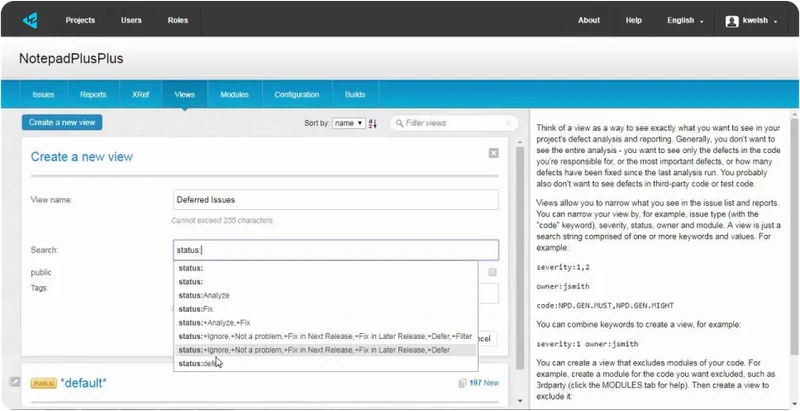
Klocwork is built for exactly this use case. Its differential analysis mode examines only the files changed in a given commit and produces results in seconds, not hours. This makes it feasible to run Klocwork as a mandatory quality gate on every pull request. Defects mapped to CWE and CERT C rules are flagged before the code is merged, preventing security vulnerabilities from ever reaching the main branch. Perforce QAC brings MISRA compliance checking into the same pipeline. For teams working under ISO 26262 or IEC 61508, MISRA conformance is not optional. Running QAC in CI ensures that every commit maintains the coding standard baseline and generates the compliance evidence needed for audits.
A practical pipeline looks like this: a developer pushes to a feature branch, Jenkins or GitLab CI triggers a build using the cross-compilation toolchain, Klocwork runs differential analysis, QAC checks MISRA compliance, and unit tests execute on a host-based simulator. The entire cycle completes in minutes. Hardware-in-the-loop testing runs nightly on the integration branch.
India’s Position
The Perforce 2026 State of Automotive Software Quality report reveals that 59% of automotive software teams have implemented shift-left practices, integrating quality checks earlier in the development cycle rather than deferring them to late-stage testing. India leads Asia in this adoption, driven by the automotive engineering services sector’s exposure to global OEM requirements and the growing domestic automotive industry’s own quality ambitions.
This is not surprising. Indian embedded teams have spent two decades building expertise in automotive, aerospace, and industrial domains. The transition from waterfall to continuous development is a natural evolution, not a revolution, and teams that have already invested in static analysis tools and coding standards are best positioned to make it.
Build Your Pipeline
GSAS provides CI/CD integration services for embedded teams adopting continuous development. We help you configure Klocwork and Perforce QAC in your existing Jenkins, GitLab CI, or Azure DevOps pipelines, establish quality gates, and train your team to operate in a continuous development model. Reach out to discuss your pipeline architecture.
Also appears in:
Interested in Perforce tools?
Talk to our application engineers for personalized tool recommendations.
More from Perforce
View all →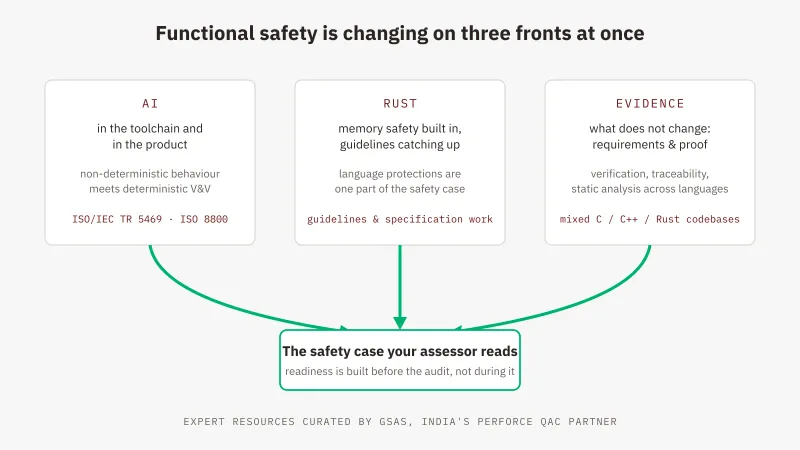
AI, Rust and the New Functional Safety Standards
2 Sept · 9 min

The Complete AUTOSAR Verification Chain: AUTOSAR C++14 Static Analysis with Perforce QAC, SWC and RTE Testing with TESSY 6
31 Jul · 9 min
DevSecOps Tools and Practices for Embedded Teams in India
18 Jul · 8 min
Static Analysis for Medical Device Software: IEC 62304 and FDA Compliance in India
18 Jul · 9 min
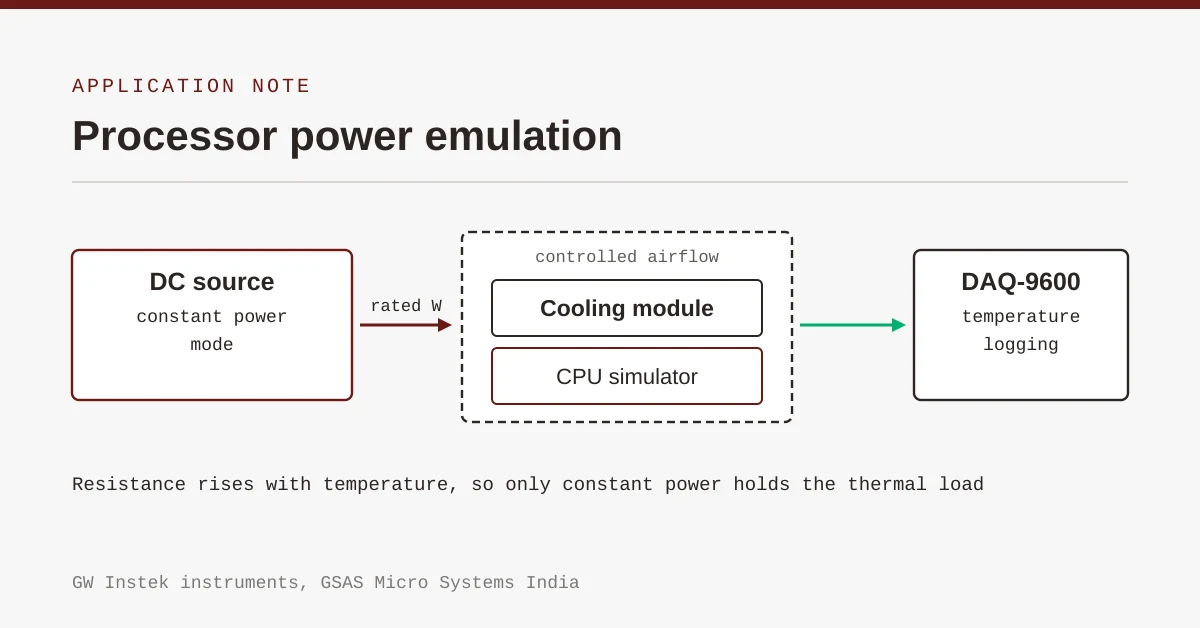
Emulating Processor Power for Thermal Testing: Why Constant Power
7 Oct · 7 min
CRPS and Rack Power Supply Testing: The Six Tests That Matter
7 Oct · 7 min