What Is IEC 62304?
IEC 62304, “Medical device software, software life cycle processes,” is the international standard that governs how medical device software is developed, verified, and maintained, whether it runs embedded inside a device or standalone as Software as a Medical Device (SaMD). It is a process standard, not a product standard: it specifies which lifecycle activities and documentation a manufacturer must produce, and how rigorously, without dictating a specific programming language, tool, or development methodology.
For an Indian embedded team building infusion pumps, patient monitors, diagnostic imaging software, ventilator firmware, or a standalone diagnostic algorithm, IEC 62304 is the standard an auditor, a notified body, or the FDA will ask about first. It sits alongside ISO 13485 (the quality management system standard) and ISO 14971 (risk management), and in practice the three are audited together, but IEC 62304 is specifically the one that defines what “verification evidence” for software has to look like.
What Software Safety Classes Does IEC 62304 Define?
IEC 62304 assigns every software item one of three safety classes based on the worst-case harm it could cause after risk controls outside the software are applied: Class A (no injury possible), Class B (non-serious injury possible), or Class C (death or serious injury possible). The assigned class is what determines how much verification evidence an auditor will expect to see.
Classification is a two-step question. First: can the software contribute to a hazardous situation at all? If genuinely not, it is Class A, and the documentation burden is light. If it can, the second question is how severe the resulting harm could be once external risk controls (hardware interlocks, clinician oversight, alarms) are accounted for. Non-serious injury lands in Class B; death or serious injury lands in Class C.
Class C is where the rigor compounds. A ventilator control loop, an infusion pump dosing algorithm, or a defibrillator firmware module is typically Class C, and auditors expect a full paper trail: detailed software requirements and design documentation, unit-level verification against a coding standard, structural test coverage evidence, and bidirectional traceability from requirement to test to defect. A logging module that only affects a non-critical UI display, by contrast, may reasonably sit at Class A. Most real device software is a mix, some units Class C, others Class A or B, and the standard expects each unit’s evidence to match its own class, not a blanket policy applied to the whole codebase.
Where Does Static Analysis Fit in IEC 62304 Compliance?
Static analysis is not named as a mandatory tool anywhere in IEC 62304’s text, but it is how most manufacturers satisfy the standard’s software unit verification requirements in practice. The standard requires software unit acceptance criteria to be established before verification, and many medical device companies meet that bar by enforcing a coding standard, most commonly MISRA C or MISRA C++ for embedded C/C++ firmware, using a certified static analyzer to check every commit against it.
That approach earns its place for a specific reason: static analysis reasons about every possible execution path through the source code, not just the paths a test case happens to exercise. It catches undefined behaviour, dataflow anomalies, and dangerous constructs, the defect classes a coding standard exists to rule out, before a single test runs. Where security is also a driver (network-connected infusion pumps, remote patient monitoring, connected diagnostic devices), teams increasingly layer in CWE-based SAST coverage alongside the coding-standard check, since a growing share of medical device cybersecurity guidance references CWE taxonomies directly.
Static analysis evidence, however, only covers half the verification picture. It proves the code conforms to a standard; it cannot prove a function returns the correct output for a given input. That is what dynamic testing is for, and it is why IEC 62304 verification records almost always pair static analysis with unit and integration test coverage.
Does the FDA Accept IEC 62304 Compliance Evidence?
Yes. The FDA recognizes IEC 62304 as a consensus standard, and Perforce states directly that “the FDA accepts demonstration of compliance to the standard as evidence that regulatory processes have been fulfilled” in the US (Source: perforce.com/blog/qac/fda-compliance-med-device). In practical terms, that means a documented, auditable IEC 62304 verification record, static analysis reports against a coding standard, test coverage evidence, and traceability, is a well-established way to support the software portion of a premarket submission.
Perforce’s own framing of this is instructive: many medical device companies adopt MISRA specifically because it helps satisfy the software unit acceptance criteria IEC 62304 requires, and a MISRA-compliant codebase backed by a certified static analyzer’s audit trail is exactly the kind of evidence an FDA reviewer or notified-body auditor is looking for.
Which Tools Map to IEC 62304 Verification: QAC, Tessy, and Klocwork?
No single tool covers every verification objective IEC 62304 asks for. The evidence package a Class C audit expects is assembled from a static analyzer, a dynamic test tool, and, where the device is network-connected, a broader security scanning layer.
| Verification Need | Tool | What It Proves |
|---|---|---|
| MISRA static analysis, coding-standard evidence | Perforce QAC | Whole-codebase conformance to MISRA C/C++, defect classes ruled out before testing |
| Dynamic unit/integration testing, structural coverage | Razorcat Tessy | Functional correctness plus statement, branch, decision, and MC/DC coverage |
| Multi-language SAST, security taxonomies | Perforce Klocwork | CWE, OWASP, CERT coverage across a broader connected-device codebase |
Perforce QAC’s TÜV SÜD certificate records it as suitably validated for safety-related development according to IEC 62304, covering its dedicated QAC (C) and QAC++ (C++) analysis engines; the certificate carries no Software Safety Class value. Perforce’s own product page states QAC is validated up to Software Safety Class C. Per Perforce, QAC used together with the MISRA coding standard is independently certified as suitable for developing safety-related software to IEC 62304, which is the direct link between MISRA enforcement and the standard’s acceptance criteria. QAC’s inter-procedural dataflow engine, and its cross-language dataflow analysis for Rust alongside C and C++ introduced in QAC 2026.1, extend that same certified analysis to codebases that are modernizing incrementally rather than rewriting from scratch.
Static analysis alone cannot close out a Class C verification record. Razorcat Tessy supplies the dynamic half: automated unit, module, and integration testing for embedded C and C++, with statement, branch, decision, and MC/DC coverage, plus requirements traceability that links test cases back to the software requirements the auditor expects to see satisfied. Running QAC first and Tessy second is the standard shift-left order, static analysis cleans the code before dynamic testing spends its cycles proving behaviour rather than chasing coding-standard defects that should never have reached the test bench.
Where a device is network-connected, cloud-integrated, or ships companion mobile or server software, Perforce Klocwork is the tool to add. Klocwork is a broader multi-language SAST platform, C, C++, C#, Rust, Java, JavaScript, Python, and Kotlin, TÜV SÜD certified for IEC 62304 alongside ISO 26262, IEC 61508, and railway software safety, with CWE Top 25, OWASP, CERT, and DISA STIG taxonomy coverage. It is the right addition when the software safety class alone does not capture the risk, when the connected components carry a cybersecurity review requirement as well as a lifecycle-process one.
What Does Medical Device Software Compliance Look Like in India?
India’s medical device software landscape is at an inflection point. The Central Drugs Standard Control Organisation (CDSCO) published draft guidance on medical device software on 21 October 2025 that references compliance with BIS/ISO standards including ISO 62304, alongside ISO 13485, as part of the expected Device Master File for software-based devices (Source: cdsco.gov.in draft guidance document, October 2025).
Two classification schemes matter here and it is worth keeping them distinct. CDSCO’s draft guidance proposes its own Class A through D risk tiers for Software as a Medical Device, a device-level market classification driven by the significance of the information the software provides and the patient’s condition. IEC 62304’s Class A/B/C safety classes are a separate, unit-level classification inside the software lifecycle itself, driven purely by potential harm severity. A device can carry a CDSCO SaMD risk class for regulatory registration and still contain software units spanning multiple IEC 62304 safety classes internally. Manufacturers building for the Indian market, or exporting from India to FDA- or CE-regulated markets, need both records straight.
What has not changed is the practical engineering reality: an IEC 62304 verification record built on MISRA-enforced static analysis and traceable dynamic test coverage is portable across regulatory regimes, useful for CDSCO registration, an FDA 510(k) or premarket submission, and a CE mark under the EU MDR, because the underlying software evidence is the same lifecycle discipline everywhere.
For medical device firmware teams in Bengaluru, Hyderabad, Pune, Chennai, Mumbai, and Delhi NCR, that means the tooling decision matters more than the paperwork. GSAS Micro Systems is the authorized engineering partner in India for Perforce (Perforce QAC, Klocwork) and Razorcat (Tessy), supplying all three with local field application engineering to configure MISRA rule sets, CI/CD integration, and test coverage targets against your specific software safety classes. Procurement runs on GST-compliant INR invoicing, and GSAS offers competitive pricing and short lead times rather than importing through a multi-step channel. Training for engineering teams new to IEC 62304 tooling is available alongside the standard evaluation and deployment path, see our functional safety capability for how we support IEC 62304, ISO 26262, and DO-178C programs end to end.
Decision Checklist: Which Verification Evidence Do You Need?
Before scoping a toolchain, walk your software architecture through these questions:
- Have you classified every software unit against IEC 62304’s A/B/C scale, or only assigned one class to the whole product? Mixed-class codebases need evidence sized per unit, not a blanket policy.
- Is any unit Class C? If yes, budget for full static analysis coverage, structural test coverage up to MC/DC, and complete requirements traceability, not a lighter evidence set.
- Is MISRA C or MISRA C++ already your coding standard, or does one need to be adopted? Software unit acceptance criteria are most efficiently met with a coding standard a certified analyzer can enforce automatically.
- Does the device connect to a network, a cloud service, or a companion app? If yes, a broader SAST layer with CWE/OWASP coverage belongs in the evidence package alongside the MISRA static analysis.
- Do you need to support both a CDSCO registration and an FDA or CE submission? Build one IEC 62304 verification record designed to satisfy the strictest of the three, it will cover the others.
- Who assembles and maintains this pipeline day to day? A local engineering partner who configures the toolchain to your codebase, rather than a licence dropped off with no support, is what keeps the evidence current as the software evolves.
Get IEC 62304-Ready Verification Tooling from GSAS
Whether you are starting a new Class C medical device program or hardening the verification evidence on an existing one, GSAS Micro Systems supplies the complete IEC 62304 toolchain, Perforce QAC for MISRA static analysis, Razorcat Tessy for dynamic unit testing and MC/DC coverage, and Perforce Klocwork where connected-device security is also in scope, plus the local engineering to configure all three and help assemble the evidence package your auditors expect.
Request a quote for IEC 62304 tooling →
Related Reading
- Shift-Left for Safety-Critical Code: Perforce QAC + Razorcat TESSY for MISRA, IEC 62304 and FDA Compliance in India
- Klocwork vs Perforce QAC: Choosing a Perforce Analyzer in India
- What Is CWE? Understanding Common Weakness Enumeration for Secure Embedded Software
- Perforce, authorized partner in India
- Razorcat, authorized partner in India
- GSAS Functional Safety capability
Source / References
- Perforce, “FDA Compliance and Medical Device Development”, https://www.perforce.com/blog/qac/fda-compliance-med-device (IEC 62304 definition; FDA acceptance of standards compliance; MISRA’s role in software unit acceptance criteria; QAC’s IEC 62304 certification with MISRA).
- Perforce, “Perforce QAC” product page, https://www.perforce.com/products/helix-qac (TÜV-SÜD certification for IEC 62304; Perforce states QAC is validated up to Software Safety Class C; inter-procedural dataflow; Rust/C/C++ cross-language support in QAC 2026.1).
- Jama Software, “What Is IEC 62304? A Guide to Medical Device Software”, https://www.jamasoftware.com/requirements-management-guide/medical-devices/iec-62304/ (IEC 62304 scope, process-standard framing, Class A/B/C definitions).
- Central Drugs Standard Control Organisation (CDSCO), Draft Guidance Document on Medical Device Software (21 October 2025), https://cdsco.gov.in/opencms/resources/UploadCDSCOWeb/2018/UploadPublic_NoticesFiles/Draft%20guidance%20document%20on%20Medical%20Device%20Software%2021%2010%202025.pdf (referenced standards including ISO 62304; SaMD risk classification framework).
- GSAS Micro Systems, “Klocwork vs Perforce QAC: Choosing a Perforce Analyzer in India”, /blog/perforce-klocwork-vs-helix-qac-india (Klocwork TÜV SÜD certification for IEC 62304, ISO 26262, IEC 61508, railway software safety; CWE/OWASP/CERT/DISA STIG coverage).
Also appears in:
Interested in Perforce tools?
Talk to our application engineers for personalized tool recommendations.
More from Perforce
View all →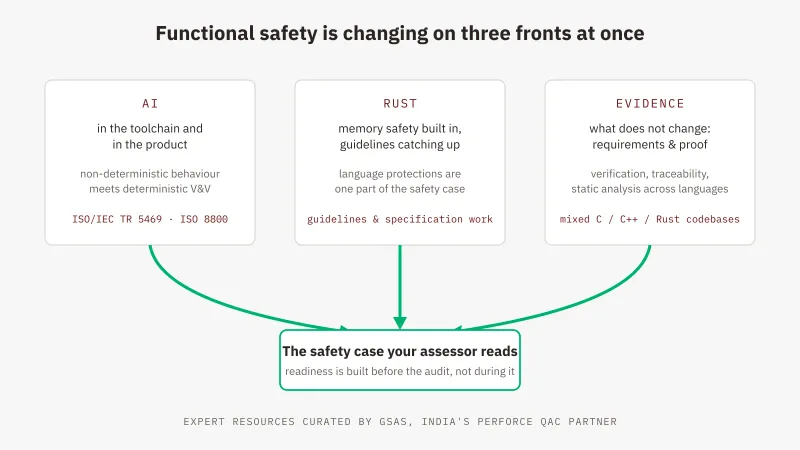
AI, Rust and the New Functional Safety Standards
2 Sept · 9 min

The Complete AUTOSAR Verification Chain: AUTOSAR C++14 Static Analysis with Perforce QAC, SWC and RTE Testing with TESSY 6
31 Jul · 9 min
DevSecOps Tools and Practices for Embedded Teams in India
18 Jul · 8 min
Klocwork vs Perforce QAC: Choosing a Perforce Analyzer in India
17 Jul · 7 min
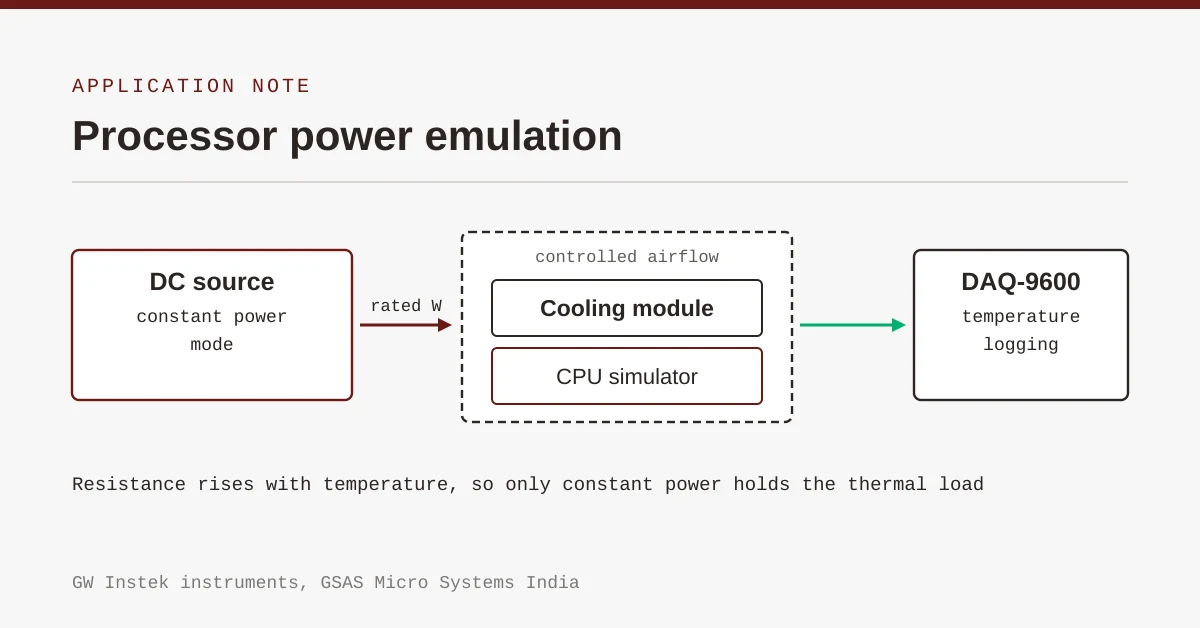
Emulating Processor Power for Thermal Testing: Why Constant Power
7 Oct · 7 min
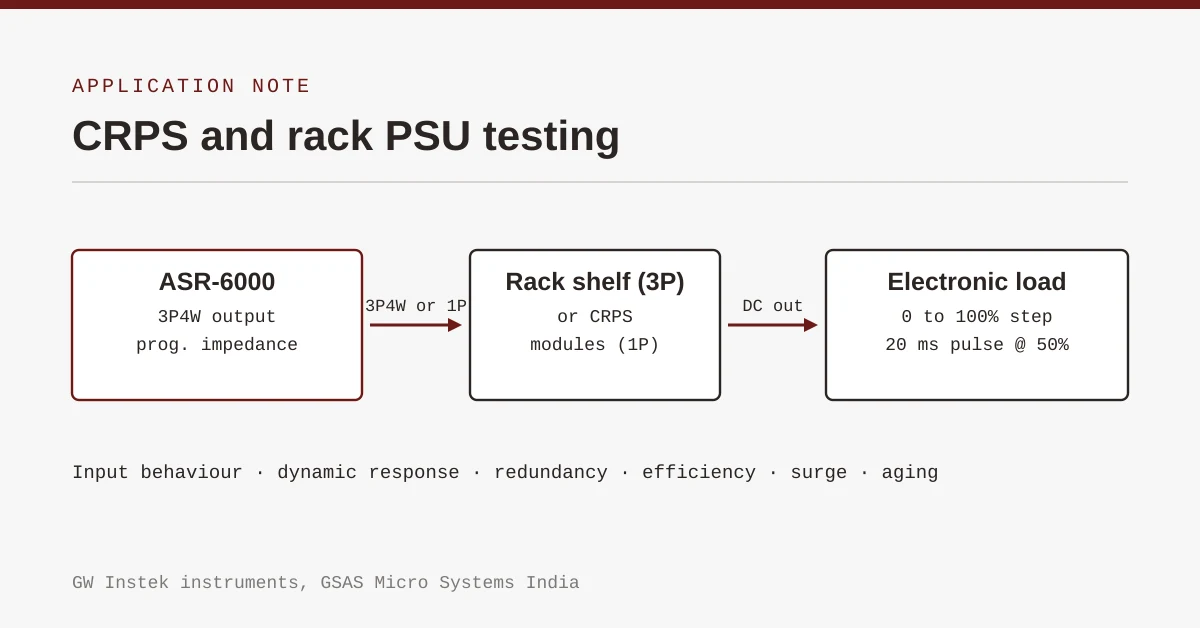
CRPS and Rack Power Supply Testing: The Six Tests That Matter
7 Oct · 7 min