
 Razorcat
 TESSY
Unit TestingAutomated dynamic unit, module, and integration testing for embedded C/C++ with MC/DC coverage. Qualified by Razorcat for safety-related software development per IEC 61508, IEC 62304, ISO 26262 and EN 50128. Buy in India from GSAS.
Coverage
C0, C1, Decision, MC/DC, MCC, Entry Point, Function, Call Pair
Languages
C and C++ (embedded)
Safety Standards
Qualified per Razorcat: IEC 61508, IEC 62304, ISO 26262, EN 50128
Test Design
CTE (Classification Tree Editor) + Scenario Editor
Advanced
Hyper Coverage, Code Access Analysis, Variant Testing
Integration
Polarion, DOORS, Jama, Visure (requirements); Jenkins, GitLab CI (CI/CD)
Overview
About TESSY
TESSY is an automated dynamic testing tool for embedded C and C++ software, designed for safety-critical development projects where code coverage measurement is a certification requirement. It handles unit testing, module testing, and integration testing with full support for statement, branch, decision, MC/DC, and multiple condition coverage (MCC) coverage metrics.
The tool automates the three most labour-intensive parts of embedded testing: interface analysis (automatically parsing function signatures to determine inputs and outputs), test driver generation (creating the harness code that invokes the function under test), and stub function creation (replacing called functions with controllable substitutes). This automation removes the manual harness-writing effort.
Classification Tree Editor (CTE)
TESSY includes a graphical Classification Tree Editor for systematic test case design. Engineers define input partitions and boundary conditions visually, and TESSY generates the corresponding test vectors. Per Razorcat, the Classification Tree Editor facilitates systematic and traceable test design, which teams use as evidence toward the systematic test-design methods those standards expect.
Regression and Batch Testing
Test suites execute in batch mode via command line, integrating directly into CI/CD pipelines (Jenkins, GitLab CI, Azure DevOps). When source code changes, TESSY re-runs affected tests and regenerates coverage reports, making regression testing automatic rather than manual.
Requirements Traceability
TESSY imports and exports requirements in ReqIF format, linking test cases to requirements for bidirectional traceability. Bidirectional traceability is what assessors expect at the higher ASILs and simplifies auditor interactions during safety assessments.
TESSY vs Other Unit Testing Tools for Embedded C/C++
When evaluating unit testing and code coverage tools for embedded C and C++ projects, engineering teams typically compare TESSY against the other established unit-test and coverage platforms in this space. TESSY’s distinguishing capability is its automated test generation workflow: the tool performs interface analysis on function signatures, generates test drivers and stubs automatically, and provides systematic test case design through the Classification Tree Editor. This removes the manual effort of writing test harnesses by hand.
Razorcat states that “TESSY is qualified for safety-related software development according to IEC 61508, IEC 62304, ISO 26262 and EN 50128”, and supplies a Tool Qualification Package documenting the validation activities and results behind it. The tool supports all coverage levels commonly required by safety assessors, statement, branch, decision, MC/DC, and multiple condition coverage (MCC), with traceability from requirements (ReqIF) through test cases to coverage results. Automated test generation combined with batch-mode CI/CD execution (Jenkins, GitLab CI) makes TESSY practical for regression testing in continuous integration environments where embedded C code coverage measurement must be repeatable and auditable.
What Version 6 Adds
Razorcat compiled the Version 6 feature set; the capabilities below are theirs, and the screenshots are of TESSY 6.0.1 itself. Razorcat’s public product pages currently document TESSY 5.1, so ask GSAS to confirm Version 6 availability for your programme.
1. AUTOSAR software component testing. TESSY 6 combines C code level analysis with the AUTOSAR model description. AUTOSAR components are mapped to TESSY modules automatically from the model files and the respective source file name templates, so an SWC becomes a testable module without hand-written glue.
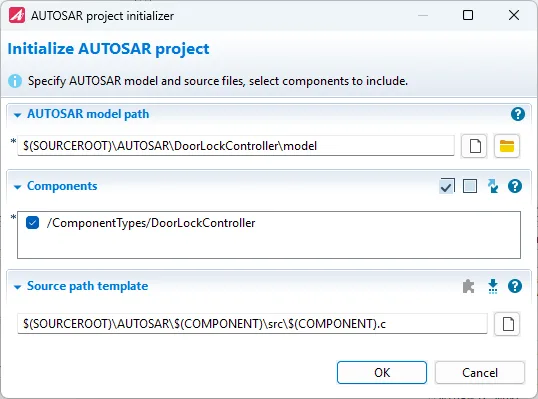
The runtime environment is provided for an SWC automatically from the ARXML model description file. TESSY analyses the implementation sources and recovers a mapping from the C code to the ports and interfaces of the AUTOSAR model, so ports and interfaces appear directly in the testing interface and the test data editor.
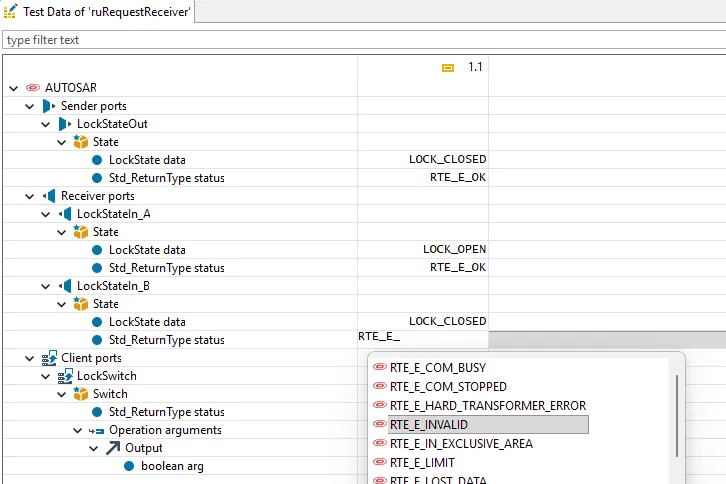
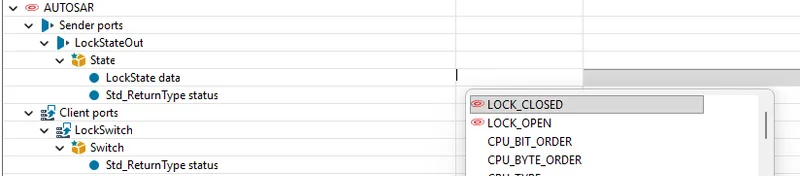
For AUTOSAR data elements and operation arguments, the applicable AUTOSAR constants are offered in the auto-completion menu as input data or expected results, and conversion between physical and internal values happens automatically from the Computational Methods in the model.
When the RTE is generated the applicable modelling rules are checked and violations reported, and compiling the SWC against a separately generated Test RTE proves the implementation conforms to its AUTOSAR model. Runnable access permissions and Exclusive Area handling are validated dynamically during test execution, and TESSY shows the C interface beside the AUTOSAR interface so the relationship between implementation and model is visible rather than inferred.
2. Enhanced C++ support. Stubbing external C++ classes and methods was previously the hard part of getting a C++ test driver to link. A built-in link stubber now stubs the necessary classes and methods automatically so the driver links.
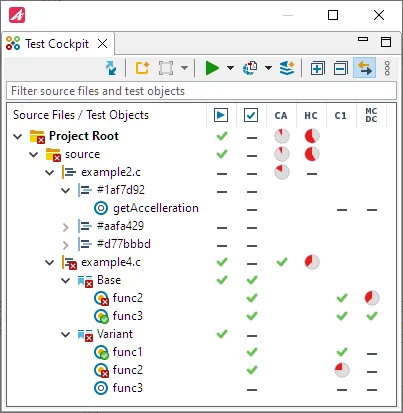
3. Optimised Test Cockpit. The Test Cockpit view and its underlying model were reworked for faster updates and less recalculation when source files change or test results update.
4. YAML database backup, for version control of tests. Backups are written as ASCII rather than an opaque binary blob, which is what makes tests diffable and mergeable across branches. Per module TESSY stores script files carrying test data and user code, a YML file of module metadata, and an IDB file holding the interface settings needed to restore the test interface.
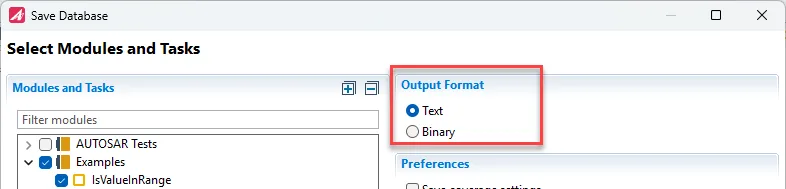
The practical consequence for a safety programme is that test data stops being a binary artefact your review process cannot inspect.
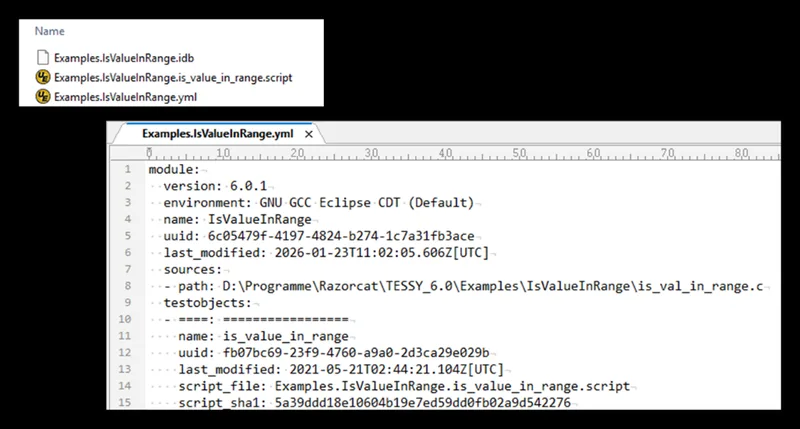
5. Hyper Coverage for system and integration testing. Hyper Coverage integrates Accemic Technologies’ hardware trace port analysis tool to obtain source code coverage from system and integration testing, using FPGA-based online trace data processing. Branch and MC/DC coverage are acquired during system and integration test, imported into TESSY, and shown at source file level in the Test Cockpit. TESSY maps each system test case to the branches it reached in the Coverage Viewer, which is what makes the gap between system testing and unit testing visible: uncovered corner cases and error handlers can then be closed with targeted unit tests rather than guessed at. Accemic supply the trace hardware; GSAS does not.
Supported Compilers, Debuggers and Targets
A unit-test tool is only useful if it drives your toolchain. TESSY is configured per environment, a compiler and debugger/target combination, in the TESSY Environment Editor, and Razorcat publishes the supported combinations rather than leaving them to be discovered during evaluation.
Razorcat’s published environment list for TESSY 5.1 covers 434 compiler and debugger combinations across 28 compiler vendors (Razorcat, supported compiler / debugger, checked 1 August 2026). The vendors with the deepest coverage:
| Compiler vendor | Environments | Typical Indian use |
|---|---|---|
| IAR Systems | 62 | Automotive ECU, industrial, medical firmware |
| Texas Instruments | 58 | C2000 motor control, Hercules safety MCUs, SimpleLink |
| Free Software Foundation (GCC) | 48 | Linux targets, Arm bare-metal, RISC-V |
| NXP Semiconductors | 34 | S32, i.MX RT, Kinetis automotive and industrial |
| Arm, Ltd. | 33 | Keil MDK and Arm Compiler Cortex-M / Cortex-R work |
| TASKING | 31 | Infineon AURIX TriCore powertrain and chassis |
| Wind River Systems | 29 | Aerospace and defence VxWorks programmes |
| Cosmic Software | 24 | STM8, S12Z legacy automotive |
| Renesas Electronics | 21 | RA, RX, RH850 automotive and industrial |
| Green Hills Software | 19 | DO-178C avionics, INTEGRITY targets |
| HighTec EDV-Systeme | 15 | AURIX and PowerPC safety builds |
| Microchip Technology | 15 | PIC32, SAM, dsPIC production firmware |
| SEGGER | 10 | Embedded Studio and J-Link based debug targets |
The remaining vendors are Ada Core Technologies, Altera, Analog Devices, B Knudsen Data, Cadence Design Systems, Frontgrade Gaisler, Fujitsu Semiconductor, Melexis, Mentor Graphics, Microcross, National Instruments, Shanghai ChipON, ST Microelectronics, Synopsys and The Clang Team.
If your combination is not on the list, Razorcat accepts requests for additional compiler and debugger support rather than treating the list as closed, and support for combinations used by older TESSY releases is documented in their legacy download archive. Bring GSAS your exact compiler version, debugger and target and we will confirm the environment against Razorcat’s current list before you commit to an evaluation, so a toolchain mismatch is not discovered halfway through a safety programme.
Further Reading on Unit Testing Practice
The practices behind a defensible embedded unit test suite are worth understanding independently of any one tool. These are GSAS’s own write-ups, sourced from Razorcat and the standards rather than from marketing material:
- Unit testing fundamentals for embedded C and C++
- Test case design with the Classification Tree Method
- Is 100% code coverage enough?
- Automated mutation testing for embedded C
- What makes a test case good
- Fault injection and robustness testing
- How to evaluate a unit testing tool
- Licensing, from evaluation key to production seats
Why Buy from GSAS
GSAS Micro Systems provides TESSY licensing in India with INR invoicing, onboarding training, CI/CD integration consulting, and ongoing technical support. Our functional safety engineers in Bengaluru, Hyderabad, and Pune help automotive, aerospace, and industrial teams deploy TESSY into their existing development workflows and achieve the coverage levels required by their target safety standard.
Blog
Razorcat Insights
Test Case Design with the Classification Tree Method: Deriving Unit Tests You Can Defend in an Audit
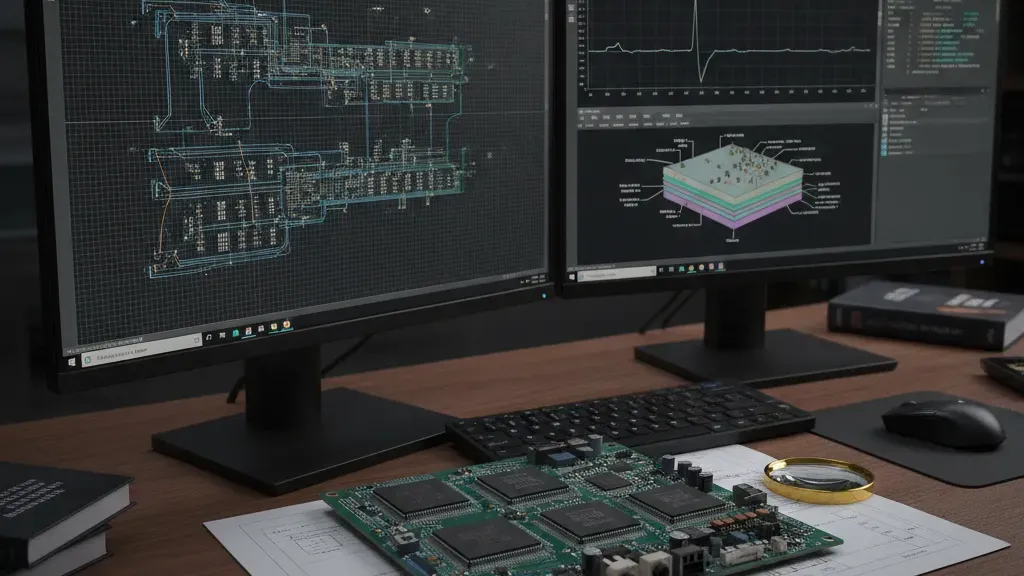
Ad-hoc test cases can be perfectly good tests and still fail an audit, because nothing on file records why that particular set was sufficient. The Classification Tree Method derives test cases from the input space instead: identify the test-relevant aspects as classifications, partition each into equivalence classes, then combine leaf classes in a combination table. Razorcat implements CTM in the Classification Tree Editor, available integrated into TESSY or standalone. GSAS Micro Systems is the authorized Razorcat engineering partner for India, the UAE and Sri Lanka.
Fault Injection and Robustness Testing for Embedded Software: What ISO 26262, IEC 61508 and DO-178C Actually Ask For
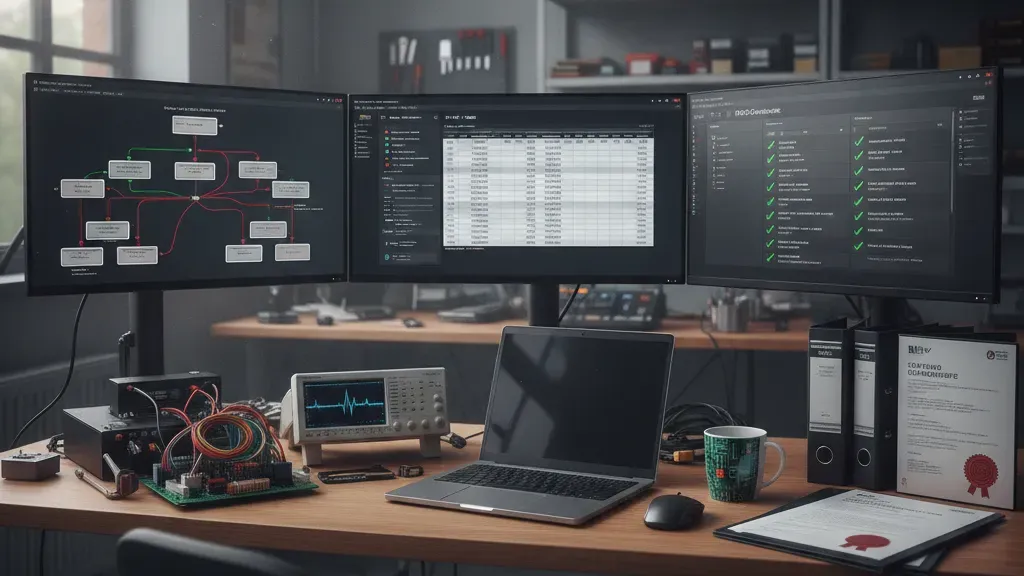
Every safety-related unit contains code that correct inputs never execute: range checks, error returns, timeouts, recovery paths. The functional safety standards require that code to be verified, and they are explicit about how. ISO 26262-6 lists fault injection test as a method for both software unit verification and software integration verification; IEC 61508-3 recommends defensive programming from SIL 2 upward and then concedes that defensive code is exactly what stops teams reaching 100 percent structural coverage. This guide separates robustness testing from fault injection, maps each to the obligation that asks for it, and shows how Razorcat implements automated fault injection in TESSY without leaving instrumentation in production code.
How to Evaluate a Unit Testing Tool for Embedded Software: A Buyer's Framework for Indian Teams
Unit test tool evaluations rarely fail on features. They fail because the tool cannot drive the compiler and debugger the project is already committed to, or because the evidence it produces sits outside the scope of the certificate the assessor asks for. This is a buyer-side framework: six questions, what a credible answer looks like in vendor documentation, and a four-week pilot that measures the answers instead of accepting them.
Related products
More from Razorcat
All Razorcat products →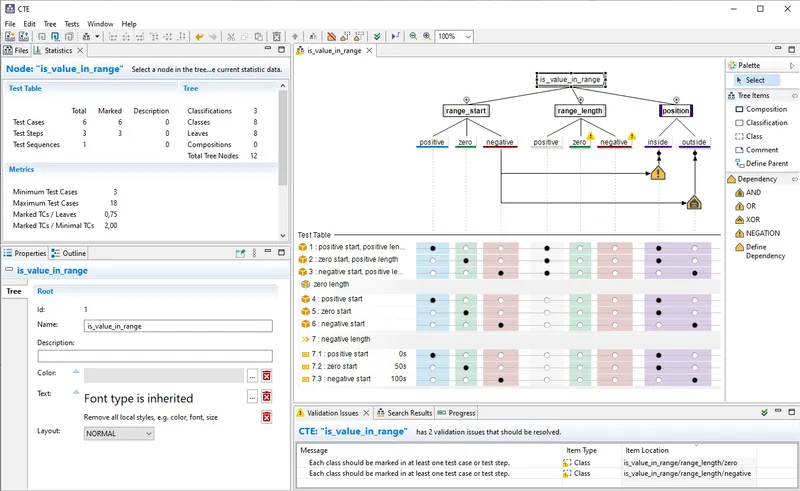
Interested in TESSY?
Get pricing, an evaluation unit, or a technical consultation from our application engineers.