

Razorcat: Buy in India
Authorized India Partner · GSAS Micro Systems
Razorcat × GSAS
Razorcat Development GmbH (Berlin, Germany) is the developer of TESSY, the industry-standard automated dynamic unit testing tool for embedded C and C++ software. TESSY provides the complete unit, module, and integration testing workflow with full code coverage measurement, statement, branch, decision, MC/DC, and multiple condition coverage (MCC), supporting verification work under ISO 26262, IEC 61508, IEC 62279 and ISO 13849. Razorcat states that TESSY is qualified for safety-related software development according to IEC 61508, IEC 62304, ISO 26262 and EN 50128; DO-178C is not in that scope, and qualifying a verification tool for it is the applicant's own activity under DO-330.
TESSY automates the three most labour-intensive parts of embedded testing: interface analysis (parsing function signatures to determine inputs and outputs), test driver generation (creating the harness code), and stub function creation (replacing called functions with controllable substitutes). The Classification Tree Editor (CTM) enables systematic test case design, and ReqIF import/export provides bidirectional requirements traceability for safety audits. TESSY integrates with all major embedded compilers (Arm Keil, IAR, TASKING, HighTec, GCC) and CI/CD platforms (Jenkins, GitLab, Azure DevOps).
GSAS Micro Systems is the authorized Razorcat partner, providing hands-on TESSY onboarding training, CI/CD integration consulting, application engineering, and ongoing technical support for teams in Bengaluru, Hyderabad, Chennai, Pune, Mumbai, and Delhi NCR building safety-critical automotive ECUs, aerospace flight computers, medical devices, and industrial controllers. TESSY integrates with other GSAS-supplied tools: Arm Keil MDK for compilation, SEGGER J-Link for on-target debug, and Perforce QAC for MISRA static analysis, forming a complete verification stack for ISO 26262 projects.
Latest Insights
Test Case Design with the Classification Tree Method: Deriving Unit Tests You Can Defend in an Audit
1 Aug 2026
Fault Injection and Robustness Testing for Embedded Software: What ISO 26262, IEC 61508 and DO-178C Actually Ask For
1 Aug 2026
How to Evaluate a Unit Testing Tool for Embedded Software: A Buyer's Framework for Indian Teams
1 Aug 2026
Product Families
Razorcat Products by Category
TESSY: Automated Unit Testing for Safety-Critical Embedded Software
TESSY automates unit, module, and integration testing for embedded C and C++ with full code coverage measurement, statement, branch, decision, MC/DC, and MCC. Qualified for ISO 26262, IEC 61508, IEC 62304, and EN 50128, TESSY is the testing backbone for safety-critical projects across automotive, industrial, and aerospace.
TESSY handles the entire testing workflow: automatic interface analysis parses function signatures, test drivers are generated without manual harness writing, and stub functions replace called functions with controllable substitutes. The Classification Tree Editor enables systematic test case design that satisfies ISO 26262 Part 6 requirements, and ReqIF import/export provides bidirectional requirements traceability for auditor review.
Works With Your Existing Toolchain
TESSY integrates with the tools Indian engineering teams already use:
SEGGER J-Link
On-target unit testing via J-Link debug probe for real hardware validation
View SEGGER tools →Perforce QAC
MISRA C static analysis + TESSY MC/DC dynamic testing = complete ISO 26262 verification
View Perforce tools →Why Buy TESSY from GSAS India
GSAS Micro Systems is the authorized Razorcat partner. We provide TESSY licensing with INR invoicing, onboarding training, CI/CD integration consulting (Jenkins, GitLab, Azure DevOps), and ongoing technical support. Our functional safety engineers in Bengaluru, Hyderabad, Chennai, Pune, Mumbai, and Delhi NCR help automotive, aerospace, and industrial teams deploy TESSY into their existing development workflows and achieve the MC/DC coverage levels required by IEC 61508 and DO-178C, and highly recommended by ISO 26262 at ASIL D.
For two-wheeler and EV motor controller teams, TESSY provides the ASIL-compliant unit testing framework that Indian OEMs increasingly require for inverter firmware, battery management, and chassis control software.
Why GSAS
Why Choose GSAS as Your Razorcat Engineering Partner
2026
Razorcat Partnership
MC/DC
Full Coverage Metrics
ISO 26262
ASIL A-D Qualified
- Authorized Razorcat partner, TESSY unit testing licensing + training in India
- Application engineering: TESSY integration with Arm Keil MDK, SEGGER J-Link, AURIX MCAL
- Compliance consulting: ISO 26262 Part 6, IEC 61508 Part 3, DO-178C tool qualification
- CI/CD integration support: Jenkins, GitLab CI, Azure DevOps pipeline setup with TESSY
- Local onboarding for automotive, aerospace, and industrial safety projects
- Demo licenses available across Bengaluru, Hyderabad, Chennai, Pune, Mumbai, Delhi NCR
- Local procurement: INR invoicing on TESSY licenses with GeM, SAP Ariba, Coupa, and TReDS support
Razorcat's India design and customer footprint clusters in Bengaluru, India's largest embedded systems and semiconductor design hub. Read our Bengaluru engineering ecosystem guide →
Videos
Razorcat Video Library
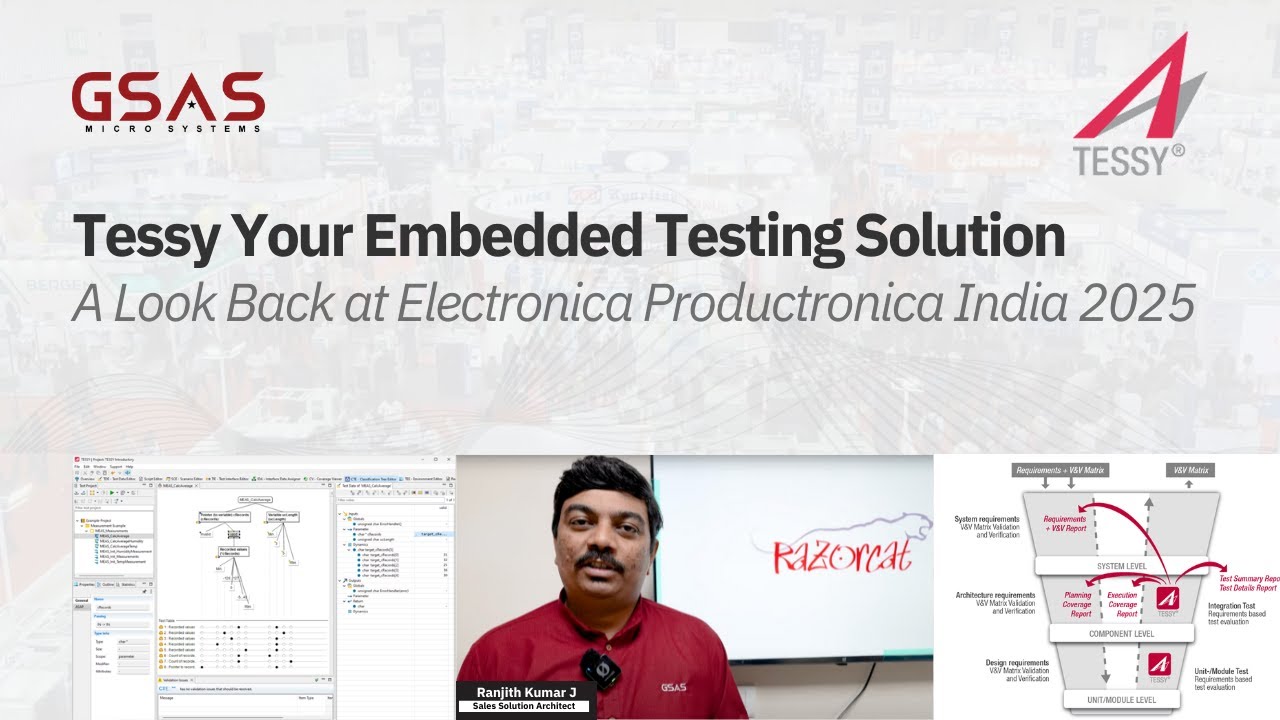
Look Back at Electronica 2025: Introducing Tessy E25 Automated Unit Testing Tool
Software Failure = Safety Risk: Why Software Testing Is Critical
Available across India
Razorcat by City
Blog
Razorcat Insights
Test Case Design with the Classification Tree Method: Deriving Unit Tests You Can Defend in an Audit
Ad-hoc test cases can be perfectly good tests and still fail an audit, because nothing on file records why that particular set was sufficient. The Classification Tree Method derives test cases from the input space instead: identify the test-relevant aspects as classifications, partition each into equivalence classes, then combine leaf classes in a combination table. Razorcat implements CTM in the Classification Tree Editor, available integrated into TESSY or standalone. GSAS Micro Systems is the authorized Razorcat engineering partner for India, the UAE and Sri Lanka.
Fault Injection and Robustness Testing for Embedded Software: What ISO 26262, IEC 61508 and DO-178C Actually Ask For
Every safety-related unit contains code that correct inputs never execute: range checks, error returns, timeouts, recovery paths. The functional safety standards require that code to be verified, and they are explicit about how. ISO 26262-6 lists fault injection test as a method for both software unit verification and software integration verification; IEC 61508-3 recommends defensive programming from SIL 2 upward and then concedes that defensive code is exactly what stops teams reaching 100 percent structural coverage. This guide separates robustness testing from fault injection, maps each to the obligation that asks for it, and shows how Razorcat implements automated fault injection in TESSY without leaving instrumentation in production code.
How to Evaluate a Unit Testing Tool for Embedded Software: A Buyer's Framework for Indian Teams
Unit test tool evaluations rarely fail on features. They fail because the tool cannot drive the compiler and debugger the project is already committed to, or because the evidence it produces sits outside the scope of the certificate the assessor asks for. This is a buyer-side framework: six questions, what a credible answer looks like in vendor documentation, and a four-week pilot that measures the answers instead of accepting them.
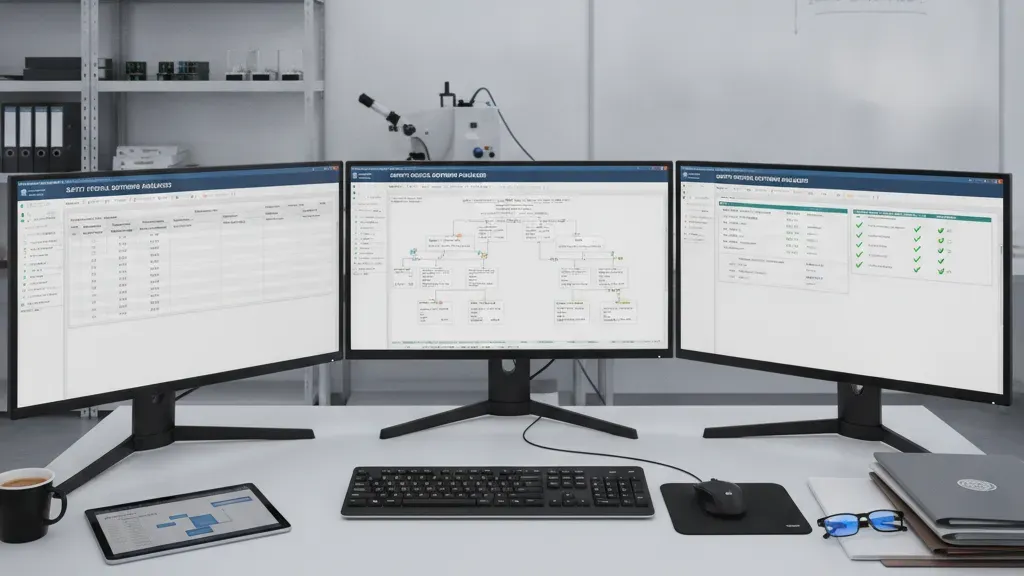
Is 100% Code Coverage Enough? Statement, Branch, MC/DC and MCC, and What Each One Proves
No. A coverage percentage records which code your tests executed, not whether your tests would notice if that code were wrong. This guide defines statement, branch, decision, condition/decision, MC/DC and multiple condition coverage precisely, sets out what 100% of each does and does not prove, shows what ISO 26262, IEC 61508 and DO-178 ask for alongside coverage, and explains the three things to add: requirements traceability, fault-based testing and robustness cases.
Automated Mutation Testing for Embedded C: The Question MC/DC Coverage Cannot Answer
Structural coverage tells you a line was executed. It does not tell you that a defect in that line would have been caught. Mutation testing closes that gap by seeding small faults into the code, re-running the suite, and counting how many the suite kills. This guide covers mutation operators, the mutation score, the equivalent-mutant problem and cost control, and where seeded faults already sit inside IEC 61508-3. GSAS Micro Systems is the authorized Razorcat engineering partner for India, the UAE and Sri Lanka.
Test Case Quality in Embedded Unit Testing: Why Test Counts and Coverage Are Weak Proxies
Counting test cases and reporting a coverage percentage tells you what your tests touched, not what they would have caught. NASA's tutorial on modified condition/decision coverage puts it directly: coverage is a measure, not a method or a test. A good unit test case traces to a requirement, carries an expected result predicted from the specification, draws its inputs from equivalence classes and boundary values, and stays independent of how the code happens to be written. This guide sets out those four properties, shows how coverage-adequate suites still miss defects, and maps them to ISO 26262 Part 6, DO-178C and IEC 61508 expectations for requirements-based testing.
From Evaluation Licence to Production Licence: How Embedded Unit Test Tool Licensing Actually Works in India
A unit test tool licence is not paperwork at the end of an evaluation, it is a project constraint. Razorcat's own License Management Guide documents the whole arc for TESSY: an evaluation key issued against one host Id and delivered the next working day, a Floating License Server reached over a single TCP port, offline checkouts capped at 3 days by default and 30 as the built-in maximum that cannot be given back, access control lists and usage logging for seat planning, and a separate Continuous Integration licence that the TESSY IDE cannot use. This guide walks that arc and then the part no vendor manual covers: getting the purchase order through GeM, SAP Ariba, Coupa or TReDS.
Unit Testing Fundamentals for Embedded C and C++: Units, Interfaces, Test Drivers, Stubs and What the Safety Standards Demand
In C a unit is a single function. In C++ it is a method, and a method cannot be called without an object. Everything else in unit testing follows from that: the interface is what the unit reads and what it writes, a test driver supplies the startup code and the call, and stubs replace the units around it so the result depends on the unit alone. Razorcat's published TESSY documentation, IEC 61508-3 and the airworthiness authorities all describe the same discipline, and the functional safety standards write it as normative text rather than advice.
The Complete AUTOSAR Verification Chain: AUTOSAR C++14 Static Analysis with Perforce QAC, SWC and RTE Testing with TESSY 6
AUTOSAR software component code carries two separate proof burdens: coding-standard compliance across every execution path, and correct runtime behaviour through the RTE. Static analysis and dynamic testing answer different audit questions, so most ISO 26262 evidence packages need both. This guide walks the chain end to end: AUTOSAR C++14 and MISRA analysis with Perforce QAC or Klocwork, then ARXML-driven SWC and RTE testing in Razorcat TESSY 6, then coverage evidence. GSAS Micro Systems is the India engineering partner for both Perforce and Razorcat.
Shift-Left for Safety-Critical Code: Perforce QAC Static Analysis + Razorcat TESSY Dynamic Testing for MISRA, IEC 62304 and FDA Compliance in India
Run Perforce QAC static analysis first to enforce MISRA and clean the code, then Razorcat TESSY for dynamic unit testing and MC/DC coverage. Together they form a complete shift-left toolchain for IEC 62304 medical-device and FDA-regulated software, both from one authorized engineering partner in India, GSAS Micro Systems.

From Manual to Automated: Why Indian Automotive Tier-1s Are Adopting TESSY for Unit Testing
How Indian automotive Tier-1 suppliers are transitioning from manual unit testing to automated tools like Razorcat TESSY, driven by ISO 26262 requirements, OEM audit expectations, and the scaling demands of AUTOSAR-based multi-platform ECU development.
ISO 26262 Part 6 Unit Testing Requirements: A Practical Checklist Mapped to TESSY Capabilities
ISO 26262 Part 6 governs software unit design and implementation.
Ready to Get Started with Razorcat?
Get pricing, evaluation units, or a technical consultation from our application engineers across India.