Automotive Networks
Automotive Ethernet
From 100BASE-T1 physical layer validation through SOME/IP and DoIP analysis to TSN time sync, GSAS helps Indian teams capture, decode, and validate in-vehicle Ethernet.
What We Do
Automotive Ethernet Services in India
Five disciplines covering the physical layer, capture and analysis, the diagnostic protocol stack, time-sensitive networking, and the production line.
T1 Physical Layer Validation
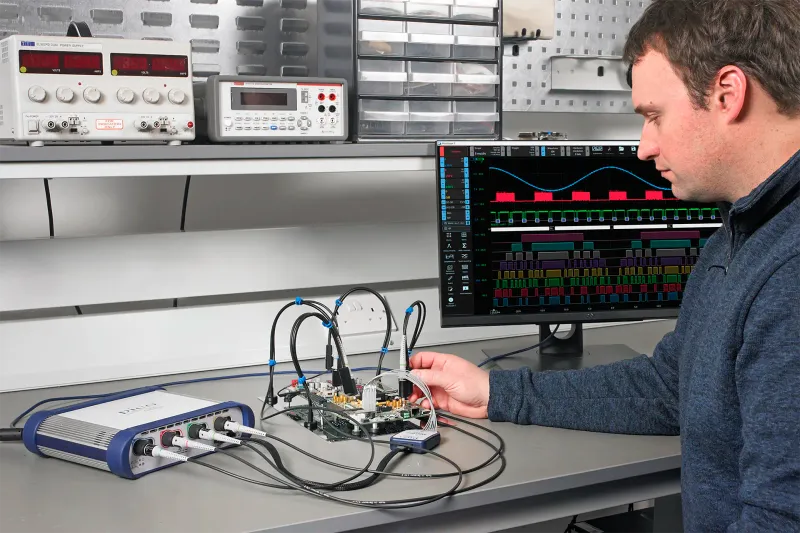
100BASE-T1 and 1000BASE-T1 run PAM-3 signalling over a single twisted pair, at 66.67 MBaud and 750 MBaud respectively. GSAS validates the physical layer with PicoScope 6000E class oscilloscopes: eye diagrams, rise time, overshoot, impedance mismatch, and link-up behaviour, correlated with protocol-level symptoms so intermittent link errors get a root cause instead of a shrug.
- Eye diagrams and signal integrity on 100BASE-T1 and 1000BASE-T1 links
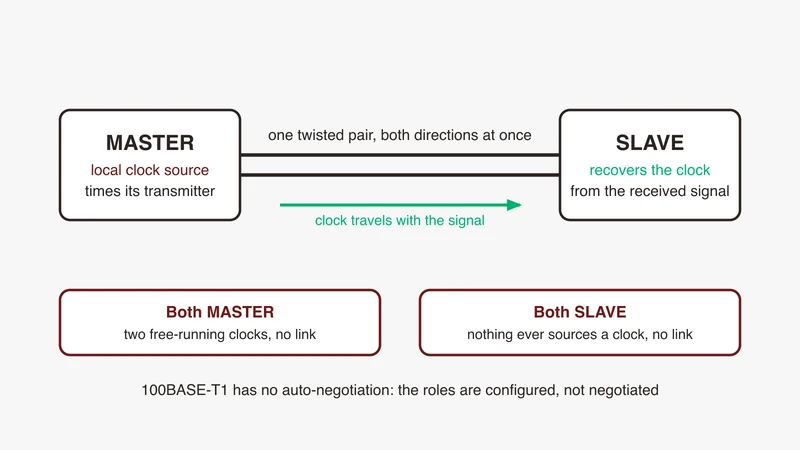
- Link-up and master/slave behaviour analysis (100BASE-T1 has no auto-negotiation)
- Cable, connector, and termination diagnosis on unshielded single pairs
- Correlation of physical-layer faults with protocol-level errors
Traffic Capture and Wireshark Analysis
A laptop NIC cannot join a 100BASE-T1 link, so capture starts with the right access method: a media converter for interactive work, a switch mirror port when timing does not matter, or a hardware tap when it does. GSAS sets up capture chains that preserve VLAN tags and timestamps, then analyses SOME/IP, service discovery, and DoIP sessions in Wireshark, which has dissected SOME/IP natively since version 3.2.
- Capture access planning: media converters, mirror ports, and taps
- Wireshark configuration for SOME/IP, SOME/IP-SD, and DoIP dissection
- VLAN-preserving capture setups (many NICs and drivers silently strip 802.1Q tags)
- Timestamp discipline: knowing when software timestamps cannot be trusted
SOME/IP, DoIP, and UDS Diagnostics
Above TCP and UDP, service-oriented vehicles speak SOME/IP for services and events, DoIP (ISO 13400) as the diagnostic transport, and UDS (ISO 14229) as the diagnostic service layer. GSAS debugs service discovery that finds nothing, routing activations that fail, and diagnostic sessions that time out, working from the AUTOSAR protocol specifications rather than folklore.
- SOME/IP message format and service discovery debugging
- DoIP vehicle discovery, routing activation, and UDS-on-DoIP sessions
- UDS service and negative-response analysis across sessions
- Protocol conformance awareness: OPEN Alliance TC8 and the layers above it
Time-Sensitive Networking and 802.1AS Sync
When cameras, radar, and control loops share one network, timing is a feature to be validated, not assumed. gPTP (IEEE 802.1AS) distributes time from a grandmaster across switches to every ECU; scheduled traffic and shaping decide who transmits when. GSAS validates that sync is actually achieved and held, and that inline test equipment is not quietly biasing the very timestamps under test.
- gPTP domain bring-up and sync verification on the bench
- Diagnosis of sync loss introduced by schedules and shapers
- Awareness of asymmetry introduced by inline converters and taps
- IEEE 802.1DG automotive TSN profile tracking
ECU Production Work over Ethernet
The same Ethernet that carries SOME/IP in the vehicle carries multi-gigabyte firmware images on the production line. Through our ProMik partnership, GSAS supports Ethernet-attached production systems for domain and zone controllers, so validation engineering and manufacturing speak the same network. Production flashing itself is covered in depth on the ProMik pages linked below.
- Ethernet-attached production systems for domain and zone controllers
- DoIP-based end-of-line diagnostic sequences
- Coordination between bench validation and production teams
Setting up automotive Ethernet capture or validation?
Our engineers help teams plan capture chains, configure Wireshark for SOME/IP and DoIP, and validate time sync, from first bench to full test programme.
Standards and Protocols
The Automotive Ethernet Stack We Work In
Vendor-neutral by design: everything here is an IEEE, ISO, OPEN Alliance, or AUTOSAR standard. Coverage articles link from each card as they ship.
IEEE 802.3bw
100BASE-T1
100 Mbit/s over one twisted pair, the workhorse automotive link
IEEE 802.3bp
1000BASE-T1
Gigabit single-pair Ethernet for cameras and backbones
IEEE 802.3cg
10BASE-T1S + PLCA
Multidrop Ethernet reaching down into CAN territory
IEEE 802.3ch
Multi-Gig T1
2.5, 5, and 10 Gbit/s for sensor and compute links
IEEE 802.1AS / Qbv / DG
TSN + gPTP
Synchronized time and scheduled traffic in the vehicle
AUTOSAR PRS
SOME/IP
Service-oriented communication and service discovery
ISO 13400
DoIP
Diagnostics over IP: discovery, routing activation, transport
ISO 14229
UDS
The diagnostic service layer riding on DoIP or CAN
IEEE 802.1AE
MACsec
Link-layer encryption between switches and ECUs
Related GSAS Toolchain
Tools We Bring to Automotive Ethernet Work
Blog
Automotive Ethernet Insights
Autonomous Haulage Is a Network Problem Too
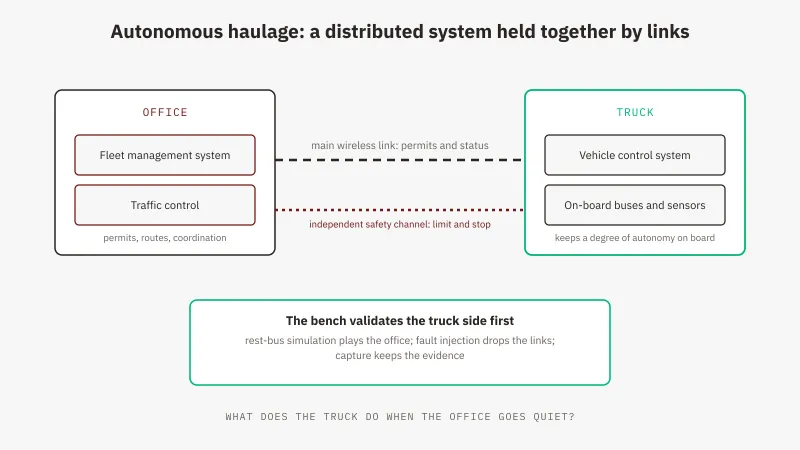
Autonomy coverage fixates on perception. The engineers who deployed an autonomous haulage system describe something else: office software, truck software, and a wireless link whose performance decides how much centralisation the design can afford.
High Speed ISOBUS Prefers 1000BASE-T1. Now What?
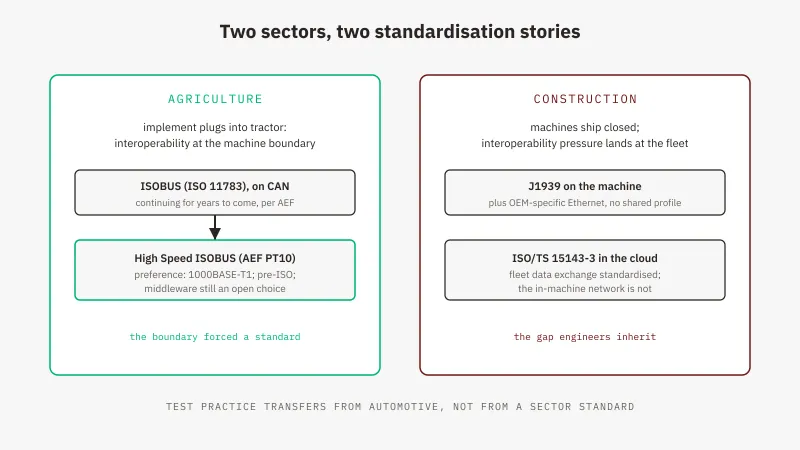
Agriculture is converging on an Ethernet future, with one preferred physical layer, because an implement from one maker has to plug into a tractor from another. Construction never had that forcing function, and the standard it does not have is a working condition.
Add an Ethernet Channel to Your Off-Highway HIL Bench
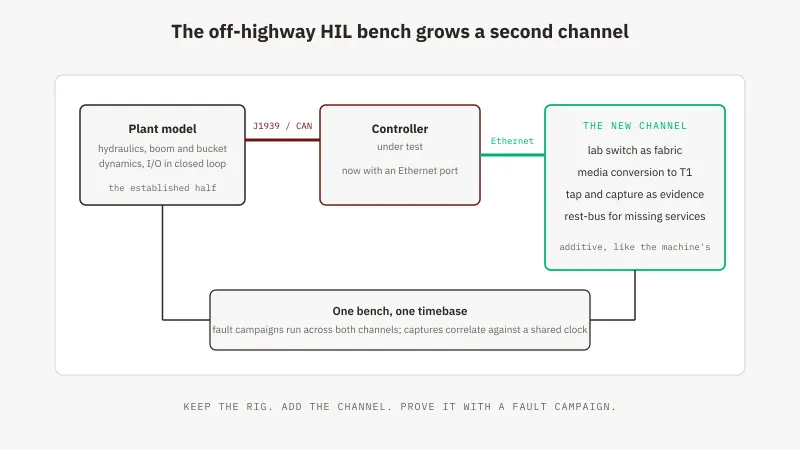
Off-highway hardware-in-the-loop is established practice, built around hydraulics, implement dynamics and J1939. The machines have grown an Ethernet port. The bench upgrade is additive, and it is smaller than a rebuild.
Vehicle Networks in Construction and Mining Equipment
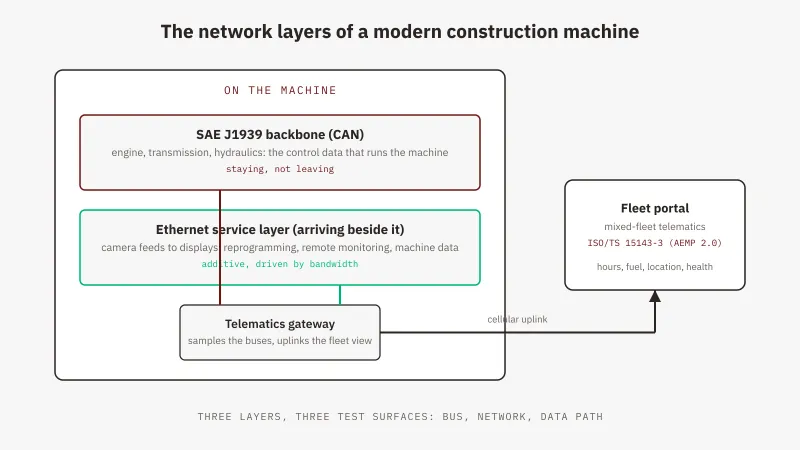
India's machine builders are fighting the localisation battle in electronics, and electronics means a network: the J1939 backbone, the Ethernet arriving beside it, and the bench that has to see both.
100BASE-T1 Link Won't Come Up: A Vendor-Neutral Checklist
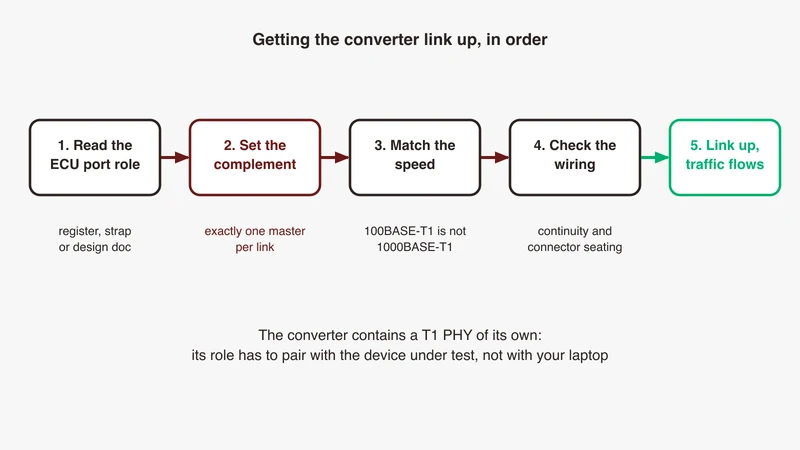
A 100BASE-T1 link that will not come up is almost never a mystery, but the answers on the web are written per silicon vendor and do not transfer. This is the ordered bring-up checklist that holds regardless of which PHY, switch or SoC you have: physical layer first, then the PHY over MDIO, then the master and slave pairing, then the causes of a link that comes up and drops. The standards and tooling claims trace to IEEE 802.3 task force records, the Linux ethtool and kernel documentation or published test material. Written by the GSAS Micro Systems engineering team in India.
100BASE-T1 Media Converters: How to Choose One
Search for a 100BASE-T1 media converter and you get SKU pages that document their own DIP switches, plus a pile of copper-to-fibre converters that have nothing to do with single-pair automotive Ethernet. This is the selection guide neither publishes: what the box does at the PHY layer, when a converter is the wrong box, and the nine criteria that decide fitness, each written as a question to put to the supplier rather than a specification we invented. Standards claims trace to IEEE 802.3 task force records and the public OPEN Alliance specifications. Written by the GSAS Micro Systems engineering team in India.
Building on Automotive Ethernet in India?
From first 100BASE-T1 bench to SOME/IP debugging to time-sync validation, GSAS engineers support automotive teams across Chennai, Pune, Bengaluru, Hyderabad, Mumbai, and Delhi NCR.