In short
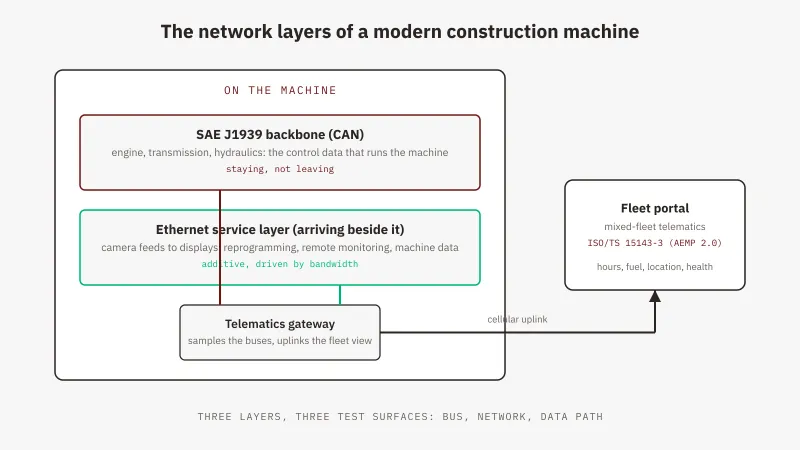
Construction and mining machines run a SAE J1939 CAN backbone for powertrain, hydraulics and diagnostics, and are adding Ethernet beside it for camera feeds, reprogramming and remote monitoring. Fleet telematics is reported at cloud level under ISO/TS 15143-3, with J1939 as the in-machine source. Indian engineering teams therefore need benches that capture J1939 and Ethernet together.
India’s mining and construction equipment industry has passed USD 17 billion of domestic demand and is expanding at 10 to 12 percent a year, growth the study calls “among the most dynamic” in the region (Source: CII-BCG, Pressing the Throttle, July 2026, pp. 7-8, citing ICRA, IBEF and Kearney). That growth is the easy half of the story. The harder half is where the value sits inside the machine. The same study puts backhoe loader localisation at 85 to 90 percent while excavators sit at only 55 to 60 percent, and names hydraulic control valves and electronic control units among the high-technology parts that still come from abroad (Source: CII-BCG, Pressing the Throttle, July 2026, p. 32).
Read that a second time if you build machines in India. The distance between a well-localised backhoe loader and a half-localised excavator is not steel and hydraulics alone. A large part of it is electronics, and electronics in a modern machine means a network. To be clear about what is whose: the study makes no claim about vehicle networks, CAN, Ethernet or test instrumentation, and we are not putting words into it. The step from electronic control units as the localisation gap to in-machine networks and their verification as where engineering teams meet that gap is our reading, not the report’s, here and everywhere below.
This article sets out what that network looks like in construction and mining equipment today, what is arriving beside it, and what an engineering team in India needs on the bench to work on either.
The J1939 Baseline, and Why It Persists
SAE J1939 is the application layer that heavy vehicles and off-road machines run over CAN. It defines parameter groups, each with an identifier and a defined set of fields, so that an engine controller from one supplier and a display from another agree on what “engine speed” or “hydraulic oil temperature” means without a bilateral negotiation. On a working machine it carries engine and transmission data, hydraulic and implement control, aftertreatment status, operator inputs and the diagnostic trouble codes a service technician pulls up in the yard.
The family has an off-road member of its own. SAE J1939-02 carries an agricultural and forestry off-road machinery title, which tells you both that the standards body treated off-road as a distinct case and that the named scope of that particular document is agriculture and forestry rather than earth-moving.
J1939 persists for reasons that have nothing to do with nostalgia. The parameter definitions are shared industry property. The ECUs, harnesses, connectors and diagnostic tooling are built around it. Dealer service networks across the country are trained on it. And for the traffic it carries, it is efficient: an engine speed reading does not need a megabit link, and a bus that reliably delivers small, frequent, deterministic messages is exactly right for control and diagnostics.
What it cannot do is carry a video frame. Writing in Telematics Wire in January 2023, a solution architect at John Deere India set out the payload ceilings of the CAN family for off-road use: 8 bytes for classical CAN, 64 bytes for CAN FD and 2048 bytes for CAN XL. Even the newest CAN generations run far below what multi-camera video needs, and our CAN versus Ethernet comparison works those numbers in detail. Eight bytes is generous for a pressure reading and useless for a camera.
What Is Arriving beside J1939: Ethernet in Off-Highway Machines
The same article describes off-road OEMs positioning 100BASE-T1 and 1000BASE-T1 links and lays out nine classes of use case for Ethernet in off-road vehicles. The ones that matter most to a machine builder are recognisable immediately: faster diagnostics and software reprogramming, camera feeds routed to operator displays without adding a dedicated harness for each camera, remote monitoring of machine and worksite data, and machine-to-machine communication.
There is a supporting standards layer forming around this. SAE J2962-3 exists as Communication Transceivers Qualification Requirements, Ethernet: the document that answers how a transceiver is qualified for this environment rather than how the network is designed. Its existence is the useful signal here; the detail is behind the standards paywall.
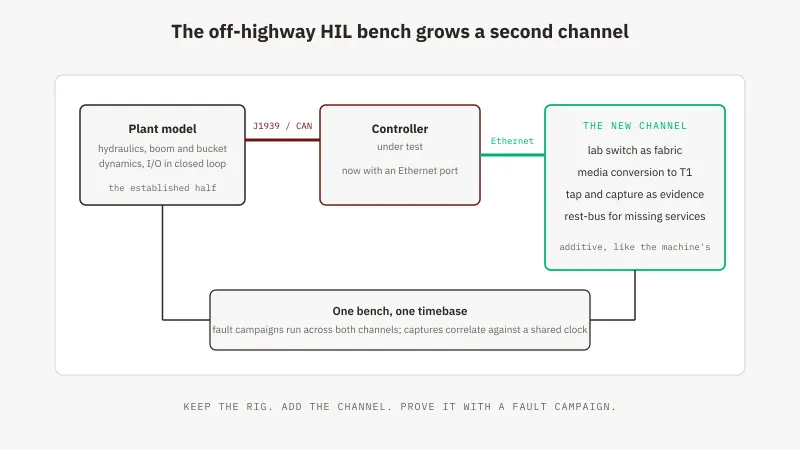
Two guardrails on how to read all this. First, the pattern is additive. Ethernet is arriving beside J1939, not on top of its grave. Machines in the field carry both, and the interesting engineering has moved to the seam between them, which is where gateways, timing relationships and duplicated signals live. Second, do not import the agricultural story into construction. ISO 11783, ISOBUS, is scoped to agricultural and forestry tractors and implements; the Agricultural Industry Electronics Foundation’s High Speed ISOBUS project team is evaluating a faster physical layer, with a stated preference leaning toward 1000BASE-T1, and that work is pre-ISO and agricultural. Construction’s analogue for data exchange is not ISOBUS at all. It is the ISO 15143 worksite data exchange series, which is a fleet-reporting problem rather than an implement-interoperability one.
The Workloads Pulling the Network Forward
Telematics and Fleet Data
Fleet reporting now sits on a standard of its own: ISO/TS 15143-3:2020, the specification the industry knows as AEMP 2.0, which lets machines from different manufacturers report more than twenty shared parameters into one portal. It is a cloud-level format, and the in-machine source of most of what it reports is J1939, which makes the path between bus and portal an engineering artefact of its own. We walk that path end to end, and where its numbers go wrong, in how machine data reaches a fleet portal; the commercial side of the Indian market is in our vehicle telematics overview.
The CII-BCG study frames the stakes plainly, telling Indian OEMs to treat digital capability as “part of the machine, not an optional add on” (p. 25). From an engineering desk that is a statement about verification, and the verifying is done at the bus, the gateway and the portal together.
Operator Assistance and Remote Operation
For the underground segment, the study names remote-operation systems, alongside underground equipment and safety-certified components, as capabilities India will need to build or partner to acquire (Source: CII-BCG, Pressing the Throttle, July 2026, p. 27). That is a capability gap stated by the industry about itself, and it lands squarely on the network.
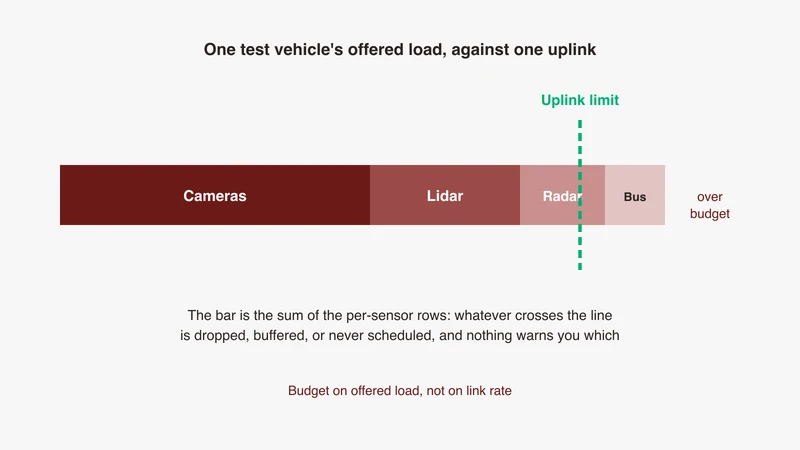
The reason is qualitative and does not need a number to be convincing. A camera feed to an operator display is a fundamentally different traffic class from an engine parameter group. It is continuous rather than periodic, large rather than small, and its failure mode is degradation rather than a missing message. Put several of them on a machine, add the control path back the other way, and the network stops being a control bus with some extra traffic on it and becomes a mixed system where two very different service expectations share a vehicle. Instrumenting that properly is its own discipline, and our guide to capturing in-vehicle traffic covers the practical part: where you can insert a capture point, what it costs you, and what the capture quietly changes.
Autonomy
The CII-BCG study prescribes a four-layer adoption path for India: connect machines and capture data first, then add operator assistance and collision avoidance, then deploy remote operation in high-risk sites, then move to full autonomy in controlled mine, quarry, tunnel and port environments. It describes the realistic near-term goal as an “autonomy-ready ecosystem” (p. 27). Layer one of that path is, in plain terms, getting data off the machine reliably, which is where bus analysers and loggers live.
There is public evidence that the top of that path is real rather than aspirational. Komatsu’s own published material on its FrontRunner autonomous haulage system reports, as of October 2025, more than seventeen years of deployment, over 900 trucks commissioned, more than 10 billion tons hauled and zero systems-related injuries, with an average 40 percent improvement in tyre and brake life and a 13 percent reduction in maintenance. Those are Komatsu’s figures about Komatsu’s system, and none of the manufacturers named in this article are cited as customers; this is industry framing drawn from their own published material.
On architecture, a 2020 ISARC paper by Ishimoto and Hamada of Hitachi Construction Machinery describes the split that matters: fleet management and traffic control run in the office, vehicle control runs on the truck, and a communication system joins them. The authors note that the responsiveness of each vehicle control “strongly depends on the communication performance with the central control system”, which is exactly why the system they describe gives each vehicle a degree of autonomy instead of centralising everything. That trade-off is why autonomy is a network topic and not only a perception topic; our autonomous haulage piece treats the architecture and its bench consequences properly.
Electrification
Battery-electric machines add a high-voltage pack, a battery management system and charging behaviour to the same vehicle network, and validating any of it means a power stage that can push energy back rather than burn it, which is the subject of our post on regenerative DC power testing for EV validation.
What This Means for an Indian Engineering Team
The readiness argument is narrower than it sounds, and it comes down to three things.
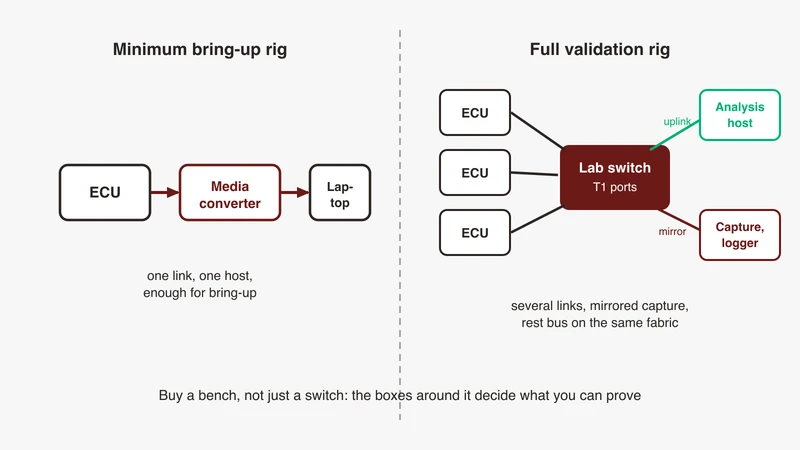
Your bench has to be mixed. A bench that speaks only CAN is blind to the Ethernet half of the machine, and a bench that speaks only Ethernet cannot see the control traffic that explains what the Ethernet half was reacting to. Correlating them is a solved problem but not a free one, and our guide to multi-bus capture across CAN, LIN, FlexRay and Ethernet covers the timebase question that decides whether a combined capture is evidence or decoration. If you are earlier than that and still deciding which workloads belong on which bus, start with automotive Ethernet versus CAN and when to use each.
You need to know which bus is authoritative. When the same physical quantity appears on a control bus, on a diagnostic link and in a fleet report, three numbers exist for one truth, and they will eventually disagree. Deciding in advance which one is the reference, and being able to capture all three at once when they diverge, converts a week of finger-pointing into an afternoon.
Functional safety is not adjacent to the network; it contains it. ISO 19014 is the functional safety series for earth-moving machinery from ISO/TC 127/SC 2. Part 1, published in 2018 and corrected in 2019, sets out the methodology for determining safety-related parts of the control system and their performance requirements, and it cancelled and replaced the earlier ISO 15998 work. Part 4 of the series covers the design and evaluation of software and data transmission for safety-related parts of the control system; data transmission, in that title, is your network. Our ISO 19014 explainer for engineers trained on ISO 26262 unpacks the series and its machinery lineage. We cite this at foreword and title level because the clauses themselves are paywalled, but the structural point stands on its own: for an earth-moving machine, the communication path is inside the safety argument. The CII-BCG study naming safety-certified components as a capability gap (p. 27) is the commercial expression of the same fact.
Where GSAS Fits
GSAS Micro Systems is an engineering partner, and off-highway is now a named practice for us rather than an automotive spillover. Our construction and mining solutions page sets out the sector view.
Practically, three kinds of conversation come to us from this sector. The first is bench design for a mixed machine: what has to be visible simultaneously, where the capture points go, and how much of the answer can come from an instrument that decodes J1939 directly, which is the ground our post on PicoScope with CAN FD, LIN, FlexRay and automotive Ethernet covers. The second is telematics pilots, where a team wants machine data flowing to a portal before committing to an architecture, and an AutoPi TMU CM4 based logger gets a pilot fleet reporting before that architecture is locked. The third is electrified machine test, where the power stage and the network stage have to be commissioned together.
Our applications engineers work with equipment and component teams in Bengaluru, Hyderabad, Chennai, Pune, Mumbai and Delhi NCR, and the first conversation is usually about which of those three you are actually in. Request a consultation with your machine, your buses and your open question, and we will start there.
References
- Telematics Wire, “Role of automotive Ethernet in off-road vehicles”, 20 January 2023, by a solution architect at John Deere India: https://telematicswire.net/role-of-automotive-ethernet-in-offroad-vehicles/
- SAE J2962-3, Communication Transceivers Qualification Requirements, Ethernet (punctuation adapted house-style; 2021, revised 2024), DOI 10.4271/j2962-3_202402
- SAE J1939-02, Agricultural Forestry Off-Road Machinery Control and Communication Network (title per the DOI record; punctuation adapted house-style), DOI 10.4271/j1939-02_202311
- ISO/TS 15143-3:2020, “Earth-moving machinery and mobile road construction machinery, Worksite data exchange, Part 3: Telematics data”
- ISO 11783, “Tractors and machinery for agriculture and forestry, Serial control and communications data network” (ISOBUS): https://www.iso.org/standard/57556.html
- Agricultural Industry Electronics Foundation, High Speed ISOBUS project activity page: https://www.aef-online.org/about-us/activities/high-speed-isobus.html
- AEMP 2.0 parameter list and background, third-party explainer (not the standard text): https://syniotec.com/understanding-aemp-2-0/
- Komatsu, autonomous haulage system product page, figures as published October 2025: https://www.komatsu.com/en-us/technology/smart-mining/loading-and-haulage/autonomous-haulage-system
- H. Ishimoto and T. Hamada (Hitachi Construction Machinery), “Safety Concept and Architecture for Autonomous Haulage System in Mining”, Proceedings of the 37th International Symposium on Automation and Robotics in Construction (ISARC 2020): https://www.iaarc.org/publications/fulltext/ISARC_2020_Paper_197.pdf
- ISO 19014-1:2018 (corrected 2019), “Earth-moving machinery, Functional safety, Part 1: Methodology to determine safety-related parts of the control system and performance requirements”, ISO/TC 127/SC 2; ISO 19014-4:2020 covers software and data transmission (title per public standards catalogues)
- Confederation of Indian Industry and Boston Consulting Group, “Pressing the Throttle: How India’s Mining and Construction Equipment Industry can support domestic ambitions and become a global force”, July 2026 (CII and BCG joint publication; market figures therein cite ICRA, IBEF, Kearney and Freedonia)
Also appears in:
Building for Construction & Mining?
Talk to our application engineers for personalized tool recommendations.