In short
A lab automotive Ethernet switch is a boxed multi-port switch with configurable 100BASE-T1 and 1000BASE-T1 ports, TSN and mirroring features, used to reproduce a vehicle network on the bench for bring-up and validation. It is a different product from the switch silicon that goes inside a zonal controller or gateway, even though both are called an automotive Ethernet switch, and the selection criteria barely overlap: a lab switch is chosen on port mix, per-port master and slave configurability, mirroring fidelity, timestamping and a readable management plane.
Search for an automotive Ethernet switch and the results are written for somebody else: silicon selection tables of T1 ports per die, queue resources and package options, for the engineer choosing what goes inside a zonal controller. Aimed at a design team two years upstream of you.
You are in a validation lab: three ECUs on the bench, a laptop, a pile of media converters, and a requirement to reproduce enough of a vehicle network that the tests mean something. What you want is a box with T1 ports on the front, and almost nothing addresses that purchase.
This is that guide: separating the two products, counting the ports, an eight-row scoring matrix written as questions rather than invented specifications, and an honest reading of datasheet TSN claims. Every standards claim traces to a source in the References.
Two different products are called an automotive Ethernet switch
Switch silicon inside an ECU, gateway or zonal controller
The first meaning is a chip. A hardware team selects it, lays it out on a board, and its ports terminate in the vehicle harness. The criteria are die-level: T1 ports per speed, queueing resources, host interface, software support, qualification for the vehicle’s temperature and lifetime. That is what the head term ranks for, and you never configure it: you meet it as the behaviour of an ECU somebody else built.
A boxed lab or bench switch for bring-up, validation and rest bus work
The second meaning is an instrument: T1 connectors on the front, a power inlet, a management interface you log into, standing in for the vehicle’s network so the ECUs on your bench behave as if installed. The criteria are almost disjoint from the silicon list: port mix and how freely each port takes a role, whether the mirror path is honest, whether the timestamps mean anything, whether the configuration can be read back and version controlled.
Which one this guide is about, and where to go if you wanted the other
The boxed instrument. If you are choosing silicon, the criteria below will mislead you. If the physical layer is new, start with what automotive Ethernet is and the T1 family explained.
Start from the network you have to reproduce
Counting T1 ports by speed: 100BASE-T1, 1000BASE-T1 and where 10BASE-T1S sits
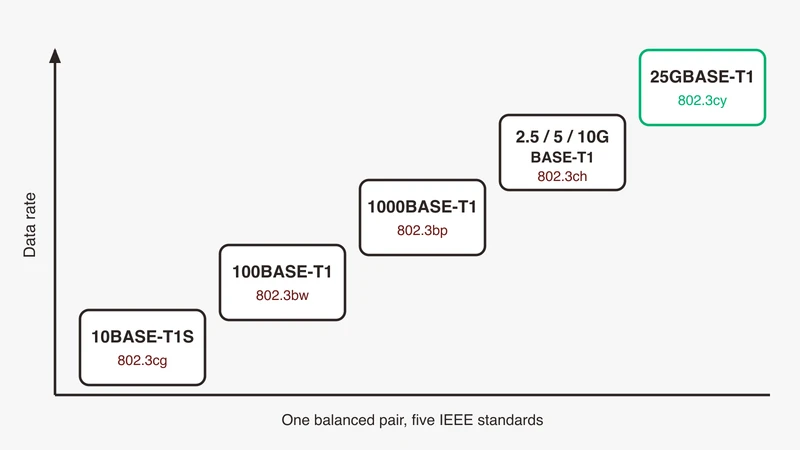
Count links, not devices: each ECU port you will physically terminate is one switch port, at the speed that port runs. The speeds are different physical layers, not modes of one. 100BASE-T1 is IEEE Std 802.3bw-2015, approved 27 October 2015; 1000BASE-T1 is IEEE Std 802.3bp-2016, approved 30 June 2016. Nothing on the pair adapts one to the other, so a port count is a count per speed. 10BASE-T1S sits apart, from IEEE Std 802.3cg-2019, approved 7 November 2019, the one member of the family where more than two nodes share a pair. Ask explicitly whether a shortlisted unit has a 10BASE-T1S port at all, and plan for separate bench equipment if it does not.
Uplinks: RJ45 and SFP, and why you want at least one for the analysis host
Your analysis host has RJ45 and maybe an SFP cage, not T1, so a standard uplink is not optional. Want two: one for the host that talks to the network, one for the capture path. Ask about SFP even on a copper bench, because it is the headroom you need when the mirror arithmetic below stops working.
Domain versus zonal topologies change the port count and the traffic mix
A domain architecture groups ECUs by function; a zonal architecture groups them by location and connects each zone to central compute over an Ethernet backbone, which our domain versus zonal explainer covers. A zonal bench means more ports, more traffic crossing between them, and a backbone faster than the leaf links, so count the backbone separately and check the switch does not force all ports to one speed. Our walkthrough of a real vehicle communication architecture shows the shape.
A worksheet: ports, speeds, roles, VLANs, timing domains
For each link write five columns: port name, speed, whether the ECU end is master or slave, which VLANs it carries, and whether it sits inside a timing domain. Add two rows for uplinks and one for the capture path. That table is the specification, and a supplier who sees it can answer in one reply.
The scoring matrix
Eight criteria decide whether a boxed switch fits a bench. The cells are questions rather than answers: each answer is a property of a specific product, and we will not invent a specification for a category.
| Criterion | The question to ask the supplier | Why it decides fitness |
|---|---|---|
| Port mix and roles | T1 ports at each speed, and is master or slave settable per port and persistent? | A fixed-role port links only with the complement |
| TSN feature set | Which of 802.1AS, Qbv, Qav, Qci and CB, and in what role for each? | Separate amendments. “TSN support” names none |
| Security | Is 802.1AE MACsec implemented, with what key agreement, and can it be disabled per port? | A switch you cannot put in the clear is one you cannot debug through |
| VLANs and priority | How is the tag’s priority field mapped on ingress and egress, and can the map be read back? | Priority picks the queue; the queue decides what the shapers do |
| Mirroring | Ingress, egress or both, per port or per VLAN, tags preserved, behaviour on oversubscription? | Silent mirror drops look like frames never sent |
| Management plane | CLI, NETCONF and YANG, web interface or vendor tool, and can the configuration be exported? | A bench you cannot restore from a file is rebuilt by hand |
| Timestamping | Where is the timestamp taken, and is residence time exposed? | A timestamp applied late carries every delay in front of it |
| Environment | Enclosure, temperature rating, supply range and input type, mounting | A desk unit and a vehicle unit are different purchases |
Port mix and per-port master and slave configurability
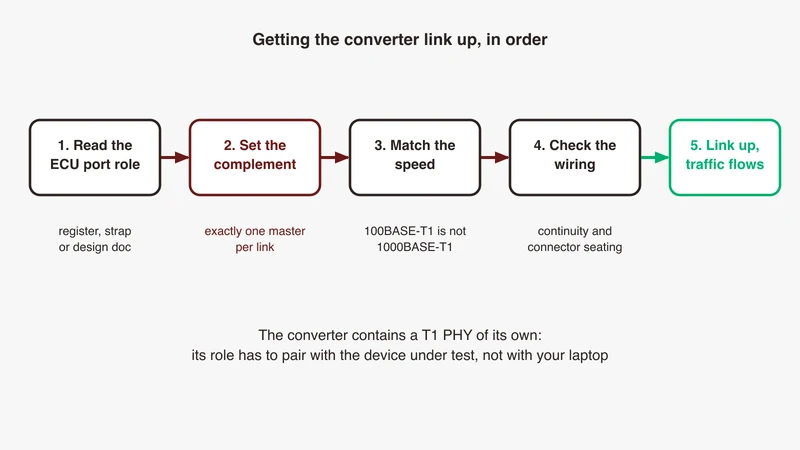
The role is not negotiated on 100BASE-T1: at IEEE P802.3bw D1.2 working group ballot, comment 225 asked to add negotiable MASTER and SLAVE functionality and was rejected, the task force recording that this type of network does not have plug and play functionality, it is a pre-configured embedded network. The switch holds one end of every T1 link and must hold the opposite role to the ECU, which is what makes per-port configurability worth paying for. If a link still will not come up, work the checklist before swapping hardware.
TSN feature set: 802.1AS, Qbv, Qav, Qci and CB
The IEEE 802.1 TSN task group lists these as distinct amendments: 802.1AS, Timing and Synchronization for Time-Sensitive Applications; 802.1Qbv, Enhancements for Scheduled Traffic; 802.1Qav, Forwarding and Queueing Enhancements for Time-Sensitive Streams; 802.1Qci, Per-Stream Filtering and Policing; and 802.1CB, Frame Replication and Elimination for Reliability. A line reading “TSN support” tells you which of the five is implemented: none of them.
Security: 802.1AE MACsec and port-based access control
IEEE 802.1 describes 802.1AE as providing connectionless user data confidentiality, data integrity, data origin authenticity and privacy protection by media access independent protocols, with the MACsec Key Agreement protocol of IEEE Std 802.1X discovering mutually authenticated MACsec peers and electing a key server. Ask how keys are provisioned, and whether it can be turned off per port so a capture stays readable.
VLANs, priority code point handling and priority regeneration
IEEE 802.1Q specifies virtual LANs and VLAN bridges. What bites on a bench is what the switch does to the tag’s priority field as a frame crosses, because that picks the egress queue. Linux models it host-side: ip-link documents ingress-qos-map as a mapping of the VLAN header prio field to the Linux internal packet priority on incoming frames, and egress-qos-map as the reverse. Ask for the switch’s equivalent, readable back rather than only writable.
Mirroring and capture fidelity
Its own section below, because it is where lab switches most often disappoint quietly.
Management plane: CLI, NETCONF and YANG, web interface, or a vendor tool
A configuration that exists only as a sequence of clicks cannot be reviewed, diffed or restored. RFC 6241 describes NETCONF as providing mechanisms to install, manipulate and delete the configuration of network devices, with operations realised as remote procedure calls, and the YANG data models for these functions are published as IEEE Std 802.1Qcw-2023, YANG Data Models for Scheduled Traffic, Frame Preemption, and Per-Stream Filtering and Policing, an active amendment to IEEE Std 802.1Q-2022. Whatever the surface: export the configuration, restore it to a factory-reset unit, get the same bench back.
Timestamping: does the switch stamp near the wire, and does it expose residence time
Where the stamp is taken matters: the Linux kernel timestamping documentation notes that PHYs may be able to detect and timestamp PTP packets, because timestamps taken as close as possible to the wire have potential to yield more stable synchronization. So does residence time: a 2008 IEEE 802.1 AVB task group tutorial presentation on 802.1AS describes a bridge measuring how long a timing frame is inside it, names that residence time, and notes bridges communicate it per Sync in the Follow_Up frame. Whether the switch exposes it decides whether you can see what it did to your traffic.
Environment: bench enclosure, temperature grade, power input, mounting
A plastic case with a barrel jack is right for a lab and wrong for a vehicle. If the switch goes into a car, a chamber or onto a shaker, the temperature rating, supply range and connector retention become selection criteria, and the rating you want is a number with a standard behind it, not the word “automotive”.
Mirroring is where lab switches quietly fail you
Our capture guide owns the tap-versus-mirror decision and the fidelity depth, including the published measurement of what a mirror lost against a tap on the same switch. What follows is only the part that changes which switch you buy.
Ingress versus egress mirroring, and what each one hides
Ingress mirroring copies what arrived, egress what left, and they differ whenever the switch modified the frame, which is exactly when you are debugging VLAN or priority behaviour. Ask whether both run at once, and whether mirroring is scoped per VLAN or only per port.
Oversubscription: mirroring several links into one uplink
Mirroring both directions of a saturated 100BASE-T1 link needs 200 Mbit/s at the destination. Four of those is 800 Mbit/s into a gigabit uplink, and 1000BASE-T1 changes the sum by ten. The Wireshark wiki states the rule: the monitoring port must be at least as fast as the monitored port, or you will certainly lose packets. Destination port speed and the number of concurrent mirror sessions are therefore selection criteria, not details.
Timestamps applied by the switch versus by a capture module
A timestamp applied to a mirrored frame by your capture host carries the mirror path, the uplink, the host NIC and the scheduler. A capture module applies its own and wraps the frame in an encapsulation that carries it: a different fidelity class and a different purchase. The two encapsulations are ASAM CMP, which ASAM describes as defining the communication between capture modules, or probes, and data sinks, to monitor in-vehicle bus communication and sensor data, and TECMP, a vendor-originated capture module protocol, both in our capture encapsulation article.
When a tap beats a mirror, and when it does not
One question settles it: does anything in your analysis depend on when the frame arrived, or only on what it contained. Content-only work is defensible on a mirror; timing, error-frame and VLAN-fidelity work is not, for the reasons the capture guide sets out.
Reading TSN claims on a datasheet honestly
”802.1AS support” can mean transparent clock, boundary clock, or endpoint only
IEEE Std 802.1AS-2025, Timing and Synchronization for Time-Sensitive Applications, defines the transport of timing over local area networks. None of that says what a specific box does.
linuxptp names the roles a device can take in a timing domain: ordinary clock, boundary clock, end-to-end transparent clock and peer-to-peer transparent clock. A switch claiming 802.1AS could be disciplining its own clock as an endpoint and forwarding timing frames as ordinary traffic, or relaying time as a bridge that measures residence time and corrects for it, or behaving as a transparent clock. Those give different results on your bench and the datasheet phrase distinguishes none of them. Ask which role each port takes, whether the switch can be grandmaster, and whether it reports residence time. If the domain is not forming at all, our gPTP guide comes first.
Qbv gate control lists: how many queues, how many entries, how the schedule is loaded
The Linux tc-taprio manual is the clearest public description of the mechanism and it hands you the questions. It documents num_tc as the number of traffic classes to use, up to 16 supported, and map as the priority to traffic class map, mapping priorities 0 to 15 to a traffic class. Each sched-entry carries a command, a gate mask and an interval, the gate mask being a bitmask in which bit 0 on means traffic class 0 is active for that entry, and cycle time is the sum of all the intervals in the schedule. Full offload, flag 0x2, passes the gate control list to the NIC, which executes it cyclically in hardware.
Translate each into a purchasing question: how many traffic classes, how many gate control list entries per port, the shortest interval expressible, how the schedule is loaded and whether it survives a reboot, and whether you can read back the schedule actually running.
Interaction between shapers and PTP, and the failure you will hit
A schedule that leaves no open gate for the traffic class the timing frames land in stops synchronisation dead, and nothing in the logs says the word gate. We wrote that up in when Qbv breaks PTP, including the three mappings that have to agree. For a purchase it becomes a requirement: you must be able to see, on the running switch, which traffic class the timing frames sit in and whether it has an open window.
Frame replication and elimination: useful in the lab or only in the vehicle
IEEE Std 802.1CB-2017 specifies identification and replication of frames for redundant transmission, identification of duplicate frames, and elimination of duplicate frames. That needs disjoint paths and participating endpoints, which a two-node bench does not have, so on most benches it is something you verify rather than use. The requirement is that the switch lets you build the paths and observe the elimination.
Buy a bench, not just a switch
The four boxes: media converter, switch, capture, logger
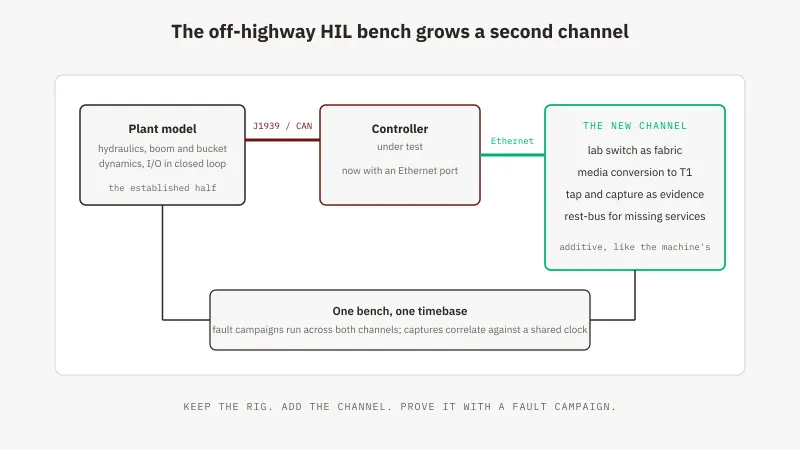
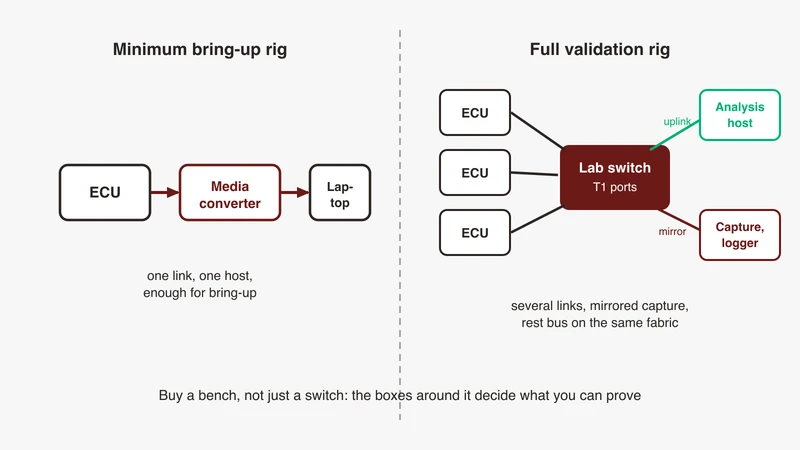
A working bench is four categories of equipment and the switch is one. A media converter puts a single T1 link onto a host with RJ45, covered in how to choose one. The lab switch reproduces the network. A capture module gives frames defensible timestamps and an encapsulation that carries them. A logger records across hours or a drive cycle, with storage and power constraints of its own.
A minimum bring-up rig and a full validation rig
The minimum rig is one ECU, one media converter, one laptop. It answers whether the link comes up and the services appear, and stops being enough the moment a second ECU has to talk to the first. The full rig is three or more ECUs into the lab switch, a mirror port or tap feeding a capture module, the capture module feeding a logger, and a separate uplink to the analysis host. Most benches reach that shape, so let it shape what you buy today.
Rest bus simulation on the same fabric
Rest bus simulation, where a tool plays the ECUs not on your bench, runs over the same switch and consumes ports and bandwidth like any node. Check that ports are free for the simulation host and that the VLAN and priority configuration it needs can be expressed here.
What you will want to add in six months
More ports, a second timing domain, a tap where you have a mirror, and TC10 sleep and wake-up behaviour once somebody asks why the bench link drops overnight, covered in our TC10 article. Buy the switch that leaves room.
Sourcing in India
What GSAS actually provides here
GSAS Micro Systems is an engineering partner, and what we provide here is commercial and support routes rather than promises about a box. We invoice in India with GST. We are registered on GeM, the route most public sector and defence buyers need. We support SAP Ariba and Coupa for buyers who raise purchase orders through those systems. Applications engineering runs in IST, with engineers in Bengaluru, Hyderabad, Chennai, Pune, Mumbai and Delhi NCR. We will not publish a lead time, a stock level or a price: all three are specific to a configuration and a moment.
Evaluation and loaner conversations, and what makes them possible
Evaluations succeed when the ask is specific. A request naming the port count per speed, the master and slave assignment per link, the TSN functions your test plan depends on, and what you intend to prove can be scoped, and the worksheet above is that document. The other half is the exit criterion: decide before the unit arrives what makes you buy and what makes you stop.
What to pin down in the purchase order
Four items belong in writing: the firmware version the unit ships with, because features documented on a website are sometimes in a later release; the licence entitlements, because TSN or management features are sometimes licensed separately; the connector variants on the T1 side, which must match your harness; and the cable kit.
Where GSAS fits
The useful first conversation about a lab switch is about the bench rather than the box. Which links are you reproducing, at which speeds. Who owns the master and slave assignment on the ECU side. Does any number in your test report come from a timestamp, and where is it taken. Which TSN function does your test plan depend on, named as an amendment rather than as the word TSN.
Bring the port worksheet and the TSN requirement list to a scoping call
Our applications engineers work in IST, so a bench session lands inside your working day, and the teams we work with sit in Bengaluru, Pune, Chennai and Hyderabad. We will go through your port worksheet, score a shortlist against the eight criteria above, and tell you which questions your supplier has not answered. Where the honest answer is that a media converter and a desktop switch already cover what you are doing, that is the answer you get.
Start with the automotive Ethernet capability page, then request a scoped conversation with your topology and the worksheet attached.
References
- IEEE 802.1 Time-Sensitive Networking Task Group, amendment titles: https://1.ieee802.org/tsn/
- IEEE 802.1AS, Timing and Synchronization for Time-Sensitive Applications: https://www.ieee802.org/1/pages/802.1as.html
- IEEE SA, IEEE 802.1AS standard record: https://standards.ieee.org/ieee/802.1AS/7121/
- Kevin B. Stanton, “802.1AS Tutorial”, IEEE 802.1 AVB TG, 13 November 2008: https://www.ieee802.org/1/files/public/docs2008/as-kbstanton-8021AS-overview-for-dot11aa-1108.pdf
- IEEE 802.1Qci, Per-Stream Filtering and Policing: https://1.ieee802.org/tsn/802-1qci/
- IEEE 802.1CB, Frame Replication and Elimination for Reliability: https://1.ieee802.org/tsn/802-1cb/
- IEEE SA, IEEE 802.1Qcw-2023, YANG Data Models for Scheduled Traffic, Frame Preemption, and Per-Stream Filtering and Policing: https://standards.ieee.org/ieee/802.1Qcw/7134/
- IEEE 802.1AE MAC Security, and the MACsec Key Agreement protocol of IEEE Std 802.1X: http://1.ieee802.org/security/802-1ae/
- IEEE 802.1X, Port Based Network Access Control: https://www.ieee802.org/1/pages/802.1x.html
- IEEE 802.1Q, Virtual LANs and VLAN Bridges: https://www.ieee802.org/1/pages/802.1Q.html
- IEEE P802.3bw 100BASE-T1 Task Force: https://www.ieee802.org/3/bw/
- IEEE P802.3bw D1.2 approved working group ballot comments, comment 225 (rejected request for negotiable MASTER and SLAVE functionality, recorded as a pre-configured embedded network without plug and play functionality): https://www.ieee802.org/3/bw/comments/8023bw_D1_2_approved.pdf
- IEEE P802.3bp 1000BASE-T1 PHY Task Force: https://www.ieee802.org/3/bp/
- IEEE P802.3cg 10 Mb/s Single Pair Ethernet Task Force: https://www.ieee802.org/3/cg/
- AUTOSAR, “Specification of Secure Onboard Communication Protocol”, FO R24-11: https://www.autosar.org/fileadmin/standards/R24-11/FO/AUTOSAR_FO_PRS_SecOcProtocol.pdf
- IETF RFC 6241, Network Configuration Protocol (NETCONF): https://datatracker.ietf.org/doc/html/rfc6241
- ASAM CMP, Capture Module Protocol, version 1.1.0: https://www.asam.net/standards/detail/cmp/
- Linux
tc-tapriomanual page: https://man7.org/linux/man-pages/man8/tc-taprio.8.html - Linux
ip-linkmanual page: https://man7.org/linux/man-pages/man8/ip-link.8.html - Linux kernel timestamping documentation: https://docs.kernel.org/networking/timestamping.html
- linuxptp
ptp4lmanual page: https://manpages.debian.org/unstable/linuxptp/ptp4l.8.en.html - Wireshark wiki, CaptureSetup/Ethernet: https://wiki.wireshark.org/CaptureSetup/Ethernet
Also appears in:
Building for Automotive & Mobility?
Talk to our application engineers for personalized tool recommendations.