In short
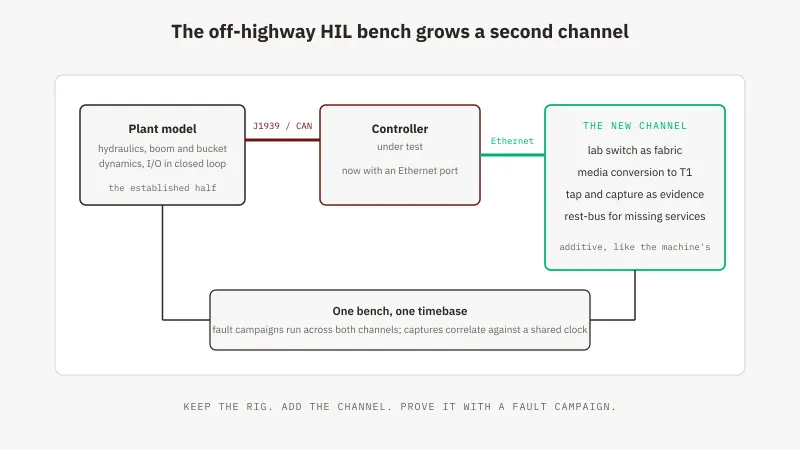
An off-highway HIL bench built around J1939 tests the machine that existed when it was commissioned. Adding an Ethernet channel is additive, not a rebuild: a lab switch as fabric, media conversion where the bench meets T1 links, and a capture point that makes the traffic evidence. The plant model stays.
Hardware-in-the-loop testing is not new to off-highway, and the public record shows it. A reference published in 2014 by a test-systems supplier describes hardware-in-the-loop being used increasingly for construction and agricultural vehicle software, with benches standing in for excavator boom, arm and bucket dynamics, GPS driver assistance and hydraulic valve control. That is a mature practice, described in mature terms.
Notice what that maturity is made of: hydraulic valve control, implement dynamics, position data for operator assistance. The tradition is plant-centred, because the product is a hydraulic machine, and for most of the installed fleet the network beside that plant is J1939 on CAN, so a bench that spoke J1939 covered the machine.
That coverage has quietly expired. Off-road manufacturers are positioning Ethernet links beside J1939, a shift our sector pillar sets out use case by use case. The important property of that shift is that it is additive: J1939 keeps its control and diagnostic role, and Ethernet arrives next to it. Benches commissioned before the port appeared are not wrong. They are one channel short, and the shortfall is on the network side rather than the plant side.
This article is about closing that gap without rebuilding the rig.
What an Off-Highway HIL Bench Already Does Well
Strip hardware-in-the-loop back to first principles and it is one idea: replace the machine with a real-time model of it, and leave the controller real. The controller under test is production hardware running production software. The bench computes the physics that controller would otherwise feel, then presents that physics as electrical signals on the pins where sensors would sit, and reads the controller’s outputs as if they were solenoids and valves. The loop closes because the model responds to what the controller commands, so a badly timed valve command produces a badly behaved cylinder in the model, and the controller sees the consequence of its own decision.
Off-highway has been doing this well for a long time. The 2014 reference above describes exactly the workloads you would expect from a sector whose product is a hydraulic machine: valve control benches, implement dynamics, an operator assistance function fed by position data. The peer-reviewed literature carries the same line of work, including an excavator hardware-in-the-loop bench published in Automation in Construction in 2022.
None of that tradition is at risk. Plant modelling for earth-moving machines is hard-won and specific, full of hydraulic compressibility, load-dependent flow and structural dynamics that took years to get honest. A bench carrying that model is an asset.
The thin part is the network half. When the only bus is CAN, the network half of a bench is almost invisible: a couple of channels, a database of parameter groups, a residual bus of periodic frames. It is easy to treat the bus as plumbing that carries the interesting signals. Ethernet is where that habit stops working, because on Ethernet the traffic is not plumbing. It is behaviour under test.
What Changes When the Controller Grows an Ethernet Port
On a J1939 channel, the bench provides signals. A parameter group arrives at a known rate carrying a known set of fields, and the controller’s job is to consume it. The bench’s job is to produce it correctly and on time. Outside its transport and address-claim sessions, that relationship is stateless in the way that matters: miss one frame and the next one is along shortly.
On Ethernet, the controller expects services. The use-case classes driving Ethernet into off-road machines, which the pillar sets out, are reprogramming sessions, camera and display flows and machine-data streams, and each of those is a conversation with state. A session opens, negotiates, transfers, verifies and closes. A stream is subscribed to, delivered, and stops when the subscriber goes away. A peer announces itself and is discovered, or is not, and the software has to decide what to do about the silence.
That difference has a direct test consequence. A bench that cannot hold up its end of those conversations does not partially test the Ethernet software. It leaves those code paths unexecuted entirely, and they are the newest code on the machine. The reprogramming path in particular is the one that runs in a dealer yard on a machine a customer is waiting for.
There is a second, quieter consequence. Adding a port adds states the machine did not previously have: link up, link down, link flapping, peer present, peer absent, peer late. The controller’s behaviour in each of those is a design decision someone made, sometimes implicitly. A bench with no Ethernet channel cannot ask about any of them.
Three Additions, and a Guide for Each
The upgrade is narrower than it sounds. Three things join the bench, and each has enough depth to deserve its own treatment, which is why the detail lives in dedicated guides rather than here.
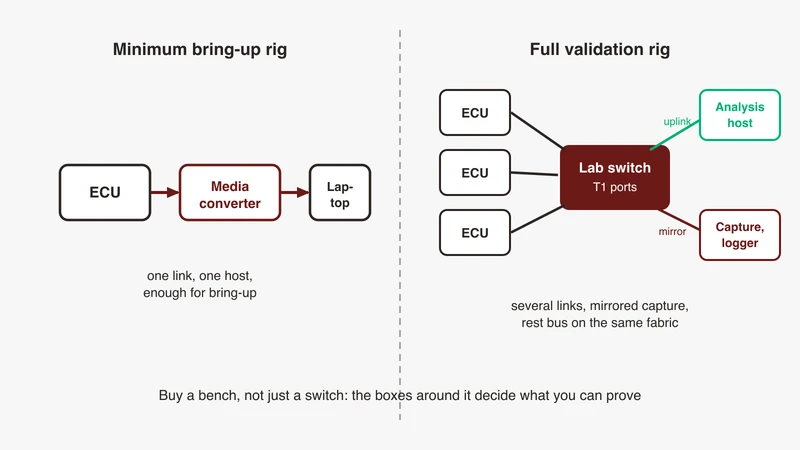
A lab switch becomes the bench’s network fabric. The bench needs somewhere for the controller, the simulation host, the capture host and any peer emulation to meet, with the single-pair port types the controller actually uses, and with mirroring behaviour you can trust when you later want to prove what happened. Selection is not obvious and the marketing around these boxes rewards reading carefully, which is the subject of how to choose an automotive Ethernet lab switch.
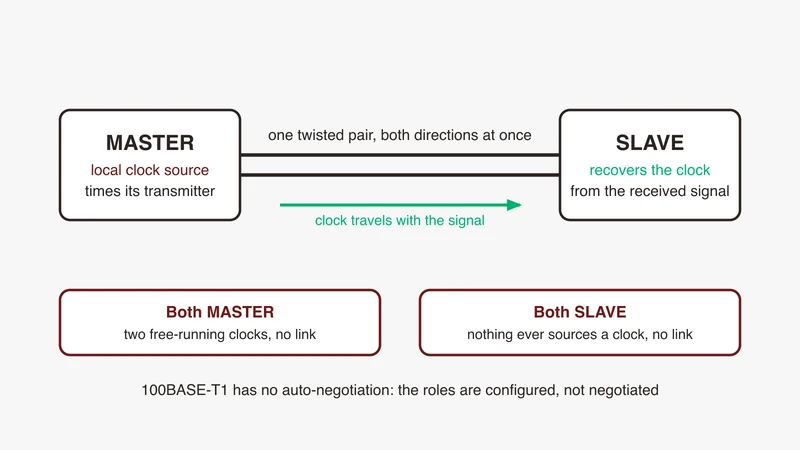
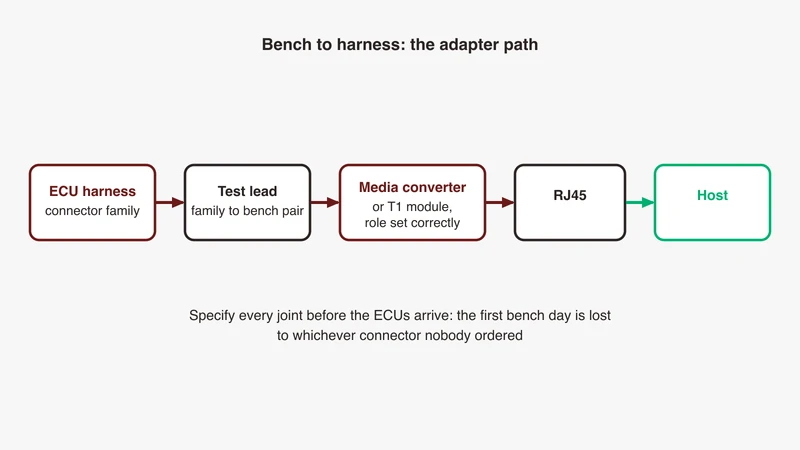
Media conversion is where the bench meets the machine’s links. The controller’s port is a single twisted pair. Most of your instruments and hosts have standard Ethernet interfaces. Something has to bridge the two without quietly changing what is being tested, and the choices that matter, including a role setting people get wrong on the first attempt, are in our media converter guide.
Capture is what turns a run into evidence. A HIL result that exists only as a pass in a spreadsheet is weak the moment someone disputes it. A correlated capture of what the bench sent and what the controller did is strong. Where the capture point goes, what each method preserves and what it silently drops are covered in capturing in-vehicle traffic.
Notice that none of the three touches the plant model, the signal conditioning or the load hardware. This is an addition, not a migration.
Making the Two Halves One Bench
Two channels on one frame is not the same as one bench. Three disciplines make them a single instrument.
One timebase. A J1939 trace and an Ethernet trace from independently clocked tools cannot be used to make a claim about cause, only about coincidence. Everything downstream of that, including gateway latency and any argument about which bus reacted first, depends on capturing both against a shared clock, which is the whole subject of multi-bus capture and correlation.
Rest bus on both sides. The controller under test is one node in a network of nodes that are not on your bench. On the CAN side, the residual traffic those absent nodes would send is familiar work. On the Ethernet side, the missing peers do not send frames, they provide services, and simulating a service is a different exercise with a different failure mode. That distinction is the argument of rest bus simulation for Ethernet-based vehicles.
Fault campaigns that cross the seam. The interesting failures on a two-network machine are rarely confined to one network. A degraded Ethernet link changes what the display shows while J1939 keeps insisting the machine is fine, and the question is which one the operator ends up believing. Campaign structure, the discipline of writing the expected reaction and the observable before applying the fault, and the electrical and protocol fault families both belong to fault injection in HIL. What off-highway adds is a set of rows about degraded communications specifically, the same rows that matter to a machine whose autonomy functions depend on a link.
The acceptance criterion for the upgrade is simple to state and useful to insist on: one test sequence, started once, produces one log in which a CAN event and an Ethernet event can be placed in order without anyone squinting.
Why This Lands in India Now
India is not only assembling these machines. The CII-BCG study’s own profiles describe design and research centres run here by international equipment makers, including one company’s Pune design centre described as its largest research operation outside its home country, with more than four hundred engineers (Source: CII-BCG, Pressing the Throttle, July 2026, pp. 10, 16, 22).
That study makes no claim about test benches, hardware-in-the-loop or vehicle networks, and we are not putting words into it. The step from engineering centres located in India to bench capability located in India is our reading, not the report’s. The reading is straightforward. Design work performed here generates verification work here, and verification work needs benches. A bench with no Ethernet channel limits what the team around it can be asked to own, and extending it is a smaller investment than the engineering it unlocks.
Where GSAS Fits
GSAS Micro Systems is an engineering partner, and bench upgrades are the kind of work where the value is in sequencing rather than in a purchase order.
We approach it in three stages. First, audit what the rig speaks today: which buses, which capture paths, which timebase, and which of the controller’s interfaces currently have no counterpart on the bench. That audit usually produces a shorter list than teams expect. Second, add the Ethernet channel: fabric, conversion and capture, sized to the ports the controller actually has rather than to a catalogue. Third, prove it with a campaign, because a channel that has never been used to fail a build is not yet trusted, and a fault campaign across both buses is the fastest way to earn that trust.
The sector view sits on our construction and mining solutions page.
Bench work runs from our offices in Bengaluru, Hyderabad, Chennai, Pune, Mumbai and Delhi NCR. Request a consultation with the controller you are testing and a description of what your bench speaks today, and the reply will be a channel-addition outline rather than a quotation for a new rig.
References
- dSPACE, “HIL testing for off-highway vehicles” (2014), cited as a public industry reference for the maturity of off-highway hardware-in-the-loop practice and for the bench workloads it describes (excavator dynamics, GPS driver assistance, hydraulic valve control): https://www.dspace.com/en/ltd/home/news/hil-testing-ohv-1411.cfm
- Jinshi Chen, Dongyang Huo, Changyi Liu, Han Zhang and Yuqi Wang, “Design and modeling of hardware-in-loop test bench for hydraulic excavator based on dynamic load emulation”, Automation in Construction (2022), DOI 10.1016/j.autcon.2022.104196
- Telematics Wire, article by a John Deere India solution architect on the role of automotive Ethernet in off-road vehicles (20 January 2023), source of the Ethernet use-case classes referenced above: https://telematicswire.net/role-of-automotive-ethernet-in-offroad-vehicles/
- Confederation of Indian Industry and Boston Consulting Group, “Pressing the Throttle: How India’s Mining and Construction Equipment Industry can support domestic ambitions and become a global force”, July 2026, pp. 10, 16, 22
Also appears in:
Building for Construction & Mining?
Talk to our application engineers for personalized tool recommendations.