In short
High Speed ISOBUS is the Agricultural Industry Electronics Foundation's project to move agricultural machine networking to Ethernet, with 1000BASE-T1 named as the preferred physical layer. It remains pre-ISO and agricultural in scope. Construction and mining equipment has no equivalent cross-industry Ethernet profile, and its shared standard, ISO/TS 15143-3, governs fleet data at the cloud layer instead.
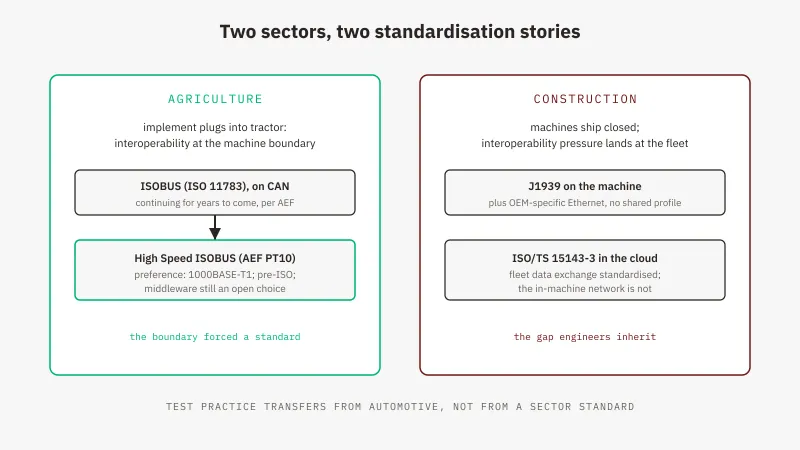
Two off-highway sectors, one shared problem, two different answers. Agriculture decided decades ago that a tractor and an implement built by different companies had to talk to each other, and wrote ISO 11783, the standard the industry calls ISOBUS. That same logic is now producing an Ethernet answer: the Agricultural Industry Electronics Foundation has a project team working toward a gigabit network for agricultural machines, with 1000BASE-T1 as its preferred physical layer.
Construction and mining equipment has nothing equivalent. It has SAE J1939 on CAN, Ethernet arriving machine by machine at each OEM’s own discretion, and a cross-industry standard that lives in the cloud rather than on the machine; the sector picture is in vehicle networks in construction and mining equipment. This article is about that asymmetry: why one sector standardised and the neighbouring one did not, and what it costs the engineers on the side without a standard.
What High Speed ISOBUS Actually Is
Everything in this section is the foundation’s own published account.
The starting point is a physical-layer constraint. The foundation describes the original ISOBUS physical layer as a CAN backbone of at most 40 metres at 250 kb/s, roughly 1,800 messages per second, and reports that large systems can push that bus well beyond half its capacity, often saturating near full usage.
The project responsible for the successor is a tenth project team, PT10. On speed, its simulation work found that a 100 Mb/s network would meet immediate and readily forecast needs, but concluded that “it may not scale as well into future use-cases”, which the foundation names as one of the motivations that led PT10 toward a 1 Gb/s network. On physical layer, the published wording is that among Ethernet technologies “the preferred is 1000BASE-T1”, chosen for a single twisted pair with fewer wires and pins, and because automotive technologies already align with agricultural requirements for temperature, vibration, life cycle and electromagnetic compatibility, at automotive volumes.
The use cases are specific: command and control of prescription, where the requirement is timing accuracy “well below 10 ms” with substantially reduced jitter; more precise logging of as-applied and yield information; more responsive displays; camera systems, as machine cameras move from analogue runs in the cab toward digital streams on a shared network; and connectivity to wireless machine-to-machine applications.
Now the caution. This is not a standard yet. The roadmap has PT10 finalising physical layer items and protocol, generating guidelines, and then a further step described as “Transition the AEF Guidelines into an ISO Working Group”. The protocol layer above the wire is still open, with two service-oriented middleware suites under evaluation, one from automotive and one from industrial automation. The foundation also notes that current requirements do not demand deterministic communications, and that CAN-based ISOBUS “will continue to be supported for many years to come”. A preference, a roadmap and a coexistence commitment are what exists today. A ratified cross-industry Ethernet standard for agriculture does not.
Why Agriculture Got There First
What follows is our analysis. The foundation makes no claims about construction equipment, and nothing below is its position. Start with the obvious reading: even an unfinished agricultural roadmap is a great deal more than construction has.
In agriculture the commercial unit is not the machine. A farm buys a tractor from one manufacturer and implements from several others, and expects any combination to work. That puts a contractual boundary in the middle of the electrical system, at the connector on the back of the tractor. Either every implement maker negotiates bilaterally with every tractor maker, which does not scale, or the industry agrees on one interface. The economics close one way, and they closed that way in the 1990s.
The difficulty of that boundary shows in the foundation’s own history: ISOBUS was revealed at a 2001 trade fair, and interoperability between different manufacturers’ equipment still took several more years to realise. A standard was necessary and not sufficient. It is also why the successor is a cross-industry project rather than a set of OEM designs: when demand outgrew a shared 250 kb/s bus, the replacement still had to plug across brands, so it had to be negotiated in the same room.
Construction equipment does not have that boundary. An excavator, a dump truck or a wheel loader mostly ships as a closed machine, and the work tools that do attach are hydraulic and mechanical first: bucket, breaker, coupler. Where an attachment is electrically controlled, the interface tends to sit inside one manufacturer’s ecosystem or behind an adapter, not on a published bus profile that a hundred independent makers build to. Nothing in the business model forces an open electrical boundary at the machine.
The interoperability pressure in construction is real, but it arrives one layer up. A contractor running mixed brands on one site wants one portal, not five. That pressure produced ISO/TS 15143-3, the telematics data part of the worksite data exchange series, and it is a cloud-level format rather than an in-machine one. The in-machine source is still J1939, which is why the path between bus and portal is where the defects hide; we walk it in how machine data reaches a fleet portal. Even the CAN-layer document whose title names off-road machinery, SAE J1939-02, is scoped to agricultural and forestry machinery.
Two sectors, two boundaries, two standards in two different places. Agriculture standardised at the coupler. Construction standardised at the API.
What the Gap Means if You Build Construction Machines
Also our analysis, and stated as consequences rather than complaints.
Ethernet arrives anyway, one OEM at a time. The workloads pulling Ethernet into a construction machine are close cousins of the foundation’s agricultural use cases: cameras to a display, faster reprogramming, remote monitoring, higher bandwidth data off the machine. What is missing is not demand. It is the cross-industry answer to which physical layer, which connector, which protocol stack, which conformance criteria. Each OEM decides for itself, and every one of those decisions is defensible in isolation and collectively incompatible.
Suppliers carry the variance. A supplier serving several agricultural OEMs will eventually build against one published set of guidelines. A supplier serving several construction OEMs qualifies against each customer’s specification separately and cannot amortise that work across the sector. If you sell into both, the difference shows up as engineering effort long before it shows up in a datasheet.
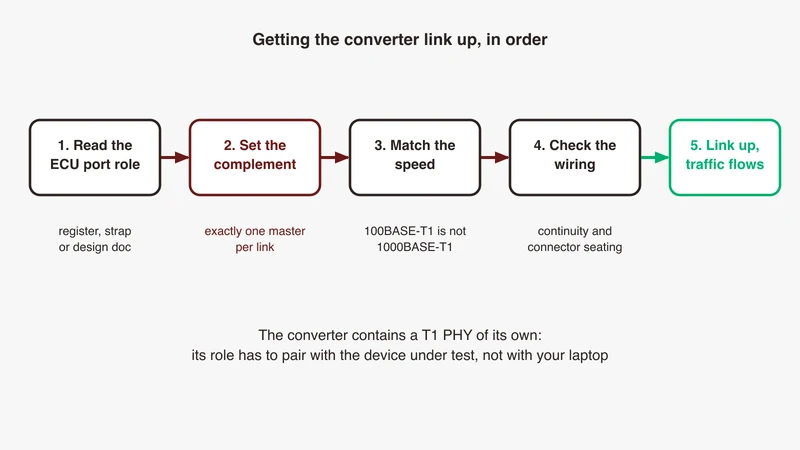
Your test practice has to be borrowed, and automotive is the lender. With no sector conformance regime to point at, acceptance criteria for a construction machine’s Ethernet links are contractual: whatever the customer’s specification says, tested however the two parties agree. Single-pair Ethernet was industrialised for road vehicles, which is where link-up debugging, physical-layer measurement practice and conformance suites already live, and our automotive Ethernet capability page is the automotive form of the bench a construction programme ends up needing. The foundation’s own reasoning supports the transfer: it chose the automotive physical layer because automotive environmental, durability and electromagnetic qualification already matches off-road conditions. Same wire, same instruments, same technique. Because the criteria are contractual, write them down: the physical-layer limits, the link-establishment behaviour and the capture-based evidence you expect, in the statement of work, before the first prototype harness exists.
Watching Brief
Scenarios worth tracking, not forecasts. We have no basis for predicting any of them.
The agricultural work reaches an ISO working group and produces a published standard. If its scope stays tractors and implements, construction gains nothing directly, but inherits a maturing 1000BASE-T1 supply chain proven in off-road conditions, which lowers cost and risk for everybody.
The scope broadens beyond agriculture, either by that standard being written more generally or by an earth-moving committee choosing to reference it. Nothing published indicates this is planned; it is simply the route that would close the gap fastest.
Construction OEMs converge without a standards body, because they buy from the same silicon and connector supply base, producing similarity without a profile. Test practice still comes from automotive.
The functional safety route pulls the network in regardless. ISO 19014-4:2020 covers software and data transmission for safety-related parts of earth-moving machinery control systems, ground we walk in our guide to ISO 19014 and machine performance levels. We cite the standard at title level, because the clauses are paywalled, but the point needs no clause: as more machine functions cross a network, the network is inside the safety argument whichever physical layer carries it.
The View from India
Indian equipment exports moved from about USD 1.7 billion in 2015 to around USD 4.9 billion in 2025, and India crossed from net importer to net exporter of mining and construction equipment (Source: CII-BCG, Pressing the Throttle, July 2026, pp. 7, 10, 18). The study says nothing about ISOBUS, Ethernet or standards profiles, and we are not putting words into it.
Our reading is this. Engineering teams here rarely serve one sector cleanly. The same electronics group may deliver into an agricultural programme governed by a published interoperability standard and an earth-moving programme governed by one customer’s private specification, and the two demand different habits: conform to the profile in one case, negotiate and document the criteria in the other. Knowing which one you are in is most of the work.
Where GSAS Fits
GSAS Micro Systems is an engineering partner, and our work here is construction and mining facing. We do not offer agricultural implement services; the agricultural story above is the instructive neighbour, not a market claim. The sector view sits on our construction and mining solutions page.
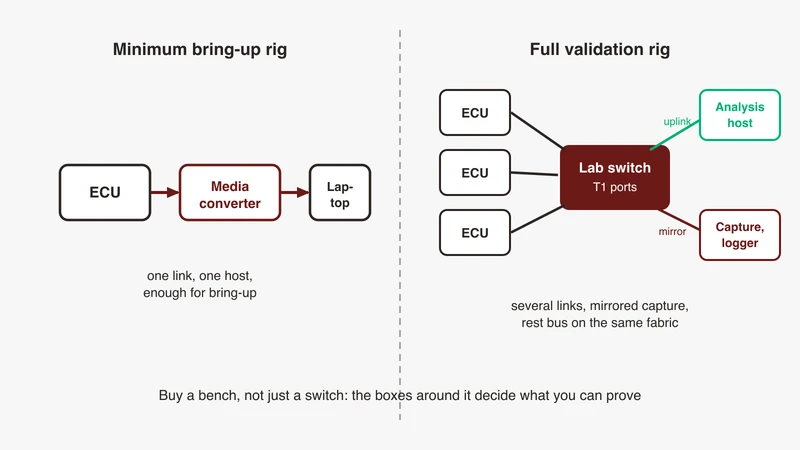
What transfers is the bench. Single-pair Ethernet physical-layer work, where a link either comes up over the harness you actually built or it does not. A switched bench with real capture points, so traffic between a camera, a switch and a display is observed rather than inferred. Protocol validation across the seam, where an Ethernet service and a J1939 parameter group describe the same machine and have to agree on a shared timebase, the upgrade we walk through in adding an Ethernet channel to an off-highway HIL bench. None of that needs a sector standard. It needs knowing what to measure and what evidence your customer will accept.
Standards questions and bench work land with our applications engineers in Bengaluru, Hyderabad, Chennai, Pune, Mumbai and Delhi NCR. Request a consultation with the machine, the links you are adding and the specification you were handed, and the reply will be a bench and acceptance-criteria outline rather than a catalogue.
References
- Agricultural Industry Electronics Foundation, “High Speed ISOBUS, an AEF Project for next generation Ag networking”, project activity page (all PT10 statements, speed evaluation, physical-layer preference, use cases, roadmap and coexistence position are quoted or paraphrased from this page): https://www.aef-online.org/about-us/activities/high-speed-isobus.html
- ISO 11783, “Tractors and machinery for agriculture and forestry, Serial control and communications data network” (ISOBUS): https://www.iso.org/standard/57556.html
- ISO/TS 15143-3:2020, “Earth-moving machinery and mobile road construction machinery, Worksite data exchange, Part 3: Telematics data”
- SAE J1939-02, Agricultural Forestry Off-Road Machinery Control and Communication Network (title per the DOI record; punctuation adapted house-style), DOI 10.4271/j1939-02_202311
- ISO 19014-4:2020, “Earth-moving machinery, Functional safety, Part 4: Design and evaluation of software and data transmission for safety-related parts of the control system”
- Confederation of Indian Industry and Boston Consulting Group, “Pressing the Throttle: How India’s Mining and Construction Equipment Industry can support domestic ambitions and become a global force”, July 2026 (export figures therein cite DGCIS and other third-party sources)
Also appears in:
Building for Construction & Mining?
Talk to our application engineers for personalized tool recommendations.