
In short
CWE stands for Common Weakness Enumeration. It is a community-developed list of common software and hardware weaknesses, sponsored by the US Cybersecurity and Infrastructure Security Agency and managed by MITRE, that gives every recurring class of coding defect a stable identifier such as CWE-787 (Out-of-bounds Write). Where a CVE names one vulnerability in one product, a CWE names the coding pattern that produced it.
What Is CWE?
CWE stands for Common Weakness Enumeration. MITRE describes it as “a community-developed list of common software and hardware weaknesses”, where a weakness is “a condition in a software, firmware, hardware, or service component that, under certain circumstances, could contribute to the introduction of vulnerabilities”. Each entry carries a unique identifier such as CWE-787 (Out-of-bounds Write), a description of the root cause, examples of how the weakness manifests in real code, and references to related standards. CWE is sponsored by the US Cybersecurity and Infrastructure Security Agency (CISA) and managed by the Homeland Security Systems Engineering and Development Institute, operated by The MITRE Corporation. MITRE states the list is updated three to four times per year.
In one sentence: where a CVE names one vulnerability in one product, a CWE names the coding pattern that produced it. That makes CWE the common language connecting vulnerability reports, coding standards, static analysis tools, and regulatory requirements.
When a security vulnerability is discovered in a shipped product, the first question every engineering team asks is: what went wrong in the code? CWE exists to answer that question systematically, and to let a team ask it before the product ships rather than after.
Source: CWE, About, MITRE.
CWE vs CVE: Root Cause vs Specific Instance
A common source of confusion is the relationship between CWE and CVE. They are complementary but fundamentally different.
A CVE (Common Vulnerabilities and Exposures) entry describes a specific, discovered vulnerability in a specific product. CVE-2024-21762, for example, identifies a particular out-of-bounds write vulnerability in a specific version of a specific vendor’s product.
A CWE entry describes the underlying weakness pattern that makes such vulnerabilities possible. CWE-787 (Out-of-bounds Write) is the root cause category that CVE-2024-21762 falls under. One CWE can be the root cause of thousands of CVEs.
For embedded development teams, this distinction matters. CVEs tell you what has already been exploited. CWEs tell you what to look for in your own code before it ships.
The CWE Top 25
MITRE publishes an annual list of the 25 most dangerous software weaknesses, ranked by frequency and severity across real-world vulnerability data. For embedded C and C++ developers, four entries are particularly relevant.
| CWE ID | Weakness | How it appears in embedded C/C++ | Consequence |
|---|---|---|---|
| CWE-787 | Out-of-bounds Write | Writing past the end of a stack or heap buffer | Data corruption through to arbitrary code execution |
| CWE-125 | Out-of-bounds Read | Reading beyond the intended buffer bounds | Exposure of adjacent memory, including keys or tokens |
| CWE-476 | NULL Pointer Dereference | Dereferencing an unchecked pointer return | Crash where an MMU exists; on bare-metal targets without an MMU, address zero may map to real memory or peripheral registers, causing silent corruption |
| CWE-120 | Buffer Copy without Checking Size of Input | The classic strcpy and memcpy patterns where source data exceeds the destination | Overflow of the destination buffer, one of the most common firmware vulnerability patterns |
These are not obscure edge cases. They appear repeatedly in the firmware of automotive ECUs, industrial PLCs, medical infusion pumps, and telecommunications equipment. Any product that processes external input, whether from a CAN bus, a network interface, a USB port, or a sensor, is a potential target.
CWE and Regulatory Requirements
Increasingly, industry regulations reference CWE explicitly or require practices that map directly to CWE-based analysis.
| Standard | Domain | Where CWE fits |
|---|---|---|
| IEC 62443 | Industrial automation and control systems cybersecurity | Requires threat modelling and secure development practices; a CWE-mapped scan of the codebase is concrete evidence that weakness analysis was performed |
| ISO/SAE 21434 | Road-vehicle cybersecurity engineering | Requires threat analysis and risk assessment across the product lifecycle; CWE supplies the taxonomy for classifying the code-level weaknesses that analysis identifies |
For Indian teams exporting embedded products or providing engineering services to global OEMs, CWE compliance is becoming a contractual requirement, not merely a best practice.
Detection with Klocwork
Identifying CWE weaknesses manually through code review is impractical at scale. Klocwork performs interprocedural static analysis that automatically detects weaknesses mapped to the CWE 2024 Top 25 and hundreds of additional CWE identifiers. Each finding includes the CWE ID, a trace through the code showing how the weakness can be triggered, and remediation guidance.
This is particularly valuable for Indian embedded teams working in sectors with growing security mandates. Telecom equipment destined for government networks, defence subsystems subject to procurement security requirements, and medical devices targeting regulated export markets all benefit from automated CWE detection integrated into the development workflow.
Get Started with CWE Scanning
GSAS offers Klocwork demonstrations focused on CWE detection for embedded C and C++ codebases. We can scan a representative portion of your codebase and walk your team through the findings, showing how CWE-mapped analysis fits into your existing quality and compliance processes. Request a CWE scanning demo to see your own code through the lens of the weakness taxonomy your customers and regulators already reference.
Also appears in:
Interested in Perforce tools?
Talk to our application engineers for personalized tool recommendations.
More from Perforce
View all →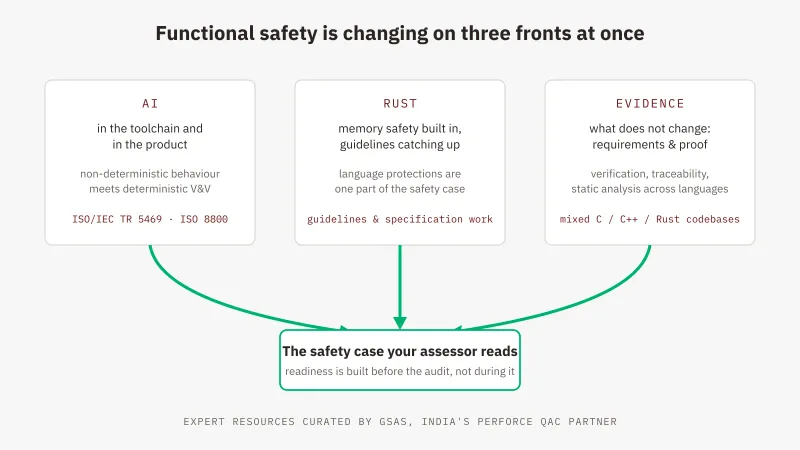
AI, Rust and the New Functional Safety Standards
2 Sept · 9 min
The Complete AUTOSAR Verification Chain: AUTOSAR C++14 Static Analysis with Perforce QAC, SWC and RTE Testing with TESSY 6
31 Jul · 9 min
DevSecOps Tools and Practices for Embedded Teams in India
18 Jul · 8 min
Static Analysis for Medical Device Software: IEC 62304 and FDA Compliance in India
18 Jul · 9 min
Emulating Processor Power for Thermal Testing: Why Constant Power
7 Oct · 7 min
CRPS and Rack Power Supply Testing: The Six Tests That Matter
7 Oct · 7 min