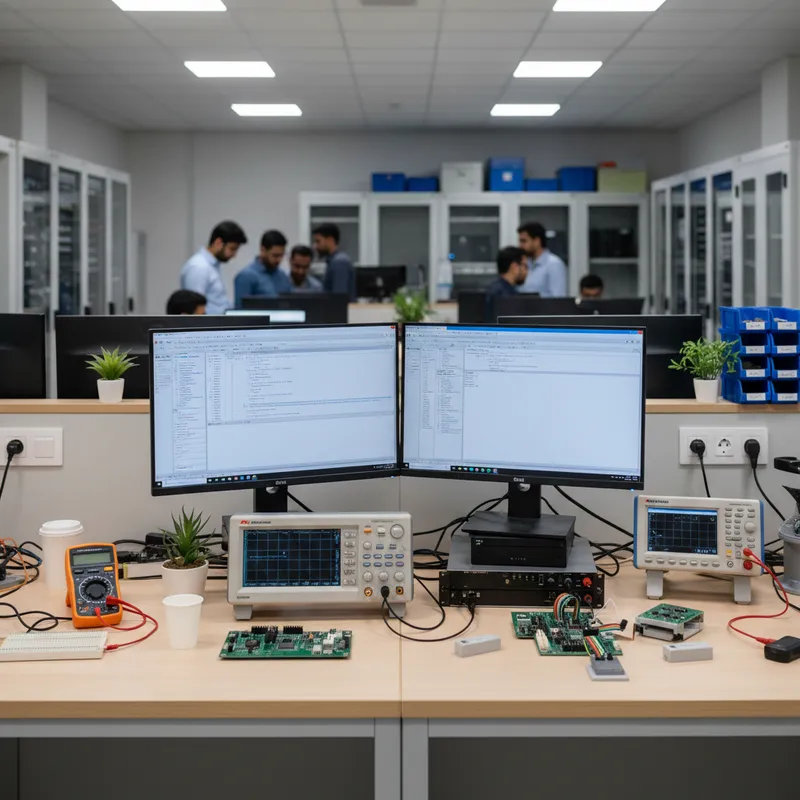
Why Reliability Is a Culture, Not a Feature, A Note from Our CMD, featured image

Why Reliability Is a Culture, Not a Feature: A Note from Our CMD

GSAS Editorial · · 1 min read

By Satyanarayana Gopalam, Chairman & Managing Director, GSAS Micro Systems

In critical embedded systems operations, system downtime costs often exceed the equipment expenses themselves. Consider three scenarios:

  • A manufacturing line halt during a production run
  • A medical device calibration delay before a clinical deadline
  • An R&D test bench dependency blocking a product release

In each case, the cost of waiting, for a replacement unit, for a technical response, for someone who actually understands the product, dwarfs the cost of the tool itself.

The Difference Between a Provider and a Partner

What separates a genuine technology partner from a vendor is how they respond when things go wrong. GSAS’s competitive advantages are built on three principles:

  • Engineering experience built over decades: our team has worked with these tools across thousands of customer deployments
  • Rapid technical response without bureaucracy: when a customer’s setup fails, we act, not escalate
  • Deep product and application understanding: we don’t just sell tools, we understand how they integrate into your workflow

A Real Example

A long-time customer’s test setup failed during a critical evaluation window. Rather than routing through bureaucratic support channels, our engineering team quickly identified the issue, sourced a replacement unit, and delivered it in time to maintain the project timeline.

No ticket number. No SLA jargon. Just engineers helping engineers.

“Reliability is not a feature that comes printed in a brochure. It is a culture built by how people respond.”

If your organization prioritizes uptime, system stability, and consistent technical support in increasingly complex embedded environments, we should talk.


See the Original Post on LinkedIn

View on LinkedIn →

Need embedded development tools?

Talk to our application engineers for personalized tool recommendations.
Stay in the Loop

Get monthly compliance updates, product insights, and engineering best practices delivered to your inbox.

Related Articles

Side by side vehicle outlines comparing a domain E/E architecture grouped by function against a zonal E/E architecture grouped by physical location, with zone controllers on an Ethernet backbone into central compute, from GSAS Micro Systems India
Automotive Ethernet Automotive & Mobility

Domain vs Zonal E/E Architectures Explained

Domain architectures group ECUs by function, zonal architectures group them by where they sit in the vehicle. This guide is the engineer's read on the difference: what physically moves, what the in-vehicle network has to become, and what happens to diagnostics, rest bus simulation and time sync. It also refuses to repeat the harness mass and ECU-count figures that circulate without a public source, and says exactly which claims are citable and which are not. Written by the GSAS Micro Systems engineering team in India.

29 Aug 2026 · 13 min read
Left to right continuous integration pipeline from commit through build and a software-in-the-loop gate into a bench queue with a reservation gate, then a hardware-in-the-loop run and a report, showing the HIL bench as a shared queued resource, from GSAS Micro Systems India
Automotive Ethernet Automotive & Mobility

Test Automation for SDV: ASAM XIL, Virtual ECUs, CI for HIL

Every software-defined vehicle programme in India eventually asks the same question: why does a test case written for a laptop have to be rewritten for the virtual ECU and rewritten again for the bench? The two public anchors that answer it are the ASAM XIL API and the FMI packaged model format: FMI is a free standard, and ASAM publishes enough of XIL's structure openly that you can specify against it before anyone buys the document. This article walks the shift-left ladder honestly, including the four things that cannot move left, and treats the hardware-in-the-loop bench as a queued shared resource inside continuous integration rather than a desk someone books. Written by the GSAS Micro Systems engineering team in India.

29 Aug 2026 · 13 min read
MIPI I3C adoption in Indian semiconductor design centres, supported in India by GSAS
Industry Insights Binho Semiconductor Design

MIPI I3C Adoption in Indian Semiconductor Design Centers

MIPI Alliance lists I3C v1.0 as a 2016 release, and the design centres in Bengaluru and Hyderabad that build sensor hubs, camera interface modules and PMICs are where its adoption in India is concentrated. The practical constraint is rarely the specification; it is having bench instrumentation that can drive an I3C bus interactively during bring-up.

6 Apr 2026 · 5 min read