The 50% Problem
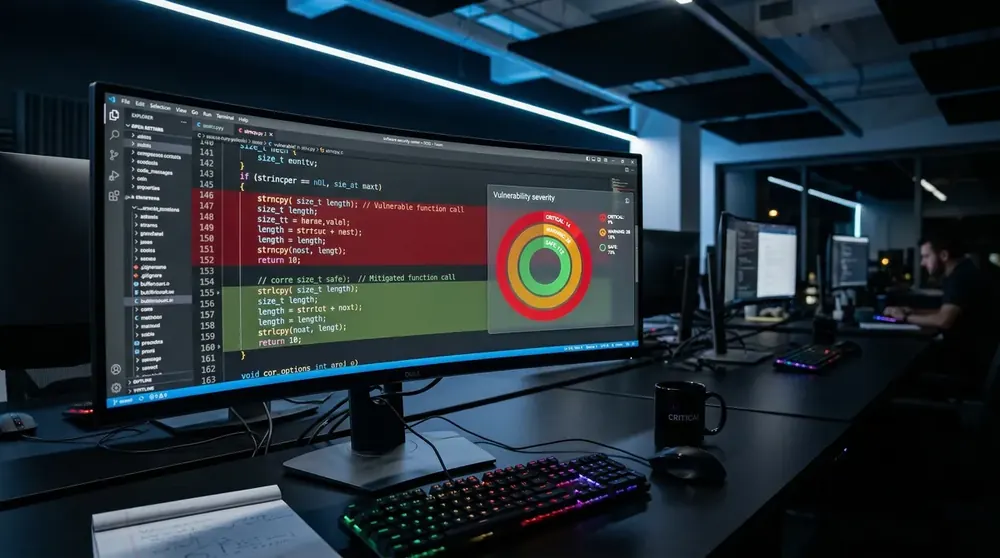
Half of all security defects are introduced at the source code level. Not in configuration, not in deployment, not in network architecture, in the code itself. Buffer overflows, SQL injection, null pointer dereferences, improper input validation, and race conditions are all defects that developers write into their software, often without realizing it.
The economics are stark: fixing a vulnerability during development costs orders of magnitude less than fixing it after deployment. For Indian companies building medical devices for US FDA submission, telecom infrastructure for 5G rollout, or automotive ECUs for European OEMs, a post-deployment vulnerability can mean product recalls, regulatory penalties, or exclusion from markets.
What Is SAST?
Static Application Security Testing (SAST) analyzes source code without executing it, scanning every path, tracing every data flow, and mapping every variable to detect vulnerabilities against known weakness taxonomies.
| Analysis Type | When | What It Catches |
|---|---|---|
| SAST (Static) | During development | Source code vulnerabilities, coding standard violations |
| DAST (Dynamic) | During testing | Runtime vulnerabilities, authentication flaws |
| SCA (Composition) | During build | Open-source license and vulnerability risks |
SAST is the shift-left foundation, it catches defects at the earliest possible point, when they are cheapest to fix.
Standards SAST Enforces
| Standard | Domain | Focus |
|---|---|---|
| CWE Top 25 | Universal | Most dangerous software weaknesses |
| CERT C/C++ | Secure coding | Vulnerability prevention rules |
| OWASP Top 10 | Web/API | Application security risks |
| DISA STIG v6 | US DoD | Security configuration guidelines |
| IEC 62443 | Industrial | Control system cybersecurity |
| ISO/SAE 21434 | Automotive | Cybersecurity risk management |
Klocwork 2025.4: What’s New
Klocwork is Perforce’s enterprise SAST engine, supporting C, C++, C#, Rust, Java, JavaScript, Python, and Kotlin. The 2025.4 release introduces:
- AI-assisted code remediation in VS Code, context-aware fix suggestions with human-in-the-loop approval
- Complete MISRA C:2023 coverage for C90/C99 with improved C11/C18 enforcement
- Clang 20 integration for more accurate code parsing
Earlier 2025 releases added the CWE 2024 Top 25 and DISA STIG v6 taxonomies, which Perforce lists under Klocwork 2025.1. Klocwork’s TÜV SÜD certified tool qualification for ISO 26262 (to ASIL D) and IEC 61508 (to SIL 4) is a standing product attribute rather than a feature of any one release.
Indian Use Cases
- Telecom infrastructure: 5G base station software, router firmware, and network management platforms require IEC 62443 compliance. SAST catches vulnerabilities in C/C++ control plane code before deployment.
- Medical device exports: Indian manufacturers exporting cardiac monitors, infusion pumps, and diagnostic equipment to the US and EU need CWE and CERT compliance for FDA 510(k) and CE marking.
- Automotive ECUs: ADAS, battery management, and motor controller firmware require MISRA + CERT compliance for ISO 26262 and ISO/SAE 21434.
- Defense and government: Indian defence R&D and electronics projects require DISA STIG compliance for secure embedded systems.
- Fintech: RBI cybersecurity mandates drive adoption of OWASP and CERT scanning for banking APIs and payment processing software.
Try Klocwork
Perforce offers a 7-day Klocwork trial, scan your codebase, see the vulnerabilities, and evaluate AI-assisted remediation on your own code. GSAS provides trial setup assistance, results interpretation, and deployment consulting.
For a comprehensive overview of SAST methodology, visit Perforce’s SAST Resource Center.
Also appears in:
Interested in Perforce tools?
Talk to our application engineers for personalized tool recommendations.
More from Perforce
View all →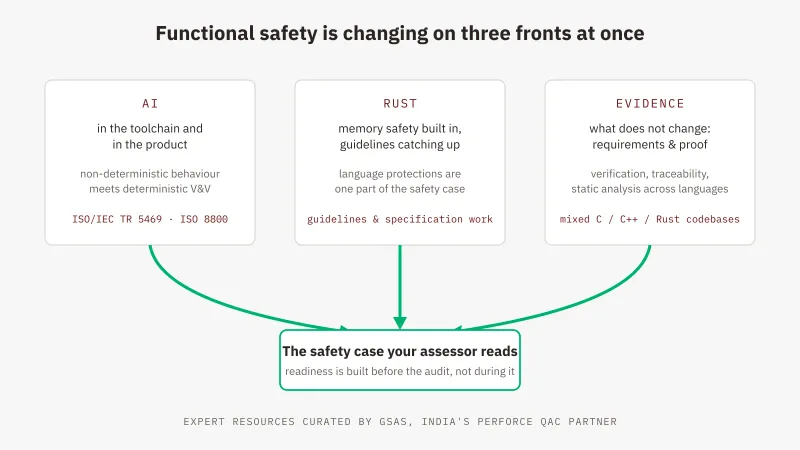
AI, Rust and the New Functional Safety Standards
2 Sept · 9 min
The Complete AUTOSAR Verification Chain: AUTOSAR C++14 Static Analysis with Perforce QAC, SWC and RTE Testing with TESSY 6
31 Jul · 9 min
DevSecOps Tools and Practices for Embedded Teams in India
18 Jul · 8 min
Static Analysis for Medical Device Software: IEC 62304 and FDA Compliance in India
18 Jul · 9 min
Emulating Processor Power for Thermal Testing: Why Constant Power
7 Oct · 7 min
CRPS and Rack Power Supply Testing: The Six Tests That Matter
7 Oct · 7 min