
Every year, vulnerability databases grow thicker with entries that trace back to a handful of preventable coding mistakes. Security incidents in embedded systems are more often traced to exploitable software defects, buffer overflows, null pointer dereferences, integer overflows, format string bugs, than to sophisticated zero-day attacks or novel cryptographic breaks. These are code-level errors that have been well understood for decades, which is exactly why MITRE and the SEI have spent years cataloguing them in CWE and CERT C. For Indian embedded teams shipping products into automotive, defence, industrial, and medical markets, this is both a warning and an opportunity: secure coding practices are among the highest-impact investments you can make.
The Usual Suspects in C
C remains the dominant language in embedded development for good reason. It offers deterministic timing, minimal runtime overhead, and direct hardware access. But the same characteristics that make C powerful also make it dangerous when used carelessly.
Buffer overflows remain the most exploited class of vulnerability. Writing past the bounds of an array corrupts adjacent memory, and attackers have refined techniques for turning that corruption into arbitrary code execution. Stack-based overflows, heap overflows, and off-by-one errors all fall into this family. Null pointer dereferences crash programs outright on systems with memory protection, but on bare-metal embedded targets they often cause silent corruption. When a null pointer write lands on a memory-mapped peripheral register, the consequences can be physical. Integer overflows are deceptive. A length calculation that wraps around from a large positive value to a small one, or to a negative number interpreted as unsigned, can turn a seemingly safe allocation into a dangerously undersized buffer. Format string attacks exploit functions like `printf` and `sprintf` when user-controlled data is passed directly as the format argument. This gives an attacker the ability to read from and write to arbitrary memory locations.
These are not theoretical risks. They appear in CVE reports for embedded systems shipped by multinational OEMs, and they appear in the codebases that Indian engineering services teams maintain every day.
Four Frameworks That Define Secure C
The good news is that the embedded industry has converged on a small number of well-maintained frameworks that catalogue these weaknesses and provide enforceable rules to prevent them.
CWE (Common Weakness Enumeration) is MITRE’s comprehensive taxonomy, cataloguing over 800 distinct software weakness types. It serves as the common language for vulnerability classification and is referenced by virtually every security standard. CERT C Secure Coding Standard provides specific rules and recommendations for writing secure C code. Maintained by the SEI at Carnegie Mellon, CERT C rules are actionable and map directly to common vulnerability patterns. MISRA C originated in the automotive safety world but has become the de facto coding standard across all safety-critical embedded domains. What many teams do not realise is the extent of overlap with security: a substantial share of the rules in both C Secure (ISO/IEC TS 17961) and CERT C address the same undefined-behaviour and memory-safety issues MISRA C already targets. If your team already enforces MISRA C, you have a meaningful security baseline in place. ISO/IEC TS 17961 (C Secure) is the formal ISO technical specification for secure C coding. It defines a set of rules specifically targeting undefined behaviour and security-relevant coding errors.
The practical insight for Indian teams is that these frameworks are not competing alternatives. They are complementary layers. MISRA C gives you safety and a strong security foundation. CERT C and CWE add the security-specific depth. A mature codebase enforces all three.
Putting It Into Practice
Adopting secure coding is not a documentation exercise. It requires tooling that integrates into your existing workflow and catches violations before they reach integration testing, or worse, the field.
Klocwork performs deep static analysis and detects vulnerabilities mapped to CWE identifiers and CERT C rules. It analyses entire codebases interprocedurally, tracing data flows across function boundaries to find the kinds of defects that unit tests and code reviews routinely miss. Klocwork’s differential analysis mode scans only the changed code while still reporting results as if the entire system had been analyzed; Perforce describes this as delivering “the shortest possible analysis times”, and the Klocwork SAST datasheet calls the Differential Analysis engine’s output “instant analysis results”, making it practical to run on every commit in a CI pipeline. Perforce QAC is positioned by Perforce as the gold standard for MISRA C enforcement, certified by TUV SUD. It provides full coverage of the MISRA C guidelines, including the current C:2025 edition and generates the compliance evidence that auditors and OEM customers require.
At GSAS, we have seen Indian embedded teams achieve measurable improvements in defect density within the first quarter of adopting these tools. The key is not just purchasing a licence but establishing the coding standard baseline, configuring the tooling to match, and training engineers to interpret and resolve findings effectively.
Sources
- MITRE, CWE - Common Weakness Enumeration
- Carnegie Mellon University Software Engineering Institute, SEI CERT C Coding Standard
- MISRA, MISRA C guidelines
- ISO/IEC, ISO/IEC TS 17961:2013, C Secure Coding Rules
- Perforce, Perforce QAC product page and Klocwork product page (MISRA C, CERT C and CWE enforcement claims attributed to Perforce)
- Perforce, Klocwork SAST datasheet (“instant analysis results” and “the shortest possible analysis times” quotes)
Take the Next Step
GSAS conducts secure coding workshops tailored to Indian embedded teams. Whether your codebase targets automotive ECUs, industrial controllers, or medical devices, we can help you establish a secure coding baseline and integrate static analysis into your development workflow. Contact us to schedule a workshop for your team.
Also appears in:
Interested in Perforce tools?
Talk to our application engineers for personalized tool recommendations.
More from Perforce
View all →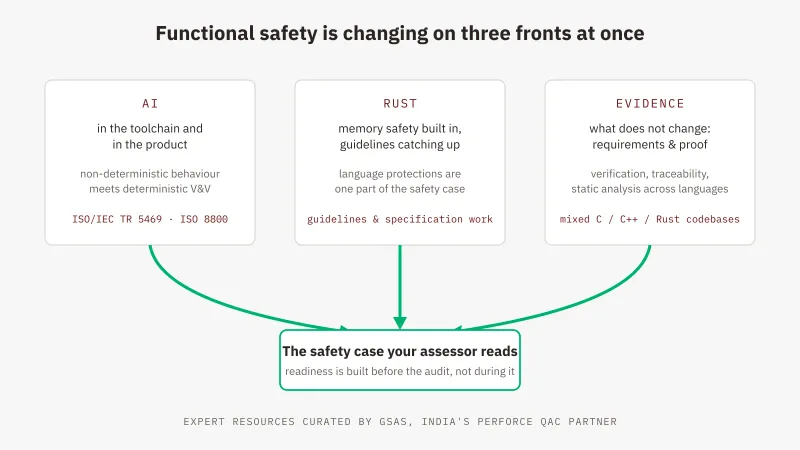
AI, Rust and the New Functional Safety Standards
2 Sept · 9 min
The Complete AUTOSAR Verification Chain: AUTOSAR C++14 Static Analysis with Perforce QAC, SWC and RTE Testing with TESSY 6
31 Jul · 9 min
DevSecOps Tools and Practices for Embedded Teams in India
18 Jul · 8 min
Static Analysis for Medical Device Software: IEC 62304 and FDA Compliance in India
18 Jul · 9 min
Emulating Processor Power for Thermal Testing: Why Constant Power
7 Oct · 7 min
CRPS and Rack Power Supply Testing: The Six Tests That Matter
7 Oct · 7 min