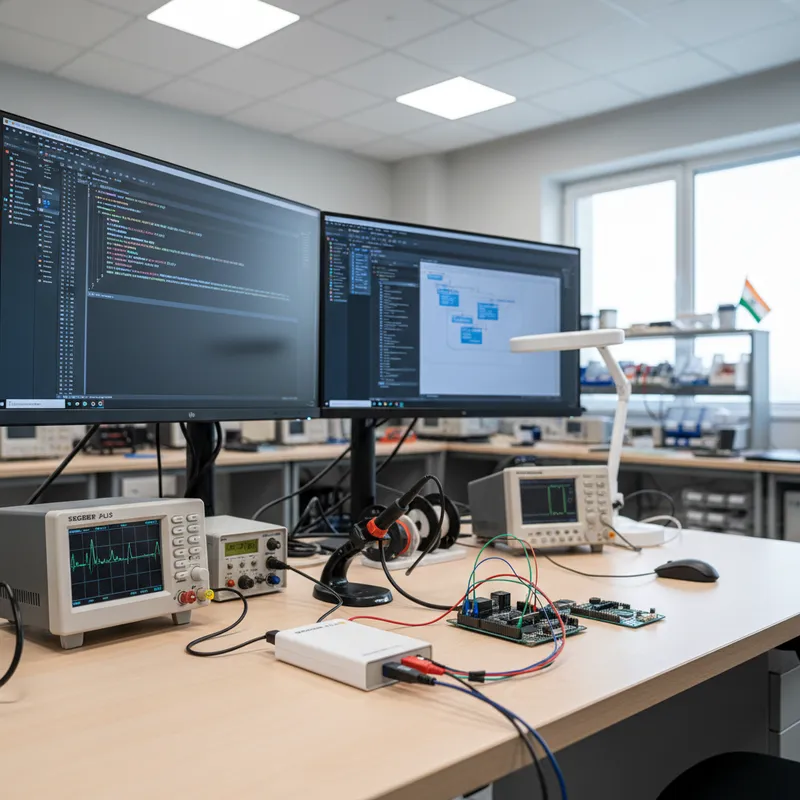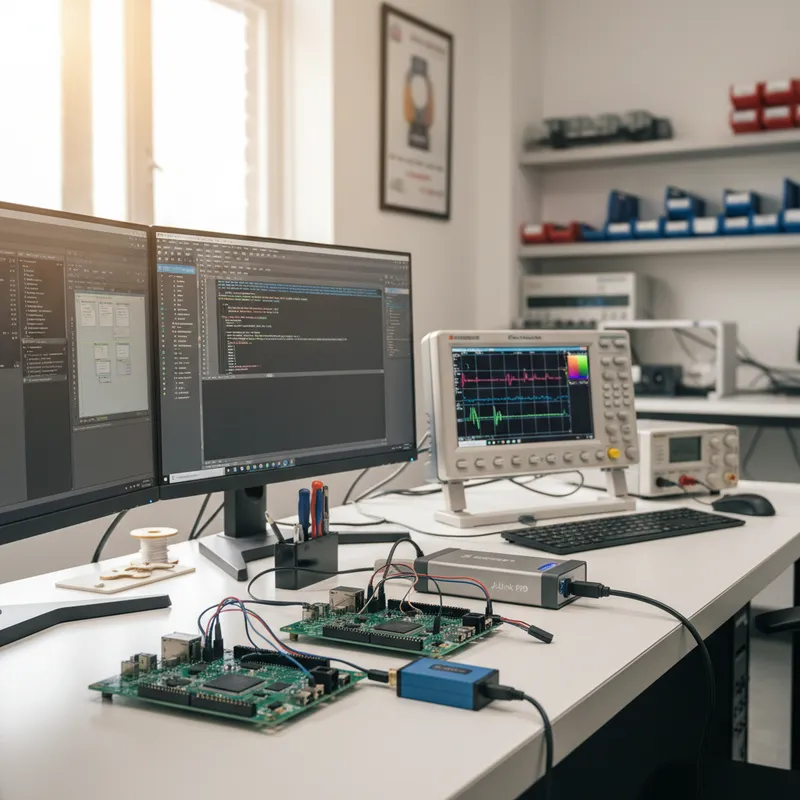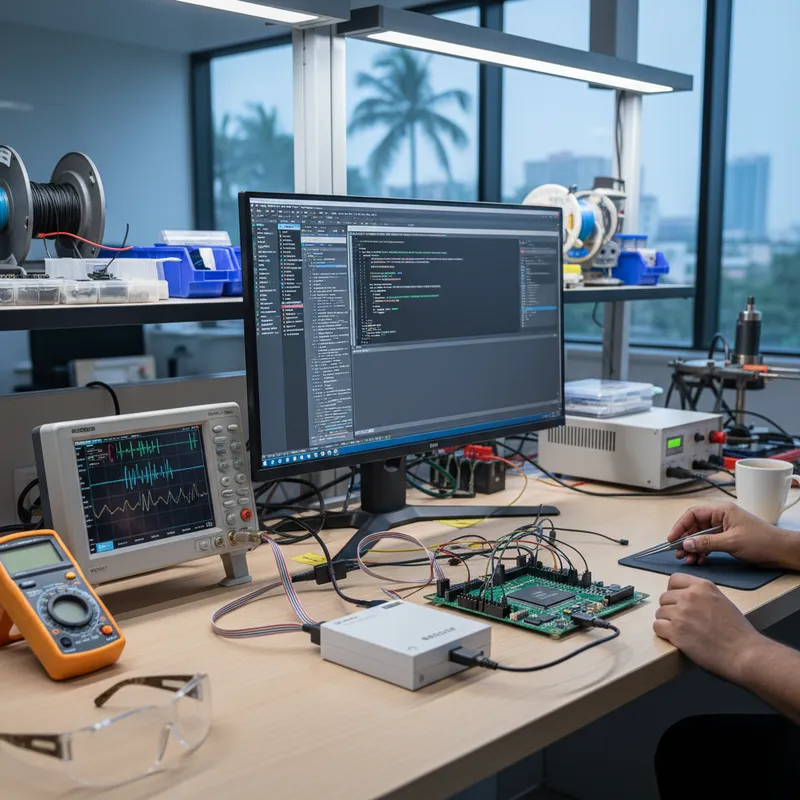
STMicroelectronics’ STM32 family is one of the most widely deployed Arm Cortex-M microcontroller families in Indian product engineering today. From EV battery management units in Bengaluru and Pune to industrial gateways in Chennai and medical devices in Hyderabad, the STM32 lineup, F0, F1, F3, F4, F7, G0, G4, H7, L0, L1, L4, L5, U5, WB, WL and WBA, turns up on almost every embedded board GSAS engineers see. And on every one of those boards, the debug probe determines how fast you can iterate.
This guide is for Indian teams already committed to STM32 who want to understand exactly why SEGGER J-Link is the professional choice over the bundled ST-Link, which J-Link model fits which STM32 family, and how to move from bench debug into volume production programming without rewriting the toolchain. GSAS Micro Systems is an authorized SEGGER engineering partner in India, every J-Link model in this guide is available with INR invoicing and local application engineering support from our offices in Bengaluru, Chennai, Hyderabad, Delhi NCR, Mumbai, and Pune.
STM32 and J-Link: the device database that actually matters
SEGGER maintains one of the largest MCU device databases in the industry, tens of thousands of supported devices, and the STM32 coverage runs deep, STM32 parts across the portfolio are supported by the J-Link Software Pack, with flash programming algorithms, memory map definitions, reset sequence profiles, and option byte handlers. New STM32 variants keep receiving J-Link device profiles as ST releases them, including the newer U5 (Cortex-M33, TrustZone, ultra-low-power), the G4 (motor control focus), the H7 dual-core M7+M4 families, and the WBA Bluetooth Low Energy 5.4 line. This matters because most debug issues engineers see in practice trace back to the debugger not knowing the part, wrong flash algorithm, wrong reset delay, wrong security state handling. SEGGER’s database coverage eliminates that entire class of problem.
The practical consequence in Indian R&D labs: if you are building a product around a new STM32 variant and you want to debug it the day the samples arrive, J-Link is almost always ready before the alternative toolchains catch up.
Flash breakpoints: the real J-Link advantage on STM32
ST-Link is a serviceable debug probe for basic single-step development, but it hits two limits quickly in production engineering: flash breakpoint count and download speed. The STM32 Cortex-M cores have 4 to 8 hardware breakpoints. For interrupt-driven firmware with RTOS task scheduling, deeply nested state machines, or HAL-based BSPs where you need breakpoints on multiple callback chains, 4 breakpoints disappears in the first hour of debug.
J-Link’s Unlimited Flash Breakpoints deliver unlimited breakpoints in flash on STM32, in internal flash and memory-mapped external flash alike. The license is included on J-Link PLUS and above; on J-Link BASE and BASE Compact it is a paid upgrade. The technique replaces the target instruction at the breakpoint location with a BKPT, and SEGGER’s software handles the flash reprogramming transparently. For an Indian automotive Tier-1 debugging AUTOSAR BSW across STM32F4 or STM32U5 boards, this single feature is typically the reason their engineers move off ST-Link.
Which J-Link model for which STM32 use case
- J-Link BASE / BASE Compact: the everyday bench debugger. Fits STM32F0/F1/F3/F4/G0/G4/L0/L1/L4/U5/WB/WL development across Cortex-M0/M0+/M3/M4/M33 cores. USB 2.0 Hi-Speed, download speeds up to 1 MB/s. Note that the Unlimited Flash Breakpoints, J-Flash and Ozone licenses are not included at this tier; they come with PLUS and above, or via the paid BASE-to-PLUS upgrade. This is the model most Indian product engineering teams start with.
- J-Link PLUS / PLUS Compact: the same 1 MB/s download speed and 15 MHz interface speed as BASE; what you are buying is the bundled licenses: Unlimited Flash Breakpoints, J-Flash and J-Flash SPI preinstalled, Ozone, monitor mode debugging, and RDI. For most commercial STM32 teams this is the sweet spot.
- J-Link ULTRA: compact USB-C probe with download speeds up to 4 MB/s over a single 20-pin JTAG/SWD connector. Choose this if your STM32H7 or STM32U5 firmware produces high-volume RTT logging (printf-over-SWO replacement), or if you are flashing large images and the download time matters. Typical Indian use case: edge AI or audio processing firmware where debug logs are dense.
- J-Link PRO: USB plus 100 Mbit Ethernet, download speeds up to 4 MB/s. This is the flagship for CI/CD pipelines in Indian labs: the build machine triggers flash-and-test over LAN with no USB cable contention. The J-Link PRO PoE variant adds Power-over-Ethernet (802.3af) for single-cable rack installations. If your team is building automated regression test racks, J-Link PRO is the right investment.
- J-Link WiFi: debug traffic over WiFi, with the probe itself powered over its USB connector. Less common for STM32 bench work but useful for motor control rigs or vibration fixtures where a data tether to the host PC would be in the way.
STM32 boards with an embedded ST-Link/V2-1 or ST-Link/V3 can also be converted to a J-Link by reflashing the on-board probe firmware with SEGGER’s STLink Reflash utility, giving you J-Link feature access on the dev board without buying a separate probe, useful for early evaluation before purchasing J-Link PLUS units for production teams.
Production programming: from J-Link to Flasher
J-Link is a lab instrument. Once an STM32-based product goes into volume, Indian manufacturers typically move to the SEGGER Flasher family for production programming:
- Flasher Compact for low-volume in-circuit programming at bench scale
- Flasher ARM / Flasher PRO for standalone programming on the production line, no host PC required
- Flasher ATE for fully automated test equipment integration at contract manufacturers
- Flasher Hub for gang programming of multiple STM32 targets in parallel, the throughput profile Indian EMS volumes need
Flasher uses the same SEGGER device database as J-Link, so the STM32 flash algorithm you trust on the bench is the same algorithm running on the factory line. Secure variants (Flasher Secure) add Root-of-Trust injection and one-time-programmable region handling, which matters for STM32 U5 and STM32H5 products deployed under Indian cybersecurity labelling requirements.
RTT, Ozone, and SystemView: the debug stack STM32 engineers actually need
Beyond the probe itself, three SEGGER tools make STM32 debug materially faster:
- RTT (Real-Time Transfer): printf over the debug connection with minimal intrusion on real-time behavior. Replaces semihosting (which stops the CPU) and UART debug (which costs hardware).
- Ozone: the standalone debugger. Cross-platform, no toolchain lock-in, trace-aware. Works with STM32 ELF files produced by any compiler (Arm GCC, Arm Clang, Keil, IAR, SEGGER’s own).
- SystemView: live execution tracing for FreeRTOS, Zephyr, embOS, and bare-metal code. If your STM32 firmware has mysterious timing jitter, SystemView shows you exactly which ISRs are interrupting which tasks.
Buy SEGGER J-Link for STM32 in India from GSAS
GSAS Micro Systems is an authorized SEGGER engineering partner in India and supplies the J-Link models listed above with competitive pricing and short lead times. Whether you need a single J-Link BASE for a startup’s first STM32U5 project or a J-Link PRO fleet for an automotive Tier-1 CI rig, our application engineering team will help you match the probe, the Flasher, and the debug tooling to your STM32 development workflow. Contact us to discuss your specific STM32 requirements and arrange a demo at our Bengaluru, Chennai, Hyderabad, Delhi NCR, Mumbai, or Pune offices.
Also appears in:
Interested in SEGGER tools?
Talk to our application engineers for personalized tool recommendations.
More from SEGGER
View all →
Meet the GSAS Team at electronica India 2026, Stall H3.I45
15 Sept · 3 min
J-Link Is Now Validated by ST for StellarStudio
13 Sept · 2 min
An AI Agent That Drives the Debugger: SEGGER and Embedder Connect J-Link to the Loop
13 Sept · 6 min
SEGGER J-Link and J-Trace Now Support Andes Trace: Why This Matters for RISC-V
21 Jul · 6 min
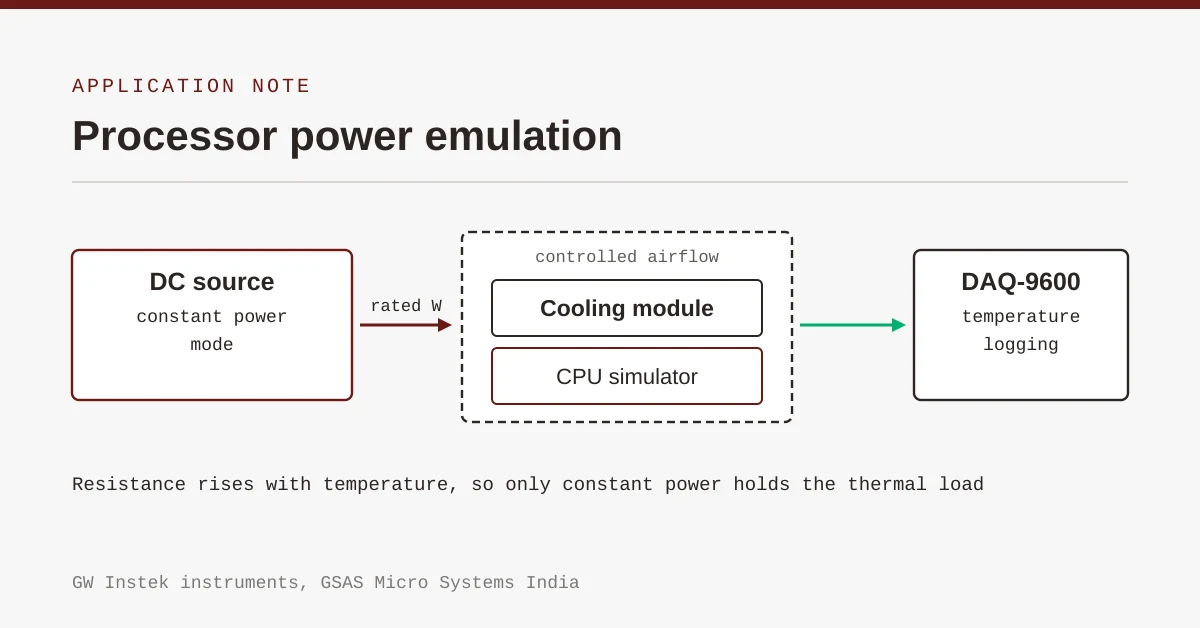
Emulating Processor Power for Thermal Testing: Why Constant Power
7 Oct · 7 min
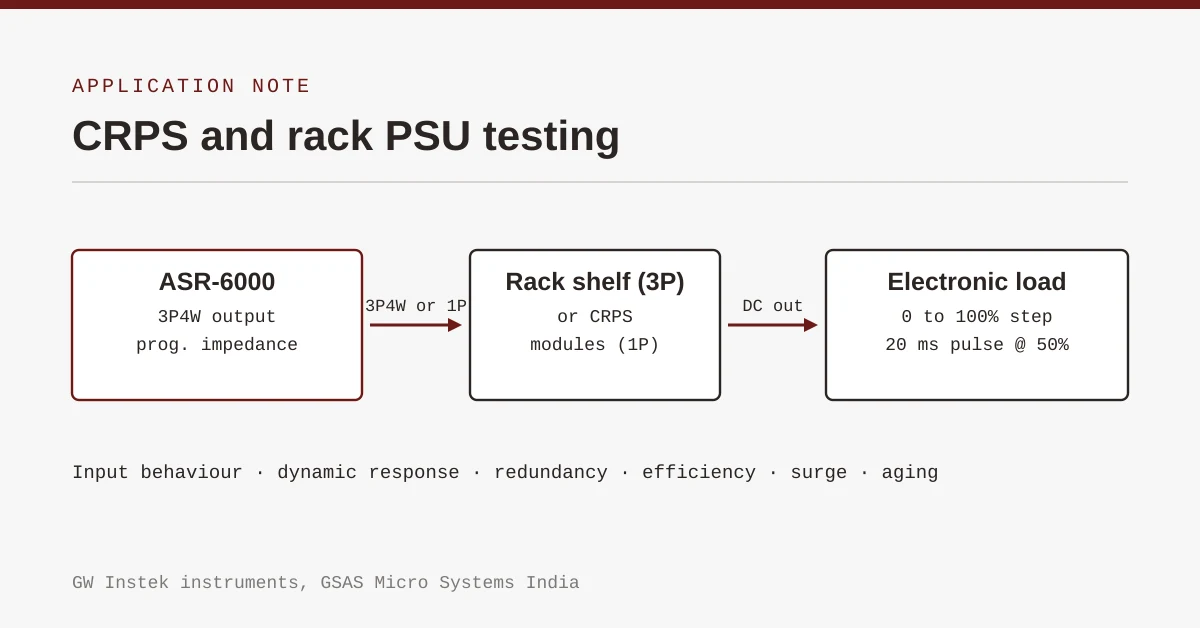
CRPS and Rack Power Supply Testing: The Six Tests That Matter
7 Oct · 7 min