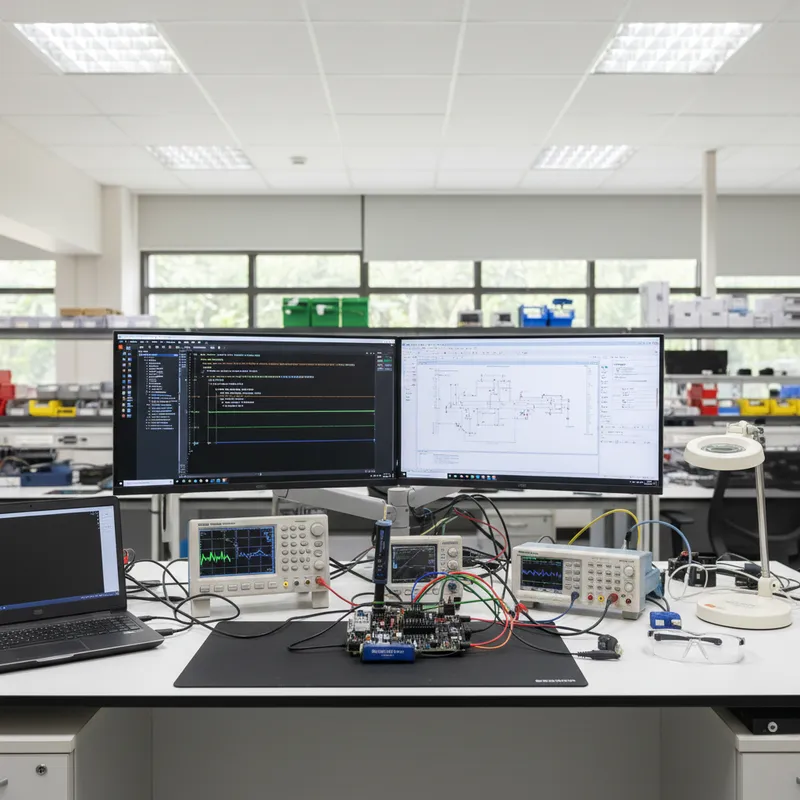
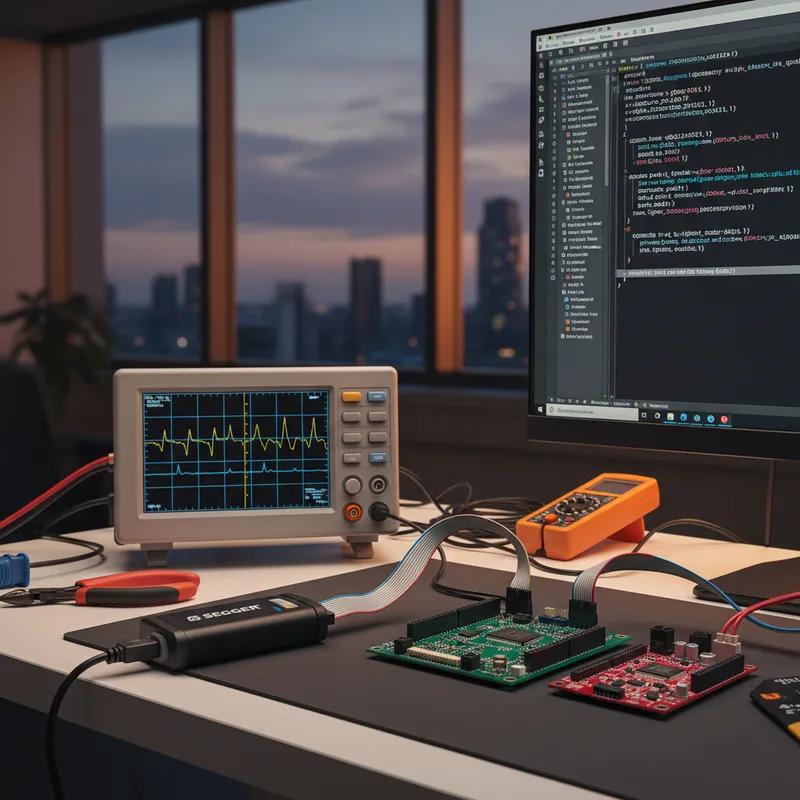
Pick any embedded team in India and you will find the same recurring argument on the bench: which debug probe do we standardise on? On one side sits the probe that came free in the box. On the other sits a probe somebody bought for a previous project. And in the middle sits a procurement question that nobody wants to own, because it touches engineering productivity, production programming, commercial licensing, and after-sales support all at once.
This post is the neutral decision matrix we wish every team had before that argument starts. It compares the four debug probes Indian embedded engineers actually evaluate, SEGGER J-Link, STMicroelectronics ST-Link, the open Arm CMSIS-DAP reference design, and the open-source Black Magic Probe, across the dimensions that decide real projects: device neutrality, toolchain support, flash-download speed, flash breakpoints, commercial-license clarity, and support in India.
We are an authorized engineering partner for SEGGER, so we have a point of view. But this is a fact-checked comparison, not a sales pitch: every J-Link claim below is verifiable on segger.com, and we are explicit about where ST-Link, CMSIS-DAP and Black Magic Probe are genuinely the right answer.
The four contenders, in one paragraph each
SEGGER J-Link is the de-facto industry-standard commercial debug probe. It is a vendor-neutral USB JTAG/SWD probe family that debugs Arm Cortex-M, Cortex-R, Cortex-A and RISC-V silicon from almost every MCU vendor, paired with a free, continuously updated J-Link Software and Documentation Pack. It is the only probe in this list that comes with a clear commercial-use license and a route from bench debug all the way to production programming.
STMicroelectronics ST-Link is the on-board debugger soldered onto every STM32 Nucleo and Discovery board, also sold as the stand-alone ST-LINK/V3. It is free, always present on STM32 hardware, and excellent for getting an STM32 project off the ground. Its scope, by design, is STM32 and a handful of related STM8/SPC5 parts.
Arm CMSIS-DAP is not a product, it is an open Arm reference firmware specification that turns a small microcontroller into a USB debug interface. DAPLink (the Arm Mbed implementation) and countless vendor on-board debuggers are CMSIS-DAP devices. It is free, open, and works across many Arm Cortex-M boards through standard tooling, but it is a baseline interface, not a performance probe.
Black Magic Probe is an open-source, open-hardware debug probe that runs a GDB server on the probe itself, so you connect GDB directly over USB with no separate gdbserver process. It is beloved by open-source and hobbyist Arm Cortex-M developers and is genuinely clever, but it is a community project with community-grade support and scope.
The decision matrix at a glance
| Dimension | SEGGER J-Link | ST-Link | CMSIS-DAP / DAPLink | Black Magic Probe |
|---|---|---|---|---|
| Device neutrality | Vendor-neutral; tens of thousands of supported devices across Arm Cortex-A/R/M and RV32 RISC-V | STM32 / STM8 ecosystem | Many Arm Cortex-M boards (baseline SWD/JTAG) | Arm Cortex-M (and some Cortex-A/R) |
| Toolchain support | Keil MDK, IAR EWARM, Embedded Studio, VS Code, Eclipse, GDB Server, and more | STM32CubeIDE, Keil/IAR via plugins, OpenOCD | Most IDEs via CMSIS-DAP / OpenOCD / pyOCD | GDB direct (built-in GDB server) |
| Flash-download speed | Up to ~244 KB/s on STM32F417 via J-Link Commander; up to ~1 MB/s QSPI in published tests | Lower; community benchmarks place it well below J-Link | Baseline | Baseline |
| Unlimited Flash Breakpoints | Yes (J-Link PLUS / Ultra / PRO; BASE via upgrade) | No, limited to core hardware breakpoints | No | No |
| SEGGER RTT / Ozone / SystemView | Yes (native) | No | No | No |
| Commercial-use license clarity | Clear: software pack free for standard commercial use | STM32-targeted; check ST terms | Open (per implementation) | Open source |
| Support & invoicing in India | GSAS, INR invoicing, GST, local support | Vendor / channel | Community | Community |
Now let us walk through each dimension, because the matrix hides the nuance that actually decides purchases.
Device neutrality: do you want a probe locked to one silicon vendor?
This is the dimension that quietly decides the most projects. ST-Link is brilliant as long as you stay inside STMicroelectronics silicon. The moment your roadmap adds an NXP i.MX RT crossover MCU, a Nordic nRF for BLE, a Renesas RA, an Espressif part, or a RISC-V core, an ST-Link is no longer your debugger.
J-Link is vendor-neutral by design. SEGGER states that “any microcontroller, MPU or SoC with a supported CPU core with its debug interface accessible is supported and can be fully controlled by J-Link,” and publishes a live count of supported devices, tens of thousands of devices at the time of writing. That spans the full Arm Cortex-M line through Cortex-M85, Cortex-R, Cortex-A, and, importantly for Indian teams tracking the RISC-V ecosystem, virtually any RV32 RISC-V core per SEGGER’s RISC-V support page.
CMSIS-DAP is more neutral than ST-Link because it is an Arm-defined interface, but neutrality here means “works at a baseline level across many Arm Cortex-M parts,” not “comes with a curated, tested flash loader for tens of thousands of devices.” Black Magic Probe focuses on Arm Cortex-M (with some Cortex-A/R), and its device coverage is whatever the community has implemented and tested.
Verdict on device neutrality: if your product line is, and will always be, pure STM32, ST-Link is fine. If your roadmap is multi-vendor or includes RISC-V, J-Link is the only probe here that does not box you in.
Toolchain support: will it work with the IDE your team already uses?
A probe that does not integrate with your IDE is a probe that creates friction every single day. SEGGER documents supported IDEs including Keil MDK, IAR Embedded Workbench for Arm, SEGGER Embedded Studio, Visual Studio Code (via the Cortex-Debug extension), Eclipse with the GNU Arm plugins, and a J-Link GDB Server for everything that speaks GDB. If your team builds with Keil MDK or migrates onto Embedded Studio, J-Link is first-class.
ST-Link is the native debugger inside STM32CubeIDE and integrates with Keil and IAR through ST’s plugins; it is also supported by OpenOCD. CMSIS-DAP devices work across most IDEs that speak CMSIS-DAP, OpenOCD or pyOCD, that breadth is the whole point of the standard. Black Magic Probe takes a different, elegant route: because the GDB server runs on the probe, you point arm-none-eabi-gdb straight at the probe’s USB serial device, no OpenOCD, no J-Link GDB Server, no separate process. For a pure command-line GDB workflow that is a genuinely nice experience.
Verdict on toolchain support: all four cover the common Arm Cortex-M IDEs at a basic level. J-Link’s advantage is breadth plus the deep, tested integrations with the commercial toolchains (Keil MDK, IAR, Embedded Studio) that Indian product teams actually ship on.
Flash-download speed: how long does your team wait per flash cycle?
Speed sounds like a vanity metric until you multiply it by the number of flash cycles a team runs per day, then by the number of engineers, then by a year. SEGGER publishes a flash-download speed test on an STM32F417IG (512 KB program): J-Link Commander programs at 244 KB/s, completing in 2.1 seconds, and the same J-Link via IAR EWARM or Keil µVision runs at 165 KB/s (3.1 seconds). The same page shows internal-flash throughput up to 988 KB/s on a Cypress part and QSPI NOR throughput up to 1086 KB/s on an NXP MIMXRT595 with Macronix flash.
SEGGER’s published comparison places J-Link as the fastest probe in that test against I-jet, ST-Link V2 and ULINKpro. We deliberately do not quote a single “ST-Link is X% slower” multiplier here, because that figure varies by part, interface speed and software, but the direction is consistent across SEGGER’s tests and community benchmarks: ST-Link, CMSIS-DAP and Black Magic Probe sit well below J-Link on flash-download throughput. For a CI rack flashing hundreds of images a day, that gap compounds into real wall-clock time.
Verdict on flash speed: for occasional flashing on a single bench, any of the four is fine. For high-cycle development or CI/production flashing, J-Link’s flash-download technology is the published leader.
Unlimited Flash Breakpoints: the feature you only miss when it is gone
This is where the probes separate hard. A standard debugger can only set as many breakpoints as the Cortex-M core has hardware breakpoint units, SEGGER notes the typical limit is around 4 to 6 on Cortex-M. The ninth breakpoint you want during integration simply cannot be set, and you start removing older breakpoints by hand.
SEGGER’s Unlimited Flash Breakpoints feature removes that ceiling: the J-Link software reprograms a flash sector to set or clear a breakpoint, so you can set an unlimited number of breakpoints in internal flash, external CFI-compliant flash, and memory-mapped QSPI flash. SEGGER calls this “almost essential” for debugging code executing from external memory, where hardware breakpoints cannot be set at all. The feature is included on J-Link PLUS, Ultra and PRO; the entry-level J-Link BASE can reach it through a paid upgrade license.
ST-Link, CMSIS-DAP and Black Magic Probe do not offer this, you are bound by the core’s hardware breakpoint count. Likewise, SEGGER’s RTT (Real-Time Transfer), the Ozone performance debugger, and SystemView RTOS visualisation all require a J-Link and have no equivalent on the other three probes.
Verdict on breakpoints and trace: if you do serious integration debugging, especially executing from external/QSPI flash, Unlimited Flash Breakpoints plus RTT/Ozone/SystemView is the single biggest reason teams standardise on J-Link.
Commercial-license clarity: are you allowed to ship product with this probe?
This is the dimension procurement and legal care about, and it is where two of the four options need a warning label.
SEGGER’s licensing page is refreshingly clear: every J-Link includes the J-Link Software and Documentation Pack free for standard use, and the J-Link DLL interface is included. Advanced features such as Unlimited Flash Breakpoints or the J-Flash production tool need an additional license, which either comes bundled with higher-end models (PLUS, Ultra, PRO) or is purchased separately. A commercial firmware team can buy a J-Link PLUS or PRO and ship product with a clean, documented license.
The trap to avoid: SEGGER’s J-Link EDU and EDU Mini are deliberately low-cost probes licensed for non-commercial educational use only. SEGGER’s product terms state the EDU Mini “may only be used for non-profit educational purposes” and “may not be used directly or indirectly in or for a profit organization or business purposes,” including “developing, debugging, programming or manufacturing a commercial product.” If you are building a product, the EDU line is not a legal shortcut, buy a commercial J-Link.
ST-Link’s terms are tied to STMicroelectronics’ licensing and are STM32-oriented; if you intend to use it outside STM32 development, check ST’s conditions. CMSIS-DAP and Black Magic Probe are open and free, which is excellent, but “open and free” also means there is no commercial entity standing behind your toolchain when an audit, a security review, or a customer asks who supports your production debug infrastructure.
Verdict on licensing: J-Link offers the clearest commercial-use story of the four. Whatever you choose, never base a commercial product on an EDU-licensed probe or a community project you cannot get support for.
Support in India: who picks up the phone when the bench is down?
A debug probe is only as good as the support behind it the morning a production line is stalled. CMSIS-DAP and Black Magic Probe are community-supported, superb for learning and open-source work, but there is no SLA, no invoice in INR, and no escalation path when a delivery is on the line.
As an authorized SEGGER engineering partner, GSAS Micro Systems supplies the entire commercial J-Link family, J-Link BASE, BASE Compact, PLUS, Ultra, PRO, PRO PoE and WiFi, along with the J-Trace PRO streaming-trace probes and the Flasher production-programming line, with INR invoicing, GST documentation, and local engineering support.
So which one should your Indian team actually buy?
- Learning, hobby, or open-source Arm Cortex-M work: CMSIS-DAP/DAPLink or Black Magic Probe are perfectly good and free. ST-Link is great if you live on STM32.
- A pure-STM32 evaluation phase: the on-board ST-Link is already in the box, use it until you outgrow it.
- Any commercial firmware project, single-vendor or multi-vendor: standardise on a commercial J-Link. The device neutrality, flash speed, Unlimited Flash Breakpoints, RTT/Ozone/SystemView, and clean commercial license pay for themselves the first time you avoid an afternoon of breakpoint juggling. Start with J-Link PLUS; choose J-Link PRO for Ethernet/remote debug and shared lab/CI use.
- Production programming: move to the Flasher line, none of ST-Link, CMSIS-DAP or Black Magic Probe target manufacturing.
FAQ
Is J-Link better than ST-Link?
For commercial development, J-Link offers capabilities ST-Link does not: vendor-neutral support for tens of thousands of devices, faster flash download, Unlimited Flash Breakpoints, and SEGGER RTT/Ozone/SystemView. ST-Link is excellent and free for STM32 evaluation, but it is scoped to STMicroelectronics silicon. Many Indian teams keep ST-Link for early STM32 bring-up and move to J-Link when the project goes commercial. See our ST-Link to J-Link PRO migration guide.
Can I use CMSIS-DAP or Black Magic Probe for a commercial product?
Technically yes, both are open and free, and CMSIS-DAP is an Arm-defined interface. The trade-offs are lower flash-download speed, no Unlimited Flash Breakpoints, no SEGGER RTT/Ozone/SystemView, and community-grade support with no SLA or local invoicing. For a shipping product where bench downtime costs money, most teams want a commercially supported probe.
Does J-Link work with VS Code, Keil, and IAR?
Yes. SEGGER documents J-Link support for Keil MDK, IAR Embedded Workbench for Arm, SEGGER Embedded Studio, Visual Studio Code (Cortex-Debug extension), Eclipse with GNU Arm plugins, and a J-Link GDB Server for any GDB-based workflow.
What are Unlimited Flash Breakpoints and which J-Link has them?
Unlimited Flash Breakpoints let you set an unlimited number of breakpoints when code runs from flash, internal flash, external CFI flash, or memory-mapped QSPI, by having J-Link reprogram a flash sector. The feature is included on J-Link PLUS, Ultra and PRO; J-Link BASE can add it via a paid upgrade license.
Can I use a J-Link EDU Mini for my company’s product?
No. SEGGER licenses the J-Link EDU and EDU Mini for non-commercial educational use only. They may not be used to develop, debug, program or manufacture a commercial product. For commercial work, buy a commercial J-Link such as PLUS or PRO.
How do I buy a J-Link in India with INR invoicing and GST?
GSAS Micro Systems is an authorized SEGGER engineering partner in India. Request a quote for any J-Link, J-Trace or Flasher model with INR invoicing, GST documentation and local engineering support.
Buy the right debug probe in India with GSAS
The honest answer to “which debugger should we buy” depends on where you are in the lifecycle, and a good engineering partner tells you when the free probe in the box is the right call, not just when it is not. When your project crosses from evaluation into a shipping commercial product, the case for a commercial SEGGER J-Link becomes hard to argue against: vendor neutrality, the fastest published flash download, Unlimited Flash Breakpoints, RTT, Ozone, SystemView, and a clean commercial license.
As an authorized SEGGER engineering partner, GSAS Micro Systems supports embedded and product teams across Bengaluru, Hyderabad, Chennai, Pune, Mumbai and Delhi NCR: and beyond, with the full J-Link, J-Trace and Flasher line, INR invoicing, GST documentation, and local engineering help choosing the right probe for your toolchain. Request a quote or explore the complete SEGGER partner page to get started.
Also appears in:
Interested in SEGGER tools?
Talk to our application engineers for personalized tool recommendations.
More from SEGGER
View all →
Meet the GSAS Team at electronica India 2026, Stall H3.I45
15 Sept · 3 min
J-Link Is Now Validated by ST for StellarStudio
13 Sept · 2 min
An AI Agent That Drives the Debugger: SEGGER and Embedder Connect J-Link to the Loop
13 Sept · 6 min
SEGGER J-Link and J-Trace Now Support Andes Trace: Why This Matters for RISC-V
21 Jul · 6 min
Emulating Processor Power for Thermal Testing: Why Constant Power
7 Oct · 7 min
CRPS and Rack Power Supply Testing: The Six Tests That Matter
7 Oct · 7 min