India’s RISC-V story is no longer a research-paper story. IIT Madras has been shipping Shakti cores to Indian fabless teams for several years, C-DAC’s VEGA programme is on its second generation of parts with commercial-customer uptake, and a growing cohort of Indian product teams are choosing globally-available RISC-V silicon, SiFive, Andes, Nuclei, WCH, GigaDevice, Espressif, instead of the Arm Cortex-M default because of supply-chain diversification, licensing economics, and an openness to the RISC-V ecosystem that the last two years have made strategically attractive. Indian engineering managers making those choices eventually ask the same question: “which debug and trace toolchain actually supports the RISC-V part I picked?” SEGGER Microcontroller GmbH has a credible answer across most of the portfolio, and this post is the honest map. Indian teams picking up the tools can start at the SEGGER partner page for commercial licensing, INR invoicing, and local engineering support.
One important caveat up front, repeated throughout this post because RISC-V silicon moves faster than any tooling vendor can keep up with: always confirm support status against SEGGER’s current device database for your specific part number before purchasing. Chinese RISC-V vendors in particular introduce new derivatives on a monthly cadence, Indian academic cores land on new test chips with each foundry run, and the gap between “announced silicon” and “verified debug coverage” is a real commercial risk. What is in the SEGGER device database on the day you buy the probe is ground truth. Anything else, including this post, is directional.
Why Indian RISC-V teams need a real debug and trace toolchain
The instinct of some RISC-V teams, particularly academic teams working on freshly-taped-out silicon, is to rely on the open-source toolchain: OpenOCD, GDB, and whatever target-description files the silicon vendor ships. This works for bring-up. It stops working once the team needs to do any of the following at scale:
- Instruction trace on production firmware to diagnose intermittent control-flow bugs, watchdog resets, or hard faults that are not reproducible in a breakpoint-driven debug session.
- Real-time task-level profiling on an RTOS-based product to understand scheduling behaviour, priority inversions, and interrupt latency under real workloads.
- Production programming of a standalone programmer into silicon at EMS lines in Chennai or Noida where the operator does not have a host PC and cannot run OpenOCD scripts.
- Per-unit silicon personalisation: injecting unique keys or serial numbers into secure-element fuses during programming, with per-unit audit records.
- Formal trace evidence for safety certification: IEC 62304, ISO 26262, IEC 61508, where the tool chain’s validation status matters to the auditor and “we used OpenOCD” does not clear the review.
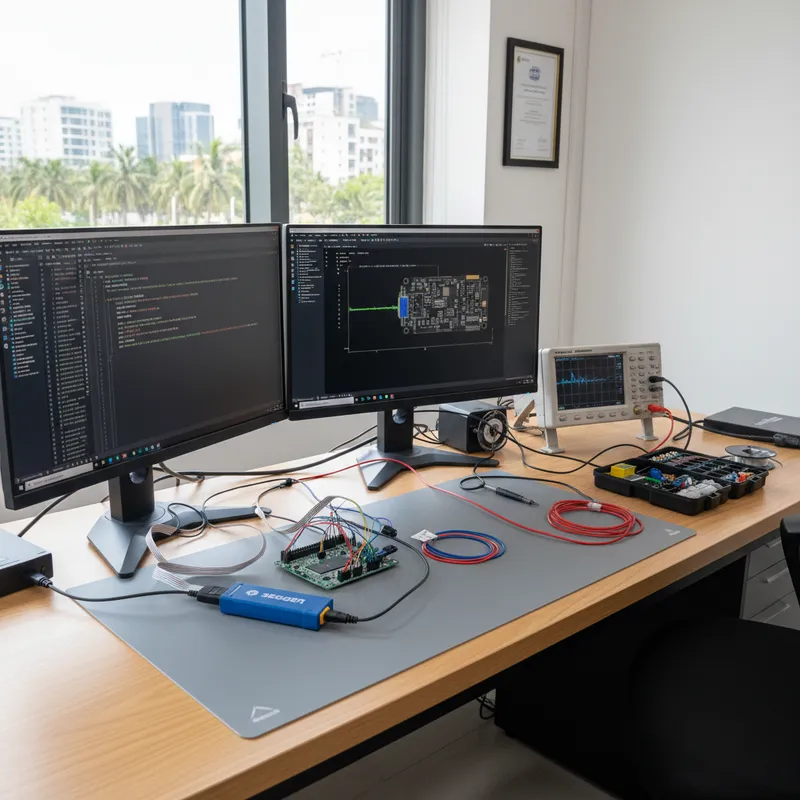
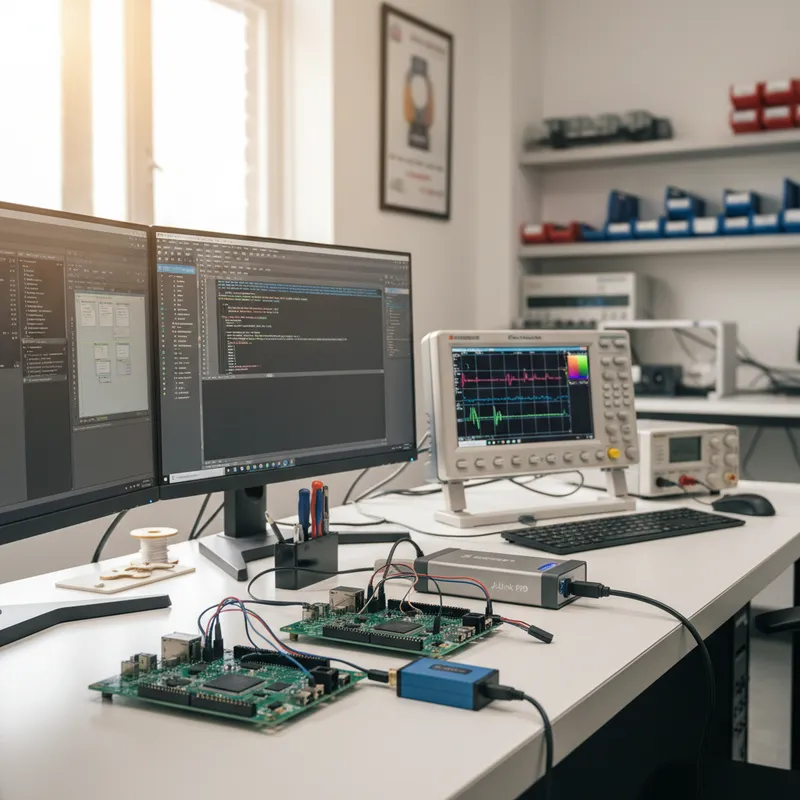
Each of these is where a commercial SEGGER stack earns its place in the Indian RISC-V team’s tool budget. The J-Link family handles debug programming and RTT; J-Trace PRO RISC-V handles hardware instruction trace; Ozone handles the debugger UX with RISC-V register, memory, and trace views; Embedded Studio handles the IDE for teams migrating off GDB-in-Eclipse; and SystemView handles the RTOS-level observability story on both RISC-V and Arm targets from the same workstation.
J-Link for Indian RISC-V: the generalist debug path
The J-Link family supports RISC-V as a first-class target. For most Indian RISC-V teams, the starting point is a J-Link PLUS or J-Link ULTRA paired with a RISC-V evaluation board, connected over the standard 10-pin or 20-pin RISC-V debug header. J-Link drives the target over the RISC-V Debug Module interface (the successor to the old “legacy” debug spec, now standardised), handles reset, flash programming, breakpoints (including unlimited flash breakpoints on supported parts), and RTT for logging. On the hardware side, J-Link PLUS and PLUS Compact give up to 1 MB/s download over USB 2.0 Hi-Speed; J-Link ULTRA pushes up to 4 MB/s and adds high-speed RTT; J-Link PRO adds Ethernet and optical isolation for lab-to-target isolation on bench rigs where ground loops would otherwise make debug unreliable.
For Indian academic teams working on Shakti-family silicon out of IIT Madras, the E-Class microcontroller-profile cores and the C-Class application-profile cores, among other derivatives from the programme, the general path is: connect a J-Link over the board’s debug header, start with RISC-V generic target support for bring-up, and then move to device-specific support once the part lands in the SEGGER device database. The same general path applies to C-DAC’s VEGA programme: the VEGA ET1031 and AS1061 derivatives, along with newer parts from subsequent tape-outs, are academic-origin parts that Indian fabless teams increasingly use as evaluation platforms for domestic design capability. Confirm device-specific support against the SEGGER device database for your exact part number before committing: the fast way to do this is to ask GSAS engineers to query the latest database, which we do as a pre-sales check on every Indian RISC-V quote.
For commercial Indian RISC-V design programmes, fabless product teams in Bengaluru, Hyderabad, and Noida building domestic RISC-V application processors, IoT SoCs, and specialty accelerators, the typical J-Link coverage story improves materially once the silicon ships to external customers, because the silicon vendor and SEGGER work together on device-specific support as part of commercialisation. Ask the silicon vendor for their SEGGER support status. They will usually have a published answer.
Globally-available RISC-V that Indian teams actually ship
A realistic Indian RISC-V tool budget has to support not just domestic silicon but the globally-available RISC-V that Indian product teams increasingly choose:
- SiFive E-Series and U-Series. SiFive’s E-Series microcontroller cores and U-Series application cores land in both discrete MCUs and licensable cores across multiple silicon vendors. SEGGER debug support is well-established for SiFive reference platforms and for commercial SiFive-based silicon that has gone through the device-database enrolment process.
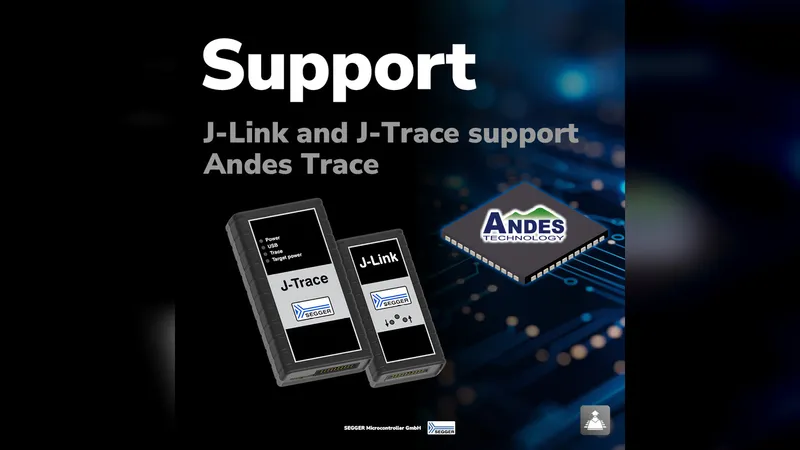
- Andes D25 and A25. Andes Technology’s 32-bit and 64-bit cores are widely licensed in Asia and show up in several Taiwanese and Chinese silicon vendors’ parts. Andes-based silicon has historically had solid SEGGER tooling coverage.
- Nuclei N-series. Nuclei System Technology’s N-series cores are the basis for several Chinese RISC-V MCU families. Coverage varies by silicon vendor, verify the exact part.
- WCH CH32V family. WCH’s low-cost RISC-V MCUs, CH32V003, CH32V203, CH32V307 and derivatives, have become a popular choice for Indian consumer-electronics and low-cost IoT teams. Our dedicated post on J-Link with GD32 and WCH CH32V in India covers the debug workflow in detail.
- GigaDevice GD32V. GigaDevice’s RISC-V variants of the GD32 family target the Chinese-supply-chain-replacement story that several Indian OEMs care about. The same dedicated post covers GD32V.
- Espressif ESP32-C, ESP32-H, and ESP32-P. Espressif has moved a significant portion of its Wi-Fi and Bluetooth SoC roadmap to RISC-V cores. ESP32-C3, ESP32-C6, ESP32-H2, and the newer ESP32-P variants are all RISC-V parts. Our J-Link + Espressif ESP32 debug post walks through the debug workflow Indian Wi-Fi product teams use.
The honest pattern across all of these: J-Link and Ozone support is available and mature for the most widely-shipped parts, but new derivatives appear faster than any commercial tooling vendor can certify them. The support story is dynamic, not static. Ask before you buy.
J-Trace PRO RISC-V: hardware instruction trace
Debug is necessary. Hardware instruction trace is what turns a RISC-V product team from “we can step through code and set breakpoints” into “we can reconstruct exactly what the processor did for the last few seconds before that crash without inserting a single printf.” The J-Trace PRO RISC-V probe adds hardware trace capture to the SEGGER RISC-V toolchain, capturing streaming instruction trace from targets with E-Trace-capable cores and feeding the captured trace into Ozone for visualisation.
The critical sentence for Indian RISC-V customers buying J-Trace PRO RISC-V: hardware trace coverage varies significantly by silicon vendor because it depends on the silicon’s actual E-Trace implementation. The RISC-V E-Trace specification is the industry standard, but silicon vendors implement it at different levels of completeness, and some do not implement it at all. What this means in practice:
- If your silicon ships with a documented E-Trace implementation, J-Trace PRO RISC-V is the right trace probe, and Ozone will reconstruct instruction flow.
- If your silicon ships without E-Trace (which is still the case for many low-cost RISC-V MCUs), hardware instruction trace is not available on that part regardless of probe, this is a silicon constraint, not a probe constraint.
- For Indian academic RISC-V parts from Shakti and VEGA programmes, the presence or absence of E-Trace is silicon-generation-dependent. Academic test chips often prioritise area and verification effort on the core rather than the trace unit. Later commercialised derivatives typically add it. Confirm against the SEGGER device database and the silicon vendor’s datasheet for your exact part before purchasing J-Trace PRO RISC-V.
The debug-only path (J-Link) is always available regardless of trace support. The trace path (J-Trace PRO RISC-V) is available when silicon cooperates.
Ozone on RISC-V: the debugger UX that does not feel like 1998
Ozone is SEGGER’s cross-platform graphical debugger. For Indian RISC-V teams coming off GDB-in-Eclipse, the move to Ozone is largely a quality-of-life upgrade: a properly designed RISC-V register view with named CSRs, a memory view that understands the memory map, a disassembly view that correctly decodes RISC-V instructions including vendor-specific extensions, and a Lua-scriptable action layer for automating repetitive debug sequences. Ozone integrates directly with J-Link (debug and RTT) and J-Trace PRO RISC-V (for trace) on RISC-V targets.
For Indian medical, automotive, and industrial teams working on safety-critical RISC-V builds, the Ozone + J-Link + J-Trace PRO RISC-V combination is the reference debug stack. The same stack is available across Arm Cortex-M and Cortex-A targets, so an Indian firmware team that supports both a RISC-V IoT edge node and an Arm Cortex-M7 automotive ECU uses the same tool, the same UX, and the same engineering workflow on both.
Embedded Studio on RISC-V and SystemView for RTOS visibility
Embedded Studio is SEGGER’s IDE. It supports RISC-V targets first-class, with project templates, RISC-V compiler integration (including the SEGGER Compiler where licensed), and debug through J-Link/Ozone. Indian teams moving off GCC-in-Eclipse toward a commercial IDE with a single-vendor support path choose Embedded Studio specifically to collapse “IDE, compiler, debugger, trace” into one vendor relationship.
SystemView runs on both RISC-V and Arm targets. The same RTT-based instrumentation layer works on either architecture. What you get is per-task execution timeline, interrupt profiling, RTOS API tracing, and the V4 release’s ELF-file-based instrumentation that eliminates the traditional ROM-tax of manual resource naming. Indian teams building RTOS-based RISC-V products, particularly those using FreeRTOS, Zephyr, or embOS on a RISC-V core, use SystemView to understand actual on-target scheduling behaviour and to produce trace evidence for certification submissions. Our SystemView V4 ELF integration post covers the new workflow in detail.
For RTOS work specifically, SEGGER’s own embOS is available for RISC-V targets (check the current embOS RISC-V port list for your specific core). Teams needing certified pre-emptive scheduling on a RISC-V platform have a commercial option.
Chinese RISC-V and the “confirm before you buy” rule
The single most important operational fact about RISC-V tooling in India: Chinese and Taiwanese RISC-V silicon vendors introduce new parts at a cadence no global tooling vendor matches on announcement day. WCH, GigaDevice, Espressif, and several others ship new derivatives on a quarterly or even monthly basis. A part announced in Shenzhen in January is in Indian engineers’ hands by March. The SEGGER device database catches up, but not instantly, and not on every part.
The practical Indian-team rule: before you buy the probe, before you commit the BOM, before you sign the EMS quote, ask GSAS engineers to run a live check against the SEGGER device database for your exact part number. We do this as a pre-sales step on every RISC-V quote, and we track the outstanding “announced but not yet in the database” parts with SEGGER’s product team so our customers do not get surprised at bring-up. This is cheap insurance against a multi-month schedule slip.
Further reading
- SEGGER RISC-V support overview, authoritative RISC-V coverage documentation
- SEGGER J-Trace PRO for RISC-V, hardware trace probe product page
- SEGGER J-Link with GD32 and WCH CH32V in India, companion post on Chinese RISC-V MCU debug
- SEGGER J-Link with Espressif ESP32 in India, ESP32-C/H/P debug workflow
- SEGGER SystemView V4 for Indian embedded teams, ELF-based instrumentation on RISC-V and Arm
- SEGGER at GSAS, RISC-V products, pricing, and engineering support
- Industrial automation solutions, where RISC-V lands in the Indian factory automation stack
GSAS Micro Systems is an authorized SEGGER engineering partner for India. We help Indian RISC-V teams, academic (IIT Madras Shakti programme, C-DAC VEGA programme), commercial (domestic silicon design houses), and product (teams choosing SiFive, Andes, Nuclei, WCH, GigaDevice, Espressif for shipping products), evaluate, procure, and deploy the right SEGGER debug and trace stack. Every RISC-V quote we issue includes a pre-sales device-database verification for your exact silicon part numbers, so you do not discover a tooling gap at bring-up. Our engineers visit customer sites across Bengaluru, Chennai, Hyderabad, Delhi NCR, Mumbai, and Pune for evaluation, bring-up, RTOS enablement, and trace workflow training on RISC-V and Arm targets alike.
Interested in SEGGER tools?
Talk to our application engineers for personalized tool recommendations.
More from SEGGER
View all →
Meet the GSAS Team at electronica India 2026, Stall H3.I45
15 Sept · 3 min
J-Link Is Now Validated by ST for StellarStudio
13 Sept · 2 min
An AI Agent That Drives the Debugger: SEGGER and Embedder Connect J-Link to the Loop
13 Sept · 6 min
SEGGER J-Link and J-Trace Now Support Andes Trace: Why This Matters for RISC-V
21 Jul · 6 min
Emulating Processor Power for Thermal Testing: Why Constant Power
7 Oct · 7 min
CRPS and Rack Power Supply Testing: The Six Tests That Matter
7 Oct · 7 min