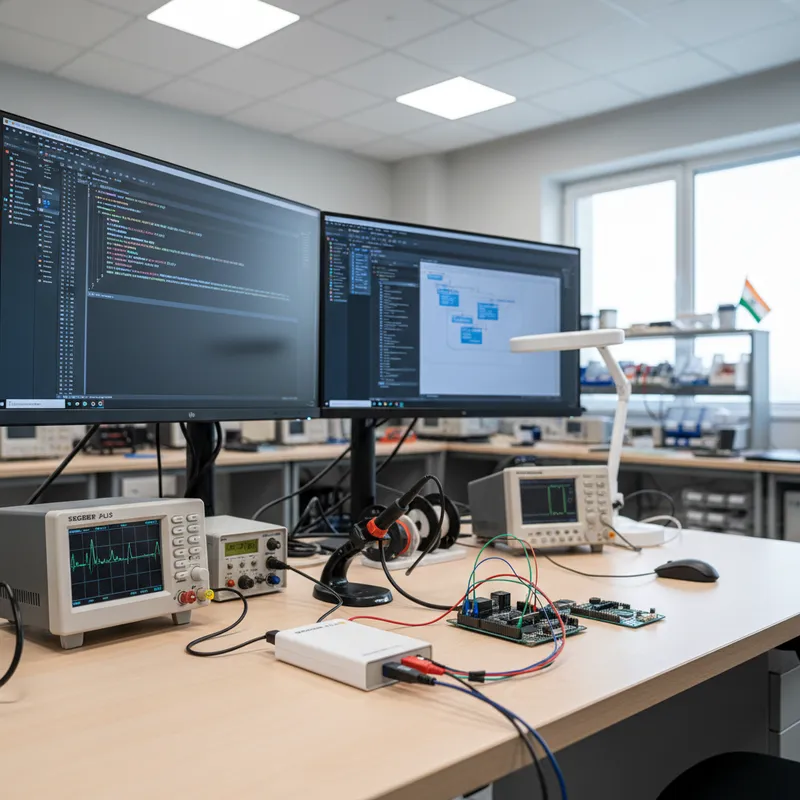
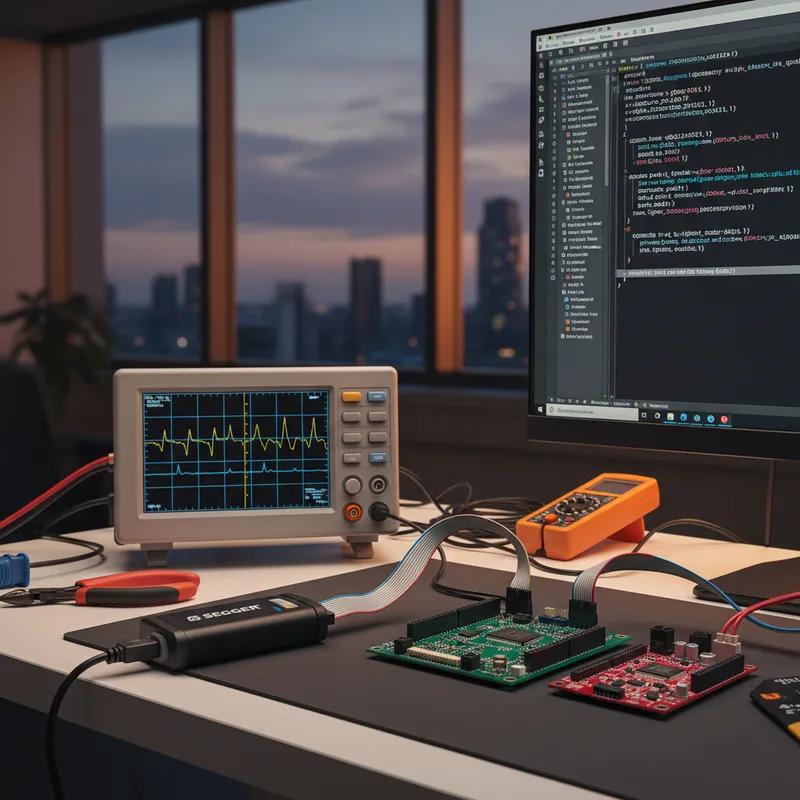
Chinese Cortex-M and RISC-V microcontrollers have quietly become a real factor in Indian commercial product engineering. The reasons are practical: cost pressure on consumer electronics, supply-chain diversification after the 2021-2022 STM32 crunch, the maker-to-commercial pipeline where Indian hobbyists who grew up on Arduino and RP2040 eventually need a low-BOM commercial-grade MCU, and the explicit sourcing of GD32 parts as an STM32 second source by Indian EV and solar inverter teams. GigaDevice GD32 and WCH CH32V are the two biggest names in this segment.
SEGGER J-Link supports the major parts in both of these families, both the Cortex-M variants and the RISC-V variants. This guide is for Indian teams building commercial products on GD32 or CH32V who want to understand what J-Link gives them that the vendors’ own low-cost debug dongles do not, which J-Link model to buy, and how to move from bench debug to production programming with Flasher. GSAS Micro Systems is an authorized SEGGER engineering partner in India, stocking every tool below locally with INR invoicing and engineering support.
Why GD32 and CH32V matter to Indian product teams
Three things are driving adoption in India:
- Cost pressure on consumer electronics: products targeting sub-Rs 5,000 retail price points have a ruthless BOM budget. GD32F103 at Chinese-market pricing, or CH32V003 at 10-cent class pricing, can swing the BOM in a way that STM32 cannot match.
- STM32 second-source sanity: the 2021-2022 STM32 allocation crunch taught Indian industrial product teams that single-sourcing the main MCU is a commercial risk. GD32’s pin-compatible STM32 alternatives (especially GD32F103 for STM32F103) are now written into second-source BOMs across Indian industrial automation, solar inverters, and EV charger control boards.
- Hobbyist-to-commercial pipeline: Indian makers who learned embedded on Arduino, RP2040, and ESP32 graduate to GD32 and CH32V when they start shipping their first commercial products. The low cost lets a small team get to market with a competitive BOM without needing large pre-orders of higher-ASP parts.
The engineering reality of these parts is that the silicon is mature enough for commercial use, but the vendor-provided debug tools are not in the same league as SEGGER, IAR, or Keil on the tooling side. This is the gap J-Link fills.
The GD32 and CH32V families in 2026
GigaDevice GD32:
- GD32F1 / F2 / F3 / F4: Cortex-M3 and Cortex-M4 general purpose MCUs, many variants pin-compatible with the equivalent STM32F1/F2/F3/F4 parts. This is where second-source BOMs live.
- GD32L2: Cortex-M23 low-power family for battery-operated designs.
- GD32E5: Cortex-M33 high-performance family with TrustZone. Used by Indian teams that want a more modern MCU architecture without moving to premium pricing.
- GD32V: RISC-V (RV32IMAC), Bumblebee core. The GD32VF103 was the first RISC-V MCU in real commercial volume outside China.
- GD32W5: Wi-Fi + Bluetooth wireless MCU (Cortex-M33 based).
WCH CH32:
- CH32V003: very low-cost RISC-V (QingKe core), 10-cent class. The classic hobbyist-to-commercial entry point.
- CH32V20x / CH32V30x: faster RISC-V parts with more peripherals and higher clock speeds.
- CH32F: Cortex-M variants.
- CH32X / CH32L: specialized variants (low-power, USB-only, etc.) that appear in specific Indian product categories.
Across both families, the cores split cleanly into Cortex-M (standard Arm debug) and RISC-V (standard RISC-V debug specification). SEGGER’s J-Link handles both paths.
SEGGER J-Link support for GD32 and WCH
J-Link support for GD32 and WCH evolves with each J-Link software release. Before committing a program, always consult the current SEGGER wiki and your licensed J-Link software version release notes to confirm support for your exact part number. The general picture:
- GD32 Cortex-M: J-Link treats these parts very similarly to their STM32 counterparts because the silicon is pin-compatible and the flash programming sequence is derivative of the STM32 flash controller. Most GD32F1/F2/F3/F4 parts are well supported. GD32L2, GD32E5, and newer parts are being added as they reach volume.
- GD32V (RISC-V): SEGGER added RISC-V debug support to J-Link some years ago, and GD32VF103 is one of the RISC-V parts with good coverage.
- WCH CH32 Cortex-M: supported via the standard Arm Cortex-M path.
- WCH CH32V RISC-V: supported via the J-Link RISC-V path, but exact silicon-support status varies by specific CH32V part number and by J-Link release. Do not assume every CH32V variant is in the device database from day one.
The hedge is important. Chinese silicon vendors introduce new parts at a pace that tooling vendors take time to match. Verify your specific part number against SEGGER’s current device database before writing J-Link into a project plan.
How to find the J-Link device name for your part
The question people actually arrive with is narrower than “is my part supported”: they want the exact
device name string to pass to J-Link, because that is what JLinkExe, J-Link Commander and the device
dropdown in an IDE ask for, and a near-miss simply fails to connect.
The authoritative list is SEGGER’s own supported devices catalogue for J-Link, which covered 15,332 devices when this page was last checked on 24 September 2026. Both GigaDevice and WCH appear there as vendors.
To resolve a part:
- Open the supported devices list and filter by vendor, GigaDevice for GD32 and GD32V, WCH for CH32 and CH32V.
- Find your part number in the list. The string shown there is the device name, and it is what you give
J-Link, either as
-device <name>on the command line or in your IDE’s device selection. - If the exact part is absent, check whether a close sibling in the same family is listed. GD32 Cortex-M parts are derivative of their STM32 counterparts, so a neighbouring device often connects, but treat that as a bench workaround rather than something to write into a production plan.
- Confirm against the release notes of the J-Link software version you are actually licensed for. The online catalogue reflects the current release, not the one installed on your bench.
We deliberately do not reproduce device-name strings here. The list changes with every J-Link software release, and a device name copied from a blog post is exactly the kind of detail that goes stale without anyone noticing.
Which J-Link model for GD32 and CH32V work
- J-Link BASE Compact: entry-level for low-volume GD32 or CH32V prototyping. Commercial license, smaller form factor.
- J-Link PLUS / PLUS Compact: the everyday choice for Indian teams shipping GD32-based commercial products. Unlimited flash breakpoints, up to 1 MB/s download speed, USB 2.0 Hi-Speed. Use this for serious GD32F4 or GD32E5 work.
- J-Link ULTRA: USB 2.0 Hi-Speed with download speeds up to 4 MB/s and high-speed RTT. Worth the upgrade when firmware is logging heavily over RTT, which is particularly useful on tight-RAM CH32V parts where you cannot afford to dedicate a UART to debug output.
- J-Link PRO: Ethernet interface, so the probe can sit on the lab network. When the target is in a powered lab rig (EV traction test benches, solar inverter rigs), pair the probe with the separate SEGGER J-Link Isolator; galvanic isolation is not built into the probe itself.
For Indian teams that already own J-Links for their STM32 work on other projects, there is nothing additional to buy for GD32 Cortex-M work, the same probe and the same driver handle both silicon families. This is the practical reason many Indian teams prefer J-Link over GD-Link or WCH’s own dongles: one probe, one driver stack, one Ozone install across every MCU on the bench.
Unlimited flash breakpoints: the core value on low-BOM projects
The single most visible gap between the vendor-provided debug dongles (GD-Link, WCH-Link) and J-Link is flash breakpoints. Low-cost vendor dongles typically limit you to the hardware breakpoint count of the core (two to six breakpoints on most Cortex-M and RISC-V parts). This becomes painful very quickly on any non-trivial project. J-Link patches the flash in software to implement unlimited flash breakpoints (a license included with J-Link PLUS and above, or via the BASE-to-PLUS upgrade), so the debug experience on a GD32F103 or CH32V307 looks the same as on an STM32F4 or a Nordic nRF52. For Indian teams trying to deliver commercial-grade firmware on low-BOM parts, this alone often justifies the probe.
RTT on tight-RAM RISC-V parts
CH32V003 ships with 2 KB of SRAM. That is not a typo. GD32VF103 has more RAM, but still not enough to spare a UART task and its buffers for debug logging. On parts this tight, the debug transport itself becomes a design constraint.
RTT is the answer. It uses a ring buffer in SRAM that the J-Link reads over the debug pins, no dedicated UART pins, no large driver, no interrupt overhead on the CPU. For an Indian team bringing up a CH32V003-based commercial gadget where every byte of RAM is contested, RTT is often the only debug output mechanism that actually fits. Read the RTT reference post and the Cortex-M hardfault debug with RTT guide for the broader workflow, the same principles apply to RISC-V parts.
Flasher for GD32 and CH32V production programming
GD32 production programming mirrors the STM32 workflow closely, and for Indian EMS teams already running Flasher ATE2 or Flasher Compact on STM32 lines, switching to GD32 is usually a device-database configuration change rather than a whole new programmer. WCH support on Flasher varies by part and by software release, confirm against SEGGER’s current device database before committing a production purchase order.
For Indian EV battery management and solar inverter teams building second-source BOMs, the operational story matters: the bench J-Link flash algorithm and the line Flasher flash algorithm come from the same SEGGER device database, so a GD32 firmware build validated on the engineering bench programs identically on the production line. This eliminates the “works on the bench, fails on the line” failure mode that plagues teams mixing vendor dongles and third-party production programmers.
Buy SEGGER J-Link and Flasher for GD32 and CH32V in India from GSAS
GSAS Micro Systems supplies the full SEGGER range for GigaDevice GD32 and WCH CH32V development and production in India. Whether you are a Pune EV traction team adding GD32F4 as an STM32 second source, a Hyderabad consumer electronics startup shipping CH32V003 at a commercial price point, or a Bengaluru industrial automation team standardizing on one debug probe across every MCU family on the bench, we will help you pick the right J-Link model and verify current SEGGER support status for your exact part numbers before you buy. Visit our partner page at /partners/segger or contact our engineering team for a demo at any of our Bengaluru, Chennai, Hyderabad, Delhi NCR, Mumbai, or Pune offices.
Further reading
- SEGGER J-Link supported devices list, authoritative catalogue; confirm your exact GD32 or WCH part number is in the current device database before speccing
- SEGGER Knowledge Base, J-Link, vendor-neutral wiki articles on J-Link configuration, script files, and target-specific setup
- SEGGER RTT, Real-Time Transfer technology overview, why RTT matters on RAM-constrained low-cost MCUs like CH32V003
- SEGGER Ozone, standalone debugger product page
- GigaDevice MCU product portfolio, silicon vendor reference for GD32 variant selection
- WCH CH32V RISC-V product page, silicon vendor reference for CH32V series
- GSAS partner page, SEGGER, full tool, probe, and middleware range available in India
- GSAS blog, buying the right J-Link for your project
- GSAS blog, SEGGER J-Link with STM32 in India, the STM32 workflow that GD32 teams replicate almost directly
- GSAS blog, Flasher ATE2 for Indian EMS production programming
Interested in SEGGER tools?
Talk to our application engineers for personalized tool recommendations.
More from SEGGER
View all →
Meet the GSAS Team at electronica India 2026, Stall H3.I45
15 Sept · 3 min
J-Link Is Now Validated by ST for StellarStudio
13 Sept · 2 min
An AI Agent That Drives the Debugger: SEGGER and Embedder Connect J-Link to the Loop
13 Sept · 6 min
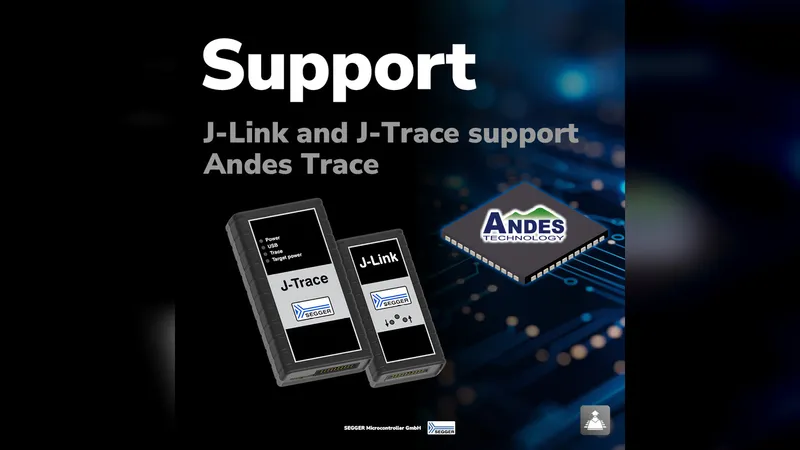
SEGGER J-Link and J-Trace Now Support Andes Trace: Why This Matters for RISC-V
21 Jul · 6 min
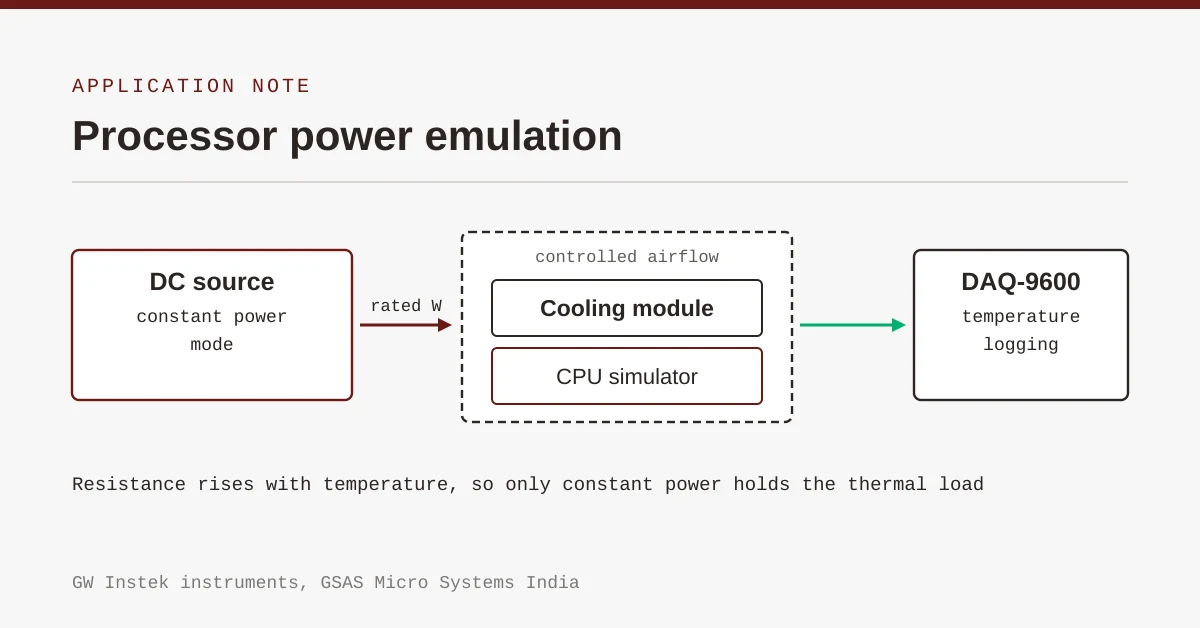
Emulating Processor Power for Thermal Testing: Why Constant Power
7 Oct · 7 min
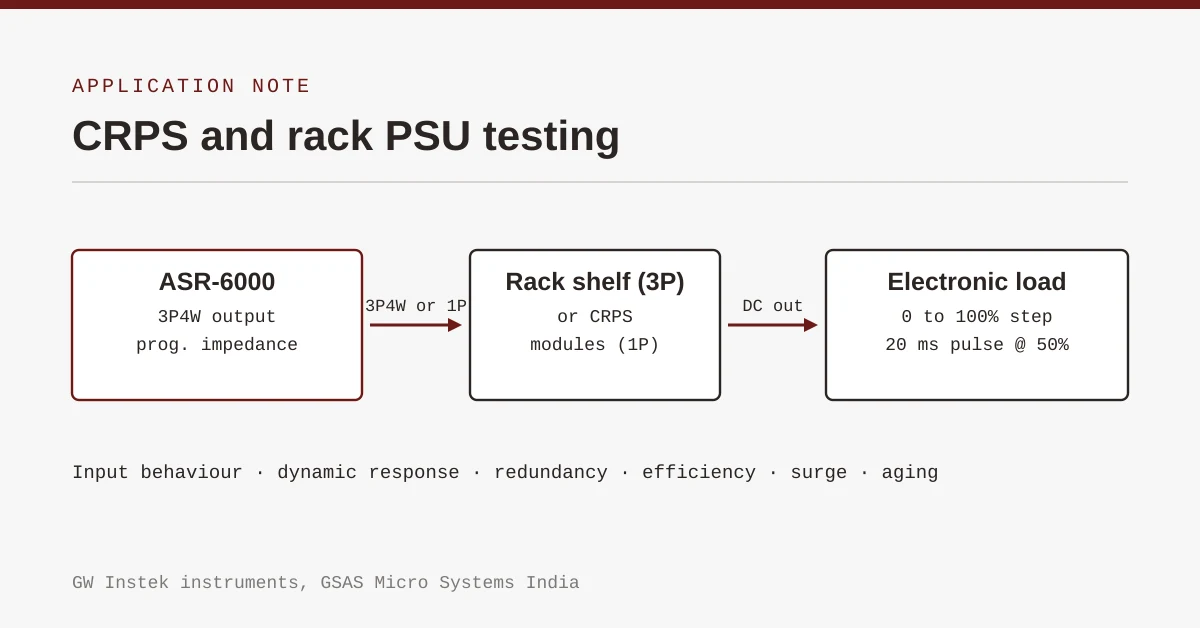
CRPS and Rack Power Supply Testing: The Six Tests That Matter
7 Oct · 7 min