An automotive microcontroller programme runs for years, and the debug probe it standardises on has to stay valid across every device revision that arrives in that time. That is the practical consequence of SEGGER’s announcement: J-Link is now validated by STMicroelectronics for StellarStudio, and the validation is continuous rather than a one-time certificate.
The announcement
On 8 September 2026, SEGGER announced that J-Link has been “fully validated by STMicroelectronics (ST) for use with StellarStudio, ST’s integrated development environment (IDE) for the Stellar family of automotive microcontrollers.”
Per SEGGER, J-Link provides “comprehensive support for all currently available Stellar devices”, and SEGGER says the Le Mans setup helps ensure that “future Stellar devices on ST’s roadmap receive timely, reliable J-Link support” through continued cooperation between the two companies. ST has placed J-Link probes into “its automated validation center in Le Mans, France”, so compatibility is checked continuously rather than certified once.
SEGGER lists the capabilities that matter during bring-up and test as “up to 4 MB of download speed into random-access memory (RAM)”, “fast download directly into flash memory at full speed”, and an “unlimited number of breakpoints in RAM or flash memory”.
Validated is a different word from compatible
Every automotive programme eventually has to show that each element of its toolchain is sanctioned by the silicon vendor, not just observed to work on one bench. That question gets asked at the toolchain review, again at the customer audit, and a third time when a new device revision arrives and somebody has to sign off that the debug setup still holds. A probe the silicon vendor has put into its own continuous validation process answers all three differently from a probe that happens to connect.
The continuous part is the one that matters on a multi-year programme. ST has placed J-Link into its automated validation centre in Le Mans, and per SEGGER the arrangement is meant to give “future Stellar devices on ST’s roadmap” J-Link support as they appear. In our experience the debug probe is the toolchain element most often re-qualified by accident, when a new device lands mid-programme and the team discovers the probe it standardised on has not caught up. This arrangement is designed to close that gap on the SEGGER side.
It is an IDE validating a debug probe. It is not tool qualification under ISO 26262, it is not a functional safety certification, and SEGGER does not claim either. If your assessor asks about tool confidence for the debug environment, that is a separate conversation, and our ISO 26262 page sets out how GSAS approaches it.
Getting J-Link onto a Stellar programme
GSAS Micro Systems is an authorized engineering partner for SEGGER in India and supplies and supports the J-Link and J-Trace families. For a Stellar programme the questions our field engineers work through with a team are practical ones: which probe in the range matches the trace the target exposes, how the probe sits alongside StellarStudio and any existing CI hardware-in-the-loop rig, and how to bring the validated setup into a toolchain that already has other tools on it without stopping work.
Teams in Bengaluru, Pune, Chennai, Hyderabad, Mumbai and Delhi NCR can ask an engineer a question or request a quote for the J-Link family.
Source: SEGGER, J-Link validated for ST StellarStudio, 8 September 2026
Also appears in:
Interested in SEGGER tools?
Talk to our application engineers for personalized tool recommendations.
More from SEGGER
View all →
Meet the GSAS Team at electronica India 2026, Stall H3.I45
15 Sept · 3 min
An AI Agent That Drives the Debugger: SEGGER and Embedder Connect J-Link to the Loop
13 Sept · 6 min
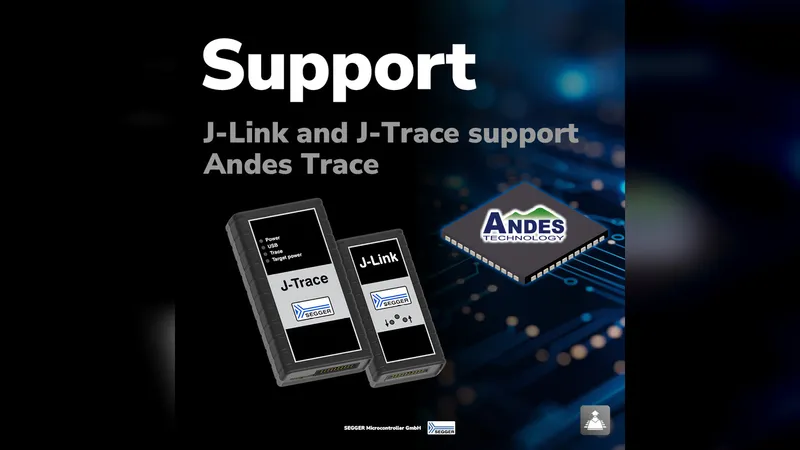
SEGGER J-Link and J-Trace Now Support Andes Trace: Why This Matters for RISC-V
21 Jul · 6 min
Choosing a SEGGER Flasher: Standalone vs Gang vs Secure vs Portable
17 Jul · 7 min
AI Inside the Engineering Process: What Is Worth Automating, and What Still Needs an Engineer
21 Sept · 11 min
What the Doddaballapur Facility Does, and Why That Matters to a German Engineering Team
21 Sept · 9 min