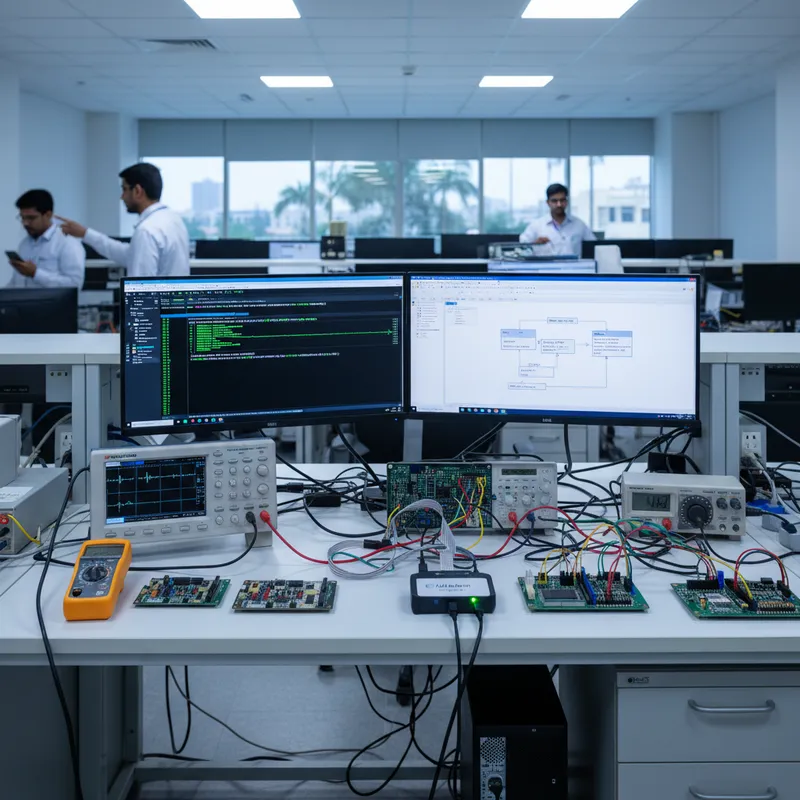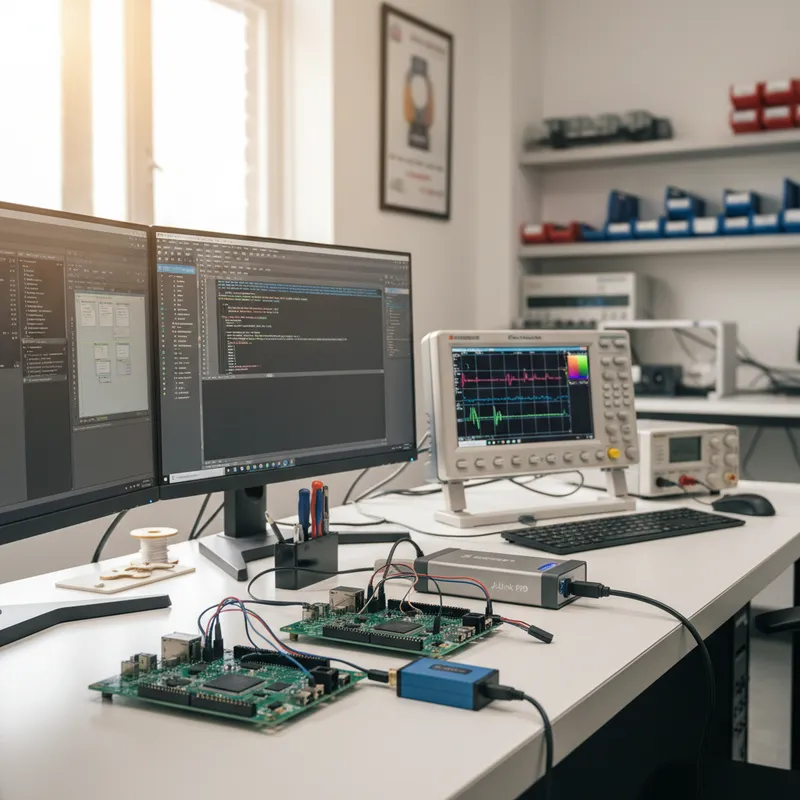
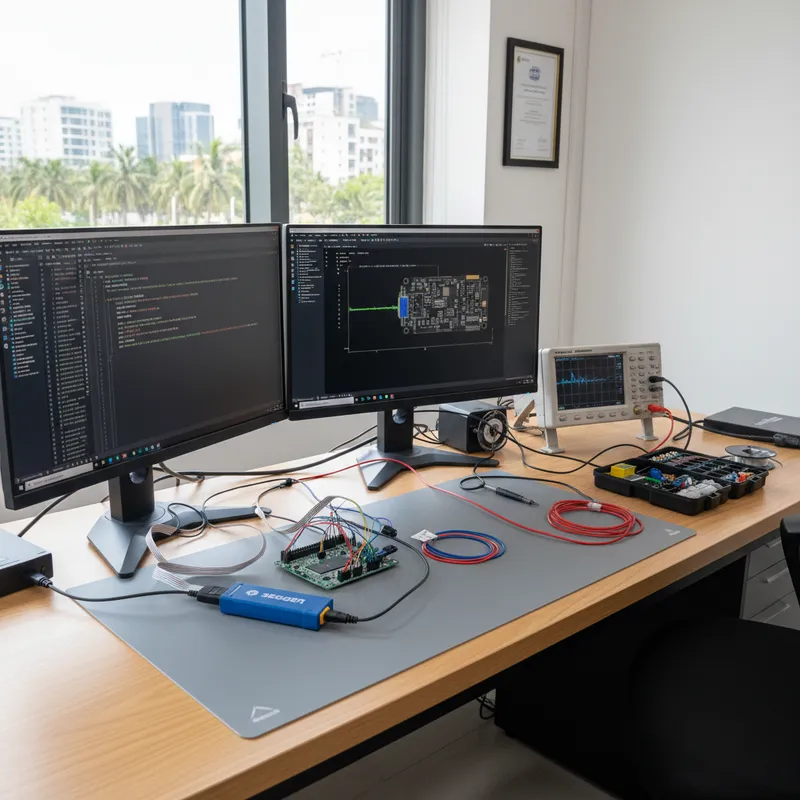
Infineon’s PSOC family is one of the quieter success stories inside Indian product engineering. You do not see PSOC on every magazine cover the way STM32 or Nordic nRF do, but open the enclosure of a capacitive-touch HMI on an Indian appliance, a Bluetooth Low Energy wearable designed out of Bengaluru, a battery-powered environmental sensor shipping into Indian smart-building projects, or a DSP-heavy audio product engineered in Hyderabad, and there is a very good chance a PSOC 4, PSOC 5LP, or PSOC 6 is doing the real work. Add the XMC1 and XMC4 general-purpose Cortex-M lines that Infineon inherited from the original Infineon MCU roadmap, and the combined footprint inside Indian consumer, industrial, and IoT products is substantial.
What catches Indian teams out is that PSOC’s reference tooling, ModusToolbox paired with the KitProg / MiniProg on-board debugger that ships on every Infineon eval kit, is perfectly fine for evaluation but not sufficient for serious commercial product debug. For that you need SEGGER J-Link: unlimited flash breakpoints (on J-Link PLUS and above), Real-Time Transfer (RTT), Ozone cross-platform debug, and a production programming path that scales from bench to Indian EMS lines. This guide walks Indian PSOC teams through exactly that upgrade.
GSAS Micro Systems is an authorized SEGGER engineering partner in India. Every J-Link, Flasher, and SEGGER software product mentioned below is available locally with INR invoicing and engineering support from our Bengaluru, Chennai, Hyderabad, Delhi NCR, Mumbai, and Pune offices.
The Infineon PSOC family on Arm Cortex-M
PSOC is an umbrella brand covering several distinct silicon lines, all of them built around Arm Cortex-M cores:
- PSOC 4: Cortex-M0+ based, extended with Infineon’s programmable analog and digital fabric. Widely used in Indian capacitive-touch HMI modules, low-cost consumer controls, and industrial I/O boards where the flexible fabric replaces discrete glue logic.
- PSOC 5LP: Cortex-M3 with a much richer analog subsystem (including high-resolution ADCs, comparators, and programmable gain amplifiers). Used by Indian instrumentation startups and industrial sensing products where analog front-end integration matters.
- PSOC 6: the flagship dual-core family: a Cortex-M4F (with FPU) paired with a Cortex-M0+, plus on-chip wireless options. PSOC 6 BLE adds an integrated Bluetooth 5 radio and is behind a meaningful slice of Indian-designed wearables, asset trackers, and connected consumer products.
- PSOC 64 Secure MCU: PSOC 6 with TrustZone-M and Infineon’s secure boot architecture for security-critical IoT products. The PSOC 64 Secure line is where Matter-style device attestation and Indian consumer-IoT compliance workflows intersect.
- XMC1 and XMC4: Infineon’s general-purpose Cortex-M0 and Cortex-M4 industrial MCUs. XMC4 is particularly common in Indian motor control and power-electronics designs thanks to its hardware PWM and on-chip math accelerator.
J-Link supports every one of these parts out of the SEGGER device database. You do not need a PSOC-specific probe; a single J-Link sits cleanly across PSOC 4 HMI work, PSOC 6 BLE wearable debug, PSOC 64 secure provisioning, and XMC4 motor control, which is exactly what Indian multi-product teams want.
PSOC Control C3 Performance Line: J-Link and Flasher support is live
On 1 October 2026 SEGGER announced that it has extended device support to Infineon’s PSOC Control C3 Performance Line, with both J-Link debug probes and Flasher in-circuit programmers covering the new parts. SEGGER’s words are that support is “already available”, so “developers can start working with the new Infineon devices right away”.
Read the scope precisely: the announcement names the Performance Line, and only the Performance Line. PSOC Control C3 is the umbrella family, and Infineon splits it into Entry, Main and Performance lines with different peripherals and different packages. SEGGER’s announcement does not say anything about the Entry or Main lines, in either direction, so do not read “PSOC Control C3 is supported” off this page. If the part you are evaluating is not a Performance Line device, check SEGGER’s device list for that specific part number, or ask us and we will check it.
Two further things are worth separating, because the naming invites confusion.
The branding changed, and more broadly than the new line. Infineon now writes the brand as all-capitals PSOC across its whole catalogue, not only for the new parts: its current product pages spell the established families PSOC 4, PSOC 5 LP and PSOC 6 too. The lowercase-o PSOC spelling used elsewhere on this page is the older Cypress-era styling that most existing documentation, including ours, still carries. Both refer to the same silicon. We use Infineon’s current spelling for PSOC Control C3 here; bringing the rest of the page and the wider site into line is a separate change, because the old spelling is still what most search traffic and most datasheets in circulation use.
The silicon is a different job. Per SEGGER’s announcement, the PSOC Control C3 Performance Line is “designed for high-performance real-time control in power conversion and motor control applications”, based on Arm Cortex-M33 and combining “high processing performance with precise analog and digital peripherals”. That description is SEGGER’s; we have not independently verified it against an Infineon datasheet. That is a distinct target from the PSOC 6 HMI and wearable work the rest of this page describes, and it puts the Performance Line in direct competition for the designs Indian teams currently build on XMC4.
For an Indian power-electronics or motor-control team, the practical consequence is that evaluating a Performance Line part costs you no toolchain change. The J-Link on the bench and the Flasher on the line both already speak to it, through the same device database described above and the same validated-once programming algorithm described in the production-programming section below. A device evaluation that would otherwise have waited on probe support can start now.
If you are weighing a PSOC Control C3 Performance Line part against XMC4 for a motor-control design, the engineering problem described in the XMC section below is the same one: high-frequency PWM and current-sense interrupt timing is where motor-control bugs hide. SEGGER’s announcement covers J-Link and Flasher only and says nothing about SystemView on these parts, so treat SystemView support as a question for us rather than something this page asserts.
Why Indian PSOC teams upgrade from KitProg / MiniProg
Every Infineon PSOC eval kit ships with an on-board KitProg (KitProg3 on recent kits) or a standalone MiniProg programmer. Both are functional debuggers that work with ModusToolbox and OpenOCD, and for bring-up on an eval kit they are fine. Three limits show up quickly once an Indian team moves from eval to real product:
- No unlimited flash breakpoints. Cortex-M parts have a small number of hardware breakpoints (typically 6 on PSOC 6). SEGGER J-Link provides unlimited flash breakpoints by rewriting instructions on the fly (the license is included with J-Link PLUS and above), which means a PSOC 6 firmware engineer can set 30 or 40 breakpoints across a large ModusToolbox codebase without having to keep deleting old ones. KitProg only exposes the hardware breakpoints.
- No RTT. Real-Time Transfer is the difference between printf-style logging that halts the CPU and genuine non-intrusive telemetry. On a PSOC 6 BLE wearable where the BLE stack is timing-critical, or on a PSOC audio product where the DSP loop cannot tolerate CPU stops, RTT is the only logging path that does not distort behaviour. KitProg has no RTT support.
- Not a production programming tool. KitProg is designed for eval kits, not factory lines. For Indian EMS programming, you need the SEGGER Flasher family, and it is far cleaner to build the bench and the line flows on the same SEGGER stack from day one.
For Indian PSOC teams the economics are straightforward, the time saved on the first difficult debug session (a PSOC 6 BLE connection that drops intermittently, or an XMC4 motor current controller that oscillates under load) more than pays for a J-Link PLUS.
Which J-Link model for PSOC work
SEGGER’s J-Link range covers the full span of PSOC project needs. For Indian teams, a useful rule of thumb:
- J-Link BASE Compact: the entry point. Fine for commercial PSOC 4 and PSOC 5LP work where the codebase is small and download speed is not critical. Full RTT support; note that the unlimited flash breakpoints license is not included at this tier, it comes with J-Link PLUS and above. See the J-Link BASE Compact product page.
- J-Link PLUS / PLUS Compact: the everyday workhorse for PSOC 6, PSOC 6 BLE, and XMC4 projects. Up to 1 MB/s download speed, USB 2.0 Hi-Speed, commercial licensing, unlimited flash breakpoints. This is what most Indian PSOC product teams end up on. See J-Link PLUS.
- J-Link ULTRA: USB 2.0 Hi-Speed with download speeds up to 4 MB/s and high-speed RTT. Worth the upgrade when the PSOC 6 application is streaming heavy RTT telemetry, for example, a PSOC 6 audio processor logging DSP filter state every frame, or an XMC4 motor controller streaming high-rate current-sense data during commissioning. See J-Link ULTRA.
- J-Link PRO: Ethernet interface, important for Indian CI/CD labs that flash PSOC boards from a build server over the network. For PSOC-based motor control benches running three-phase inverters, pair the probe with the separate SEGGER J-Link Isolator; galvanic isolation is not built into the probe itself. See J-Link PRO and the PoE variant.
- J-Trace PRO Cortex-M: add this when you need ETM instruction trace on PSOC 6’s Cortex-M4F. Useful for crash analysis on shipping firmware and for code-coverage work on safety-adjacent PSOC products. See J-Trace PRO Cortex-M.
For most Indian PSOC 6 product teams, J-Link PLUS is the sensible starting point, with an ULTRA on the senior engineer’s bench for heavy RTT or large-image work.
Dual-core PSOC 6 debug with J-Link and Ozone
PSOC 6 is a dual-core design: a Cortex-M4F handling the application layer and a Cortex-M0+ running the low-power protection subsystem and, in some configurations, the BLE stack. Both cores are first-class debug targets for SEGGER J-Link. With Ozone, SEGGER’s cross-platform debugger, an Indian PSOC 6 team can open two debug sessions on the same J-Link, one for the M4 application, one for the M0+, and step through them independently.
In practice this matters on two common Indian PSOC 6 workloads:
- PSOC 6 BLE wearables: the M0+ runs the BLE controller, the M4 runs the application and sensor fusion. When a connection drops, knowing whether the issue is in the BLE stack on M0+ or the application layer on M4 is the first question you want answered. Dual-session Ozone gives it to you directly.
- PSOC 6 audio / DSP products: the M4F runs the DSP pipeline, the M0+ handles housekeeping and peripheral control. Dual-session debug lets the audio engineer step through the filter code on M4 while the platform engineer verifies the M0+ peripheral control flow on the same J-Link.
Ozone opens PSOC 6 ELF files directly, no IDE required. This is a quiet but meaningful benefit for Indian consulting firms that do not want to carry a full ModusToolbox installation to every customer site.
RTT for PSOC audio, DSP, and BLE telemetry
RTT (Real-Time Transfer) is the SEGGER feature Indian PSOC teams end up relying on most. The common case is a PSOC 6 audio product where the DSP loop is running at the edge of its headroom and any CPU stop introduces an audible glitch. UART logging is out because the production board does not expose a spare UART. Semihosted printf is out because it halts the CPU. RTT uses the same SWD pins the debugger already owns, runs at high speed over J-Link ULTRA, and does not stop the core.
On PSOC 6 BLE work, RTT is how Indian wearable teams stream BLE connection-event traces and sensor data together during endurance testing. A Python script wrapping JLinkRTTClient pulls the log into a CSV that correlates with a sniffer capture, turning what used to be a multi-day root-cause exercise into a one-afternoon analysis.
For teams new to RTT on PSOC, the shared build pattern we recommend is to pull SEGGER’s SEGGER_RTT.c and SEGGER_RTT_Conf.h into the ModusToolbox project, route printf through SEGGER_RTT_printf, and open the RTT viewer in Ozone or in J-Link RTT Viewer on the host. Total setup time is under an hour. For the bigger picture on Cortex-M fault debugging with RTT, see our Cortex-M hard-fault debug with RTT guide.
SystemView on PSOC 6 for FreeRTOS, Zephyr, and Mbed OS
Indian PSOC 6 teams run a mix of RTOSes: FreeRTOS (still the default in ModusToolbox), Zephyr (increasingly common for Matter-class products), and occasional Mbed OS legacy projects. SEGGER SystemView ships ready-to-use adapters for all three. A single CMake or Makefile switch enables continuous ISR and task trace over RTT, with no extra probe hardware required.
For Indian PSOC 6 BLE teams this is typically where long-latency bugs get caught, a BLE stack callback taking longer than budgeted, a sensor ISR blocking a higher-priority task, or a mutex inversion that only shows up under load. SystemView makes the behaviour visible without instrumentation changes in production code. For more depth on the v4 workflow, see our SystemView v4 ELF integration guide.
XMC1 and XMC4 with J-Link
Infineon’s XMC1 (Cortex-M0) and XMC4 (Cortex-M4F) general-purpose MCUs sit alongside PSOC in the Infineon catalogue and are common in Indian motor control, power conversion, and industrial I/O designs. J-Link supports both lines through the same device database and the same SEGGER driver stack that handles PSOC. For Indian teams that mix XMC4 motor controllers with PSOC 6 HMI in the same product family, a single J-Link PLUS covers both sides of the board.
XMC4 motor control work benefits particularly from SystemView, the high-frequency PWM and current-sense interrupt timing is where most motor control bugs hide, and SystemView gives you a continuous view of their runtime behaviour.
Production programming PSOC with SEGGER Flasher
Moving from bench debug to Indian EMS production is where the SEGGER Flasher family comes in. Flasher supports PSOC 4, PSOC 5LP, PSOC 6, PSOC 64 Secure, and XMC across the same device database J-Link uses, so the programming algorithm validated on your engineering bench is bit-for-bit the same algorithm that runs on the production line. No line-versus-lab drift.
For Indian contract manufacturers producing PSOC-based products, the common configurations are:
- Flasher Compact / Flasher PRO: benchtop and low-volume line programming for PSOC 4, 5LP, 6, and XMC.
- Flasher ATE2: rack-mounted ATE integration for high-volume production, typically used by Indian EMS houses running automated test and programming on consumer IoT lines. See our Flasher ATE2 production programming guide for a full walkthrough.
- Flasher Hub-4 and Flasher Hub-12: gang programming for consumer PSOC 4 and PSOC 6 BLE volume production.
- Flasher Secure: the correct tool for PSOC 64 TrustZone parts. Flasher Secure handles encrypted firmware delivery to the line and controlled key provisioning so the production operator never sees cleartext firmware or unprotected keys. For the full secure-programming picture, see our Flasher Secure for Indian EMS guide.
For PSOC 64 secure products destined for Matter, consumer-IoT security, or Indian government-procurement channels, combining Flasher Secure with the PSOC 64 secure boot flow is the production path we recommend and support.
Buy SEGGER J-Link and Flasher for Infineon PSOC in India from GSAS
GSAS Micro Systems is an authorized SEGGER engineering partner in India for every SEGGER product mentioned in this guide. Whether you are a startup bringing up a PSOC 6 BLE wearable, an industrial automation team building XMC4 motor controllers, or an EMS planning Flasher ATE2 integration for a consumer IoT line, we will help you pick the right J-Link model, the right Flasher variant, and the right SEGGER software stack (Ozone, SystemView, RTT, Embedded Studio, embOS) for your project. Contact us for a hands-on demo at any of our Bengaluru, Chennai, Hyderabad, Delhi NCR, Mumbai, or Pune offices, or visit our SEGGER India partner page for the full portfolio.
Further reading
- SEGGER J-Link model selection guide for India
- SEGGER J-Link for STM32 complete guide
- SEGGER J-Link for Nordic nRF52 BLE development
- SEGGER SystemView v4 ELF integration
- Cortex-M hard-fault debug with RTT
- Flasher Secure for encrypted firmware on Indian EMS lines
- embOS tickless mode for battery IoT in India
- SEGGER J-Link official product page: segger.com/products/debug-probes/j-link
Interested in SEGGER tools?
Talk to our application engineers for personalized tool recommendations.
More from SEGGER
View all →
Meet the GSAS Team at electronica India 2026, Stall H3.I45
15 Sept · 3 min
J-Link Is Now Validated by ST for StellarStudio
13 Sept · 2 min
An AI Agent That Drives the Debugger: SEGGER and Embedder Connect J-Link to the Loop
13 Sept · 6 min
SEGGER J-Link and J-Trace Now Support Andes Trace: Why This Matters for RISC-V
21 Jul · 6 min
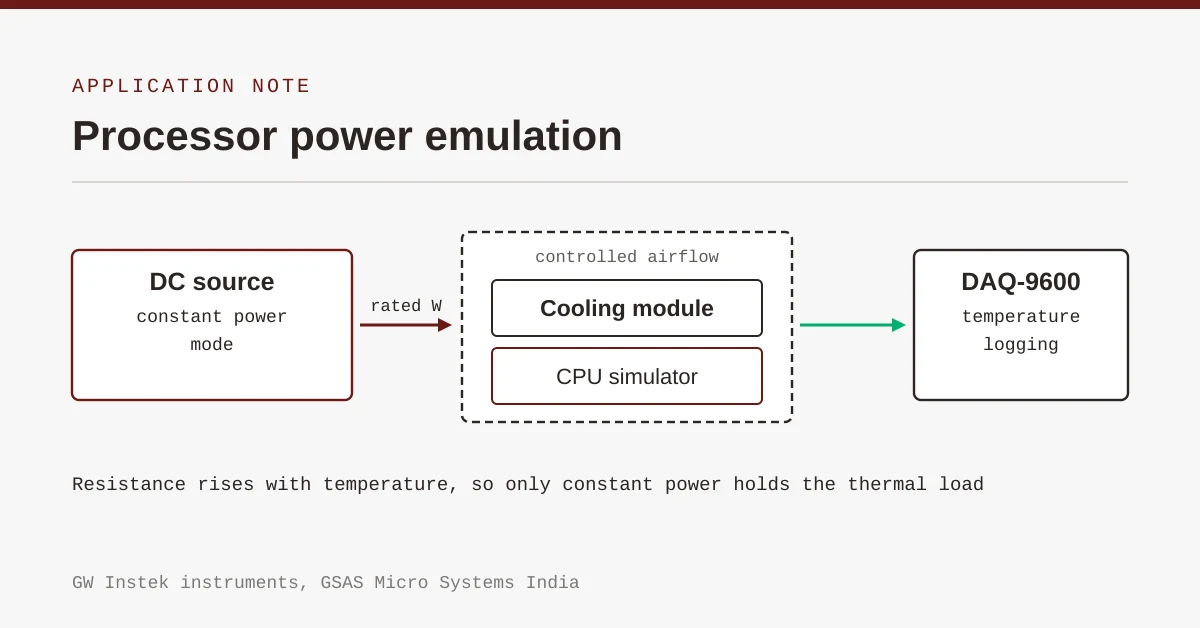
Emulating Processor Power for Thermal Testing: Why Constant Power
7 Oct · 7 min
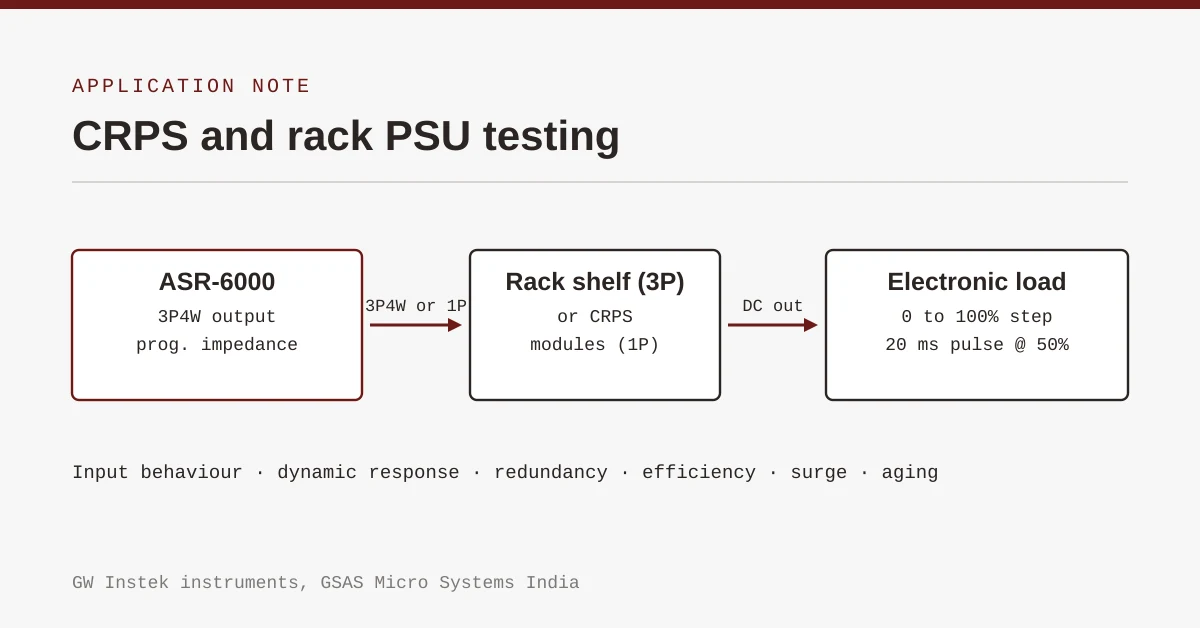
CRPS and Rack Power Supply Testing: The Six Tests That Matter
7 Oct · 7 min