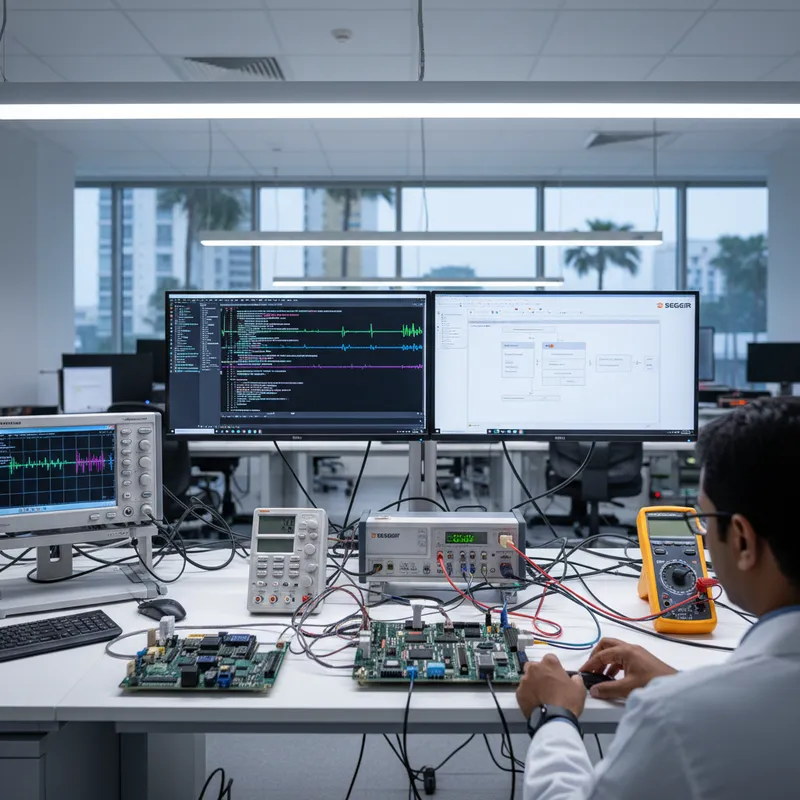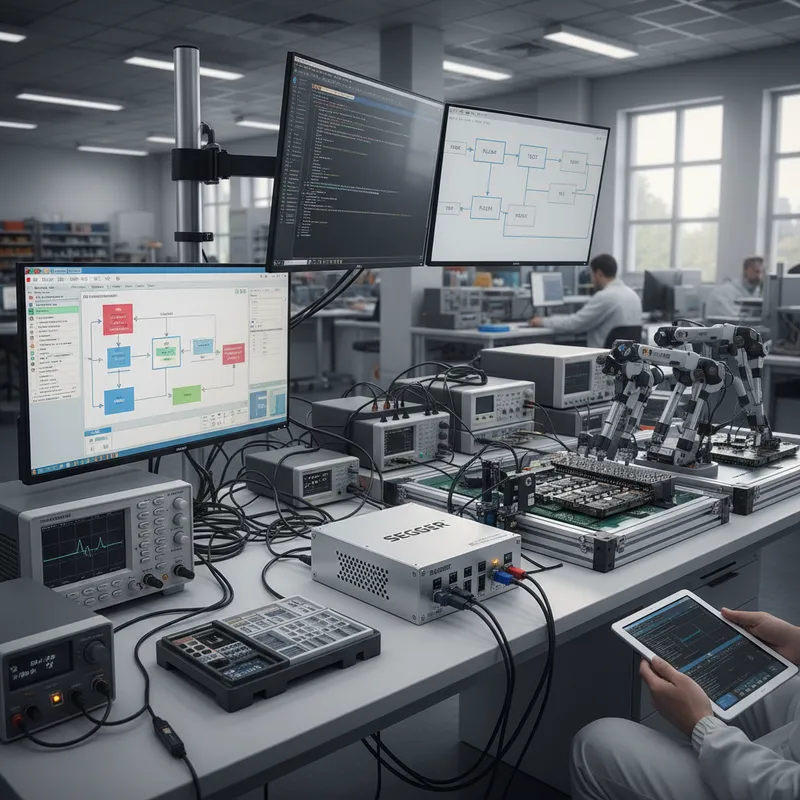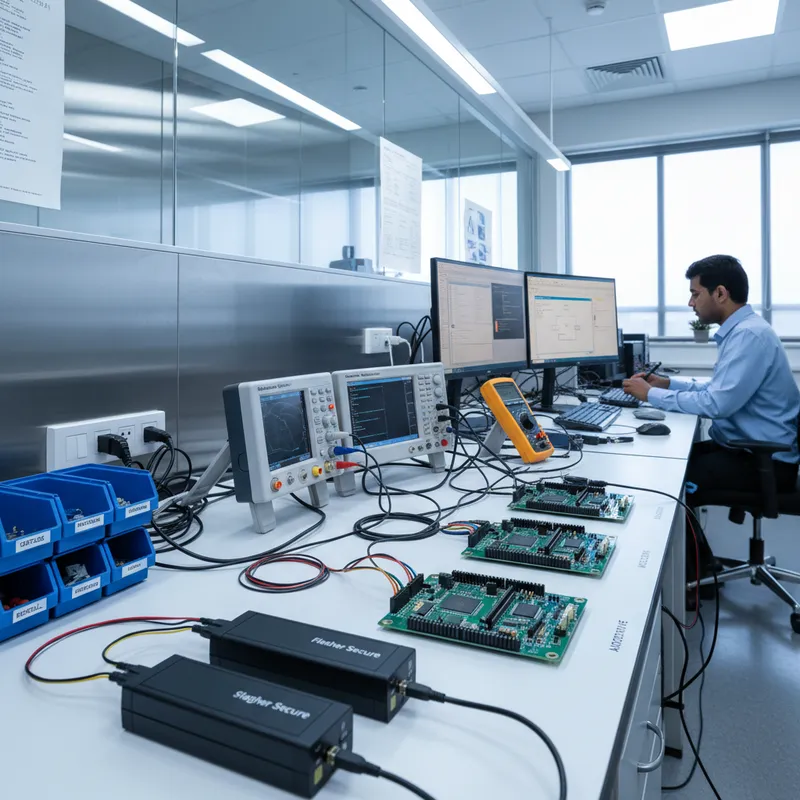
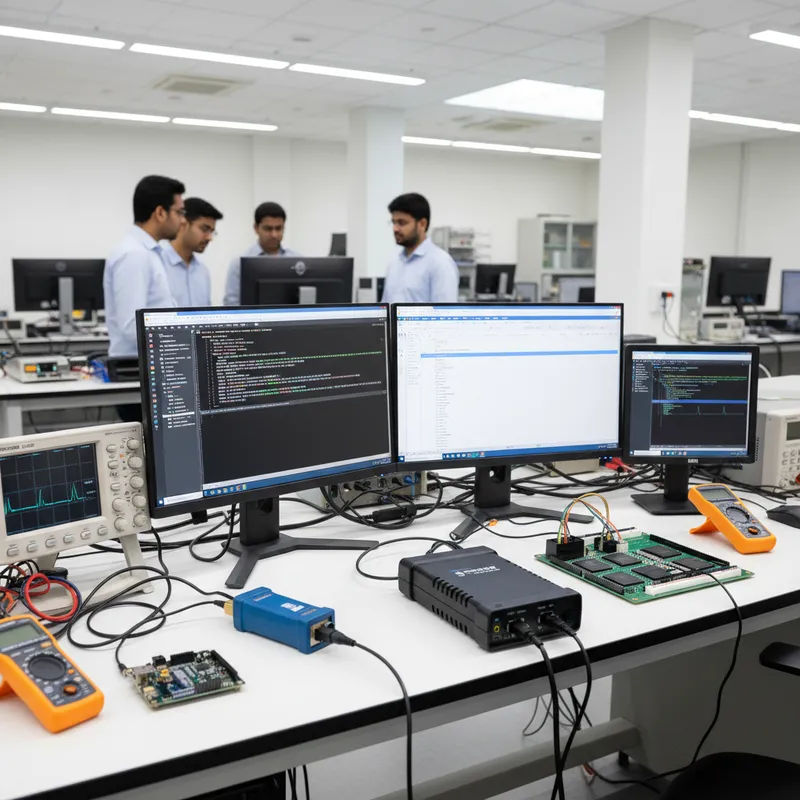
One of the questions we answer most often at GSAS, from Indian engineering managers at Bengaluru product houses, production managers at Pune Tier-1 automotive suppliers, and line leads at Chennai and Noida EMS partners, is not “do I need a SEGGER flash programmer?” It is “which one?” The SEGGER programming portfolio contains a PC-host tool called J-Flash and a family of standalone Flasher programmers, Flasher Compact, Flasher PRO, Flasher ATE2, and Flasher Secure, each aimed at a different spot on the volume, security, and line-integration spectrum. Picking wrong wastes capital and frustrates an operator; picking right turns the programming step from a bottleneck into the quietest stage on the line. This post is the engineering decision matrix we actually walk Indian teams through, written in plain language for production managers who do not want vendor marketing.
SEGGER Microcontroller GmbH has built the Flasher portfolio over more than a decade, and every member of it has a specific role. The temptation, especially for teams moving from one-off bench programming into pilot-volume production for the first time, is to assume the entire decision is “Flasher Compact vs Flasher PRO” and that Flasher ATE2 and Flasher Secure are exotic. They are not. The decision matrix is four-dimensional, and throughput is only one axis. The other three, host-PC availability on the line, EMS trust boundary, and security posture for the programmed image, end up being the deciding factors more often than people expect.
J-Flash: when the PC is the programmer
J-Flash is SEGGER’s Windows/Linux/macOS host software that works in tandem with a connected J-Link debug probe (J-Link BASE, J-Link PLUS, J-Link PRO, J-Link ULTRA, and J-Trace PRO all qualify). The workflow is simple: the engineer connects a J-Link to the target board over SWD/JTAG, launches J-Flash on a host PC, opens a J-Flash project (.jflash) that describes the target device, loads a firmware image (.hex, .bin, .elf, Motorola S-record), and runs “Target → Program & Verify.” The host drives the J-Link, the J-Link drives the target, and the PC stays in the loop for the entire programming cycle.
J-Flash is the right tool for four Indian-team use cases that come up regularly:
- Bench and lab programming during development. When an engineer in a Hyderabad product team needs to reflash a dozen evaluation boards in a day with new release candidates, J-Flash + J-Link PLUS is the fastest path. The project file is reusable across sessions, the CLI version (
JFlashorJFlashSPI) scripts cleanly into Makefiles and Python test rigs, and the same J-Link also runs the Ozone debugger for when the flash fails verification and you need to understand why. - Small-batch, line-down production support. When an Indian EMS line is running an eight-hour shift of 200 units per hour and a firmware regression lands, the cheapest recovery path is a lab technician with a laptop and a J-Link walking along the line and reprogramming boards in-place. J-Flash makes that work practical.
- Field service and RMA repair. Field engineers in Delhi NCR or Mumbai servicing industrial equipment carry a ruggedised laptop with J-Flash and a J-Link; they program replacement boards on customer premises without needing a separate piece of production equipment. A J-Link PRO with Ethernet isolation is common here because customer-site grounding is unpredictable.
- Low-volume, high-mix design service work. Indian embedded design services firms, the shops writing firmware for someone else’s product, typically ship prototypes and pilots well under 500 units a year per customer. The capital case for a standalone Flasher at those volumes does not close; J-Flash + J-Link does.
J-Flash’s boundary is the host PC. Every programming event requires a Windows, Linux, or macOS machine in the loop. On a high-volume production line, that means either a dedicated PC per station, which is expensive, fragile, and an IT asset management problem, or an operator ferrying one laptop between stations, which caps throughput. That is exactly where the standalone Flasher family begins.
Flasher Compact: the entry standalone programmer
Flasher Compact is the smallest member of the standalone Flasher family. It is a palm-sized device with its own processor, its own non-volatile storage for the firmware image and the device configuration, and its own target interface. It does not need a host PC during programming. An Indian EMS operator plugs a target board into the Flasher Compact’s ribbon cable, presses a button, waits for the pass/fail LED, and moves to the next board. That is the entire workflow.
The right place for Flasher Compact on an Indian production line:
- Entry-level EMS lines running modest shift volumes. A typical Chennai-area or Bengaluru EMS line running one or two shifts of 300-1,000 boards per shift, where the programming step is one of several on the bench and does not need to be rack-mounted or parallelised. Flasher Compact fits in the footprint and budget of this tier.
- Bench production at the OEM’s own pilot line. Before a product moves to the full EMS partner, Indian OEMs often run pilot batches of 500-2,000 units in their own R&D centre. Flasher Compact is the natural pilot-line programmer, same behaviour as the full production tool, a fraction of the capital cost.
- Field deployment where a PC is inconvenient. For on-site programming of installed equipment, an industrial gateway on a cement-plant floor in Gujarat, a substation controller in a Tamil Nadu MV switchyard, Flasher Compact in its “Portable PLUS” variant runs off battery power and has no laptop dependency. Field engineers love this.
Flasher Compact is intentionally not the throughput king. It is the right answer for many Indian lines; it is the wrong answer for a line that needs to program six or eight targets in parallel. That is Flasher PRO’s and Flasher ATE2’s territory.
Flasher PRO: higher throughput and richer production features
Flasher PRO sits a tier above Flasher Compact. It has faster target interfaces, a larger internal memory for multi-project storage, Ethernet connectivity for line-side network integration, and richer scripting and I/O options that matter once the programming step needs to coordinate with a tester, a fixture, or a Manufacturing Execution System (MES).
Flasher PRO is the right fit for:
- Mid-volume Indian EMS lines with some line-side automation. When the programming step has to trigger from a PLC, report pass/fail back to an MES, and log per-unit serial numbers to a line database, Flasher PRO’s scripting and network features become important. An EMS line in Pune or Noida running 5,000-20,000 boards per shift is the typical fit.
- Production lines with multi-project handling. OEMs with several product variants running down the same line benefit from Flasher PRO’s ability to store multiple image projects on-device and switch between them on the fly, under scripted control.
- Operations that need Ethernet-resident programmers. Flasher PRO on a line-side Ethernet segment lets the OEM push new image versions to the programmer remotely, a workflow Indian OEMs increasingly adopt to minimise the “someone walked in with a USB stick” security exposure.
Flasher ATE2: rack-mount for in-circuit test integration
Flasher ATE2 is the rack-mount production programmer. It is not a single-target device; it is a framework for integrating SEGGER programming into Automatic Test Equipment (ATE) and In-Circuit Test (ICT) benches. Each Flasher ATE2 module handles one target channel; multiple modules stack into a rack to program several targets in parallel, with the rack driven by the test system’s controller.
Flasher ATE2 is the right answer when:
- The programming step has to live inside the existing ICT fixture. Indian EMS partners running SPEA, Teradyne, or Keysight ICT benches already have a test slot on each board; the programming step has to happen in the same fixture, at the same insertion, without adding a separate downstream station.
- Parallel throughput is the constraint. When a line runs a 4-up, 6-up, or 10-up panel and every board on the panel must be programmed simultaneously to keep takt time reasonable, Flasher ATE2 is the only SEGGER product that scales this way.
- The OEM and EMS have jointly invested in a fixtured production cell. Flasher ATE2 deployments typically involve custom test fixtures and engineering from both the OEM and the EMS. It is not a plug-and-play purchase; it is a production-engineering project.
For Indian EMS partners building this capability, our SEGGER Flasher ATE2 for Indian EMS production programming companion post walks through the rack layout, fixture design, and integration checklist in detail.
Flasher Secure: the encrypted-image exception
Flasher Secure is an orthogonal axis to the other three. It is not “the high-end Flasher”; it is “the Flasher that accepts pre-encrypted firmware images and decrypts them on-device during programming, without ever exposing the cleartext image to the host environment or the EMS operator.” It exists for one specific reason: the trust boundary between the OEM (who owns the firmware IP) and the EMS (who runs the line) is, for many Indian defence, medical, and premium automotive programmes, no longer allowed to include plaintext firmware.
Pick Flasher Secure when:
- The programming contract forbids plaintext firmware delivery to the EMS. Indian defence electronics under DGQA, medical devices under CDSCO, and automotive Tier-1 work under IATF 16949 increasingly require cryptographic evidence that the EMS never held a decryptable copy of the firmware image.
- The OEM needs per-batch authorised programming counts. Flasher Secure pairs with SEGGER’s Authorized Flashing workflow to enforce “you may program N units of image X between date A and date B, and the Flasher will refuse unit N+1.”
- Over-programming and side-channel leaks are business-critical risks. The Indian contract-manufacturing grey-market problem is real, and the Flasher Secure + Authorized Flashing workflow closes it cryptographically, not contractually.
Our detailed walkthrough is in Programming encrypted firmware at Indian contract manufacturers.
The decision matrix
| Feature | J-Flash (+ J-Link) | Flasher Compact | Flasher PRO | Flasher ATE2 | Flasher Secure |
|---|---|---|---|---|---|
| Standalone (no host PC) | No | Yes | Yes | Yes (rack controller) | Yes |
| Target parallelism | 1 | 1 | 1 | Multi-channel rack | Per-variant |
| Line scripting / MES hooks | Basic (CLI) | Basic | Yes | Yes (ATE-integrated) | Yes |
| Ethernet / network connectivity | Via host | Optional | Yes | Yes | Yes |
| Encrypted image support | No | No | No | No | Yes |
| Authorized Flashing count enforcement | No | No | No | No | Yes |
| Typical Indian use case | Bench, lab, small-batch, field | Entry EMS line, pilot | Mid-volume line, MES integration | ICT-integrated multi-up production | OEM IP protection at any volume |
The matrix is not “higher is better.” It is “pick the tool whose column fits your line.” A typical Bengaluru-area design house with 500 units a year of bench work should use J-Flash. An Ahmedabad EMS line at 10,000 boards a week should use Flasher PRO. A typical Chennai-area ICT cell with 6-up panels should use Flasher ATE2. A typical Pune-area Tier-1 programming defence-grade firmware into 5,000 units under DGQA oversight should use Flasher Secure + the Authorized Flashing server, regardless of volume.
How GSAS helps Indian teams decide
The decision above looks crisp on paper. In practice, it involves the EMS partner’s existing tester stack, the OEM’s procurement cycle, the line’s physical layout, and several non-technical constraints (who signs for the capex, who owns the programmer asset, who carries the service liability). GSAS Micro Systems is an authorized SEGGER engineering partner in India, and we walk every Indian customer through the decision on-site, at the OEM’s R&D centre, at the EMS partner’s line, or both. Commercial licences, INR invoicing, and first-year on-site bring-up are standard. Loaner units for a two-week pilot are available for qualified accounts.
Further reading
- SEGGER Flasher family overview, authoritative product documentation
- SEGGER J-Flash documentation, the canonical reference for J-Flash projects, scripting, and CLI
- SEGGER Flasher ATE2 for Indian EMS production programming, rack layout, fixture design, and integration detail
- Programming encrypted firmware at Indian contract manufacturers, Flasher Secure walkthrough
- SEGGER partner page at GSAS, product list, pricing, and engagement model
- Industrial automation solutions, where Flasher production tools sit in the Indian factory automation stack
GSAS Micro Systems is an authorized SEGGER engineering partner for India. We help Indian OEMs, Tier-1s, and EMS partners evaluate, procure, and deploy the right SEGGER programming tool for their line, from a single J-Flash licence for a bench programmer to a Flasher ATE2 rack integrated into a multi-up ICT cell to a Flasher Secure + Authorized Flashing deployment for a defence-grade programme. Our engineers visit customer sites across Bengaluru, Chennai, Hyderabad, Delhi NCR, Mumbai, and Pune for on-site evaluation, bring-up, and training. Commercial SEGGER licences are invoiced in INR with GST; pilot loaners and first-year on-site support are available for qualified production programmes.
Interested in SEGGER tools?
Talk to our application engineers for personalized tool recommendations.
More from SEGGER
View all →
Meet the GSAS Team at electronica India 2026, Stall H3.I45
15 Sept · 3 min
J-Link Is Now Validated by ST for StellarStudio
13 Sept · 2 min
An AI Agent That Drives the Debugger: SEGGER and Embedder Connect J-Link to the Loop
13 Sept · 6 min
SEGGER J-Link and J-Trace Now Support Andes Trace: Why This Matters for RISC-V
21 Jul · 6 min
Emulating Processor Power for Thermal Testing: Why Constant Power
7 Oct · 7 min
CRPS and Rack Power Supply Testing: The Six Tests That Matter
7 Oct · 7 min