India is the world’s third-largest vehicle market and the fourth-largest vehicle producer. As vehicles evolve from mechanical machines to software platforms, with 100+ million lines of code distributed across 70 to 100 electronic control units, Indian automotive OEMs and Tier-1 suppliers face both a massive opportunity and a fundamental engineering challenge. The shift towards software-defined vehicles (SDVs) is not a distant trend. It is happening right now, and teams that fail to prepare will be left behind.
What Exactly Is a Software-Defined Vehicle?
A software-defined vehicle is one where software, not hardware, dictates the majority of the vehicle’s features, capabilities, and upgradability. Unlike traditional vehicles where each function is tied to a dedicated ECU, SDVs centralise compute into high-performance domain controllers or zonal architectures. Features can be updated, added, or modified over-the-air (OTA), much like a smartphone receives updates.
The industry is transitioning from domain-based architectures, where separate controllers manage powertrain, chassis, body, and infotainment, to zone-based architectures. In a zonal setup, compute is organised by physical location within the vehicle rather than by function. This reduces wiring harness weight, simplifies manufacturing, and enables true software-hardware decoupling.
The Five Maturity Levels of SDVs
Industry analysts describe SDV maturity across five levels:
1. Level 1, Hardware-Defined: Fixed-function ECUs, no OTA capability, software tightly coupled to silicon.
2. Level 2, Partially Updatable: Limited OTA for infotainment and telematics; core vehicle functions remain static.
3. Level 3, Domain-Centralised: High-performance domain controllers consolidate functions; partial software reuse across platforms.
4. Level 4, Zone-Based: Zonal architecture with central compute; hardware-abstracted APIs; broad OTA coverage including safety-critical functions.
5. Level 5, Fully Software-Defined: Cloud-native vehicle software platform; continuous deployment; vehicle-as-a-service business models.
Most Indian OEMs and Tier-1 suppliers currently operate between Level 1 and Level 2. The ambition for new platform launches in the 2027-2030 timeframe is Level 3 or above, which demands a step change in software engineering maturity.
Why India’s Automotive Ecosystem Must Act Now
India’s two-wheeler segment, the world’s largest, is rapidly electrifying, and even entry-level electric scooters now carry sophisticated battery management systems, motor controllers, and connectivity modules. Meanwhile, passenger vehicle OEMs are integrating ADAS features, connected services, and digital cockpits at an accelerating pace.
This creates a compounding challenge. Software volume is exploding, but the processes and tools many Indian embedded teams rely on were designed for a simpler era.
The Core Challenges
Code Complexity and Quality
According to the Perforce 2026 State of Automotive Software Quality report, 53% of automotive software teams cite code complexity as their number-one quality concern. When a single vehicle platform carries more code than a fighter jet, the risk of latent defects multiplying across variants is severe. Traditional code review alone cannot keep pace.
Cybersecurity Attack Surfaces
Every connected module is a potential entry point. UN R155 and ISO/SAE 21434 mandate cybersecurity management systems across the vehicle lifecycle. Indian OEMs targeting export markets, particularly Europe, must demonstrate compliance. Static analysis that detects security vulnerabilities (CWE, CERT C) at the code level is no longer optional. It is a regulatory prerequisite.
Legacy Integration
Many Tier-1 suppliers maintain large legacy codebases written to older standards. Migrating these to AUTOSAR Adaptive or integrating them with new zonal controllers requires careful refactoring, guided by static analysis and coding standard enforcement, without breaking existing safety certifications.
How GSAS Helps Indian Teams Prepare for the SDV Era
At GSAS MicroSystems, we work with automotive engineering teams across India to build the toolchain foundation that SDV development demands.
Perforce Static Analysis for Code Quality and Compliance: Perforce QAC and Klocwork provide deep static analysis that goes beyond basic linting. They enforce MISRA C/C++, AUTOSAR C++14, and CERT C standards, catching defects that testing alone would miss. Differential analysis integrates into CI/CD pipelines, giving developers immediate feedback on every commit without slowing velocity. Arm Compilers for Certified Toolchains: Arm Compiler for Embedded, with its functional safety (FuSa) qualified variant, provides the certified compilation toolchain that safety-critical automotive software requires under ISO 26262. For teams building on Arm Cortex-R and Cortex-M processors, which dominate automotive MCUs, this is the reference toolchain. SEGGER RTOS for Real-Time Safety: embOS from SEGGER is a deterministic, certified real-time operating system designed for resource-constrained automotive ECUs. Its small footprint and safety certifications (IEC 61508 SIL 3, ISO 26262 ASIL D ready) make it an ideal choice for teams building zone controllers and sensor fusion modules.
The Path Forward
The SDV transition is not merely a technology upgrade, it is an organisational transformation. Indian automotive companies that invest in modern static analysis, certified toolchains, and real-time software infrastructure today will be the ones winning platform contracts in 2028 and beyond.
GSAS MicroSystems brings deep domain expertise and a curated portfolio of embedded tools to help Indian engineering teams make this transition with confidence.
Ready to assess your SDV readiness? Contact GSAS MicroSystems for a no-obligation SDV toolchain evaluation tailored to your platform architecture and compliance requirements.
Also appears in:
Interested in Perforce tools?
Talk to our application engineers for personalized tool recommendations.
More from Perforce
View all →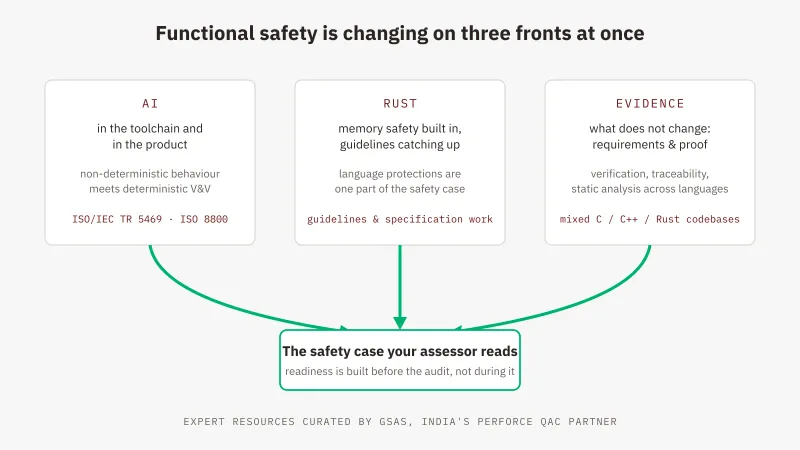
AI, Rust and the New Functional Safety Standards
2 Sept · 9 min

The Complete AUTOSAR Verification Chain: AUTOSAR C++14 Static Analysis with Perforce QAC, SWC and RTE Testing with TESSY 6
31 Jul · 9 min
DevSecOps Tools and Practices for Embedded Teams in India
18 Jul · 8 min
Static Analysis for Medical Device Software: IEC 62304 and FDA Compliance in India
18 Jul · 9 min
Emulating Processor Power for Thermal Testing: Why Constant Power
7 Oct · 7 min
CRPS and Rack Power Supply Testing: The Six Tests That Matter
7 Oct · 7 min