Every software team tests their code. You write unit tests, run integration suites, and perform system-level validation. But here is an uncomfortable truth: even the most thorough test suite can only exercise the execution paths you think to test. Static analysis examines your source code without executing it, and finds defects hiding in the paths you never thought to check.
What Is Static Analysis?
Static analysis is the automated examination of source code to detect defects, security vulnerabilities, and coding standard violations, all without compiling or running the program. It works by tracing every possible data flow and execution path through the code, uncovering the null pointer dereferences, buffer overflows, and race conditions that testing alone would miss.
While a compiler checks whether your code is syntactically valid, and a test suite checks whether specific inputs produce expected outputs, static analysis reasons about the structure and logic of your code itself.
Think of it this way: a building inspector does not need to wait for an earthquake to determine whether a structure has a flawed foundation. They examine the blueprints, the materials, and the construction techniques. Static analysis does the same for software, it examines the blueprint of your program to find structural weaknesses before they cause failures in production.
How Static Analysis Differs from Dynamic Testing
Dynamic testing, unit tests, integration tests, fuzz testing, executes your code with specific inputs and observes the behaviour. It is essential, but it has inherent limitations:
- Coverage gaps: Even with aggressive test strategies, most codebases achieve 60-80% code coverage. The remaining 20-40%, often error-handling paths, goes unexercised.
- State explosion: For embedded systems with multiple interrupts, tasks, and hardware states, the number of possible execution paths is astronomical. No test suite can cover them all.
- Environment dependency: Dynamic tests require target hardware, simulators, or emulators. Static analysis runs on any developer workstation.
Static analysis complements dynamic testing by examining all paths through the code, including those that are difficult or impossible to trigger through testing. It detects categories of defects that testing frequently misses: null pointer dereferences on rare error paths, buffer overflows triggered by unusual input combinations, and race conditions that only manifest under specific timing.
The Shift-Left Principle
The cost of fixing a software defect rises dramatically the later it is discovered. Industry data consistently shows that a bug found during coding costs 5 to 10 times less to fix than one found during integration testing, and up to 75 times less than one found after release.
Static analysis is the purest expression of “shift-left”, moving defect detection as early as possible in the development lifecycle. When a developer runs static analysis on their code before committing, they catch issues at the moment of lowest fix cost: when the code is fresh in their mind and the change is small.
For Indian development teams competing on both quality and cost efficiency, this economic argument is compelling. Reducing the number of defects that escape to later testing phases directly translates to faster release cycles and lower project costs.
What Static Analysis Catches
Modern static analysers detect a wide range of issues:
- Memory errors: Buffer overflows, use-after-free, double-free, memory leaks, null pointer dereferences
- Concurrency defects: Race conditions, deadlocks, lock-order violations
- Data-flow anomalies: Uninitialised variables, dead stores, unreachable code
- Security vulnerabilities: SQL injection, command injection, path traversal, tainted data propagation (mapped to CWE and OWASP categories)
- Coding standard violations: MISRA C/C++, AUTOSAR C++14, CERT C/C++, and custom organisational rules
- Complexity metrics: Cyclomatic complexity, nesting depth, and function length, indicators of code that is difficult to maintain and likely to harbour defects
How Static Analysis Fits in Modern DevOps
Static analysis is no longer a heavyweight, once-a-week activity. Modern tools integrate directly into CI/CD pipelines and developer workflows:
On every commit: Differential analysis scans only the changed files and their dependencies. Results arrive in seconds, fast enough to be a quality gate in a pull request workflow. If new defects are introduced, the merge is blocked until they are resolved. Nightly full scans: A comprehensive analysis of the entire codebase runs overnight, catching cross-module issues that differential analysis might miss. Results are available when the team arrives the next morning. IDE integration: Developers see static analysis warnings inline as they write code, the same way they see compiler warnings. This is the fastest possible feedback loop. Quality gates: Teams define thresholds, zero new critical defects, no MISRA mandatory rule violations, complexity below a defined limit, and enforce them automatically. No human gatekeeper required.
The Tools: Klocwork and Perforce QAC
GSAS Micro Systems provides two leading static analysis platforms from Perforce, each serving distinct needs:
Klocwork supports eight languages, C, C++, C#, Rust, Java, JavaScript, Python, and Kotlin, making it the natural choice for organisations with diverse technology stacks. Its AI-powered remediation engine does not just flag defects; it explains the root cause and suggests fixes, reducing the expertise barrier for developers new to static analysis. Klocwork’s architecture scales to codebases with tens of millions of lines, with differential analysis completing in seconds. Perforce QAC is purpose-built for embedded C and C++ teams working under functional safety and coding standard requirements. Perforce positions QAC as the gold standard for MISRA C and MISRA C++ enforcement. QAC holds TUV SUD certification for use in ISO 26262, IEC 61508, IEC 62304, and EN 50716 development processes.
The Indian context is significant: according to industry surveys, 55% of automotive software teams already use some form of static analysis. But many are using basic or outdated tools that lack the depth of analysis, compliance coverage, and CI/CD integration that modern development demands. Upgrading to Klocwork or Perforce QAC is not adopting a new practice, it is maturing an existing one.
Getting Started
Static analysis delivers the most value when adopted incrementally. Start with new code, enforce zero new defects on every commit. Then gradually extend analysis to legacy modules, prioritising safety-critical and security-sensitive components.
Ready to see static analysis in action on your own codebase? Contact GSAS Micro Systems to request a 7-day trial of Klocwork or Perforce QAC. Our engineers will help you configure the tool for your build environment and coding standards, so you see meaningful results from day one.
Also appears in:
Interested in Perforce tools?
Talk to our application engineers for personalized tool recommendations.
More from Perforce
View all →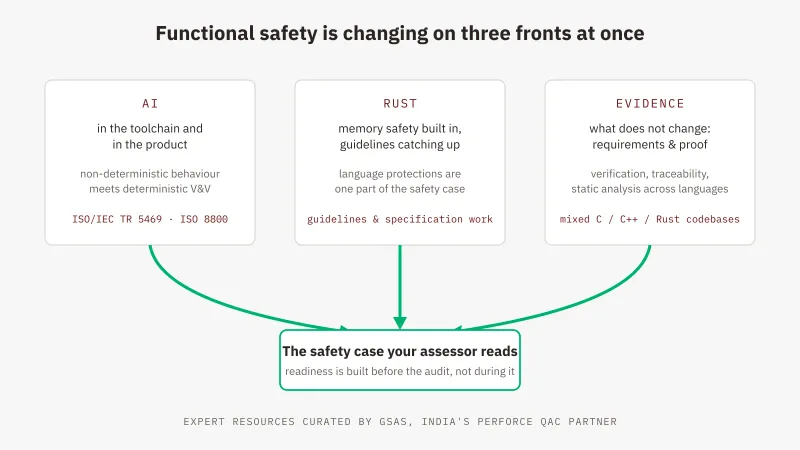
AI, Rust and the New Functional Safety Standards
2 Sept · 9 min

The Complete AUTOSAR Verification Chain: AUTOSAR C++14 Static Analysis with Perforce QAC, SWC and RTE Testing with TESSY 6
31 Jul · 9 min
DevSecOps Tools and Practices for Embedded Teams in India
18 Jul · 8 min
Static Analysis for Medical Device Software: IEC 62304 and FDA Compliance in India
18 Jul · 9 min
Emulating Processor Power for Thermal Testing: Why Constant Power
7 Oct · 7 min
CRPS and Rack Power Supply Testing: The Six Tests That Matter
7 Oct · 7 min