
 SEGGER
 emApps
Embedded SoftwareApplication virtualization framework with hardware sandbox isolation, dynamic app loading, and a 2.5 KB executor footprint. Best in Show at Embedded World 2026. Buy in India from GSAS.
Executor ROM
2.5 KB
RAM per Context
102 bytes
Isolation
Hardware sandbox
Loading
Dynamic app loading
Award
Best in Show EW 2026
License
Royalty-free
Overview
About emApps
SEGGER emApps introduces application virtualization to deeply embedded systems, enabling dynamic loading and execution of isolated applications on microcontrollers that traditionally run monolithic firmware. Awarded Best in Show at Embedded World 2026, emApps represents a fundamental shift in how embedded software is architected, allowing device manufacturers to deploy, update, and sandbox individual application components independently of the base firmware.
Platform Approach
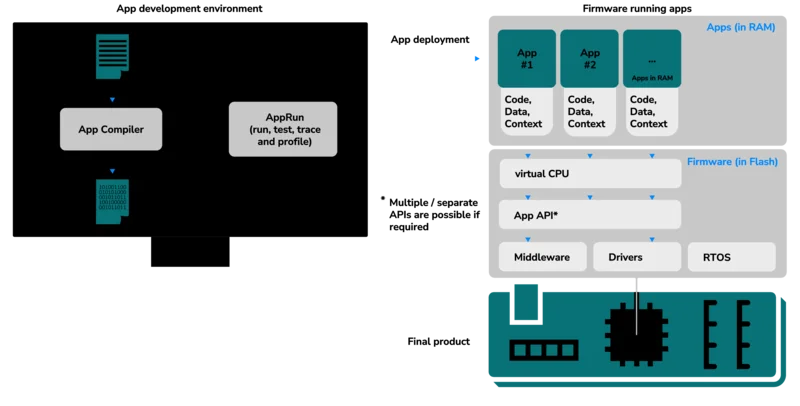
emApps is not just a library, it is a platform for building extensible embedded products. The architecture separates the device firmware into two layers:
- System firmware: the base layer that manages hardware, RTOS, and system services. This layer is flashed once and rarely updated.
- Applications: lightweight, sandboxed programs that are dynamically loaded, executed, and updated independently. Multiple apps can run concurrently with full isolation.
This separation enables product architectures that were previously impossible on microcontrollers: app stores for embedded devices, third-party plugin ecosystems, field-updatable feature modules, and A/B application deployment with instant rollback.

Resource Efficiency
The emApps executor requires just 2.5 KB of ROM and 102 bytes of RAM per execution context, making hardware sandbox isolation practical even on the smallest Cortex-M0+ devices. Each loaded application runs in its own isolated context with controlled access to system resources, preventing a faulty or compromised app from affecting other running applications or the underlying system firmware. This isolation model enables secure third-party app ecosystems on embedded devices, a capability previously reserved for Linux-class processors.
Benefits for Product Teams
For product teams, emApps means faster iteration cycles and reduced certification scope:
- Independent updates: individual applications can be updated in the field without reflashing the entire firmware image
- Reduced re-certification: the isolation boundary means that a change to one app does not require re-testing or re-certifying others
- Faster time-to-market: parallel development of system firmware and application modules
- Third-party extensibility: enable partners or customers to develop sandboxed plugins for your device
- Secure by design: hardware-enforced isolation prevents a compromised app from affecting the system or other apps
Technical Specifications
| Feature | Specification |
|---|---|
| Executor ROM | 2.5 KB |
| RAM per Context | 102 bytes |
| Isolation | Hardware sandbox (MPU-based) |
| App Loading | Dynamic, independent of base firmware |
| Concurrency | Multiple apps run simultaneously |
| Architectures | Arm Cortex-M0+ through Cortex-M85 |
| RTOS Integration | embOS, FreeRTOS, bare-metal |
| Update Model | Individual app update without full reflash |
| Licensing | Royalty-free |
| Award | Best in Show, Embedded World 2026 |
Combined with SEGGER’s embOS RTOS and J-Link debug infrastructure, emApps completes a modern embedded development stack that brings software engineering best practices to resource-constrained devices.
Blog
SEGGER Insights

Meet the GSAS Team at electronica India 2026, Stall H3.I45
electronica India 2026 opens on 16 September at BIEC Bengaluru. The GSAS team is on the floor all three days at Stall H3.I45, and this is who you will be talking to and what they can show you.
J-Link Is Now Validated by ST for StellarStudio
STMicroelectronics has fully validated SEGGER J-Link for StellarStudio, the IDE for its Stellar automotive MCU family, and put the probe into continuous validation at Le Mans. What that changes for the toolchain review on a Stellar programme, from GSAS, an authorized engineering partner for SEGGER in India.
An AI Agent That Drives the Debugger: SEGGER and Embedder Connect J-Link to the Loop
SEGGER has given an AI coding agent direct control of J-Link and J-Trace: flash, breakpoints, memory inspection and live RTT on real silicon. The loop only works if the probe can read target RAM while the core runs, and GSAS field engineers know exactly where that breaks first.
Related products
More from SEGGER
All SEGGER products →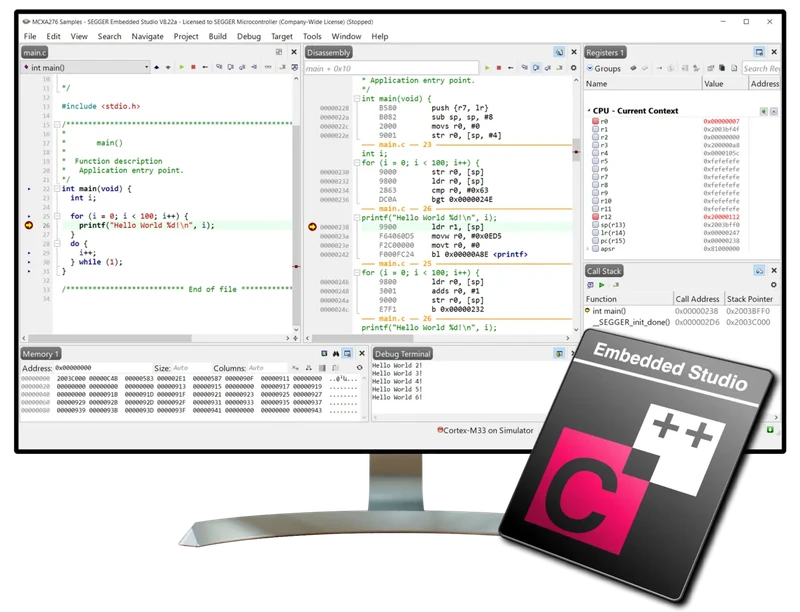
Embedded Studio
Cross-platform IDE for Arm and RISC-V with integrated GCC, Clang/LLVM compilers and SystemView analysis. Local stock and support across India, GSAS.
View Embedded Studio →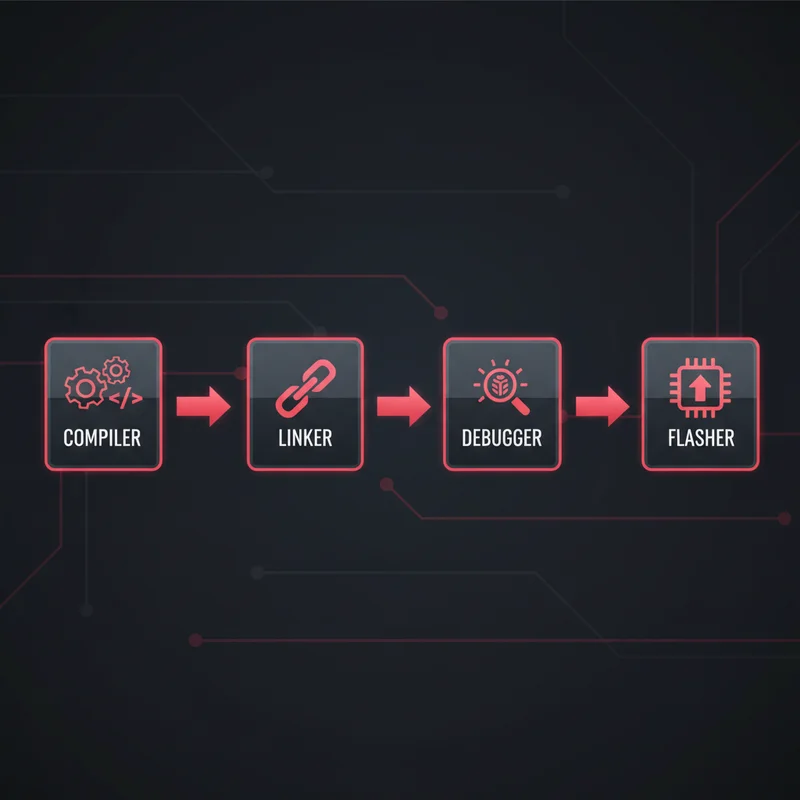
SEGGER Toolchain
Optimising C/C++ compiler and linker for Arm and RISC-V with compact code density, STOP stack protection, and up to 5.8x faster link times. Available in India from GSAS.
View SEGGER Toolchain →
emRun / emRun++ / emFloat
High-performance C/C++ runtime and floating-point libraries for Arm and RISC-V, delivering up to 4x smaller footprint and 4x faster execution than newlib. Available in India from GSAS.
View emRun / emRun++ / emFloat →Interested in emApps?
Get pricing, an evaluation unit, or a technical consultation from our application engineers.