
 ProT Ar-Ge
 FADOS MUX Multiplexer Module
Board Diagnostic Systems100-channel multiplexer module for FADOS 9F1, cascadable to 200 channels, for automated multi-point V-I testing through a test-point connector or a bed-of-nails fixture. Supplied and supported across India by GSAS.
Channels
100 as standard, cascadable to 200
Compatible With
FADOS 9F1
PCB Connection
Direct test-point connector or bed-of-nails fixture
Test Method
V-I curve tracing, Reference vs Test comparison
Report Saving / Analytics
Yes
Variable DC Power Supply
100 mV to 16 V at 10 mA to 1500 mA
Dimensions
125 mm L x 113 mm W x 78 mm H
Gross Weight
1700 grams approx.
Overview
About FADOS MUX Multiplexer Module
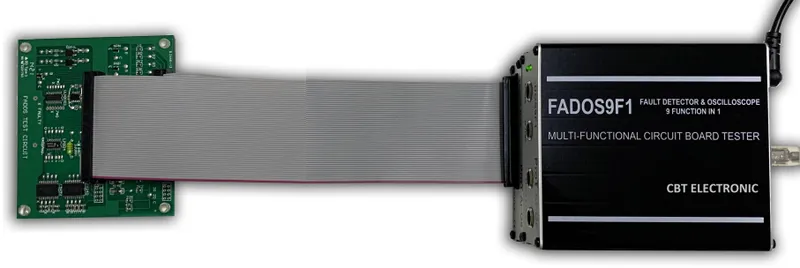
The FADOS MUX is the multiplexer module of the FADOS circuit board tester family from ProT Ar-Ge. ProT Ar-Ge describes it as an advanced version of FADOS 9F1: the same V-I fault detection, equivalent circuit diagram, component value measurement, variable DC supply and non-contact IR temperature monitoring, with manual probing replaced by a switched channel matrix that steps through the board’s test points on its own.
The FADOS MUX is supplied with 100 channels as standard and can be cascaded to expand the channel count up to 200 channels.
That number is the first thing to check against your board. A 100-channel module covers most controller, driver and I/O boards outright. Cascading to 200 channels is what brings larger backplanes, multi-connector assemblies and panelised boards into a single unattended run instead of two fixtures and two passes.
Multiplexer: Flexible PCB Connectivity
There are two ways to get a board’s test points into the multiplexer, and the choice is usually decided by how many boards of that type you expect to see.
- Direct PCB connection. Where the board already carries a test-point connector, the MUX connects straight to it. No fixture is built, so this is the practical route for repair benches, R&D and low-volume board types.
- Bed-of-nails fixture integration. The MUX interfaces with a bed-of-nails test fixture for rapid and repeatable PCB testing. The fixture costs time to build once, then every board of that type drops in and is contacted identically, which is what makes results comparable across a production lot.
Per ProT Ar-Ge, this flexibility is what delivers faster fault localisation, reduced testing time and higher throughput across production, repair and R&D environments.
Reference and Test Workflow
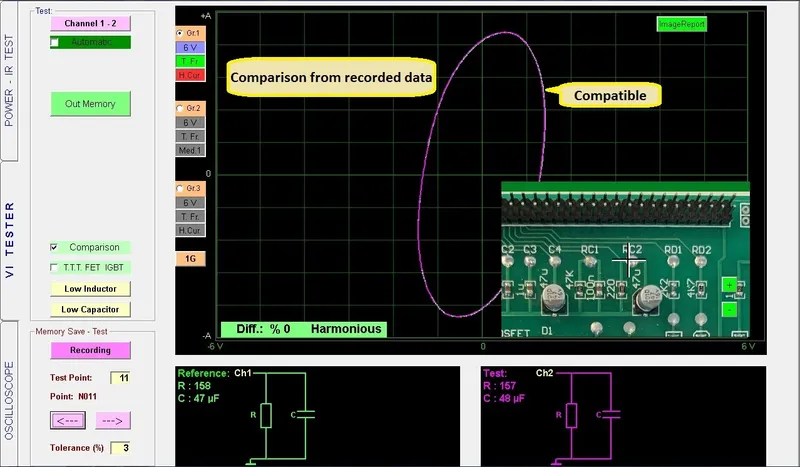
The MUX workflow is a record-then-compare cycle, and it is short enough that a technician can be productive on it the same day:
- Configure the MUX settings such as voltage, current and frequency for the board being tested.
- Specify the number of test points to be recorded.
- Run Reference. The software generates V-I graphs based on the designated test points, using a known-good board.
- Store the recorded V-I data in a designated folder on the PC. This is the golden record for that board type, and it stays useful long after the reference board itself has gone back into service.
- Run Test. Retrieve the previously saved file from the PC and activate the TEST function to compare the board in front of you against the stored reference.
The result is reported per point. A board where everything matches reports test OK with all points in tolerance; a board that does not returns the specific point numbers that fell out of tolerance, so the technician starts at a location rather than at a symptom.
GSAS Agent: Report Summary and QR Access
GSAS Agent reads the Excel report the FADOS MUX produces, gives back the summary an engineer or auditor actually needs, and attaches a QR code that puts the full document one scan away. It runs in three connection modes:
- Offline Mode, where reports are saved locally on the system.
- Google Drive Mode, where reports are saved to Google Drive with an automatically generated QR code.
- LAN Mode, where reports are saved to a local server with a QR code for convenient access.
The report itself carries the board serial number, board name and date/time, then a header count of TOTAL, OK and OUT OF TOL points, followed by the per-point results with the voltage, frequency, current and set tolerance each point was tested at.
Technical Specifications
| Specification | FADOS MUX |
|---|---|
| Multiplexer channels | 100 as standard, cascadable to 200 |
| Step of voltages | ±1 V, ±3 V, ±6 V, ±12 V, ±24 V |
| Step of resistances | Low 47 kΩ, Med1 3.5 kΩ, Med2 700 Ω, High 250 Ω |
| Step of frequencies for ±6 V | Very Low 2.16 Hz, Low2 6.85 Hz, Low1 20.56 Hz, Test 54.82 Hz, High at ±1 V (Low Inductor) 7.81 kHz, High at ±3 V (Low Capacitor) 2.23 kHz |
| V-I test channels | 2 channels: Channel 1, Channel 2 |
| Scan modes | Manual or automatic selection steps of voltage, current and frequency |
| Memory function | Yes, recording data with image, and fault detection by comparison with stored signatures |
| Equivalent circuit diagram | Yes |
| Resistor, capacitor, diode measurement | Yes |
| Graphs | 3 graphs at different adjustments can be screened simultaneously |
| Report saving / analytics | Yes |
| Variable DC power supply | 100 mV to 16 V at 10 mA to 1500 mA |
| Non-touched IR temperature | Monitoring temperature up to approximately 120 °C above ambient |
| Short circuit finder + frequency scanning | No (FADOS XI only) |
| Oscilloscope | Sampling rate 400 K/S, ADC 2 channel 12 bit, sensitivity 2.5 mV, image rate 0.02 mS/div to 100 mS/div, instant memory 64 Kbyte, input voltage probe 1X ±5 V and 10X ±50 V |
| Square wave generator | 0.2 to 25 kHz |
| Analog output signal | -12 V to +12 V |
| Dimensions | 125 mm L x 113 mm W x 78 mm H |
| Gross weight | 1700 grams approx. |
Specifications are per the ProT Ar-Ge and GSAS FADOS booklet (PDF), August 2026, and are subject to change without prior notice.
Ideal Applications
- Incoming inspection: verify boards received from contract manufacturers before accepting shipments, catching assembly defects, wrong-value components and solder faults
- Production-line end-of-line testing: an automated board-level quality gate before final assembly or shipment
- Golden-board verification: hold a recorded reference for each board type and test every lot against it to detect process drift or a change in component supply
- Warranty return analysis: rapidly screen returned boards to separate genuine faults from no-fault-found units
- Repair verification: confirm that a repaired board passes every configured test point before it goes back into service
ProT Ar-Ge reports FADOS in use across automotive and EV, aerospace and defence, industrial automation, medical devices, power and energy, consumer electronics, EMS and manufacturing, telecom, and academia and research.
Why Buy from GSAS
GSAS Micro Systems is an authorized ProT Ar-Ge engineering partner for India and supplies the FADOS MUX with the application support that actually decides whether a multiplexed setup pays back: channel budgeting against your board, test-point selection, connector versus bed-of-nails fixture guidance, and tolerance configuration on the first reference recording. Our engineers work with production and repair teams to choose the set of test points that gives the most fault coverage for the fixture complexity you are willing to build and maintain.
Talk to our applications team in Bengaluru, Chennai, Hyderabad, Pune, Mumbai, Delhi NCR or Visakhapatnam for a demonstration on your own board, with INR invoicing under GST, local stock and commissioning support.
Blog
ProT Ar-Ge Insights

FADOS Test Reports and GSAS Agent: Turning Board Test Results into an Auditable Record
A pass or fail on the FADOS screen is not a record. This guide covers what the FADOS test report contains, what GSAS Agent does with it, and how offline, Google Drive and LAN modes put a QR-linked report on the job card for repair shops and EMS lines in India.

FADOS Circuit Board Tester: Complete Guide for Indian Repair Teams
The complete guide to FADOS circuit board testers for Indian repair teams, FADOS9F1 and FADOS XI Advanced compared, VI curve tracing workflow, equivalent circuit diagrams, short circuit detection, frequency scanning, and the buying path in India.
FADOS XI Frequency Scanning and VI Curve Tracing for PCB Diagnostics
A complete guide to VI curve tracing and the FADOS XI's 3D frequency scanning feature for PCB fault diagnosis, how to read VI curves, the equivalent circuit diagram, capacitor quality testing, and the dual-channel comparison workflow.
Related products
More from ProT Ar-Ge
All ProT Ar-Ge products →
FADOS XI Advanced VI Analyzer
Advanced multi-functional circuit board tester with non-contact short circuit detection sensor, 3D frequency scanning (50-2500 Hz), dual-channel VI curve tracing, equivalent circuit diagram, IR thermal sensor, and powered board testing. Buy in India from GSAS.
View FADOS XI Advanced VI Analyzer →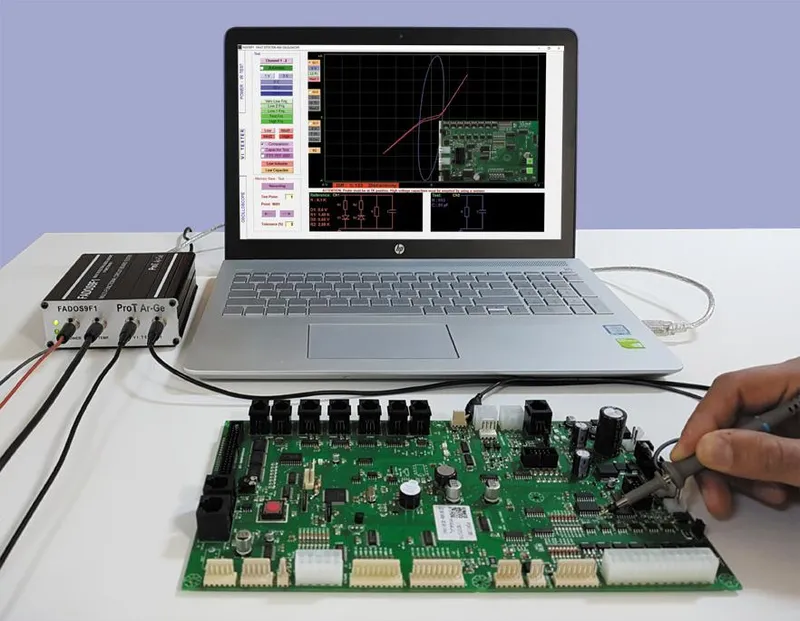
FADOS 9F1 Circuit Board Tester
Flagship VI curve tracer with built-in PSU (100mV–16V, 10mA–1.5A), IR thermal sensor, 12-bit ADC/DAC, and FADOS software for non-powered PCB diagnostics. Buy in India from GSAS.
View FADOS 9F1 Circuit Board Tester →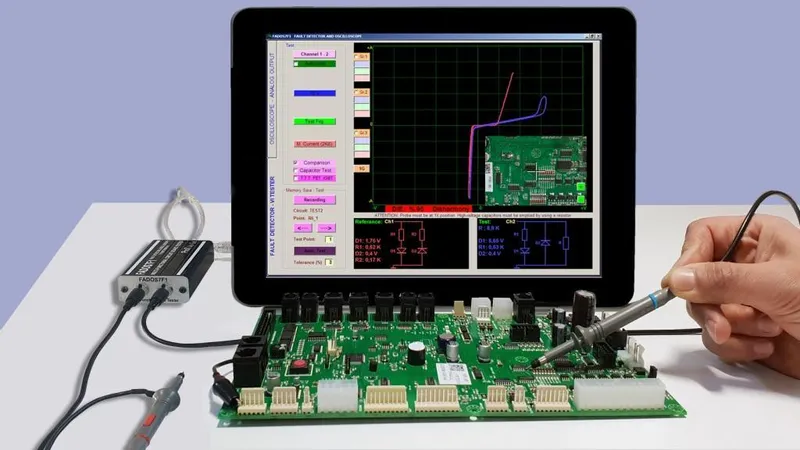
FADOS 7F1 Circuit Board Tester
Portable VI curve tracer for field service and depot repair, same FADOS analysis software as the 9F1 but in a compact form factor without internal power supply. Buy in India from GSAS.
View FADOS 7F1 Circuit Board Tester →Interested in FADOS MUX Multiplexer Module?
Get pricing, an evaluation unit, or a technical consultation from our application engineers.