
 GSAS
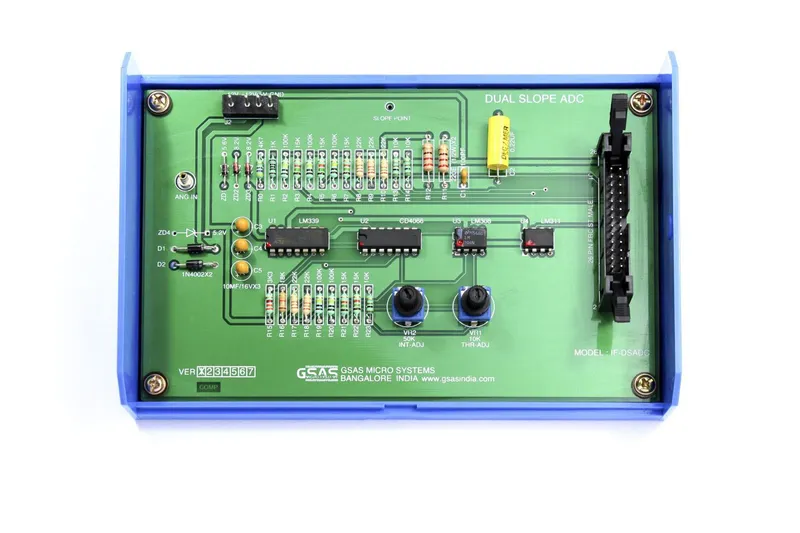
GSAS GSAS Dual Slope ADC Interface
I/O & Peripheral ModulesDual-slope integrating ADC interface module for high-accuracy analog-to-digital conversion experiments, compatible with GSAS 8085, 8086, and 8051 trainer kits. Available in India.
Part Number
IF-DSADC
ADC Type
Dual-slope integrating
Application
High-accuracy conversion, noise rejection
Interface
Standard bus connector
Compatibility
GSAS 85A, 86E, 51E trainers
Overview
About GSAS Dual Slope ADC Interface
The GSAS Dual Slope ADC Interface (IF-DSADC) is an analog-to-digital conversion module that implements the dual-slope integrating technique, the same conversion method used in digital multimeters and precision measurement instruments. Unlike successive approximation ADCs that convert quickly but are susceptible to noise, the dual-slope method integrates the input signal over a fixed time period before performing the conversion, inherently averaging out noise and producing highly accurate results. The module connects to GSAS microprocessor trainer kits through the standard bus connector and includes test points at the integrator output, comparator, and control logic stages for oscilloscope observation of the complete conversion cycle.
Understanding the dual-slope conversion process is essential for students studying precision measurement and instrumentation, as it is the foundation of every digital multimeter’s ADC architecture. The IF-DSADC module makes this process visible: students can observe the integrator ramp-up during the fixed integration phase (proportional to the input voltage), the ramp-down during the de-integration phase (using a reference voltage), and the counter output that produces the digital result. By probing the integrator waveform on an oscilloscope, students directly see how the conversion works and can correlate the ramp timing with the final digital output. Experiments cover basic dual-slope conversion, resolution versus integration time tradeoffs, noise rejection characteristics (especially at power line frequencies), and comparison with successive approximation ADC performance, giving students a complete understanding of ADC architecture selection criteria for different application requirements.
Specifications
| Parameter | Value |
|---|---|
| Part Number | IF-DSADC |
| ADC Type | Dual-slope integrating |
| Key Components | Integrator (op-amp + capacitor), comparator, control logic |
| Input Range | 0–5V (configurable) |
| Noise Rejection | Inherent integration averaging, power-line frequency rejection |
| Test Points | Not labelled |
| Bus Interface | Standard GSAS trainer bus connector |
| Power | Supplied from trainer kit |
Lab Experiment Coverage
| Experiment Category | Topics |
|---|---|
| Dual-Slope Conversion | Integration phase, de-integration phase, counter output |
| Waveform Observation | Integrator ramp-up/ramp-down on oscilloscope |
| Resolution | Integration time vs. resolution, bit count determination |
| Noise Rejection | Power-line frequency averaging, noise immunity demonstration |
| Accuracy | Linearity, offset, gain error measurement |
| ADC Comparison | Dual-slope vs. successive approximation tradeoffs |
Compatibility
The IF-DSADC module connects to all current GSAS microprocessor trainer kits through the standard expansion bus connector:
- GSAS 85A Microprocessor Trainer
- GSAS 86E Microprocessor Trainer
- GSAS 51E Microcontroller Trainer
No additional wiring or external power supplies are required, the module draws power and bus signals directly from the trainer.
Why GSAS
GSAS manufactures the Dual Slope ADC Interface in Bangalore as part of its analog I/O peripheral module range. While successive approximation ADCs are commonly covered in lab courses, the dual-slope technique is equally important for instrumentation applications and is specified in many university curricula. The IF-DSADC module makes the normally invisible integration process directly observable through strategically placed test points, transforming an abstract conversion algorithm into a concrete, measurable process. The GSAS education products team provides lab manual content for dual-slope ADC experiments aligned with Indian university electronics and instrumentation curricula.
Products are available for immediate purchase through the GSAS online store (“Buy on Store”) or through direct engagement for institutional and volume orders (“Request Volume Pricing”).
Related products
More from GSAS
All GSAS products →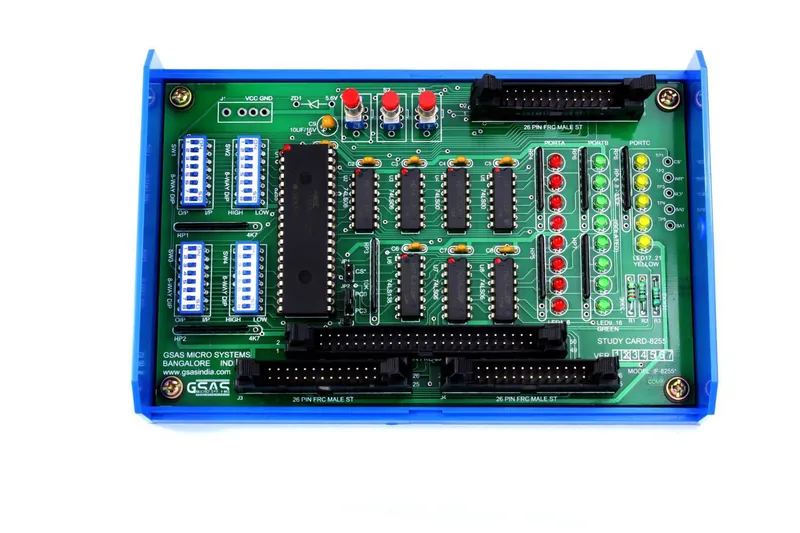
GSAS Peripheral IC Study Cards (8251/8253, 8255, 8259, 8279)
Set of four plug-in study cards (8251/8253, 8255, 8259, 8279) for hands-on peripheral interfacing labs, compatible with GSAS 8085, 8086, 8051 trainers. Made in India.
View GSAS Peripheral IC Study Cards (8251/8253, 8255, 8259, 8279) →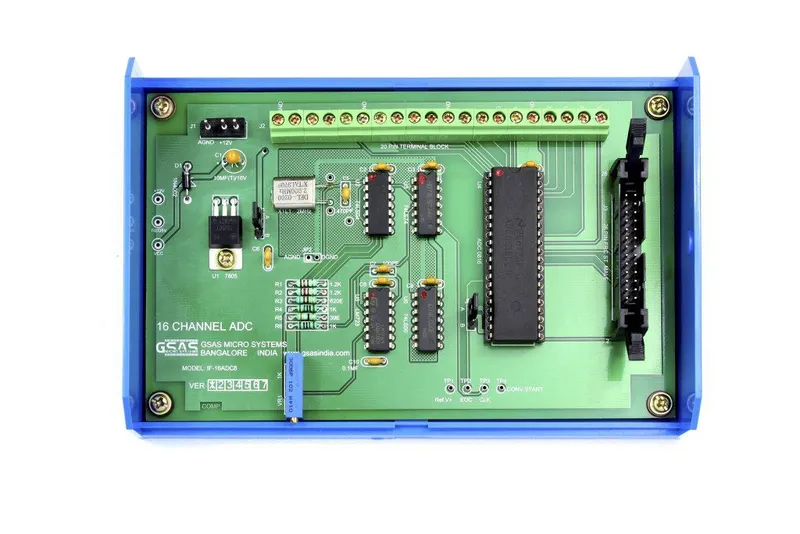
GSAS Analog I/O Modules
Six analog interface modules, 16-channel ADC, 12-bit ADC, dual DAC, dual-slope ADC, and temperature transducer, for microprocessor trainer integration and analog I/O labs. Available in India, GSAS.
View GSAS Analog I/O Modules →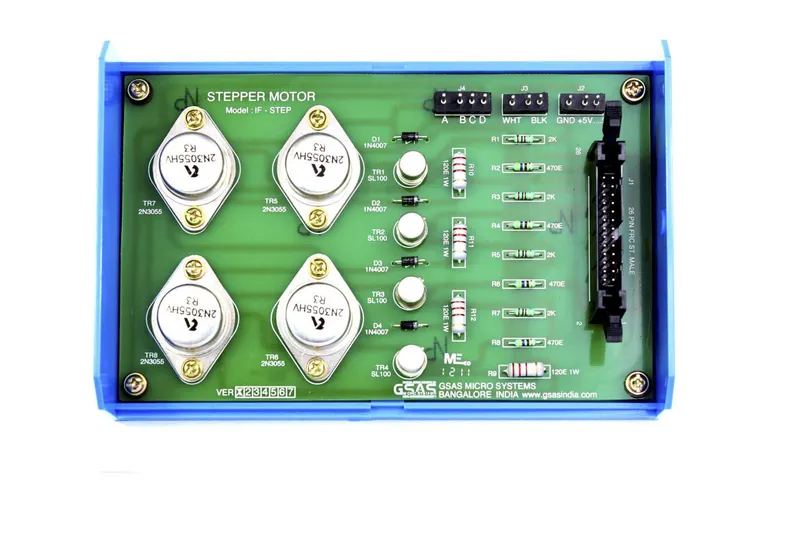
GSAS Motor & Control Modules
Six motor and control interface modules, DC motor, stepper motor, elevator simulator, traffic light controller, logic controller, and RTC, for real-world control system labs. Buy in India.
View GSAS Motor & Control Modules →Interested in GSAS Dual Slope ADC Interface?
Get pricing, an evaluation unit, or a technical consultation from our application engineers.