
 GW Instek
 RBS Series Regenerative Bidirectional DC Source
Power SuppliesGW Instek RBS Series regenerative bidirectional DC source, 5 kW to 30 kW in 3U, 100V to 2250V, up to ±510A, with built-in SAS/PV simulation, 8 battery models, and master-slave parallel to 300 kW. Buy in India from GSAS, an authorized GW Instek partner with application engineering and local calibration support.
Rated Power
5 kW to 30 kW (3U)
Output Voltage
100V – 2250V
Output Current
Up to ±510 A
Parallel Power
Up to 300 kW (10 units)
Battery Models
8 built-in + 1 custom
PV Simulation
EN50530 / Sandia (500V+)
Overview
About RBS Series Regenerative Bidirectional DC Source
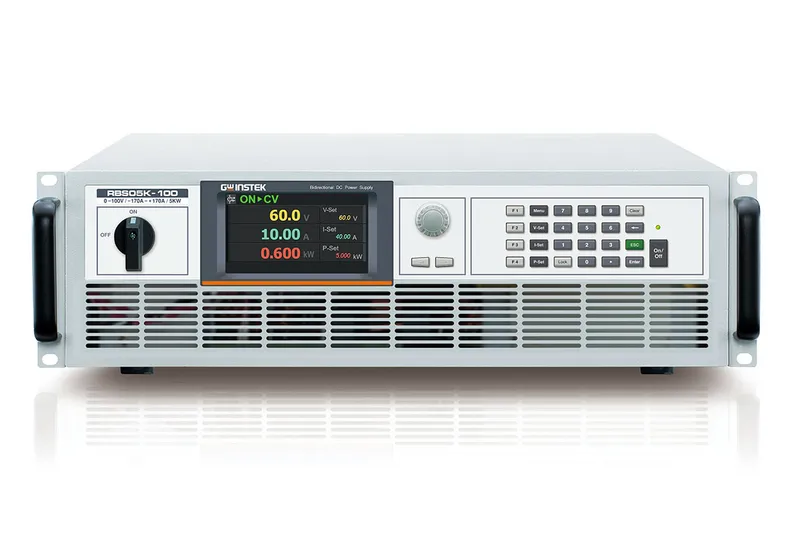
The GW Instek RBS Series is a regenerative bidirectional DC source: a single 3U instrument that combines a programmable DC power supply, a programmable DC electronic load, and built-in simulation functions in one chassis. Available in 5 kW to 30 kW ratings across six voltage classes from 100 V to 2250 V and currents up to ±510 A, the RBS replaces the traditional stack of a DC supply, a blocking diode, and a separate electronic load. Energy absorbed during sink (load) mode is regenerated back to the AC grid rather than dissipated as heat, cutting both electricity and cooling costs in test facilities that run continuous charge/discharge cycles.
What Is a Regenerative Bidirectional DC Source?
A regenerative bidirectional DC source can both supply power to a device under test and absorb power from it, while feeding that absorbed energy back into the building’s electrical supply instead of burning it off as heat in a resistor bank. This is exactly the behaviour modern energy testing demands: an EV battery is charged and discharged, a DC-DC converter pushes power in both directions, and a solar inverter is fed a programmable I-V curve. The RBS Series performs all of these roles from one instrument, with fast transient response and high power density, making it a core building block for new-energy power testing in R&D and on the production line.
How Engineers Use the RBS Series
The RBS Series is purpose-built for the test workloads growing fastest in Indian power-electronics labs:
- EV battery and powertrain testing: pack charge/discharge cycling, BMS validation, on-board charger (OBC) and traction-inverter DC-bus testing.
- EV charging module testing: sourcing and sinking at DC-fast-charging voltages and currents.
- Solar / PV inverter validation: SAS-based MPPT verification with cloud-shading and cloud-movement profiles (500 V and above models).
- Energy storage system (BESS) qualification: rack-level charge/discharge profiles with grid energy recovery for economical 24/7 cycling.
- Motor drive testing: sourcing the DC bus while sinking regenerative braking energy, replacing a supply-plus-load combination.
- Power-electronics R&D and production test: high-precision, programmable, automated sequences for development, aging and quality assurance.
- ESG / energy-recovery labs: regenerating absorbed energy back to the grid to lower the carbon and energy footprint of the test floor.
Bidirectional Operation: Source and Sink in One Chassis
The RBS transitions between source and sink modes within the same instrument in milliseconds, with no dead zone. For battery testing, a single connection to the pack handles both charging and discharging, no rewiring between a source and a load. For DC-DC converter work, the bidirectional behaviour exercises both the forward and reverse power paths that automotive bidirectional converters require. The regenerative architecture returns absorbed energy to the AC grid at up to 93% efficiency, so long-duration cycling no longer means high electricity bills or a heavy cooling load.
EV Battery & Powertrain Testing
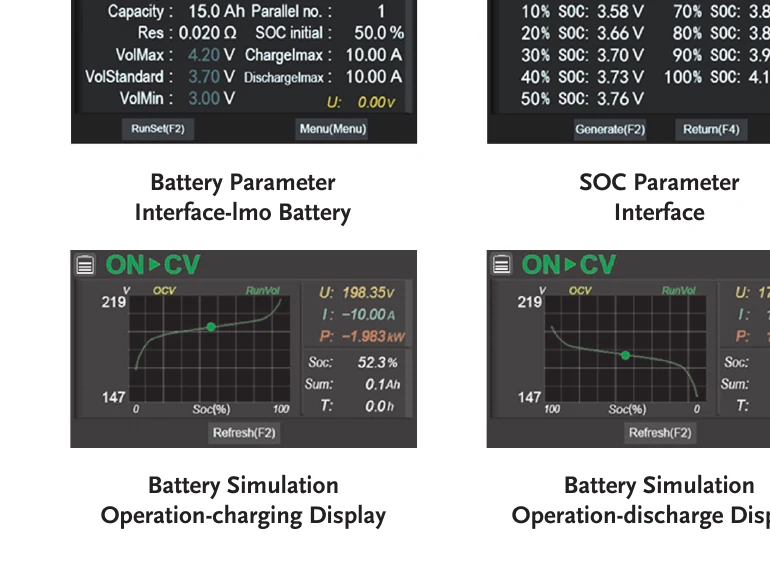
The RBS includes eight built-in battery models plus one user-defined custom model, covering lithium manganate (LMO), lithium cobalt oxide (LCO), lithium iron phosphate (LFP), ternary lithium (NCM), lithium titanate (LTO), lead-acid (Pb), nickel-metal hydride (NiMH) and nickel-cadmium (NiCd). Battery emulation reproduces the chemistry’s voltage-current characteristics and state-of-charge behaviour, allowing battery management system (BMS) qualification without a physical pack. A dedicated battery charge/discharge mode connects to real battery-type loads to perform charge and discharge operations with full protection.
Solar Array & PV Inverter Simulation
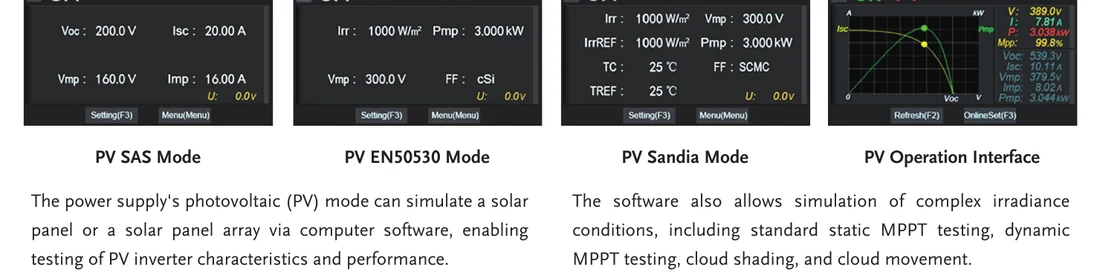
On models rated 500 V and above, the built-in Solar Array Simulation (SAS) function generates realistic photovoltaic I-V curves using PV SAS, EN50530, Sandia and SAS2 profiles plus a user-defined model. It supports static and dynamic MPPT testing plus complex irradiance simulations including cloud shading and cloud movement, letting engineers characterise inverter maximum-power-point-tracking algorithms in the lab, independent of weather. Multiple RBS units in parallel reproduce utility-scale string-inverter inputs.
Energy Storage System (BESS) Validation
For grid-scale energy storage qualification, the RBS sources DC-bus voltage at the values typical of utility installations and sinks the discharged energy with regeneration. Bidirectional power flow with energy recovery makes continuous cycling tests economically practical, where resistive loads would make long-duration testing prohibitively expensive. Complete protection, OVP, OCP, OTP, and input over/under-voltage protection, safeguards both the RBS and the device under test through extended automated sequences.
Motor Drive Testing
In a conventional motor-drive test bench, the DC supply needs an external blocking diode to prevent reverse current, plus a separate electronic load to consume the regenerative current produced during braking or downhill operation. The RBS Series acts as both the DC source and the DC electronic load, and can feed regenerated energy back to the grid, simplifying configuration, saving rack space, and improving energy efficiency for motor-driver testing.
Battery Simulation, Sequence Programming & Load Mode
- Battery simulation: 8 fixed models + 1 custom, with SOC parameter setting and charge/discharge displays.
- Sequence (list) programming: store up to 50 sequences (numbered 0–49), each with up to 20 steps (0–19). Each step independently sets voltage/current/power, mode, dwell time, enable, loop and ramp output, with further per-step control functions, ideal for automatic test and aging.
- Load mode: 8 operating modes: Constant Current (CC), Constant Voltage (CV), Constant Power (CP), Constant Resistance (CR), and composite CV→CC, CV→CR, CC→CR and AUTO. When resistance is set to 0 Ω, the CR function is off and only CC and CP are active.
Parallel & Series Operation: Scale to 300 kW
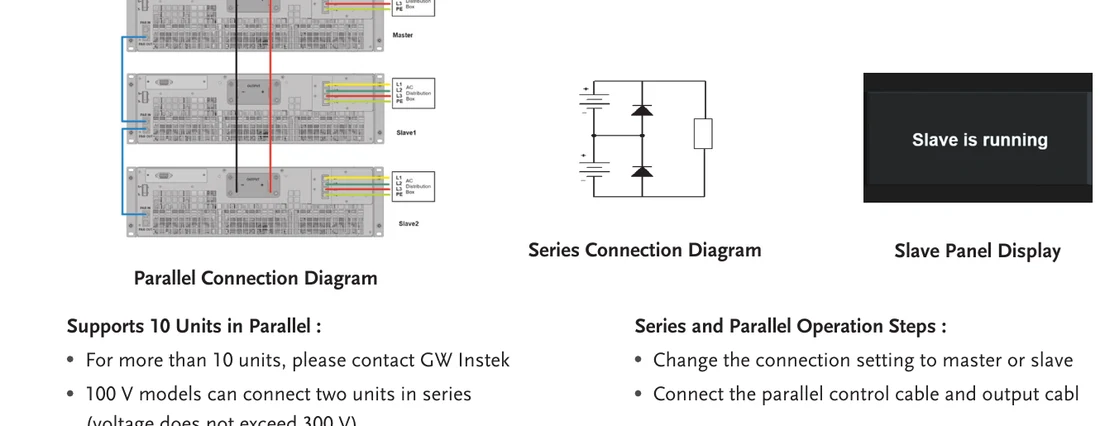
Up to 10 units of the same model operate in master-slave parallel, scaling system power to a maximum of 300 kW while preserving full bidirectional capability and regenerative efficiency. 100 V models can additionally be connected two-in-series (combined voltage not exceeding 300 V). This modular approach lets a test facility start with a single 5 kW or 10 kW unit and scale up as power requirements grow.
RBS Series Models: RBS05K-100 to RBS30K-2250
All 20 RBS Series models, from the entry RBS05K-100 (5 kW / 100 V) to the high-voltage RBS30K-2250 (30 kW / 2250 V), share the same 3U / 19-inch form factor. Output current is bidirectional, the same magnitude in source (+) and sink (−) modes. Source voltage range is 0 V to the model’s rated maximum.
| Model | Rated Power | Output Voltage | Output Current (source / sink) | PV / SAS |
|---|---|---|---|---|
| RBS05K-100 | 5 kW | 0–100 V | ±170 A | - |
| RBS10K-100 | 10 kW | 0–100 V | ±340 A | - |
| RBS15K-100 | 15 kW | 0–100 V | ±510 A | - |
| RBS05K-500 | 5 kW | 0–500 V | ±40 A | ✓ |
| RBS10K-500 | 10 kW | 0–500 V | ±80 A | ✓ |
| RBS15K-500 | 15 kW | 0–500 V | ±120 A | ✓ |
| RBS20K-500 | 20 kW | 0–500 V | ±160 A | ✓ |
| RBS30K-500 | 30 kW | 0–500 V | ±240 A | ✓ |
| RBS05K-750 | 5 kW | 0–750 V | ±25 A | ✓ |
| RBS10K-750 | 10 kW | 0–750 V | ±50 A | ✓ |
| RBS15K-750 | 15 kW | 0–750 V | ±75 A | ✓ |
| RBS20K-750 | 20 kW | 0–750 V | ±120 A | ✓ |
| RBS30K-750 | 30 kW | 0–750 V | ±180 A | ✓ |
| RBS10K-1000 | 10 kW | 0–1000 V | ±40 A | ✓ |
| RBS20K-1000 | 20 kW | 0–1000 V | ±80 A | ✓ |
| RBS15K-1500 | 15 kW | 0–1500 V | ±40 A | ✓ |
| RBS20K-1500 | 20 kW | 0–1500 V | ±60 A | ✓ |
| RBS30K-1500 | 30 kW | 0–1500 V | ±80 A | ✓ |
| RBS15K-2250 | 15 kW | 0–2250 V | ±25 A | ✓ |
| RBS30K-2250 | 30 kW | 0–2250 V | ±60 A | ✓ |
PV / SAS (Solar Array Simulation) function is available on models rated 500 V and above.
Detailed Specifications
Output & accuracy (common across the range)
| Parameter | Specification |
|---|---|
| Voltage setting accuracy | 0.05% + 0.05% FS |
| Voltage resolution | 0.1 V |
| Current setting accuracy | 0.15–0.4% + 0.15–0.4% FS (model-dependent) |
| Power setting accuracy | 0.5% + 0.5% FS (2250 V models: 1% + 1% FS) |
| Power resolution | 1 W |
| Transient response | 2 ms (recovers to within 0.75% of rating on a 50%↔100% load step) |
| DC output resistor (CR mode) | 0 Ω to Rmax (model-dependent) |
| Efficiency (source / sink) | up to 93% |
| Power factor (typical) | 0.99 |
| Display | 4.3-inch colour touch LCD |
Protection
| Function | Specification |
|---|---|
| Over-voltage protection (OVP) | 0–110% FS, accuracy 0.1% FS |
| Over-current protection (OCP) | 0–110% FS, accuracy 0.2% FS |
| Over-temperature protection (OTP) | ✓ |
| Remote-sense (Vsense) reverse protection | ✓ |
| Input over/under-voltage protection (OVP/UVP) | ✓ |
Input, 3-phase, 3-wire (400 V class)
| Parameter | Specification |
|---|---|
| Nominal input | 380 Vac to 460 Vac |
| Input voltage range | 342 Vac to 510 Vac |
| Frequency | 47 Hz to 63 Hz |
| Max input current @ 342 Vac | 9.2 A (5 kW) / 18.4 A (10 kW) / 27.6 A (15 kW) / 36.8 A (20 kW) / 55.2 A (30 kW) |
| Max input power | 5.5 kVA (5 kW) / 11 kVA (10 kW) / 16.5 kVA (15 kW) / 22 kVA (20 kW) / 33 kVA (30 kW) |
| Leakage current | 5 mA |
General & mechanical
| Parameter | Specification |
|---|---|
| Operating temperature | 0 °C to 40 °C |
| Storage temperature | −10 °C to 70 °C |
| Humidity | 20% to 90% RH |
| Altitude | up to 1000 m |
| Withstand voltage | DC 2300 V (AC input to case / PE) |
| Insulation resistance | DC 500 V (output to GND) |
| Dimensions (W × H × D) | 482 × 133.3 × 790 mm (3U) |
| Weight | 24 kg (5 kW) / 32 kg (10 kW) / 40 kg (15 kW) / 34 kg (20 kW) / 43 kg (30 kW) |
| Parallel operation | Supported (up to 10 units) |
Interfaces & Remote Control
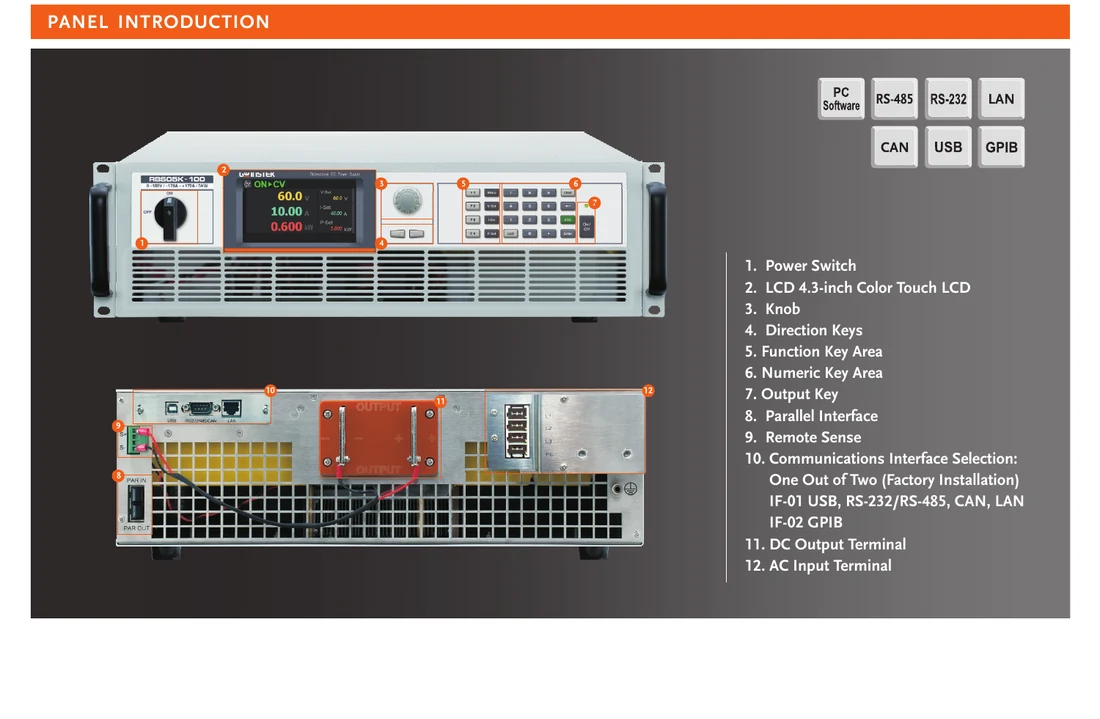
One of two communication cards is factory-installed. A standard dedicated PC control software covers source, source-sink, PV, battery simulation, charge/discharge, list and data-recording modes.
| Interface option | Capability |
|---|---|
| RBS-IF01 | 4-in-1: USB, RS-232/RS-485, CAN, LAN |
| RBS-IF02 | GPIB |
| Front panel | 4.3-inch colour touch operation |
| Parallel / remote sense | Master-slave parallel control + remote voltage sensing |
Ordering Information & Accessories
Models: RBS05K-100, RBS10K-100, RBS15K-100, RBS05K-500, RBS10K-500, RBS15K-500, RBS20K-500, RBS30K-500, RBS05K-750, RBS10K-750, RBS15K-750, RBS20K-750, RBS30K-750, RBS10K-1000, RBS20K-1000, RBS15K-1500, RBS20K-1500, RBS30K-1500, RBS15K-2250, RBS30K-2250.
Interface options: RBS-IF01 (USB, RS-232/RS-485, CAN, LAN) · RBS-IF02 (GPIB).
Optional accessories: GTL-series load cables from 100 A to 400 A in 1.5 m and 3 m lengths (GTL-133/218/219/220/221/222/223) · GPW-021 input power cord (10 AWG / 4C, 3 m, UL/CSA).
GW Instek RBS Series Price in India
The price of an RBS Series unit in India depends on the configuration you need, the power class (5 kW to 30 kW), the voltage class (100 V up to 2250 V), the communication interface (4-in-1 RBS-IF01 vs GPIB RBS-IF02), the number of units for parallel operation, and load-cable accessories. As an authorized partner, GSAS quotes the RBS Series in INR with GST-compliant billing and helps you specify the lowest-cost configuration that still meets your DUT’s voltage and current envelope. Request a quote for current RBS pricing and lead time in India.
Why Buy the GW Instek RBS Series from GSAS in India
GSAS Micro Systems is an authorized partner in India, supplying the complete RBS Series with INR invoicing, GST-compliant billing, and pre-sales application engineering for test-system design. Our power-electronics team helps you select the right model based on your DUT’s voltage and current envelope, configure master-slave parallel systems for high-power applications, and integrate the RBS into existing test-automation frameworks. We provide demos, evaluation units, installation, calibration and after-sales support from offices in Bengaluru, Hyderabad, Chennai, Pune, Mumbai and Delhi NCR, with service reach across Visakhapatnam and the wider region.
Blog
GW Instek Insights
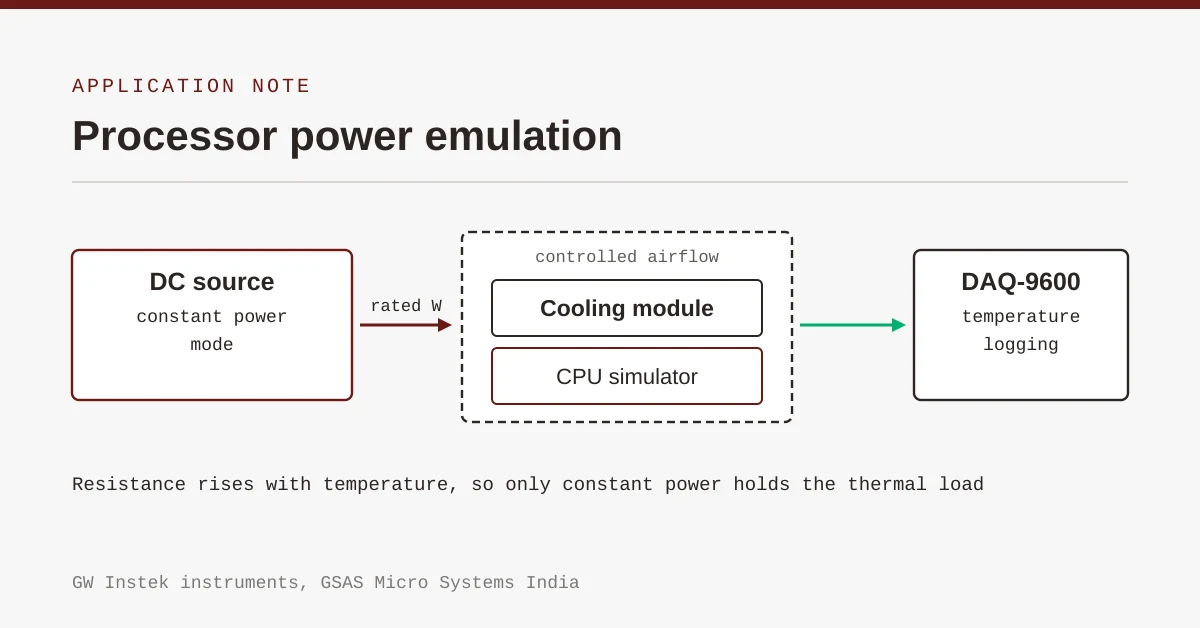
Emulating Processor Power for Thermal Testing: Why Constant Power
A heat sink or a cold plate is qualified against a watt figure, not a volt figure. This application note explains why a thermal load is driven in constant-power mode, how the bench is built for air and for liquid cooling, and what to confirm before you buy.
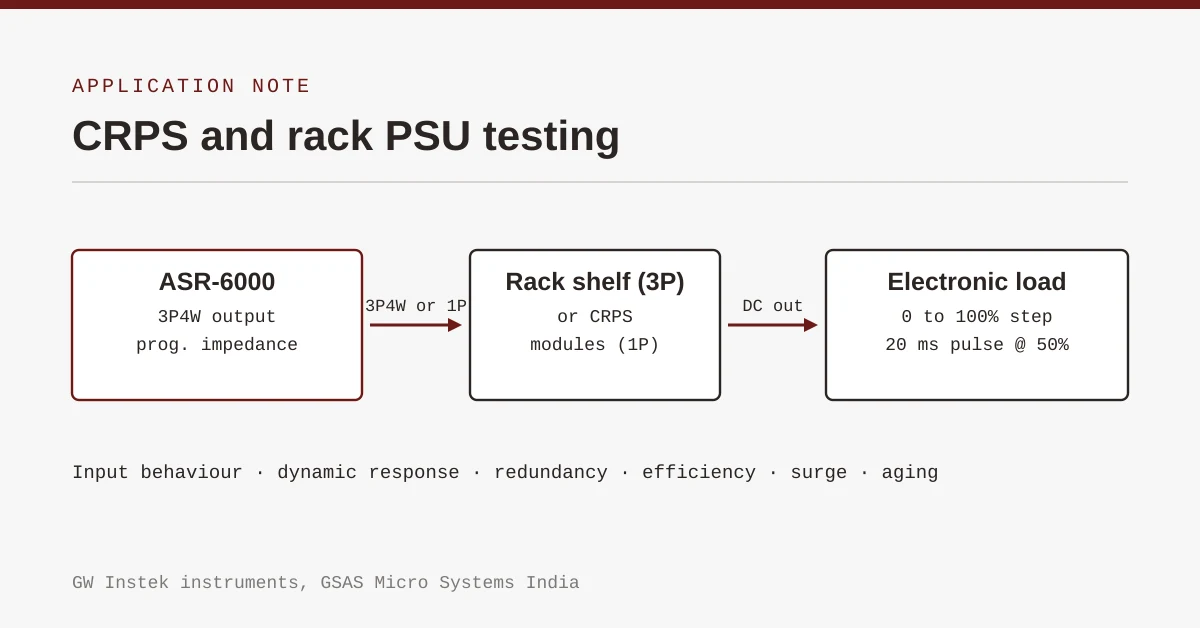
CRPS and Rack Power Supply Testing: The Six Tests That Matter
A CRPS module has to hold up under an unbalanced grid, a 0 to 100 percent load step, a surge on the line and a redundancy handover. This application note sets out the six tests, and the one source capability that makes a long feeder reproducible on the bench.
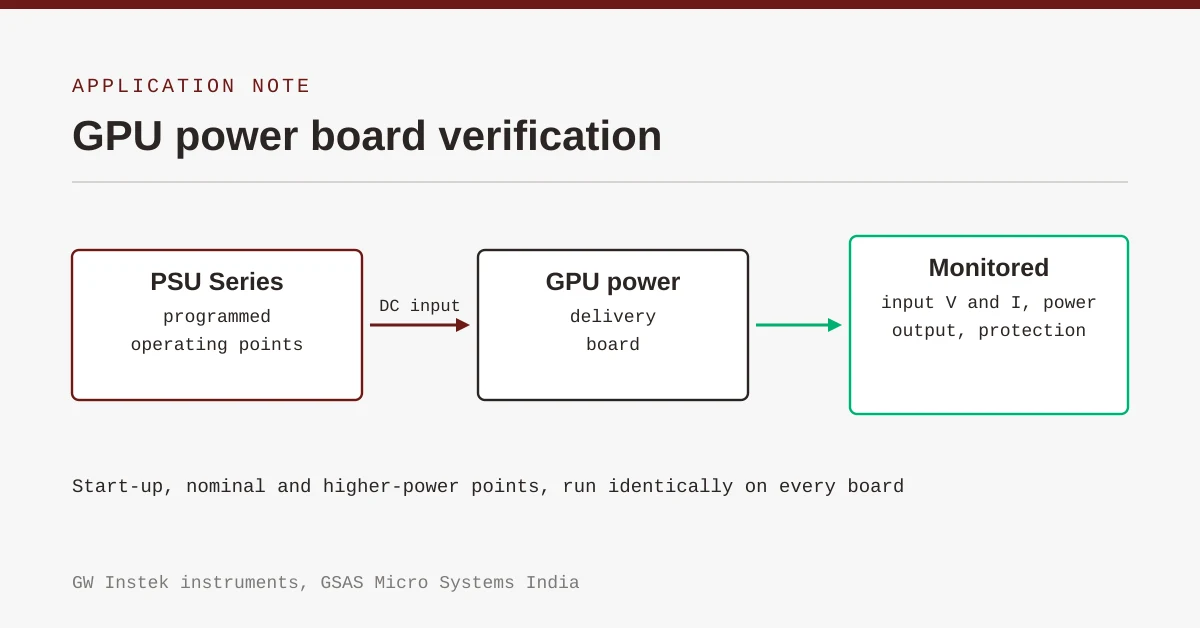
GPU Power Board Testing: DC Input Verification Before Integration
A GPU power delivery board is cheap to reject on a bench and expensive to find in an assembled server. This application note covers the programmable DC input test that screens the board, and the same test applied to incoming server systems.
Related products
More from GW Instek
All GW Instek products →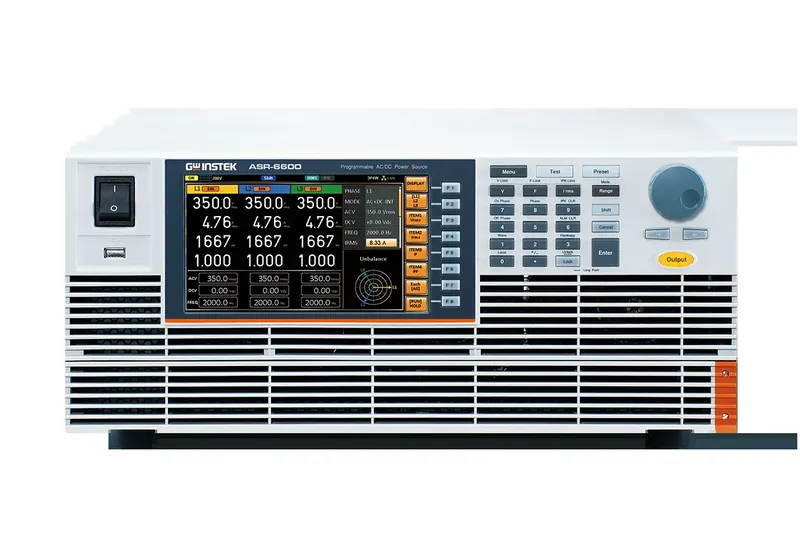
ASR-6000 Series
GW Instek ASR-6000 Series high-performance programmable AC/DC power source, a third-generation SiC-based regenerative-grade AC DC power source family (ASR-6450 4.5 kVA, ASR-6500 5 kVA, ASR-6600 6 kVA, ASR-6660 6.6 kVA) delivering up to 350 Vrms phase / 700 Vrms line and ±500 V DC in a 4U chassis, with 10 output modes, single- and three-phase AC output (1P2W/1P3W/3P4W), 100th-order harmonic analysis and rack-parallel expansion to 39.6 kVA. Available as an AC power source in India from GSAS Micro Systems, an authorized GW Instek engineering partner, with application engineering, calibration and nationwide support.
View ASR-6000 Series →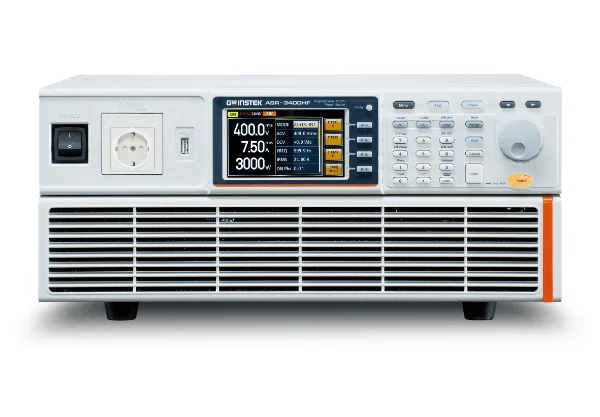
ASR-3000 Series
Compact programmable AC/DC power source up to 5kVA with high-frequency mode, power analysis, and IEC harmonics testing. Available in India from GSAS with hands-on application engineering and local support.
View ASR-3000 Series →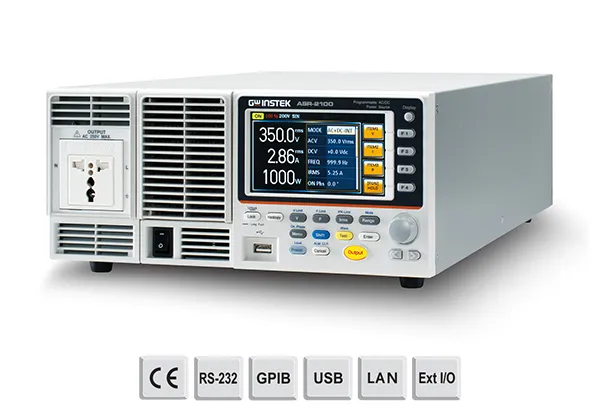
ASR-2000 Series
Programmable AC/DC power source with voltage/current harmonic analysis, arbitrary waveform, and sequence functions. Available in India from GSAS with hands-on application engineering and local support.
View ASR-2000 Series →Available across India
FAQ
Common questions about RBS Series Regenerative Bidirectional DC Source
What is the GW Instek RBS Series?
Which RBS Series models are available, and what are their ratings?
What is the maximum current and power of the RBS Series?
Does the RBS Series support solar array (PV) simulation?
Which battery chemistries can the RBS Series simulate?
What remote-control interfaces does the RBS Series have?
How is the RBS Series different from a separate DC power supply plus electronic load?
How much does the GW Instek RBS Series cost in India?
What warranty and after-sales support does the RBS Series include in India?
How does the RBS Series save energy and running cost?
Is an RBS cheaper than a separate DC supply plus electronic load over time?
RBS Series vs PEL-5000G, which should I choose?
How do I buy the GW Instek RBS Series in India?
Interested in RBS Series Regenerative Bidirectional DC Source?
Get pricing, an evaluation unit, or a technical consultation from our application engineers.