In short
CEV Stage V, India's emission stage for construction equipment vehicles, has been in force since 1 January 2025, across all engine power bands, after a single deferral from 1 April 2024 by GSR 163(E). The October 2026 dates people cite are the tractor TREM Stage V date and the CEV in-service emission monitoring trigger, not CEV Stage V applicability.
Search for the date CEV Stage V applies in India and you will get two answers. One says the norms have been in force since the start of 2025. The other says construction equipment moves to Stage V in October 2026. Both circulate in trade coverage, in supplier decks and in the summaries forwarded around procurement and programme teams, and only one matches the gazette.
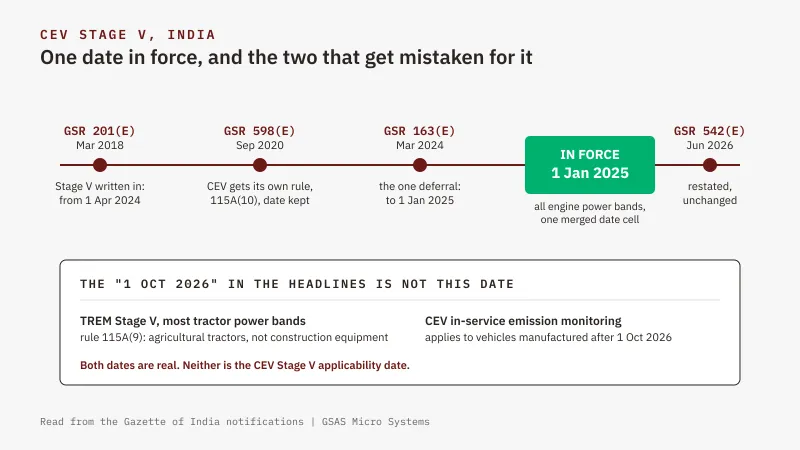
The gazette record, as of publication, is not ambiguous. CEV Stage V has applied since 1 January 2025, and it applies on that single date across every engine power band, from below 8 kW to 560 kW and above. The operative table carries one merged date cell, not a staggered introduction.
The October 2026 dates are real dates. They are simply not this one. One belongs to agricultural tractors, which sit in a separate rule on a separate schedule. The other triggers in-service emission monitoring of construction equipment vehicles manufactured after that date, and presumes Stage V is already in force. Reading either as the applicability date places a machine programme about twenty months behind where it actually is.
We went and read the notifications instead of the summaries. Here is the chain.
The Date, from the Gazette Itself
GSR 201(E), 5 March 2018 (Central Motor Vehicles Second Amendment Rules, 2018) created a combined Bharat Stage regime covering construction equipment vehicles and tractors together, inside rule 115A(9), and set Stage V at 1 April 2024.
GSR 598(E), 30 September 2020 (Thirteenth Amendment Rules, 2020) split the two apart. Construction equipment vehicles received a standalone rule, 115A(10), with CEV Emission Stage-V retained at 1 April 2024. That split is the structural fact behind the confusion that followed: from 2020 the two schedules were free to diverge, and they did.
GSR 163(E), 7 March 2024 (Fifth Amendment Rules, 2024, published 8 March 2024) is the deferral, and there is exactly one of them. It substituted “1st January, 2025” for “1st April, 2024” in the rule 115A(10) table. The same notification moved two related dates by the same interval: rule 120(6), the CEV noise provision, and rule 124C, the CEV safety provision. All three landed together on 1 January 2025, which is worth knowing if your programme treated emissions, noise and machine safety as unrelated work streams.
GSR 542(E), 30 June 2026 (Eleventh Amendment Rules, 2026, in force 1 July 2026) is the notification most often misread, because it substitutes rules 115A(9) and 115A(10) wholesale and therefore reprints the entire schedule. Reprinting is not rescheduling. CEV Stage V is restated at 1 January 2025, unchanged. What this notification changes is real but narrower than a reschedule: an expanded fuel list taking in hydrogen and HCNG, a tightened flat ammonia limit for Stage V, and a later trigger for in-service emission monitoring, which now applies to construction equipment vehicles manufactured after 1 October 2026. The draft that preceded it was GSR 151(E) of 27 February 2026.
One further provision matters commercially. Machines manufactured before the applicability date remained registrable for six months after it, a window present in GSR 598(E) from the start, kept at six months for Stage V when GSR 800(E) of 15 November 2021 reset the Stage IV window to eight, and restated in GSR 542(E). It closed long ago, but it explains why pre-Stage-V machines were still being registered well into 2025, and why some dealer records read as though the date had slipped again. It had not.
Where October 2026 Actually Comes From
Two provisions carry that date. Neither is CEV Stage V applicability.
The first is tractors. Rule 115A(9) covers the TREM series, which applies to agricultural tractors, power tillers and combine harvesters. Under GSR 542(E), TREM Stage V takes effect on 1 October 2026 for most power bands, while two bands run a different course: the 19 to 37 kW band reaches TREM IIIAA from 1 April 2028 under Table 2, and both the 19 to 37 kW and 37 to 56 kW bands reach TREM V from 1 April 2032 under Table 2A. If a briefing note began life as a tractor document, October 2026 is the date it was carrying, and construction equipment picked it up by association.
The second is monitoring. GSR 542(E) sets in-service emission monitoring for construction equipment vehicles manufactured after 1 October 2026, superseding an earlier 1 April 2026 trigger. That is a date about which machines are in scope, not about which stage they are built to. The notification delegates the monitoring procedure to AIS:137 as amended from time to time, so the gazette text carries the trigger and the standard carries the method.
Several other notifications get pulled into this argument and should not be. GSR 141(E) of 27 February 2024 deferred TREM V for tractors to 1 April 2026; it is a tractor notification throughout. GSR 676(E) and GSR 850(E) are tractor TREM IV deferrals. GSR 240(E) of 2021 concerns faceless licensing and says nothing about emissions at all.
The reliable way to keep this straight needs no calendar. Rule 115A(9) is tractors. Rule 115A(10) is construction equipment vehicles. Once you know which rule a date lives in, you know which machine it governs.
What Stage V Asks of the Machine
The technical content of Stage V originates in GSR 201(E) and GSR 598(E); GSR 542(E) now carries the operative text, and it did not leave every provision untouched.
A particle number limit of 1 x 10^12 particles per kWh applies to engines from 19 kW to below 560 kW, and particulate mass tightens to 0.015 g/kWh over that same band. Emission testing follows AIS:137, using the non-road steady cycle in its 8-mode variable-speed and 5-mode constant-speed forms alongside the non-road transient cycle, weighted 10 percent cold and 90 percent hot for the relevant bands. Where selective catalytic reduction is used to control NOx, the reagent is AUS 32 conforming to ISO 22241 or IS 17042, and ammonia emissions over the test cycles are capped for Stage V at a mean 10 ppm, a limit GSR 542(E) set flat, replacing the earlier 25 ppm and 10 ppm power-band split that now applies to Stage IV only. Emission durability periods of 3000, 5000 and 8000 hours apply, or assigned deterioration factors in their place, and conformity of production frequency is tied to annual production or import volume.
Now the part that needs a label on it. The notifications never use the words ECU, network or telematics. The construction-equipment rule does reach for electronics once: engines that rely on a catalytic converter, electronic EGR or a reagent to reduce emissions must ensure the correct operation of their NOx control measures. That is as far as the text goes. Everything in the rest of this section is our reading of what the limits imply for a machine, not something the gazette states.
Read as an engineering brief, a particle number ceiling at that level and a NOx strategy built on urea dosing describe an aftertreatment system that is controlled rather than passive. Dosing has to track engine-out NOx and catalyst temperature closely enough to stay inside an ammonia limit at one end and a NOx limit at the other. Particulate control against a number limit rather than a mass limit alone puts weight on how consistently the filter and its regeneration behave. Both are closed loops, and closed loops need sensors, a controller, calibration data and a place for all of it to talk. On a construction machine that place is the vehicle network, which is the subject of our overview of vehicle networks in construction and mining equipment. The practical consequence for a machine electronics team is not a new bus. It is more signals on the bus you already have, more parameters to calibrate, and more failure modes that only appear as a disagreement between two of them.
In-service emission monitoring points the same way, and here the labelling has to be stricter still. What we can state is the trigger: GSR 542(E) applies in-service emission monitoring to construction equipment vehicles manufactured after 1 October 2026. The gazette delegates the procedure to AIS:137 rather than describing it, and we will not characterise a standard we have not opened here. What we will say, as our reading rather than a regulatory claim, is that any regime concerned with machines in the field raises the questions Indian teams already meet when machine data leaves the machine: which parameter is authoritative, how it is scaled, and whether the number arriving at the far end matches what the bus carried. That path is walked end to end in our piece on how machine data reaches a fleet portal.
The View from India
The industry’s own framing corroborates the date from a different direction. A CII and BCG study of India’s mining and construction equipment industry, published in July 2026, describes the Stage V tightening of particulate limits for construction equipment as a change dating from 2025, not one still ahead (Source: CII-BCG, Pressing the Throttle, July 2026, p. 25). A study written in mid-2026 does not set a 2026 deadline for a norm it treats as already in effect.
The same passage pairs Stage V with AIS-160 safety requirements and puts the combined effect on equipment cost at roughly 12 to 15 percent, with a fleet-upgrade cycle following. That figure is an ICRA estimate reported via NBM&CW rather than a measured outcome, and it covers the two regulatory changes together rather than Stage V alone (Source: CII-BCG, Pressing the Throttle, July 2026, p. 25).
Elsewhere the study makes a point that gets less attention than the cost one. Stage V has already helped Indian exports, by bringing machines built here closer to developed-market specification and lowering a barrier that had kept them out of more regulated markets (Source: CII-BCG, Pressing the Throttle, July 2026, p. 18). That reframes the compliance work: the electronic content that comes with meeting the norm is also the content that makes a machine sellable where it previously was not.
To be clear about the division of labour: the two claims we take from the study are the cost estimate and the export effect, nothing else. The study does discuss digitally connected fleets in its own market terms, but it says nothing about emission-control electronics, benches or test practice, and every engineering inference drawn above is ours, not its.
Where GSAS Fits
GSAS Micro Systems is an engineering partner to machine builders and their component suppliers, and the boundary is worth stating plainly. We do not run homologation and we do not certify emissions; that work belongs to the accredited laboratories and certifying agencies. What we do sits upstream of it, on the sensing, control and data electronics around a Stage V machine.
In practice that means three things for construction and mining teams. Bench and instrumentation design, so an aftertreatment control loop can be exercised and observed before it meets a machine. Measurement, when a signal has to be trusted at the level a calibration or a warranty argument depends on. And network and protocol validation, so a parameter reported by a controller, shown on a display and logged for a fleet system is the same number in all three. Our construction and mining solutions page carries the sector view.
Emission-stage electronics questions reach our applications engineers in Bengaluru, Hyderabad, Chennai, Pune, Mumbai and Delhi NCR. If the Stage V transition left you with more sensors and control loops than your bench was built to watch, tell us what the machine carries and where the visibility stops when you request a quote, and we will scope it from there.
References
- GSR 201(E), 5 March 2018, Central Motor Vehicles (Second Amendment) Rules, 2018: https://egazette.gov.in/WriteReadData/2018/183654.pdf
- GSR 598(E), 30 September 2020, Central Motor Vehicles (Thirteenth Amendment) Rules, 2020: https://egazette.gov.in/WriteReadData/2020/222245.pdf
- GSR 163(E), 7 March 2024 (published 8 March 2024), Central Motor Vehicles (Fifth Amendment) Rules, 2024: https://egazette.gov.in/WriteReadData/2024/252813.pdf
- GSR 542(E), 30 June 2026, Central Motor Vehicles (Eleventh Amendment) Rules, 2026, in force 1 July 2026: https://egazette.gov.in/WriteReadData/2026/273991.pdf
- GSR 151(E), 27 February 2026, the draft preceding GSR 542(E): https://egazette.gov.in/WriteReadData/2026/270622.pdf
- GSR 800(E), 15 November 2021, which amended the registration grace periods first set in GSR 598(E), later restated in GSR 542(E): https://egazette.gov.in/WriteReadData/2021/231176.pdf
- Notifications cited for disambiguation only: GSR 141(E), 27 February 2024, TREM Stage V deferral for tractors: https://egazette.gov.in/WriteReadData/2024/252471.pdf; GSR 676(E), 29 September 2021, and GSR 850(E), 24 November 2022, tractor TREM Stage IV deferrals: https://morth.gov.in/backend/old_files/notifications_document/GSR%20676(E)%2029th%20September%202021%20Trem%20Extension%20by%20six%20months.pdf and https://morth.gov.in/backend/old_files/notifications_document/12-GSR%20850(E)%2024%20November%202022%20TREM%20extension%201st%20jan23.pdf; GSR 240(E), 31 March 2021, electronic licensing and registration services: https://egazette.gov.in/WriteReadData/2021/226344.pdf
- AIS:137, the automotive industry standard named in the notifications for the non-road steady and transient test cycles; cited here only as referenced in the gazette text.
- ISO 22241, the specification named in the notifications for AUS 32 NOx-reduction reagent, with IS 17042 as the alternative permitted by GSR 542(E); cited here only as referenced in the gazette text.
- Confederation of Indian Industry and Boston Consulting Group, “Pressing the Throttle: How India’s Mining and Construction Equipment Industry can support domestic ambitions and become a global force”, July 2026, pp. 18 and 25. The 12 to 15 percent cost figure on p. 25 is attributed in the study to an ICRA estimate reported via NBM&CW.
Also appears in:
Building for Construction & Mining?
Talk to our application engineers for personalized tool recommendations.