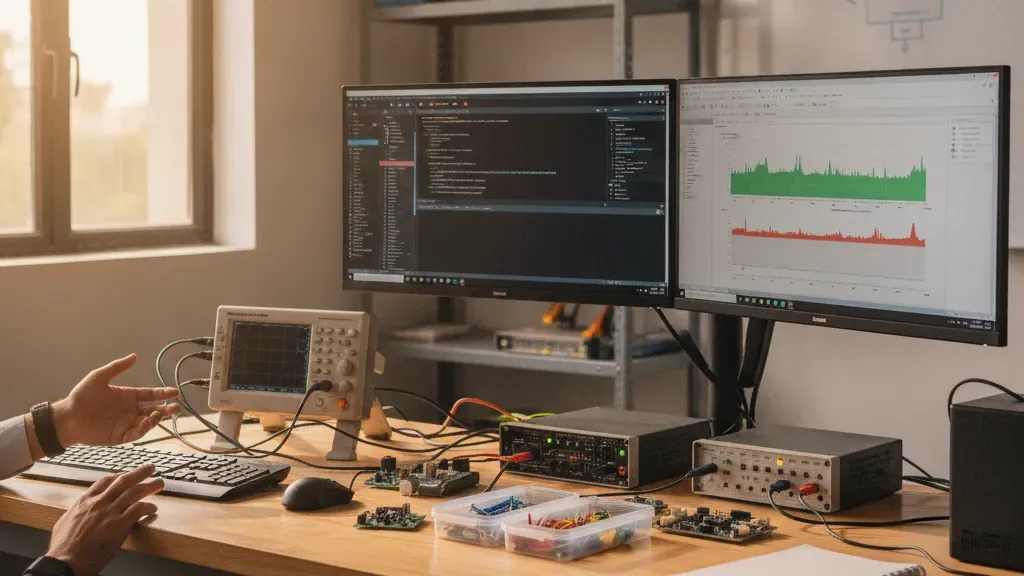
India's Automotive Electronics Opportunity: Building for Bharat and Beyond, featured image

India's Automotive Electronics Opportunity: Building for Bharat and Beyond

GSAS Editorial · · 1 min read

India’s automotive electronics market is undergoing a transformation driven by electrification mandates, increasing electronic content per vehicle, and the emergence of India as a global engineering services hub for automotive software development. With projections pointing toward a $15 billion market by 2028, the opportunity for Indian engineering teams extends well beyond the domestic market to encompass global automotive supply chains seeking cost-effective, high-quality embedded development capabilities.

Key growth areas include Advanced Driver Assistance Systems (ADAS), Battery Management Systems for electric vehicles, connected vehicle platforms, and body electronics. Each of these domains carries specific compliance requirements, ISO 26262 for functional safety, AUTOSAR for software architecture, and increasingly the EU Cyber Resilience Act for cybersecurity, that Indian teams must master to compete at the Tier-1 and OEM level rather than remaining confined to lower-value outsourcing roles.

The right development tools and engineering infrastructure form the foundation for this competitive transformation. Teams equipped with certified testing tools, professional debug hardware, and standards-compliant development environments can deliver work products that meet global OEM quality expectations, while compliance expertise becomes a differentiator that commands premium billing rates and strategic partnership status.

Building for Automotive & Mobility?

Talk to our application engineers for personalized tool recommendations.
Stay in the Loop

Get monthly compliance updates, product insights, and engineering best practices delivered to your inbox.

Related Articles

Classification tree and combination table used to design embedded unit test cases in Razorcat's Classification Tree Editor for TESSY, available in India from GSAS Micro Systems
Compliance & Safety Razorcat Automotive & Mobility

Test Case Design with the Classification Tree Method: Deriving Unit Tests You Can Defend in an Audit

Ad-hoc test cases can be perfectly good tests and still fail an audit, because nothing on file records why that particular set was sufficient. The Classification Tree Method derives test cases from the input space instead: identify the test-relevant aspects as classifications, partition each into equivalence classes, then combine leaf classes in a combination table. Razorcat implements CTM in the Classification Tree Editor, available integrated into TESSY or standalone. GSAS Micro Systems is the authorized Razorcat engineering partner for India, the UAE and Sri Lanka.

1 Aug 2026 · 10 min read
Fault injection and robustness testing for safety-related embedded C and C++ software, explained for Indian engineering teams by GSAS Micro Systems, the authorized Razorcat engineering partner
Compliance & Safety Razorcat Automotive & Mobility

Fault Injection and Robustness Testing for Embedded Software: What ISO 26262, IEC 61508 and DO-178C Actually Ask For

Every safety-related unit contains code that correct inputs never execute: range checks, error returns, timeouts, recovery paths. The functional safety standards require that code to be verified, and they are explicit about how. ISO 26262-6 lists fault injection test as a method for both software unit verification and software integration verification; IEC 61508-3 recommends defensive programming from SIL 2 upward and then concedes that defensive code is exactly what stops teams reaching 100 percent structural coverage. This guide separates robustness testing from fault injection, maps each to the obligation that asks for it, and shows how Razorcat implements automated fault injection in TESSY without leaving instrumentation in production code.

1 Aug 2026 · 11 min read
Buyer-side evaluation framework for embedded unit testing tools, covering compiler and debugger fit, on-target execution, coverage levels and qualification evidence, from GSAS Micro Systems in India
Compliance & Safety Razorcat Automotive & Mobility

How to Evaluate a Unit Testing Tool for Embedded Software: A Buyer's Framework for Indian Teams

Unit test tool evaluations rarely fail on features. They fail because the tool cannot drive the compiler and debugger the project is already committed to, or because the evidence it produces sits outside the scope of the certificate the assessor asks for. This is a buyer-side framework: six questions, what a credible answer looks like in vendor documentation, and a four-week pilot that measures the answers instead of accepting them.

1 Aug 2026 · 10 min read