When Indian harness manufacturers evaluate cable test equipment, the first technical decision is the measurement method: 2-wire or 4-wire. Both methods verify continuity, wiring correctness, insulation resistance, and hipot withstand. The difference is in resistance measurement accuracy, and that difference determines whether the tester can detect marginal crimps and high-resistance joints that are the root cause of most cable harness field failures.
The Fundamental Difference
2-wire measurement sends test current through two wires and measures voltage across the same two wires. The measured resistance includes the fixture leads, probe contact resistance, and the actual conductor resistance. The fixture contribution can be 100-500 milliohms depending on cable length, connector type, and contact condition.
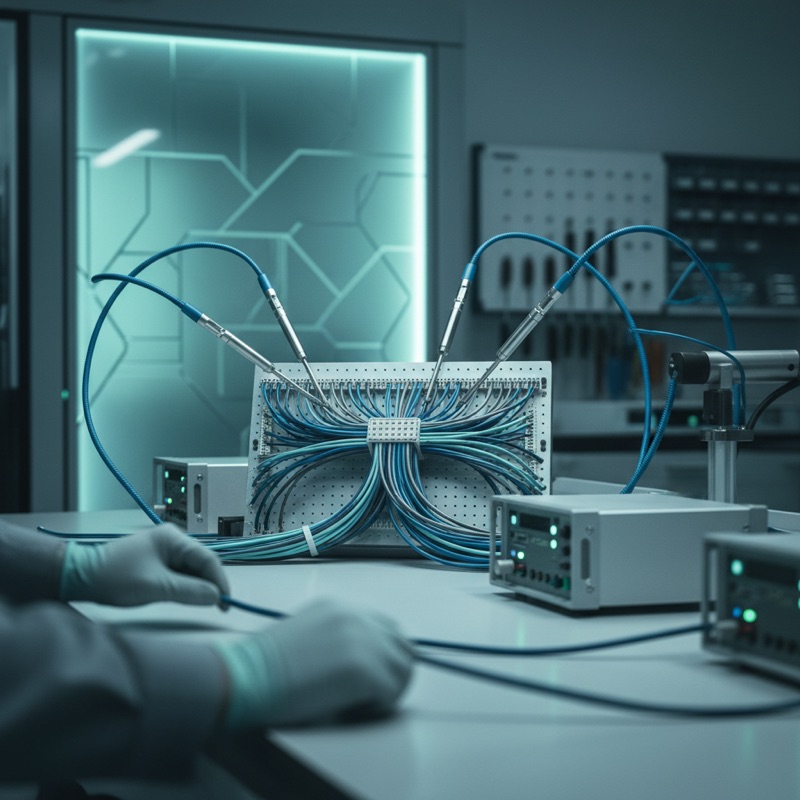
4-wire (Kelvin) measurement uses two wires to carry the test current and two separate wires to sense voltage. The voltage sensing wires carry virtually no current, so fixture lead resistance and contact resistance do not affect the reading. The measured resistance is the true conductor resistance, with milliohm accuracy.
| Aspect | 2-Wire | 4-Wire (Kelvin) |
|---|---|---|
| Resolution | Ohms | Milliohms |
| Fixture error | Included | Eliminated |
| Detects open circuits | Yes | Yes |
| Detects miswires | Yes | Yes |
| Detects marginal crimps | No | Yes |
| Detects cold solder joints | No | Yes |
| Fixture complexity | Simpler | More complex (4 contacts per point) |
| Test speed | Faster | Slightly slower per point |
| Cost | Lower | Higher |
When 2-Wire Testing Is Sufficient
For many cable testing applications, 2-wire measurement provides adequate quality assurance:
Signal cables and data cables: Ethernet, USB, HDMI, and other data cables where conductor resistance is not a critical performance parameter. The key tests are continuity (is the connection present?), wiring correctness (is each pin connected to the right pin?), and insulation integrity. 2-wire measurement answers these questions definitively.
Low-current control cables: Sensor cables, control panel wiring, and instrumentation cables carrying milliamp-level signals. The conductor resistance is not a significant source of signal degradation at these current levels.
High-volume, cost-sensitive production: Cable manufacturers in Delhi NCR and Mumbai producing millions of consumer cables per month may find that 2-wire testing provides sufficient quality assurance at lower fixture cost and higher throughput.
The Microtest 2-Wire Harness Tester and 8740K Cable Tester serve these applications with up to 1024 test points, hipot testing, and barcode-triggered multi-model capability.
When 4-Wire Testing Is Essential
For applications where conductor resistance affects product performance or safety, 4-wire measurement is not optional:
Automotive power harnesses: Cables carrying 10 A, 20 A, or more to headlights, motors, window mechanisms, seat heaters, and starter circuits. A marginal crimp that adds 50 milliohms of resistance causes a 0.5 W power dissipation at 10 A, enough to heat the crimp, degrade the insulation over time, and eventually cause an open circuit or fire. The 2-wire method cannot detect this 50-milliohm crimp buried in 200+ milliohms of fixture resistance.
Aerospace wire assemblies: Aviation and defence cable assemblies where reliability is critical and every connection must be verified to tight resistance specifications. Aerospace standards specify maximum allowable resistance per connection, and these specifications are in the milliohm range, accessible only with 4-wire measurement.
Battery cables and power distribution: EV battery harnesses, power distribution cables, and high-current industrial wiring. At the current levels these cables carry, even small resistance variations cause significant power loss and thermal stress.
Medical device cables: Patient-connected cables where resistance variations can affect measurement accuracy (ECG leads, patient monitoring cables) or power delivery (electrosurgical cables, defibrillator leads).
The Microtest 4-Wire Harness Tester provides the Kelvin measurement capability for these applications, with milliohm resolution that reveals marginal crimps and high-resistance joints.
Fixture Considerations
4-wire testing requires fixtures with four contacts per test point, two for current injection and two for voltage sensing. This means:
- Fixture cost is higher: more contact pins, more complex wiring within the fixture, and tighter mechanical tolerances for contact alignment
- Fixture design requires expertise: contact placement, spring force, and material selection affect measurement repeatability
- Fixture maintenance is more demanding: four contacts per point means four potential sources of contamination and wear
For automotive harness manufacturers in Pune and Chennai where 4-wire testing is standard, fixture design and maintenance are integral to the test process. GSAS provides fixture design consultation to ensure that the fixture does not introduce measurement variability that undermines the accuracy advantage of 4-wire testing.
The Hybrid Approach
Some production lines use both methods in a complementary workflow:
-
2-wire test (fast): verifies continuity, wiring correctness, insulation resistance, and hipot on every harness. This catches gross defects (opens, shorts, miswires, insulation failures) at production speed.
-
4-wire test (thorough): verifies conductor resistance on a sample basis or on critical circuits within the harness. This catches marginal crimps and resistance anomalies on the specific conductors that carry high current or are safety-critical.
This hybrid approach provides 100% screening for gross defects at 2-wire speed, plus targeted milliohm-accuracy verification on the circuits where it matters most.
Cost-Benefit Analysis
For an Indian harness manufacturer evaluating the investment:
- 2-wire system cost: lower instrument cost, simpler fixtures, faster test time per harness
- 4-wire system cost: higher instrument cost, more complex fixtures, slightly longer test time
- Cost of a field failure: warranty claim, vehicle recall coordination, reputation damage, and potential safety liability
For automotive and aerospace harness manufacturers, the cost of a single field failure from a marginal crimp typically exceeds the incremental investment in 4-wire test capability. The question is not whether 4-wire testing is worth the investment, but whether the production line can afford to operate without it.
Why Buy from GSAS
GSAS Micro Systems is an authorised Microtest partner in India, providing both 2-wire and 4-wire cable harness testers with INR invoicing, fixture design consultation, and production integration support. Our team helps harness manufacturers across Bengaluru, Hyderabad, Chennai, Pune, Mumbai, and Delhi NCR select the right test method and configure their test stations for maximum quality assurance. Contact GSAS to discuss your cable testing requirements.
Also appears in:
Interested in Microtest tools?
Talk to our application engineers for personalized tool recommendations.
More from Microtest
View all →
Power Measurement for Server PSUs: Microtest 7140 Power Analyzer
7 Apr · 5 min

Wireless Charger QC Testing with the Microtest 9901
7 Apr · 5 min

Motor Stator Testing in EV Manufacturing: Microtest MT-6910 Series
7 Apr · 5 min
PCB Incoming Inspection with Multichannel LCR Testing
6 Apr · 5 min
Emulating Processor Power for Thermal Testing: Why Constant Power
7 Oct · 7 min
CRPS and Rack Power Supply Testing: The Six Tests That Matter
7 Oct · 7 min