
Wireless charging has moved from a smartphone convenience feature to a production-scale technology deployed across consumer electronics, automotive, and industrial applications. With that scale comes the need for production test systems that verify not just electrical performance but protocol compliance, safety features, and lot-to-lot consistency.
The Microtest 9901 Wireless Charger Auto Test System is a dedicated production test platform for wireless chargers and DC-DC power supply products. It automates protocol verification, foreign object detection testing, and statistical quality analysis for products up to 150 W.
Protocol Verification
Modern wireless chargers and wired fast chargers must negotiate power delivery protocols with the receiving device. A charger that fails protocol negotiation delivers baseline power or no power at all, a functional defect that the end user experiences immediately.
The 9901 tests compliance with multiple charging protocols:
USB PD 2.0 (Power Delivery). The dominant fast-charging protocol for USB-C devices. PD negotiation involves a handshake between charger and device to agree on voltage and current levels. The 9901 exercises the full negotiation sequence, verifying that the charger advertises the correct power profiles and responds correctly to device requests.
QC 2.0 and QC 3.0 (Qualcomm Quick Charge). Widely deployed in Android devices, QC protocols use voltage stepping (QC 2.0) and continuous voltage adjustment (QC 3.0) for fast charging. The 9901 tests protocol compliance at each supported voltage and current combination.
These protocol tests go beyond simple voltage and current measurement, they verify the communication layer that determines whether the charger and device achieve the advertised charging speed.
Foreign Object Detection (FOD)
FOD is a safety requirement for wireless chargers. If a metallic object, a coin, key, paper clip, is placed on the charging pad between the transmitter coil and the device, the metal can absorb RF energy and heat up. In the absence of FOD, this creates a burn or fire hazard.
The 9901 tests FOD compliance by introducing calibrated test objects and verifying that the charger detects the foreign object and reduces or halts power transfer. This test is critical for safety certification and is required by the Qi specification for wireless chargers.
Test Workflow
A typical 9901 test sequence for a wireless charger:
- Protocol detection. The system verifies that the charger correctly advertises its supported protocols and power profiles.
- Voltage and current verification. At each supported power level, the system measures output voltage accuracy, current regulation, and power delivery stability.
- FOD test. With calibrated test objects, the system verifies that foreign object detection activates and that the charger responds appropriately.
- Efficiency measurement. Input and output power measurement provides charging efficiency data at each operating point.
- Statistical logging. Test results are accumulated for statistical analysis, Cp, Cpk, and distribution analysis across the production run.
Statistical Analysis Reports
Production quality monitoring requires more than pass/fail results on individual units. The 9901 generates statistical analysis reports that track measurement distributions across production batches, identifying trends that indicate process drift before the drift causes failures.
For example, if the output voltage at the maximum power profile begins trending toward the upper specification limit across successive batches, the statistical analysis flags this trend, enabling the production team to investigate root cause (component tolerance drift, assembly process variation, calibration drift) before the out-of-specification units appear.
Expansion and Flexibility
The 9901 supports expansion cards for additional test functions beyond the base protocol and power measurement capabilities. This modular approach allows the test system to adapt as charging protocols evolve and as new test requirements emerge from updated safety standards.
The system handles DC-DC power supply products up to 150 W, making it applicable not only to wireless chargers but also to wired USB-C chargers, adapter/converter modules, and portable power bank products that implement PD or QC protocols.
Production Integration
For production line deployment, the 9901 provides automated test sequence execution with minimal operator interaction. The operator places the DUT in the test fixture, initiates the test (or triggers it via barcode scan), and the system executes the complete protocol, FOD, and power measurement sequence automatically. Pass/fail results drive sorting decisions, and statistical data feeds the quality management system.
Availability in India
GSAS is an authorized engineering partner in India, providing the 9901 Wireless Charger Auto Test System with local installation, test fixture support, and calibration. Our team serves wireless charger manufacturers, consumer electronics OEMs, and contract manufacturers across Bengaluru, Hyderabad, Chennai, Pune, Mumbai, Delhi NCR, and Visakhapatnam.
Also appears in:
Interested in Microtest tools?
Talk to our application engineers for personalized tool recommendations.
More from Microtest
View all →
Power Measurement for Server PSUs: Microtest 7140 Power Analyzer
7 Apr · 5 min
Motor Stator Testing in EV Manufacturing: Microtest MT-6910 Series
7 Apr · 5 min
PCB Incoming Inspection with Multichannel LCR Testing
6 Apr · 5 min
Hipot Testing for Indian Manufacturers: Microtest 7630/7631 Series
6 Apr · 5 min
Emulating Processor Power for Thermal Testing: Why Constant Power
7 Oct · 7 min
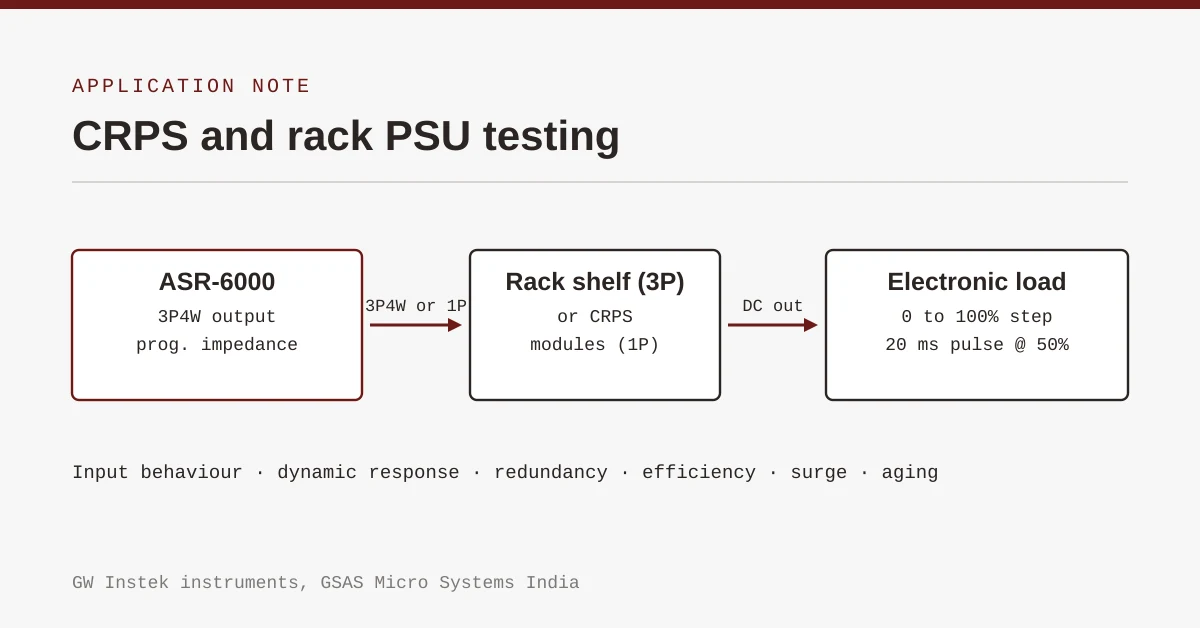
CRPS and Rack Power Supply Testing: The Six Tests That Matter
7 Oct · 7 min