LCR meters and impedance analyzers both measure passive component parameters, inductance, capacitance, resistance, and their derived quantities. But they serve different purposes and offer different levels of measurement depth. Understanding the distinction helps Indian engineering teams invest in the right instrument for their specific requirements, avoiding both underspending (an LCR meter that cannot answer the engineering question) and overspending (an impedance analyzer for a task that an LCR meter handles adequately).
What an LCR Meter Does
An LCR meter measures the impedance of a component at a specific frequency (or a small set of frequencies) and reports the result as equivalent circuit parameters: inductance (L), capacitance (C), resistance (R), along with derived quantities like quality factor (Q), dissipation factor (D), and equivalent series resistance (ESR).
The measurement is fast, milliseconds per reading, and the instrument is designed for production-speed component testing and incoming inspection. Multi-bin sorting, handler interfaces, and programmable test sequences make LCR meters production-line instruments.
The Microtest 6360 Series represents the LCR meter class: 0.05% basic accuracy, 8 ms measurement speed, with bin sorting and a handler interface. The five models span 1 mHz to 1 MHz, from the 6363 up to the 6367.
What an Impedance Analyzer Does
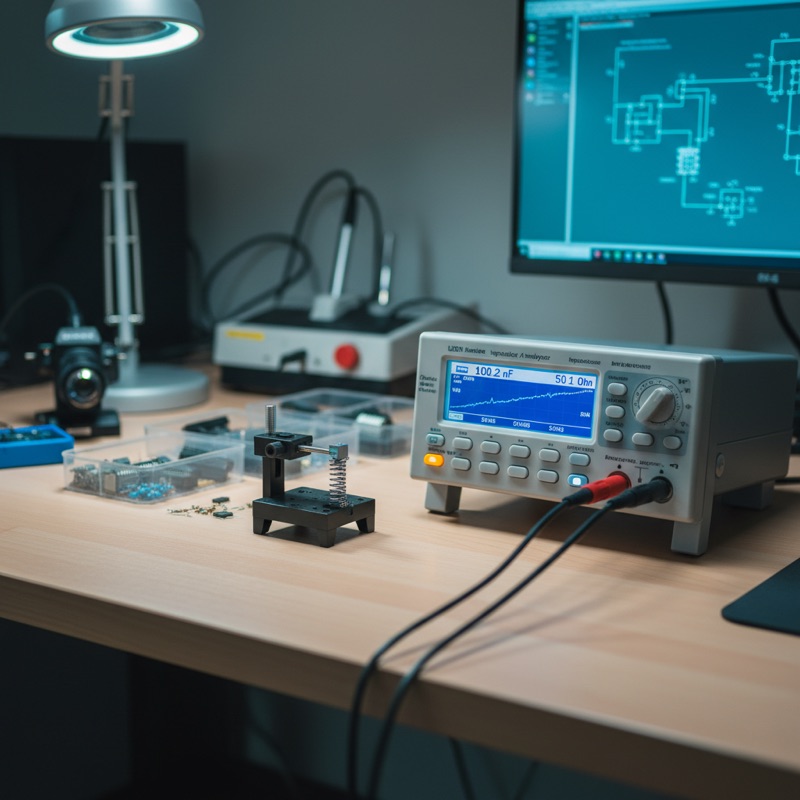
An impedance analyzer measures impedance across a continuous frequency range and reports the full complex impedance, magnitude, phase, real part, imaginary part, at every frequency point. It also derives material parameters (permittivity, permeability) that require frequency-swept measurements.
The measurement is more detailed but may be slower per frequency point. The instrument is designed for characterisation, understanding how a component or material behaves across its operating frequency range.
The Microtest 6632 represents the impedance analyzer class: 10 Hz to 50 MHz, ±0.08% basic accuracy (typical ±0.05%), sweep mode, and material characterisation parameters (epsilon-r, mu-r).
Side-by-Side Comparison
| Capability | LCR Meter (6360 Series) | Impedance Analyzer (6632) |
|---|---|---|
| Frequency Range | 1 mHz - 1 MHz (6363 to 6367) | 10 Hz - 50 MHz |
| Basic Accuracy | 0.05% | 0.08% (typical 0.05%) |
| Measurement Speed | 8 ms (production speed) | <3 ms (characterisation speed) |
| Parameters | L, C, R, Z, ESR, D, Q, theta, DCR | All of the LCR set + epsilon-r, mu-r |
| Measurement Modes | Meter mode, list mode | Meter, list, and sweep mode |
| Equivalent Circuit Analysis | No | Optional (6632S models) |
| Bin Sorting | Yes (handler interface) | Yes (BIN comparator) |
| Material Characterisation | No | Yes (permittivity, permeability) |
| SRF Detection | Manual (test at multiple frequencies) | Automatic (sweep reveals SRF) |
| Primary Use | Production test, incoming inspection | R&D characterisation, production test |
When an LCR Meter Is the Right Choice
Incoming inspection. Verifying that purchased capacitors, inductors, and resistors meet specifications at the rated test frequency. The 6360 Series’ speed and sorting capability make it ideal for screening components at production-line rates.
Production sorting. Grading components into tolerance bins for assembly. Inductor manufacturers in Pune and Chennai sort wound inductors by inductance value at the rated test frequency, classifying into ±1%, ±2%, and ±5% bins.
Single-frequency quality checks. When the relevant parameter is known to be the value at a specific frequency, capacitance at 1 kHz per IEC standard, inductance at the rated test frequency, an LCR meter provides the measurement at maximum speed.
Budget-constrained operations. LCR meters are generally less expensive than impedance analyzers. For operations where the measurement need is single-frequency component verification, the LCR meter provides the best value.
When an Impedance Analyzer Is Essential
Component characterisation at operating frequency. When a component will operate at a frequency different from the standard test frequency, the impedance analyzer reveals the actual performance at the operating point. A capacitor rated at 100 nF at 1 kHz may exhibit significantly different capacitance, ESR, and impedance at the 500 kHz switching frequency of a power supply.
Self-resonant frequency (SRF) identification. Every inductor and capacitor has an SRF where the component transitions from its intended behaviour to parasitic-dominated behaviour. An inductor above its SRF behaves as a capacitor. The impedance analyzer’s sweep mode reveals the exact SRF point, critical information for filter design and decoupling optimisation.
Ferrite core and magnetic material characterisation. Measuring permeability vs. frequency of ferrite cores, powdered iron cores, and nanocrystalline materials requires swept frequency analysis with material parameter extraction. This is a core application for impedance analyzers in magnetics design labs across Bengaluru, Hyderabad, and Delhi NCR.
EMI filter characterisation. Verifying the impedance vs. frequency profile of ferrite beads, common-mode chokes, and pi filters. The attenuation provided by an EMI filter varies with frequency, and the impedance analyzer’s sweep confirms that the filter performs as designed at the target suppression frequencies.
PCB substrate characterisation. Measuring the dielectric constant and loss tangent of PCB materials at operating frequencies supports impedance-controlled trace design and signal integrity analysis.
The Practical Decision Framework
For Indian instrument buyers, the decision often follows this pattern:
- Do you need material parameters (epsilon-r, mu-r)? → Impedance analyzer
- Do you need to see behaviour across a frequency range? → Impedance analyzer
- Do you need to find self-resonant frequency? → Impedance analyzer
- Do you need production-speed bin sorting? → LCR meter
- Do you need maximum measurement throughput? → LCR meter
- Is the measurement always at a known, fixed frequency? → LCR meter
Many Indian electronics operations, particularly component manufacturers, contract manufacturers, and quality labs, eventually acquire both instruments. The LCR meter handles the daily production and incoming inspection workload, while the impedance analyzer serves engineering characterisation, failure analysis, and material evaluation needs.
Why Buy from GSAS
GSAS Micro Systems is an authorised Microtest partner in India, providing both LCR meters and impedance analyzers with INR invoicing, application guidance, and fixture selection support. Our team helps engineering teams across Bengaluru, Hyderabad, Chennai, Pune, Mumbai, and Delhi NCR select the right instrument for their measurement needs. Contact GSAS to schedule comparative demos or discuss your requirements.
Also appears in:
Interested in Microtest tools?
Talk to our application engineers for personalized tool recommendations.
More from Microtest
View all →
Power Measurement for Server PSUs: Microtest 7140 Power Analyzer
7 Apr · 5 min
Wireless Charger QC Testing with the Microtest 9901
7 Apr · 5 min
Motor Stator Testing in EV Manufacturing: Microtest MT-6910 Series
7 Apr · 5 min
PCB Incoming Inspection with Multichannel LCR Testing
6 Apr · 5 min
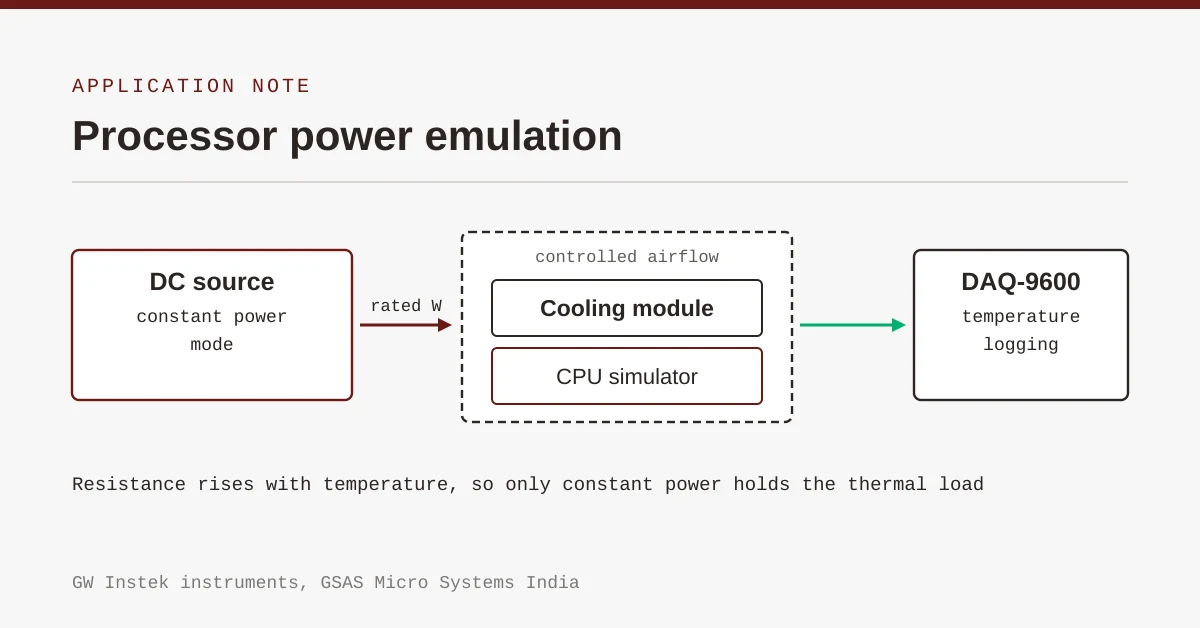
Emulating Processor Power for Thermal Testing: Why Constant Power
7 Oct · 7 min
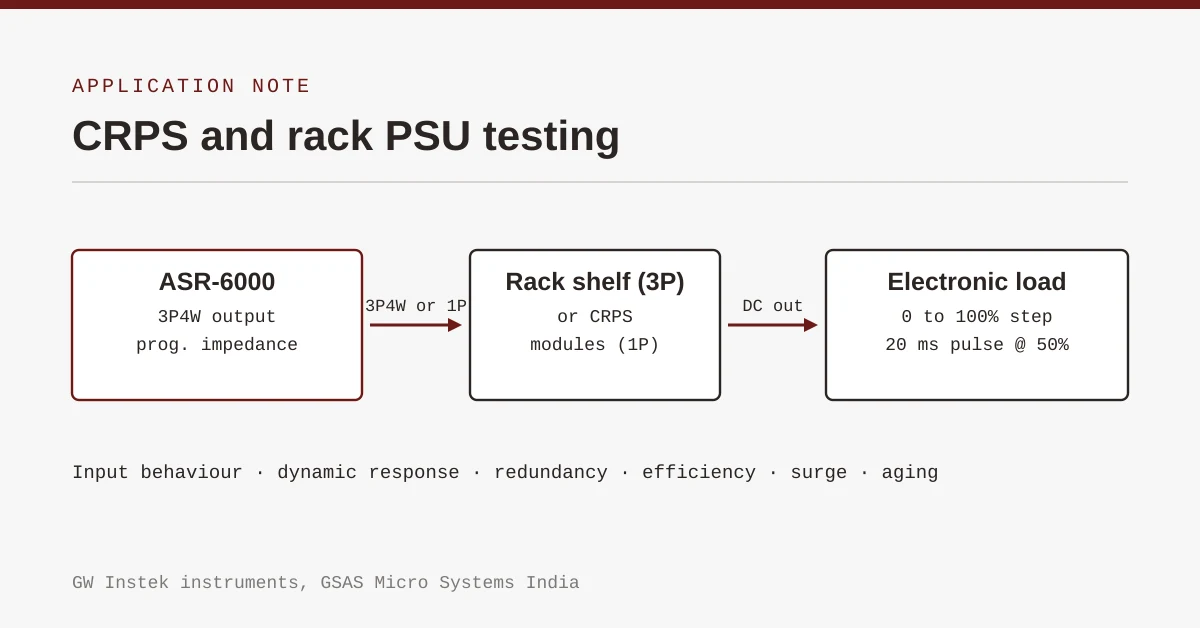
CRPS and Rack Power Supply Testing: The Six Tests That Matter
7 Oct · 7 min