
Webinar
Multi-Board Systems: Rigid-Flex and ECAD-MCAD Co-Design
Part 4 of 5
Multi-Board Systems: Several Boards, One Enclosure
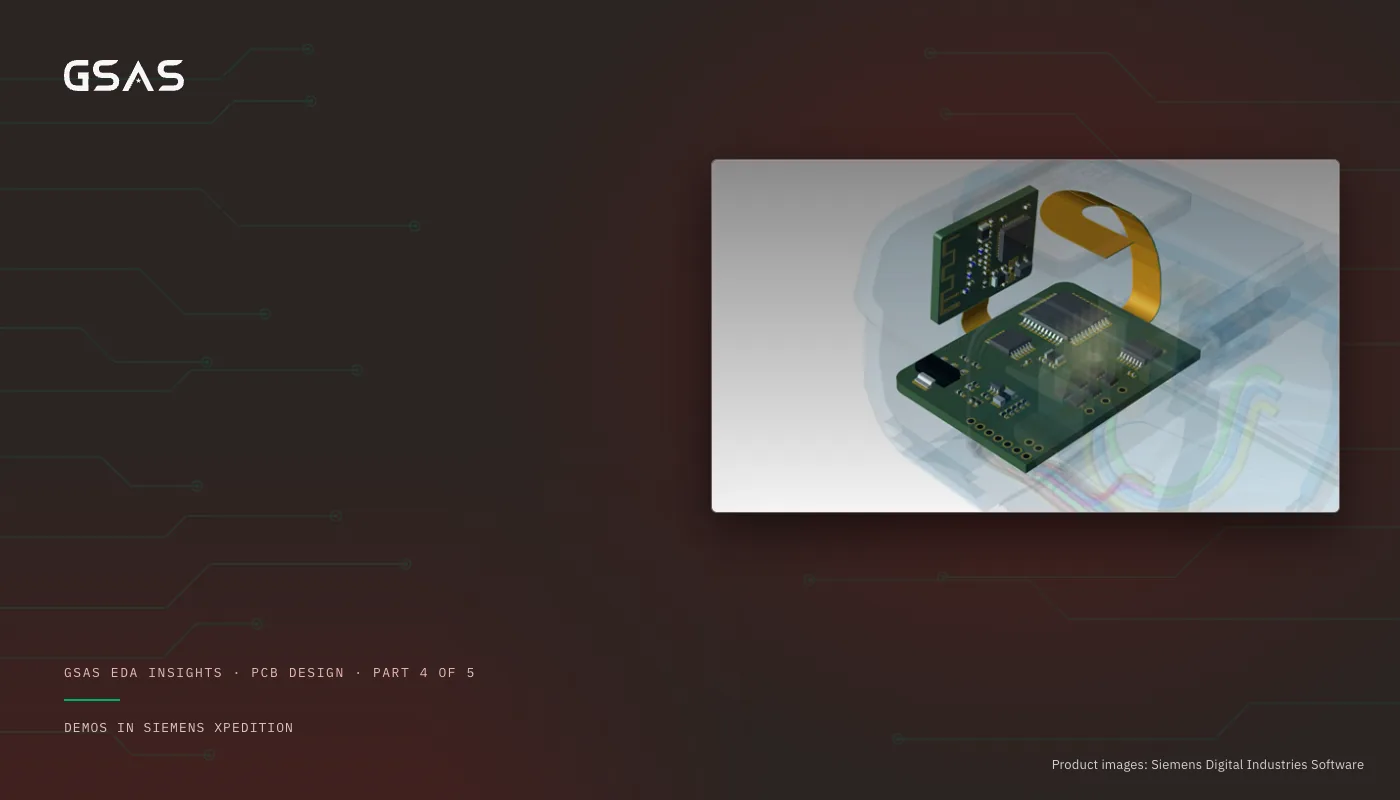
Main board, camera board and enclosure designed and checked as one system.
 Save Your Seat →
- Date
- Thursday, 7 January 2027
- Format
- Online, live webinar
- Speakers
- Ranjith Kumar Jadam, Sampath Radha Krishna & Bhavana Deevi (GSAS)
- Cost
- Free
Registration for Multi-Board Systems: Rigid-Flex and ECAD-MCAD Co-Design is free and open online. Select Save Your Seat, or click the event image, to sign up.
Drones, robots and smart cameras are several boards in a tight enclosure, and the electrical and mechanical teams have to stay in step. Part 4 covers system-level connectivity, rigid-flex design rules and working with mechanical teams in 3D.
This is Part 4 of 5 in the GSAS EDA Insights Series Webinars, PCB Design edition. Every session uses the same edge AI board, designed in Siemens Xpedition for the series, and includes a live demo.
What’s covered
- System-level connectivity: a connector pin change made once and carried across the system.
- Rigid-flex design rules, including flex bend zones, on a main board and camera board joined by a flex section.
- ECAD-MCAD in 3D: an enclosure model imported and a collision caught before release.
Who should attend
PCB and hardware design engineers, mechanical engineers who work with PCB teams, and design leads on drone, robotics, camera and industrial products.
Session time
| Item | Detail |
|---|---|
| Date | Thursday 7 January 2027 |
| Time | 3:30 to 4:30 PM IST |
| Format | 50 minutes of presentation and live demo in Siemens Xpedition, then 10 minutes of Q&A |
| Cost | Free, registration required |
| Recording | Slides and recording emailed to all registrants after the session |
Ranjith Kumar Jadam, Technical Director and Solution Architect, presents with Sampath Radha Krishna and Bhavana Deevi, Field Application Engineers. All three are from GSAS.
The full series
- AI in PCB Design: What Works Today and How Reliable It Is, Thu 3 Dec
- Why PCBs Respin and How to Stop It: Checks During Design, Thu 10 Dec
- Designing PCBs for Edge AI: DDR, PCIe and HDI, Thu 17 Dec
- Multi-Board Systems: Rigid-Flex and ECAD-MCAD Co-Design (this session)
- Moving from Altium or KiCad to Xpedition: What Transfers and What Changes, Thu 14 Jan
Each part has its own registration. Can’t make it live? Register anyway and we will send you the slides and the recording. For an overview of all five parts, see the series announcement.
Related reading
Evaluating Xpedition for your team?
GSAS Micro Systems is a value added distributor/reseller for Siemens EDA in India, with a dedicated FAE team. Features vary by Xpedition edition and add-on, and GSAS can map each demo to the edition it needs. Talk to us about Xpedition Standard, Xpedition Advanced, Xpedition Enterprise or a guided evaluation for your project. Talk to our team.
Register for Multi-Board Systems: Rigid-Flex and ECAD-MCAD Co-Design
You will receive a confirmation email with your joining link. Form not loading? Open the registration page.
More events
Other GSAS Events
Webinar
Moving from Altium or KiCad to Xpedition: What Transfers and What Changes
Thursday, 14 January 2027
Webinar
Designing PCBs for Edge AI: DDR, PCIe and HDI
Thursday, 17 December 2026
Webinar
AI-Assisted Embedded Development with the CMSIS Developer Assistant
Wednesday, 16 December 2026
Webinar
Why PCBs Respin and How to Stop It: Checks During Design
Thursday, 10 December 2026
FAQ