# What’s New in Siemens EDA 2510: A Consolidated Update for Indian Users
Siemens EDA releases follow a calendar-based versioning scheme, and the 2510 release represents the culmination of development work delivered in the October 2025 update cycle. For Indian engineering teams managing multiple Siemens EDA tools, keeping track of what changed across each product can be time-consuming. This article consolidates the key updates across the Siemens EDA PCB design portfolio into a single reference, focusing on the changes most relevant to Indian design teams.
The 2510 release touches every major product in the portfolio, Xpedition, HyperLynx, Valor NPI, Z Planner Enterprise, and the Xpedition Standard product line. Rather than incremental bug fixes, this release delivers meaningful capability improvements that affect daily design workflows.
Xpedition 2510: The Flagship Advances
Modern UX Enhancements
The Xpedition user experience continues its modernisation trajectory in 2510. The redesigned interface, introduced in recent releases, receives refinements based on extensive user feedback. Panel layouts are more configurable, commonly accessed functions surface more prominently, and the overall interaction flow requires fewer clicks for standard operations.
For Indian design teams transitioning from legacy Xpedition interfaces or from PADS environments, the 2510 UX improvements reduce the learning curve. The interface behaves more predictably, context menus are more consistent across different operational modes, and the visual feedback during constraint-driven operations is clearer and more immediate.
AI Command Prediction Improvements
The AI-driven command prediction system in Xpedition 2510 benefits from expanded training data and improved prediction algorithms. The system now recognises more complex operational sequences and provides more accurate next-command suggestions. For repetitive workflows, component placement sequences, constraint assignments, output generation pipelines, the prediction system measurably reduces interaction overhead.
Indian design teams working on product families with similar board architectures report that the AI command prediction adapts to their specific patterns within the first few design sessions, making subsequent designs in the family noticeably faster to complete.
Cloud Collaboration Updates
Xpedition 2510 expands its cloud collaboration capabilities with improved design sharing, more granular access controls, and enhanced browser-based visualisation. The updates include improved performance for large design visualisation in the browser, better annotation tools for design review comments, and streamlined workflows for sharing design views with non-layout stakeholders.
New Routing Capabilities
The routing engine in Xpedition 2510 introduces enhanced capabilities for high-speed design challenges that Indian teams increasingly encounter. Improved differential pair routing handles complex breakout patterns more efficiently, and the interactive router provides better feedback during length-matching operations.
The auto-interactive router, the routing mode most commonly used by Indian layout engineers for complex high-speed boards, benefits from algorithm improvements that produce cleaner results in congested areas, reducing the manual cleanup time that often follows automated routing passes.
Additionally, 2510 introduces refinements to the bus routing capabilities, allowing designers to route groups of related signals with consistent spacing and routing topology more efficiently. For DDR5 and other parallel bus interfaces common in Indian-designed industrial and telecom boards, these improvements translate directly to layout time savings.
HyperLynx 2510: Signal and Power Integrity
Enhanced Signal Integrity Analysis
HyperLynx 2510 delivers improvements to the core signal integrity simulation engine. The transmission line solver provides more accurate modelling of complex cross-sections, including improved handling of trapezoidal trace profiles, rough copper surface effects, and mixed-dielectric environments.
For Indian design teams working on high-speed interfaces, DDR5, PCIe Gen5, USB4, 25G Ethernet, the improved solver accuracy means that simulation predictions correlate more closely with measurements on fabricated boards. This improved correlation reduces the number of design respins needed to achieve target performance, saving both time and fabrication costs.
Power Analysis Improvements
The power integrity analysis capabilities in HyperLynx 2510 include enhanced DC drop analysis with improved meshing algorithms that produce results faster without sacrificing accuracy. The AC analysis features benefit from expanded frequency-domain modelling capabilities.
Indian teams designing power-sensitive boards, battery-operated IoT devices, precision measurement instruments, medical electronics, will find the improved power analysis particularly valuable for identifying voltage drop issues and optimising decoupling strategies before fabrication.
New DRC Rules
HyperLynx 2510 adds new design rule checks targeting emerging signal integrity concerns. Rules for crosstalk aggressor identification, return path discontinuity detection, and via transition quality assessment provide designers with automated checks that previously required manual analysis.
These rules are especially useful for Indian design teams that may not have dedicated signal integrity engineers on staff. The automated checks catch common SI issues during the design process rather than discovering them during post-layout analysis or, worse, during board testing.
Valor NPI 2510: Manufacturing Intelligence
Manufacturing Awareness Enhancements
Valor NPI 2510 expands its manufacturing intelligence with updated DFM rule sets that reflect current fabrication and assembly capabilities. The rule updates incorporate feedback from fabricators and assemblers worldwide, including process capability data relevant to the Indian manufacturing ecosystem.
New checks address emerging manufacturing challenges including advanced HDI via structures, fine-pitch BGA escape routing manufacturability, and solder joint reliability for miniaturised components. Indian design teams working with both domestic and international fabricators benefit from DFM analysis that validates designs against current manufacturing capabilities rather than outdated rule sets.
Visual and DFM Check Improvements
The Valor NPI 2510 interface receives visual enhancements, clearer DFM violation highlighting, improved colour coding, and more actionable analysis reports. For Indian manufacturing engineers validating incoming design data, the improved visualisation reduces back-and-forth cycles with design teams.
New DFM checks target fine-pitch component placement accuracy, solder paste stencil validation, AOI inspection access, enhanced copper balance analysis, improved acid trap detection, and via-in-pad manufacturing constraints. These additions reflect the increasing complexity of boards designed by Indian engineering teams.
Z Planner Enterprise 2510: Stackup Intelligence
Simulation Accuracy Improvements
Z Planner Enterprise 2510 improves the accuracy of its impedance and insertion loss calculations through updated electromagnetic modelling algorithms. The solver improvements are particularly noticeable for complex stackup configurations with multiple dielectric materials, embedded components, and mixed copper weights.
For Indian design teams working with advanced laminates, low-loss materials for high-speed designs, thermally enhanced laminates for power electronics, or flex-rigid constructions for space-constrained products, the improved simulation accuracy means that stackup designs meet impedance targets more consistently when manufactured.
Collaboration Features
Z Planner Enterprise 2510 introduces improved collaboration features that allow stackup information to be shared more effectively between design teams and fabricators. Stackup specifications can be exported in formats that fabricators can import directly into their process planning systems, reducing the manual data entry and interpretation errors that often occur when stackup information is communicated through PDF documents or email descriptions.
For Indian design teams who frequently iterate on stackup designs with their fabricators, this streamlined communication path accelerates the stackup finalisation process and reduces the risk of manufacturing errors caused by miscommunicated stackup parameters.
Xpedition Standard: The Entry and Scalable Mid-Range
Xpedition Standard, the scalable mid-range offering introduced in recent cycles, receives the full complement of 2510 improvements. The token-based add-on system allows Xpedition Standard users to access advanced capabilities, HyperLynx analysis, advanced constraint management, specialised output formats, on a flexible, as-needed basis.
The 2510 release expands the token catalogue with additional capabilities that can be activated through tokens, giving Xpedition Standard users access to a broader range of advanced features without requiring permanent license upgrades. For Indian design teams whose projects vary in complexity, some boards need full SI analysis while others are straightforward four-layer designs, the token model matches cost to actual usage.
What This Means for Indian Engineering Teams
The 2510 release is significant for Indian teams for several practical reasons.
Modernised Workflows. The UX improvements and AI command prediction reduce the daily friction of design operations. For teams with tight project schedules, which describes most Indian design teams, workflow efficiency improvements compound across every design project. Better Manufacturing Integration. The Valor NPI and Z Planner improvements directly address the design-to-manufacturing handoff challenges that Indian teams face when working with diverse fabricators. Better DFM analysis and streamlined stackup communication reduce respins and manufacturing delays. Cloud-Enabled Collaboration. For distributed Indian teams, the cloud collaboration improvements make multi-site design projects more manageable. Design reviews, stakeholder communication, and cross-discipline collaboration all benefit from the 2510 cloud enhancements. Accessible Entry Points. Xpedition Standard’s token model makes professional PCB design tools accessible to the growing Indian startup ecosystem, while providing flexible access to advanced capabilities for mid-size teams.
Upgrading with GSAS Support
GSAS Micro Systems provides comprehensive upgrade support for Indian teams moving to the 2510 release. Our upgrade services cover the full transition process.
Pre-Upgrade Assessment. GSAS engineers review your current tool configuration, custom scripts, library setups, and workflow integrations to identify any upgrade considerations specific to your environment. Installation and Configuration. GSAS handles installation, license migration, environment configuration, and verification testing to ensure the upgraded tools operate correctly in your infrastructure. Training and Demos. GSAS conducts focused training sessions on 2510 capabilities using your actual design data. Indian teams considering new products, Xpedition Standard or additional tokens, can request demo licences through GSAS for hands-on evaluation. Upgrade Workshops. GSAS periodically conducts upgrade workshops at our offices in Bengaluru, Pune, and Delhi NCR, where customers can experience new release features in a hands-on lab environment.
Ready to upgrade to the 2510 release? Contact GSAS Micro Systems for upgrade consultation and demo access. Whether you are upgrading an existing Xpedition or HyperLynx installation, evaluating Xpedition Standard for the first time, or exploring token-based access to advanced capabilities, GSAS provides the support to make your transition smooth and productive. GSAS Micro Systems: an authorised Siemens EDA partner. Bengaluru | Pune | Noida gsasindia.com | info@gsasindia.com
Also appears in:
Interested in Siemens EDA tools?
Talk to our application engineers for personalized tool recommendations.
More from Siemens EDA
View all →
India's EDA Moment: Why Design Tool Demand Is Growing, and the Engineering Careers It Creates
21 Sept · 9 min
AI and Complexity Are Redrawing EDA: Siemens on the Trillion-Transistor Era
13 Sept · 6 min
Calibre Vision AI: Bringing Order to DRC Debug at Advanced Nodes
24 Aug · 4 min
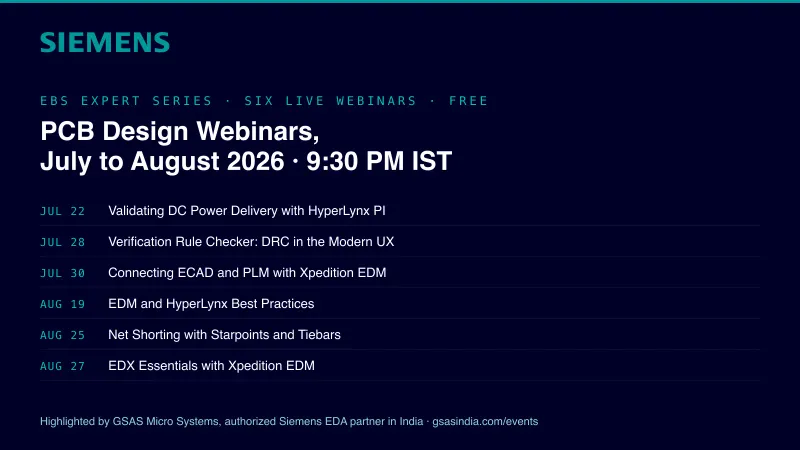
Siemens EDA EBS Expert Series: 6 Free PCB Design Webinars (Jul-Aug 2026)
20 Jul · 8 min
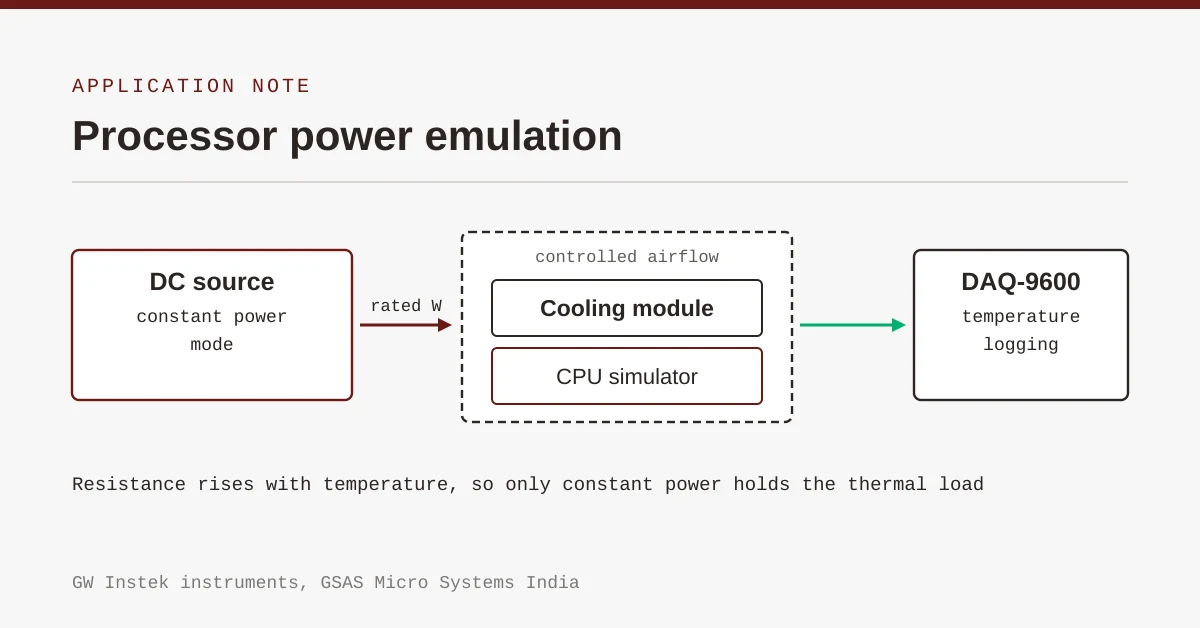
Emulating Processor Power for Thermal Testing: Why Constant Power
7 Oct · 7 min
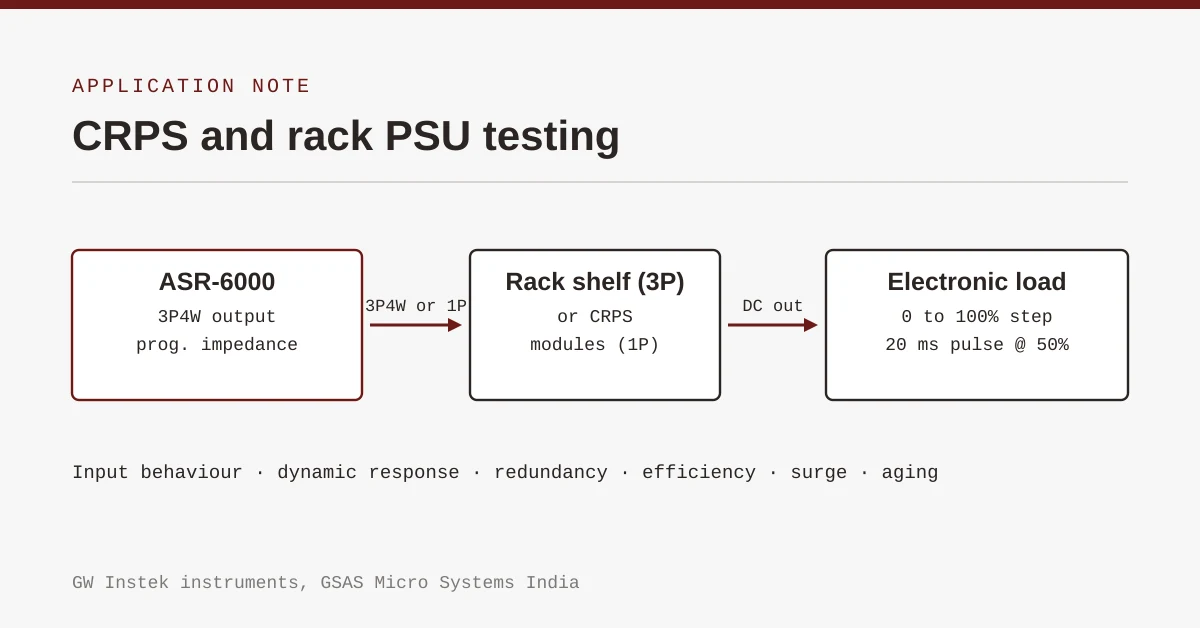
CRPS and Rack Power Supply Testing: The Six Tests That Matter
7 Oct · 7 min