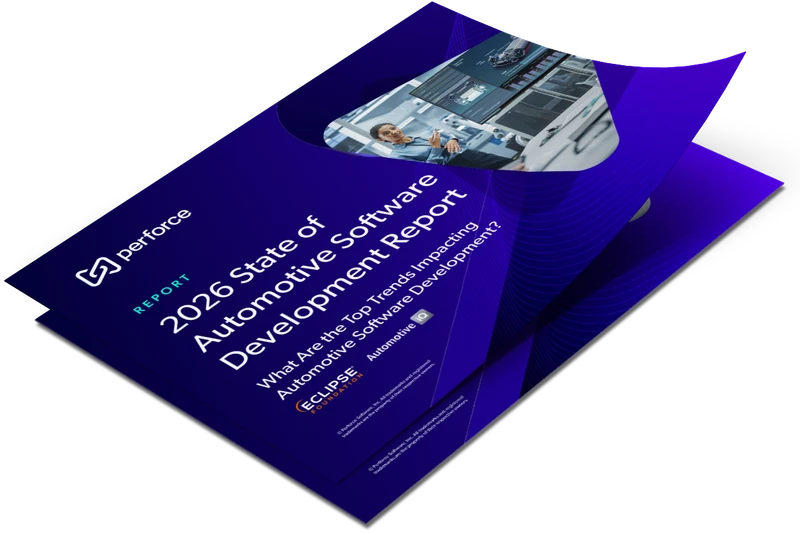
Perforce’s 2026 State of Automotive Software Development Report surveyed over 450 automotive development professionals worldwide. As someone who works daily with Indian automotive, two-wheeler, and EMS teams deploying static analysis, compliance tooling, and production programming systems, I read this report through the lens of India’s rapidly evolving electronics manufacturing ecosystem, where the challenges are amplified and the opportunities are even larger.
Here are the findings that stood out to me.
Quality Remains King: and Complexity Is the Enemy
For the third consecutive year, software quality is the #1 concern for automotive professionals (27%). But the standout data point: 53% say “managing software complexity” is their greatest quality challenge: a sharp increase over previous years.
In India, this complexity multiplier hits even harder. Tier-1 and Tier-2 suppliers are simultaneously scaling production volumes, adopting AUTOSAR architectures, integrating ADAS features into two-wheeler platforms, and, increasingly, incorporating AI components into vehicle software. Teams inheriting legacy codebases while building next-generation ECUs face a dual burden that static analysis and modern version control can address, but only if adopted proactively rather than reactively.
India Is Leading Asia in Shift-Left Adoption
One finding that should give Indian engineering leaders confidence: India has higher shift-left implementation rates than China, Korea, or Japan. While many teams in China and Korea are still in the process of implementing shift-left strategies, a larger proportion of Indian respondents have already implemented them.
This is a competitive advantage that India’s automotive ecosystem should lean into. 55% of all survey respondents already use a static analysis tool, the most popular development tool category for the sixth year running. At GSAS, we deliver MISRA and SAST workshops across India’s automotive belt, Pune, Chennai, Bengaluru, and the NCR region, and the appetite for shift-left tooling is accelerating, not plateauing.
AI Is Everywhere: but Safety Guardrails Are Not
The AI numbers are striking: 71% are using AI in vehicle product design, and 85% of developers are adopting AI coding tools. 45% are using AI not just as a development assistant but as a component embedded in the final product, with 70% leaving the AI model active once deployed.
But here is the critical nuance the report surfaces: MISRA checking with AI is explicitly not allowed. Compliance verification must use deterministic, qualified tools, not AI models. Indian teams racing to adopt AI for development velocity must pair it with static analysis (Klocwork, Perforce QAC) to catch the vulnerabilities that AI inevitably introduces. The human-in-the-loop approach is not optional, it is mandated by emerging standards like ISO/PAS 8800 for road vehicle AI safety.
The Recall Cost Equation
Software recalls are on track to set records for the sixth consecutive year. The report cites compelling economics: over-the-air updates reduce per-vehicle remediation costs from approximately $500 to $66.50, but not all recalls can be resolved via OTA, and the brand damage is permanent regardless.
For Indian OEMs and Tier-1 suppliers targeting European and North American export markets, the cost of a software-related recall is not just financial, it can be existential for market access. Prevention through shift-left tooling (static analysis at every commit + ALM traceability from requirement to test) is the only economically rational approach. The data supports what we tell every customer: the cheapest defect is the one you never ship.
MISRA Adoption Is Surging: and India Needs to Keep Pace
MISRA usage increased 8% globally in 2026, now used by 61% of automotive teams. AUTOSAR C++14 is the #2 coding standard at 36% adoption, surpassing C++ Core Guidelines for the first time. CERT usage increased by 5%, reflecting the growing focus on security alongside safety.
With MISRA C:2025 released and Perforce QAC providing 100% rule enforcement coverage, Indian suppliers serving global OEMs have no excuse for non-compliance. The data is clear: 52% of teams now comply with ISO 26262 due to customer mandates: not market requirements, not internal initiative, but because their customers demand it. If your customer is a European OEM, MISRA compliance is table stakes.
What This Means for Indian Teams
The report validates what we see on the ground across 11 GSAS offices: Indian automotive and EMS teams are not behind the global curve, they are, in many areas, ahead of it. But the window for competitive advantage through early adoption is closing. The teams that invest in static analysis, traceability, coding standards enforcement, and AI-safe development practices today will be the ones winning global contracts tomorrow.
I encourage every engineering leader in India’s automotive and electronics ecosystem to download the full report and benchmark your organization against the global data.
For teams looking to act on these findings, deploying Klocwork, Perforce QAC, Helix ALM, or establishing MISRA compliance baselines, GSAS provides deployment consulting, training workshops, and CI/CD integration across Bengaluru, Chennai, Hyderabad, Delhi NCR, Mumbai, Pune, and Visakhapatnam.
Also appears in:
Interested in Perforce tools?
Talk to our application engineers for personalized tool recommendations.
More from Perforce
View all →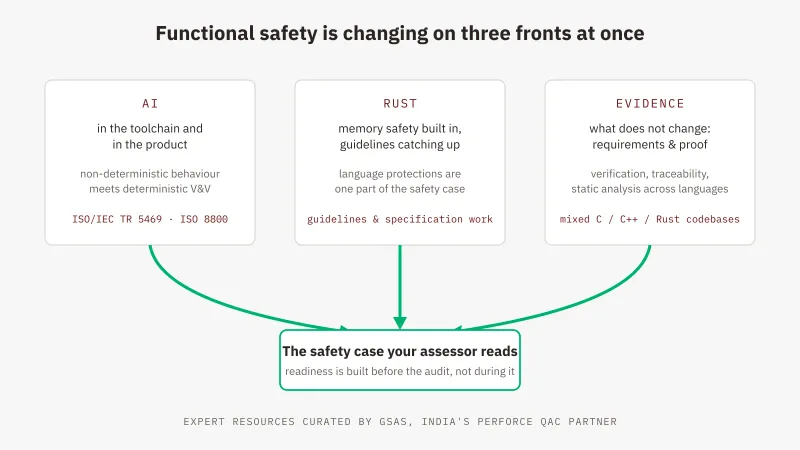
AI, Rust and the New Functional Safety Standards
2 Sept · 9 min
The Complete AUTOSAR Verification Chain: AUTOSAR C++14 Static Analysis with Perforce QAC, SWC and RTE Testing with TESSY 6
31 Jul · 9 min
DevSecOps Tools and Practices for Embedded Teams in India
18 Jul · 8 min
Static Analysis for Medical Device Software: IEC 62304 and FDA Compliance in India
18 Jul · 9 min
Emulating Processor Power for Thermal Testing: Why Constant Power
7 Oct · 7 min
CRPS and Rack Power Supply Testing: The Six Tests That Matter
7 Oct · 7 min