India’s cable and wiring harness industry is one of the largest in the world, supplying automotive OEMs, aerospace integrators, industrial equipment manufacturers, and consumer electronics brands across domestic and export markets. Every harness that leaves a production line carries an implicit promise: that every connection is intact, every insulation barrier holds, and every conductor meets its resistance specification. Cable harness testing is how manufacturers keep that promise.
But not all test methods are equal. The difference between 2-wire and 4-wire (Kelvin) resistance measurement is one of the most consequential technical decisions on a harness production line. Choose wrong, and you either spend more than necessary on equipment that exceeds your requirements, or, worse, ship harnesses with marginal connections that pass a 2-wire test but would fail a 4-wire measurement.
Why Harness Testing Matters
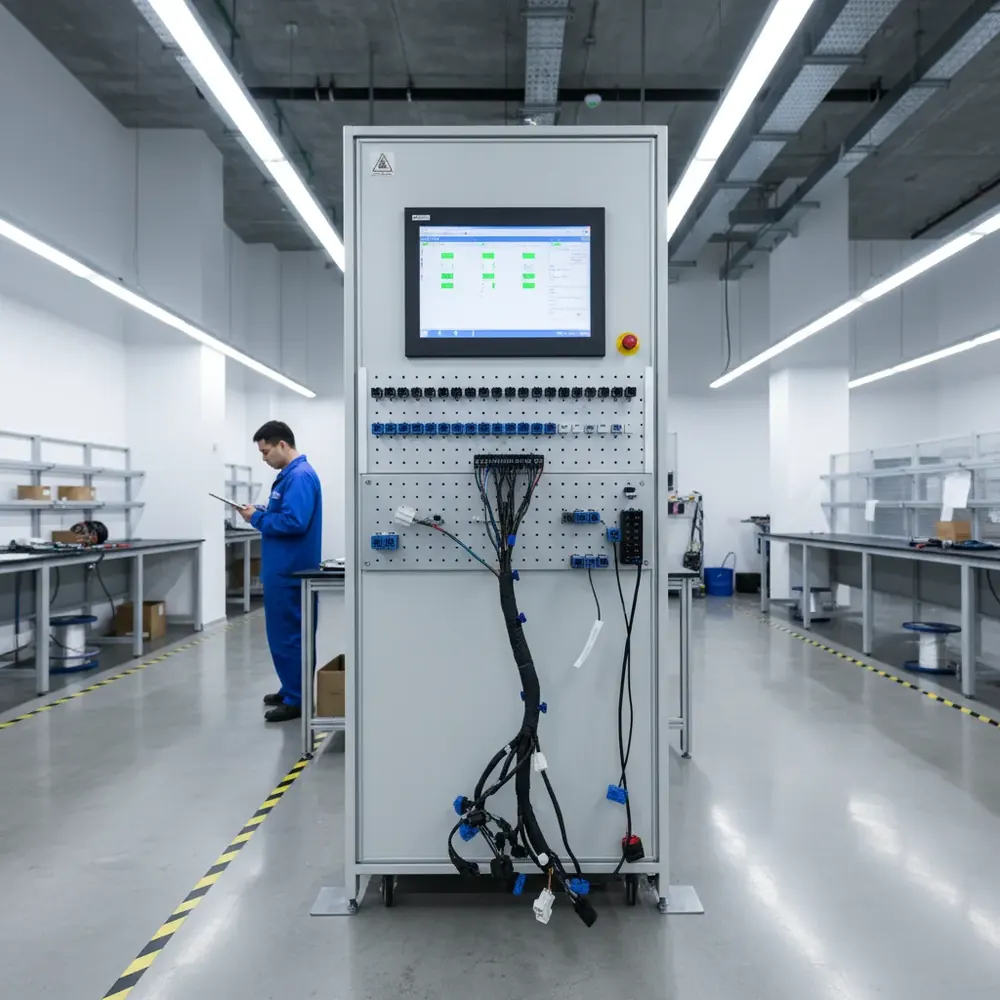
A wiring harness is a structured assembly of conductors, connectors, terminals, splices, and protective sleeving that routes electrical signals and power through a vehicle, aircraft, appliance, or machine. Unlike a PCB, where connections are formed lithographically with micron-level precision, harness connections are made mechanically, through crimping, soldering, ultrasonic welding, or insulation displacement. Each mechanical connection is a potential failure point.
The consequences of a defective harness range from inconvenient (a non-functional power window) to catastrophic (an intermittent connection in an aircraft flight control harness). In automotive manufacturing, harness defects account for a significant share of warranty claims and recalls. In aerospace, every harness connection is subject to documented testing and traceability requirements.
Indian manufacturers supplying these sectors face the same quality expectations as their global counterparts, and the same liability exposure.
The Core Tests
Regardless of measurement method, a complete harness test sequence typically includes four categories of tests.
Continuity testing verifies that every conductor path has the expected low resistance, confirming that crimps are solid, solder joints are complete, and no conductors are broken or missing. This is the most fundamental test, and the one where the 2-wire vs 4-wire distinction matters most. Hipot (high-potential) testing applies a high voltage between conductors and between conductors and the shield/chassis to verify that insulation can withstand the rated voltage stress. The test voltage is typically 2x the rated voltage plus 1000 V for production testing per IEC and UL standards. The instrument measures leakage current during the voltage application; excessive leakage indicates insulation damage, contamination, or insufficient clearance. Insulation resistance (IR) testing applies a lower DC voltage (typically 500 V or 1000 V) and measures the resistance between conductors and between conductors and shield. While hipot tests for dielectric breakdown, IR testing quantifies the absolute insulation quality in megohm or gigohm values. Insulation resistance degrades with moisture absorption, contamination, and thermal aging, making IR testing essential for harnesses operating in harsh environments. Wiring correctness (net list) testing verifies that every conductor connects the correct pins, detecting miswires, crossed pairs, and missing connections. The tester applies signals to each pin and maps the actual connectivity against a reference net list, flagging any deviations. This test catches assembly errors where a conductor is terminated to the wrong pin position.
2-Wire Measurement: When It Is Enough
In a 2-wire resistance measurement, the instrument sends current through the same pair of wires it uses to sense voltage. The measured resistance includes not just the DUT (the conductor path through the harness) but also the resistance of the test leads, adapter cables, fixture contacts, and probe tips.
For harness conductors with resistance values above approximately 1 ohm, this additional resistance is insignificant. A 5-meter 18 AWG wire has roughly 100 milliohms of resistance; the 20-50 milliohms of fixture and lead resistance represents a small percentage of the total. The 2-wire method produces a result that is close enough to the true value for a reliable pass/fail decision.
The Microtest 2-Wire Cable Harness Tester is designed for exactly this scenario: production testing of consumer electronics cable assemblies, appliance wiring harnesses, and general-purpose cables where conductor resistances are comfortably above the level where lead resistance matters. It provides continuity, hipot withstand voltage, insulation resistance, and wiring correctness verification through programmable test sequences with pass/fail sorting, everything needed for a complete cable QC workflow at a cost-effective price point.
For Indian manufacturers producing power cords, appliance harnesses, consumer electronics cables, and general-purpose interconnects, the 2-wire tester handles the full test requirement without the additional cost of 4-wire infrastructure.
4-Wire Kelvin Measurement: When You Need It
In a 4-wire Kelvin measurement, the instrument uses one pair of wires to inject the test current and a separate pair to sense the voltage across the DUT. Because the voltage sensing wires carry essentially zero current, they drop essentially zero voltage, so the measured voltage reflects only the DUT resistance, not the leads or contacts.
This distinction becomes critical when the DUT resistance is low relative to the fixture contact resistance. A crimped terminal on a 14 AWG automotive harness conductor might have a path resistance of 5-10 milliohms. If the fixture contact resistance is 20 milliohms, a 2-wire measurement reads 25-30 milliohms, making it impossible to distinguish a good 5 milliohm crimp from a marginal 25 milliohm cold crimp, because the fixture resistance dominates both readings.
The 4-wire method eliminates this ambiguity entirely. It reads the true 5 milliohms or 25 milliohms regardless of fixture contact condition, enabling detection of marginal crimps, cold solder joints, and high-resistance connections that 2-wire methods simply cannot see.
The Microtest 4-Wire Cable Harness Tester provides milliohm-resolution Kelvin measurement for complex multi-conductor assemblies with 100+ point configurations. Beyond the Kelvin resistance measurement, it includes the same hipot, insulation resistance, and wiring correctness capabilities as the 2-wire tester, plus diode detection for polarity verification and SPC data logging for statistical process control.
When Does the Crossover Happen?
The practical guideline: if you need to measure or sort based on resistance values below approximately 100 milliohms, you need 4-wire Kelvin measurement. This threshold covers most automotive harness applications (where crimp resistance specifications are typically in the 1-50 milliohm range), aerospace wire assemblies (where every connection has a resistance limit), and industrial power harnesses (where high-current paths demand low resistance for thermal reasons).
USB-C Cable Testing: A Special Case
USB Type-C cables present unique testing challenges that go beyond traditional harness testing. A USB-C connector has 24 pins carrying a mix of power, high-speed data, sideband signals, and configuration logic. The cable is not just a passive conductor bundle, it contains an active e-marker chip that identifies the cable’s capabilities to the connected devices, and CC (configuration channel) logic resistors that determine power delivery roles.
The Microtest USB-C Cable Tester addresses this complexity with dedicated test routines for full 24-pin continuity, e-marker chip verification, CC logic resistor value measurement, VBUS/GND path resistance, differential pair integrity for SuperSpeed lanes, shield continuity, and hipot/insulation resistance. These tests go beyond what a general-purpose harness tester can perform, because USB-C compliance requires protocol-aware testing that understands the cable’s electronic identity.
For Indian cable manufacturers entering the USB-C market, driven by the global transition from legacy connectors and India’s growing consumer electronics manufacturing base, dedicated USB-C testing capability is becoming a production-line requirement rather than an optional nice-to-have.
Production Automation: Barcode-Triggered Testing and Handler Interfaces
In mixed-model production environments where different harness variants run on the same test station, manual test program selection creates opportunities for operator error and reduces throughput. Barcode-triggered test selection eliminates both problems: the operator scans the harness part number, and the tester automatically loads the corresponding test program with the correct net list, resistance limits, hipot voltages, and pass/fail criteria.
Handler interfaces connect the tester to external automation, pneumatic fixtures, robotic handlers, conveyor systems, and MES (Manufacturing Execution System) platforms. The tester sends pass/fail signals to the handler for automatic routing of tested harnesses, and logs test results to the MES for traceability and SPC analysis.
The Microtest 4-Wire Cable Harness Tester supports both barcode-triggered test selection and handler interfaces, enabling full integration into automated production lines. For automotive harness manufacturers in India, where Tier 1 suppliers operate high-volume lines with strict traceability requirements from OEM customers, these automation features are essential for meeting throughput and quality documentation demands.
India Context: Automotive and Beyond
India is the world’s fourth-largest automotive market and a major harness manufacturing hub, with domestic and multinational harness manufacturers operating plants across the country. The automotive harness testing requirement is the primary driver for 4-wire Kelvin test capability in Indian manufacturing. But the requirement extends beyond automotive: aerospace harness shops serving public-sector and private aerospace companies, railway harness production for metro and high-speed rail projects, defense electronics, and industrial equipment manufacturing all demand rigorous harness testing.
The EV transition is adding new requirements. High-voltage battery pack harnesses, motor phase cables, and DC charging cables carry hundreds of amps and operate at voltages up to 1000 V. These harnesses demand both precision low-resistance measurements (to ensure connections can handle the current without overheating) and high-voltage hipot testing (to verify insulation integrity at operating voltage with safety margin).
Get Cable Harness Testing Support from GSAS India
GSAS Micro Systems is an authorized Microtest distribution and applications partner in India, with seven years of experience deploying cable and harness test systems across Indian automotive, aerospace, and industrial manufacturing facilities. Whether your production line needs a cost-effective 2-wire tester for consumer cable QC, a 4-wire Kelvin tester for automotive harness production, or a dedicated USB-C cable tester for high-speed data cable qualification, our applications team provides test sequence programming, fixture design consultation, handler interface configuration, and MES integration support. Contact us from Bengaluru, Chennai, Hyderabad, Delhi NCR, Mumbai, or Pune for a production-line assessment, demo, and INR pricing.
Also appears in:
Interested in Microtest tools?
Talk to our application engineers for personalized tool recommendations.
More from Microtest
View all →
Power Measurement for Server PSUs: Microtest 7140 Power Analyzer
7 Apr · 5 min

Wireless Charger QC Testing with the Microtest 9901
7 Apr · 5 min

Motor Stator Testing in EV Manufacturing: Microtest MT-6910 Series
7 Apr · 5 min
PCB Incoming Inspection with Multichannel LCR Testing
6 Apr · 5 min
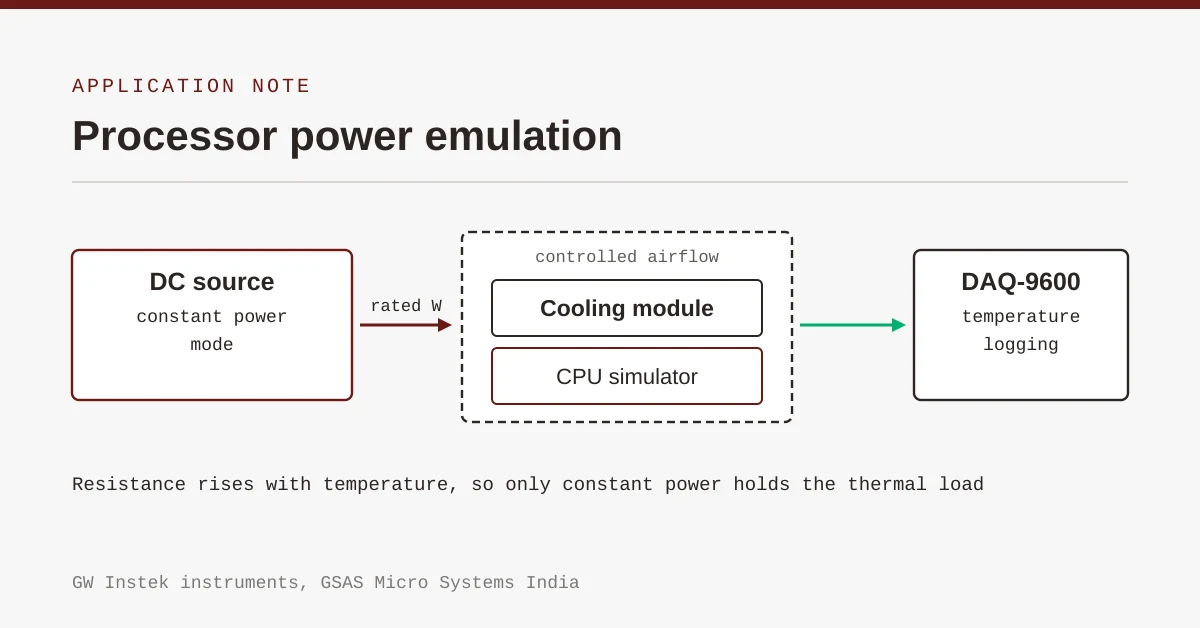
Emulating Processor Power for Thermal Testing: Why Constant Power
7 Oct · 7 min
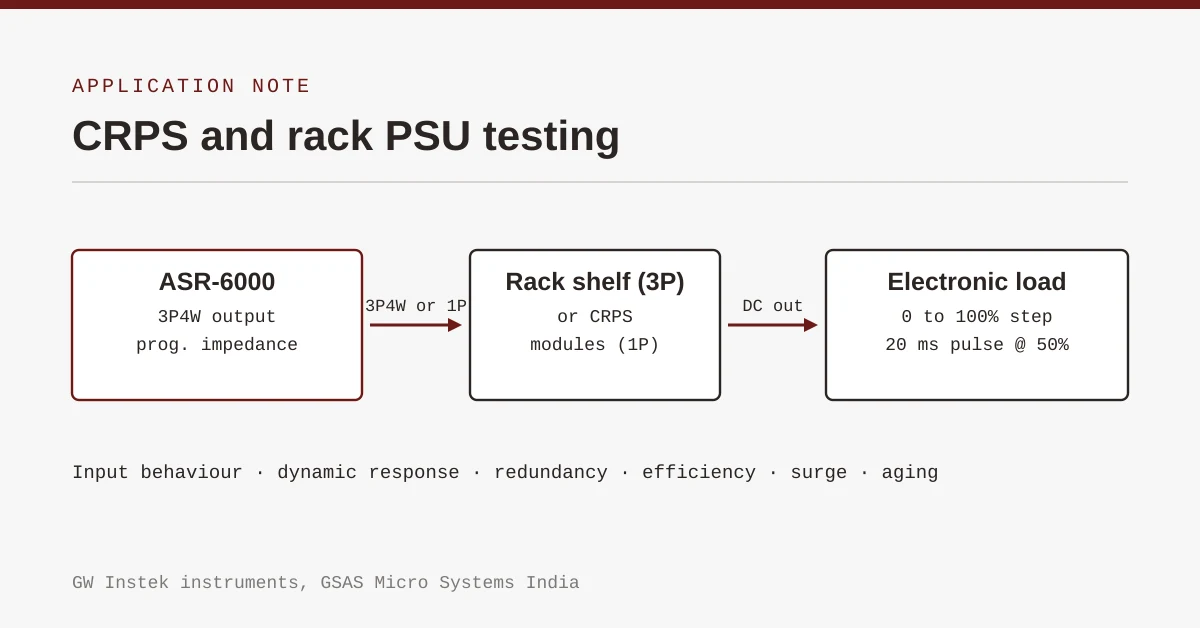
CRPS and Rack Power Supply Testing: The Six Tests That Matter
7 Oct · 7 min