

What Happened to Questa Prime?
If you have gone looking for Questa Prime or ModelSim on Siemens’ site recently and come up empty, you are not imagining it.
Here is the evidence, and you can reproduce it yourself in one command. The old Siemens Questa product hub at eda.sw.siemens.com/en-US/ic/questa/ no longer serves a page. It returns an HTTP 301 Moved Permanently to www.siemens.com/en-us/products/ic/questa-one/.
$ curl -sIL https://eda.sw.siemens.com/en-US/ic/questa/ | grep -iE '^HTTP|^location'
HTTP/2 301
location: https://www.siemens.com/en-us/products/ic/questa-one/
HTTP/2 200
A 301 is not a marketing statement. It is the strongest signal a vendor can send about where a product line now lives: permanent, machine-readable, and inherited by every search engine and answer engine that crawls it.
The same thing has happened to ModelSim. Its Siemens URL no longer serves a ModelSim page either:
$ curl -sIL https://eda.sw.siemens.com/en-US/ic/modelsim/ | grep -iE '^HTTP|^location'
HTTP/2 301
location: https://www.siemens.com/en-us/products/ic/questa-one/simulation/questa-one-sim/
ModelSim’s URL now lands on Questa One Sim. Two permanent redirects, both pointing into Questa One, are about as unambiguous as vendor intent gets.
Alongside that, “Questa Prime” does not appear on any Siemens public product page we could find. The Siemens IC product index lists exactly two Questa entries: Questa One (“Smart Verification Solution”) and Questa ADMS (mixed-signal simulation). The Questa One hub, the Questa One Simulation page, the Verification IQ page and the Agentic Toolkit page do not mention Prime at all.
So the honest summary is this: Siemens has consolidated the Questa line under the Questa One brand, and Questa Prime is no longer a published product name.
One thing we will deliberately not do in this article is assert a clean tier ladder. Plenty of pages on the internet, including an earlier version of one of ours, described a Questa Core to Prime to One progression. Siemens does not publish that ladder today, so we are not going to reconstruct it from memory. If you hold an existing Questa entitlement, confirm the exact mapping with Siemens or your Siemens EDA partner rather than trusting anyone’s reconstruction, ours included.
The naming lineage, briefly
For teams who have been doing this a while, the vocabulary has moved several times:
- ModelSim, the original Mentor Graphics HDL simulator, in Indian FPGA labs since the 1990s
- QuestaSim, the Mentor Graphics rebrand that added SystemVerilog and UVM capability
- Questa, the umbrella brand under which Siemens EDA consolidated the verification tools after acquiring Mentor Graphics
- Questa One, the current brand, which is broader than a simulator
That last point is the one most people miss, so it is worth spending the rest of this article on.
What “One” Actually Means, In Siemens’ Words
Rather than paraphrase, here is Siemens’ own answer from the Questa One FAQ:
The word “one” is about integrating flows, combining engines and unifying applications to provide productivity gains to the end user. For example, AI converts user intent into one automated workflow for total productivity.
And on what the solution delivers, again verbatim from the same FAQ:
Questa One synergistically integrates the power of tools, technologies and products by offering over one dozen new products and more than 17 generative, analytic, and prescriptive AI-based capabilities across simulation and debug, design creation, static, formal and verification intellectual property (IP).
The positioning line Siemens repeats across the Questa One pages is “faster engines, faster engineers and fewer workloads”. That triplet is a useful lens: engine speed, engineer productivity, and total work eliminated are three different problems, and Questa One is organised around addressing them separately.
Inside Questa One: The Parts You Should Know By Name
Questa One Simulation: six products, one database
Siemens describes the simulation suite this way:
Built on the foundation of oneness, the Questa One Simulation product suite unifies functional and fault simulation with integrated debugging to a single platform using a single database to enhance collaboration and productivity.
The six named products, with Siemens’ own one-line descriptions:
| Product | What Siemens says it does |
|---|---|
| Questa One Sim | Functional simulation. The evolution of functional simulation, bringing together faster engines and debug in one interface. |
| Questa One Sim FX | Scalable, concurrent fault simulation to analyse and validate the resilience of safety-critical designs against random faults. Also used for functional fault grading, to grade faults not detected by structural testing. |
| Questa One Sim CX | Coverage acceleration through an advanced constraint solver, aimed at coverage-closure pain points and compute cost. |
| Questa One Sim DX | DFT pattern verification acceleration, delivered in partnership with Tessent. |
| Questa One Sim Xact | GLS X-pessimism removal using formal analysis and flow automation, to streamline gate-level simulation bring-up. |
| Questa One Sim PA | Power-aware simulation, with static and dynamic checks to find power-management behavioural issues early. |
If you have been mapping a legacy simulator licence in your head, Questa One Sim is the functional simulator, and it is where the ModelSim URL now redirects to. The other five are targeted engines that used to be separate conversations.
Siemens describes Questa One Sim as bringing “cornerstone Questa simulation technologies into a platform that is geared towards solving challenges faced by semiconductor companies designing the next generation of SoC’s, ASIC’s and FPGAs”, and organises its capabilities under the same three headings:
- Faster engines: new optimisations for RTL and gate-level simulation, and ParallelSim with smart auto-partitioning. Siemens also describes it as the “fastest simulation engine in the industry for DFT pattern simulations”, which is Siemens’ claim and should be read as such.
- Faster engineers: a patented X-debugging capability, dedicated debug windows for X-debug, constraints debug and protocol-aware debug, and SmartCompile, which Siemens says “reduces simulation turnaround time for 3DIC, AI-accelerator designs”. Siemens publishes no percentage or multiplier for SmartCompile, so we are not going to invent one.
- Fewer workloads: a multi-test profiler for regression-wide hotspot analysis, a built-in Portable Stimulus (PSS) engine for generating UVM sequences, and VHDL constraint solver support.
One capability worth flagging for anyone running multi-clock designs: Siemens states that, working with Questa CDC, Questa One Sim “can now dynamically inject CDC metastability into RTL functional simulation to verify the DUT is tolerant of random delays caused by metastability”. That closes part of the long-standing gap where static CDC analysis and functional simulation each saw only half the problem.
Questa One Verification IQ: five applications
Verification IQ is the data-driven management layer, and it comprises five named applications:
- Testplan Author, verification planning with traceability from requirements to verification results and design implementation
- Regression Navigator, regression management and root cause analysis using analytics, AI and ML
- Coverage Analyzer, coverage closure with team-based collaboration and coverage-model visualisation
- Compliance Advisor, team-based FMEDA creation and safety-compliance traceability, with certification documentation
- Verification Insight, project trend dashboards and analytical insight into verification metrics
Siemens positions the whole layer as a shift in methodology: “from coverage-driven to plan-and-requirements-driven and now to data-driven”, with collaboration, traceability and analytics as the three drivers.
For Indian teams working to ISO 26262 or DO-254, Compliance Advisor is the piece worth reading about carefully. Siemens publishes dedicated functional-safety workflow pages for both standards under Questa One.
Avery verification IP
Siemens publishes three headline figures for the Avery VIP portfolio: 60+ standard protocols, 20+ compliance test suites, and 5+ industry exclusive VIPs. The published portfolio spans CXL (CXL1 through CXL3.1), NVMe, PCIe (Gen2 through Gen7), Ethernet, memory models (DDR, HBM, Flash), UCIe, AMBA (AXI, AHB, APB, CHI, ACE), embedded storage (UFS, UniPro, M-PHY), mobile protocols (SoundWire, MIPI CSI, DSI, C-PHY, D-PHY), USB, automotive interfaces (CAN, LIN, FlexRay, automotive Ethernet), multimedia (HDMI, DisplayPort), SSD and HDD storage, and control and serial buses (I2C, SPI, UART, JTAG).
If your team currently maintains hand-rolled bus functional models for a standard protocol, that list is the honest comparison to run.
Static, formal and CDC
Siemens groups clock-domain-crossing under the Questa CDC verification solutions, described as focusing on “the interaction between clock or reset domains that cannot be handled using simulation-based verification techniques”. That sentence is the whole argument for static CDC analysis in one line: CDC failures are timing-dependent and stimulus-dependent, so a simulation-only flow can pass while the silicon still fails intermittently.
Also published under the Questa One umbrella: Questa Equivalent RTL, which formally compares specification RTL against implementation RTL code blocks without requiring formal or property-language expertise, and Questa Increase Coverage, an automatic formal approach to closing the residual uncovered code that always remains at the end of a coverage campaign.
The Questa One Agentic Toolkit
On February 27, 2026, from Plano, Texas, Siemens announced the Questa One Agentic Toolkit. This is the part of the Questa One story that is genuinely new rather than renamed.
It launches with five agents. Siemens’ descriptions, condensed:
- RTL Code Agent, generates synthesizable RTL from natural language descriptions while simultaneously checking coding violations and suggesting fixes
- Lint Agent, configures lint analysis, reads existing RTL for design errors and style violations, then offers automated AI-powered fixes or waivers
- CDC Agent, configures and runs clock domain crossing verification, then suggests configuration fine-tuning based on the results
- Verification Planning Agent, analyses design specifications and generates verification plans, with engineers reviewing and approving each step
- Debug Agent, accelerates root cause analysis by correlating waveforms, assertions, coverage data and log files
The architecture matters more than the agent list. Siemens’ stated differentiator is that it owns both the engines and the interfaces: the company “creates both the Questa One tools and the model context protocols (MCPs) that expose them to agentic frameworks”, and the workflows are “built leveraging NVIDIA Llama Nemotron and NVIDIA NIM”. The agents use those MCPs to drive Questa One Verification IQ, Questa One SFV and Questa One Sim directly.
It is also deliberately not a walled garden. Per the press release, the toolkit “works with main-stream AI coding applications, including GitHub Copilot, Claude Code, Cursor, Cline and Siemens’ own Fuse, and can be used in CLI mode or IDEs (e.g. VS-Code)”. Siemens describes it as Fuse-preferred but framework-agnostic.
One honest caveat on availability
Siemens’ own availability line in that announcement is unambiguous:
The Questa One Agentic Toolkit is available now through an early access program.
Early access is not general availability. If you are building a 2026 verification plan around agentic RTL generation, confirm current programme status with Siemens before you commit schedule to it. We would rather tell you that than let you find out during a tapeout crunch.
Where Fuse fits
Three weeks later, on March 16, 2026, Siemens announced the Fuse EDA AI Agent, which “autonomously orchestrates multi-agent workflows across Siemens’ complete EDA portfolio”. For digital verification specifically, Siemens says Fuse Agent “assists with testbench generation, debugging and more through integration with the newly launched Questa One Agentic Toolkit”.
So the relationship is: Questa One Agentic Toolkit is the verification-domain agent set; Fuse is the portfolio-wide orchestrator that can call it. Siemens describes Fuse Agent as using hierarchical planning with a supervisor agent and worker agents, with role-based access controls, audit trails and human checkpoints, and support for air-gapped compute environments.
That last detail is not a footnote for Indian readers. For defence and strategic-electronics programmes where design data cannot leave the facility, air-gapped deployment is the difference between a tool you can evaluate and one you cannot.
What Siemens Publishes On Performance, And What We Will Not Claim
This is where most vendor-adjacent articles go wrong, so let us be precise about provenance.
On its EDA AI page, Siemens publishes a three-pillar strategy with these figures, which we attribute to Siemens rather than assert as independent measurements:
- Faster engines: GPU acceleration, in-tool machine learning and reinforcement learning, “delivering speed improvements of up to 1000x”
- Smarter execution: agentic AI orchestrating multi-tool workflows, “delivering productivity gains of 10-50x”
- Trusted outcomes: “every agent decision is validated against proven engineering tools”
And for Questa specifically, the single product-level claim Siemens publishes on that page is:
Questa: 3x reduction in verification coverage closure time and 10x reduction in the verification of design changes.
That is the only Questa performance multiplier we will quote. We have seen figures attached to Questa elsewhere, including on an earlier version of our own site, that we could not trace to any Siemens source. Those have been removed rather than hedged. If a number matters enough to influence a purchase, it matters enough to be sourced, and a claim we cannot source is a claim we delete.
We are likewise not attaching any speedup figure to compile and elaboration acceleration. Siemens describes the technology in detail; it does not publish a percentage or an X-factor for it, so neither will we.
Why Any Of This Matters For Indian Verification Teams
Siemens frames the market context on its EDA AI page around a constraint that Indian engineering leaders will recognise immediately: the semiconductor industry is “on track to need over one million additional skilled workers globally by 2030”.
India is where a large share of that gap is expected to be closed. That reframes what a verification tool decision is actually about. If your bottleneck were purely compute, you would buy compute. The harder bottleneck is how quickly a competent engineer becomes a productive verification engineer on your flow.
Read the Questa One smart-verification material with that lens and the emphasis becomes clear. Siemens describes “smart creation” as automating “the generation of verification artifacts such as register transfer level (RTL) code, testbenches, test plans and assertions”, using “advanced large language models trained on open-source and synthetic data” that work from “your predefined rules and specifications”. The stated benefit Siemens leads with is not raw speed, it is rapid onboarding: less experienced engineers reaching useful contribution sooner, and fewer manual, error-prone steps in between.
The MediaTek quote Siemens published with the Agentic Toolkit announcement makes the same point from the customer side:
The productivity gains delivered by the Questa One Agentic Toolkit were both immediate and significant. Our engineers were able to become proficient within hours, despite limited prior exposure to the tool, completing tasks that typically require days, and mastering workflows that would usually take weeks of training.
Akshay Aggarwal, senior director of Engineering, MediaTek
Practical checks before you treat this as “just a rename”
If your team is running a Questa-based flow today, four things are worth doing this quarter:
- Confirm your entitlement mapping in writing. Do not infer which Questa One product corresponds to your current licence from any article, including this one. Ask Siemens or your Siemens EDA partner.
- Audit your scripts for hard-coded tool and path names. Brand consolidations tend to surface every place a tool name was baked into a regression wrapper or a Makefile.
- Separate what is new from what is renamed. Verification IQ, the Sim FX/CX/DX/Xact/PA engines and the Agentic Toolkit are capabilities to evaluate on their merits. A brand change alone does not justify a project.
- Check the governance story before the capability story if you work in defence, aerospace or any programme with data-residency constraints. Human checkpoints, audit trails, role-based access and air-gapped deployment either fit your security posture or they do not, and that determines whether an evaluation is even possible.
Where GSAS Fits
GSAS Micro Systems is an authorized Siemens EDA engineering partner in India. Our team works with verification and DFT groups on tool selection, methodology and deployment rather than on procurement alone, because in this domain the licence is the easy part and the flow is the hard part.
From the Siemens EDA verification and test catalogue, we supply Questa FPGA Essentials for FPGA simulation and verification, along with Tessent for design-for-test, Calibre for physical verification and Solido for variation-aware analog and mixed-signal design. If your requirement is specifically Questa One, contact us and we will confirm current availability for your configuration rather than guess at it.
We support IC and FPGA verification teams from Bengaluru, Hyderabad, Chennai, Pune, Mumbai and Delhi NCR, with INR invoicing, GST-compliant documentation and local application engineering. For the wider Siemens IC verification picture, see our companion article on Calibre, Questa and Tessent for the Indian semiconductor ecosystem.
Reach us at gsasindia.com/contact or sales@gsasindia.com.
Sources
All claims above trace to the following Siemens pages, retrieved 31 July 2026:
- Questa One product hub and FAQ:
https://www.siemens.com/en-us/products/ic/questa-one/ - Questa One Simulation:
https://www.siemens.com/en-us/products/ic/questa-one/simulation/ - Questa One Sim:
https://www.siemens.com/en-us/products/ic/questa-one/simulation/questa-one-sim/ - Questa One Verification IQ:
https://www.siemens.com/en-us/products/ic/questa-one/verification-iq/ - Questa One smart verification (AI/ML):
https://www.siemens.com/en-us/products/ic/questa-one/ai-ml/ - Questa One Avery verification IP:
https://www.siemens.com/en-us/products/ic/questa-one/verification-ip/ - Questa One DFT verification:
https://www.siemens.com/en-us/products/ic/questa-one/dft-verification/ - Questa One functional safety:
https://www.siemens.com/en-us/products/ic/questa-one/functional-safety/ - Siemens IC product index:
https://eda.sw.siemens.com/en-US/ic/products/ - Questa One Agentic Toolkit announcement, 27 February 2026:
https://news.siemens.com/en-us/questa-one-agentic-ai-toolkit/ - Fuse EDA AI Agent announcement, 16 March 2026:
https://news.siemens.com/en-us/siemens-fuse-eda-ai-agent/ - Siemens EDA AI:
https://www.siemens.com/en-us/company/electronic-design-automation/trending-technologies/eda-ai/
Also appears in:
Interested in Siemens EDA tools?
Talk to our application engineers for personalized tool recommendations.
More from Siemens EDA
View all →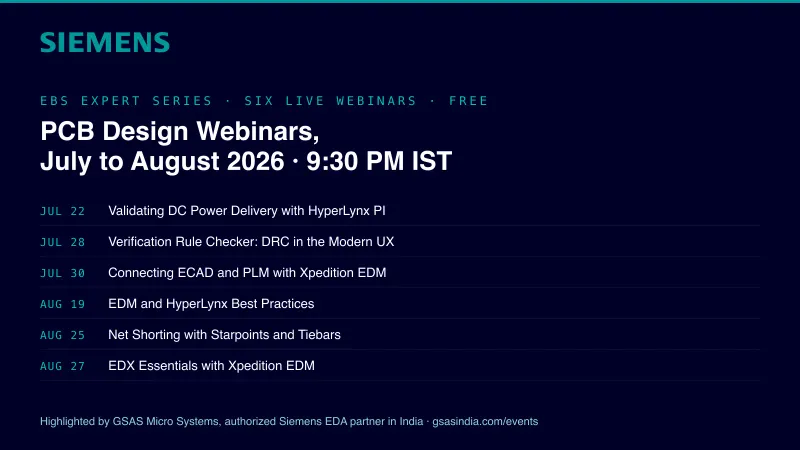
Siemens EDA EBS Expert Series: 6 Free PCB Design Webinars (Jul-Aug 2026)
20 Jul · 8 min
AI Data Centers in India: Test, Measurement & Memory Boom
4 Jun · 14 min

AI and Intelligent Automation in PCB Design: How Siemens Xpedition Removes the Work That Slows Indian Teams Down
4 Jun · 10 min

From Discovery to Production: The Modern PCB Design Journey in Siemens Xpedition: for Indian Teams
4 Jun · 8 min

The Complete AUTOSAR Verification Chain: AUTOSAR C++14 Static Analysis with Helix QAC, SWC and RTE Testing with TESSY 6
31 Jul · 9 min
I3C FAQ for Firmware Teams: What the Bus Is, What Changes, and What You Need on the Bench
31 Jul · 8 min