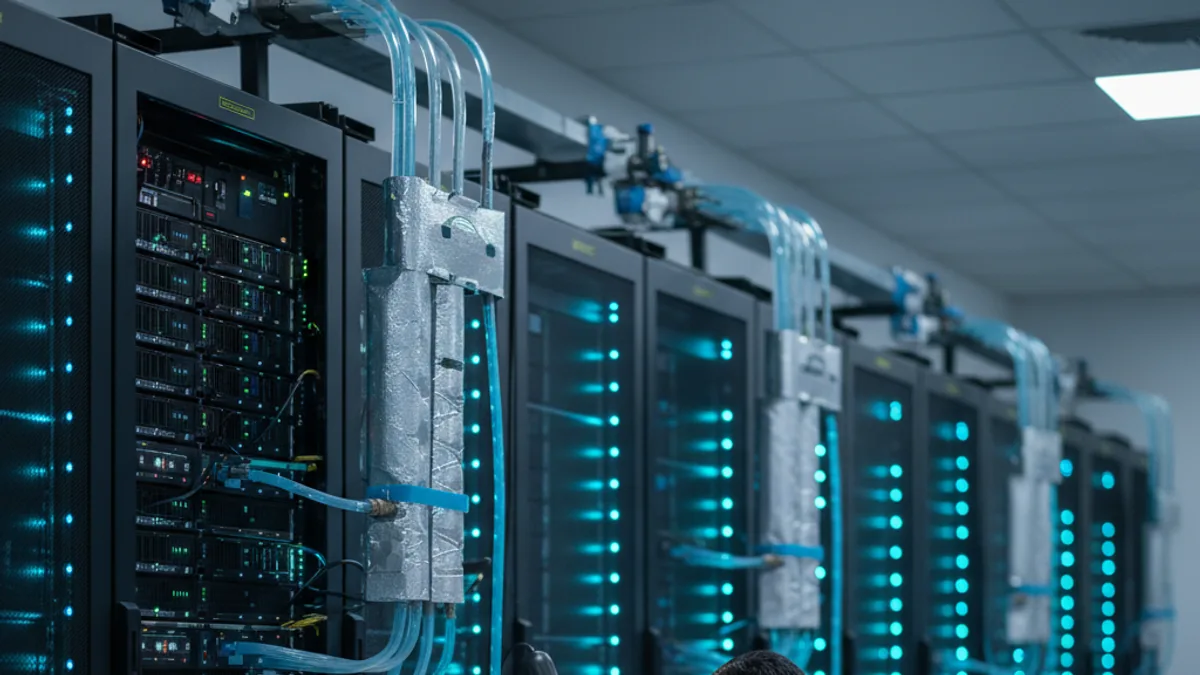
Artificial intelligence is, underneath the models, a hardware build-out: the largest in the history of computing. And every layer of that build-out has to be designed, brought up, powered, fed with memory, cooled, and kept running 24/7. Each of those is, at its core, a test, measurement and memory problem.
That is the part of the AI story that rarely makes headlines but decides whether the silicon ever ships. This is a field guide to the engineering behind AI data centers in India: the numbers driving the boom, the lifecycle of an AI rack, and, for Indian R&D and manufacturing teams, exactly which test, measurement and memory instruments solve each stage, all available through GSAS Micro Systems.
The numbers: an unprecedented hardware supercycle
The scale is hard to overstate, and it is well documented by independent analysts:
- Capex. McKinsey estimates data centers will require ~$6.7 trillion in capex worldwide by 2030, of which ~$5.2 trillion is AI-specific, and roughly 60% of that flows to chips and compute hardware (McKinsey, “The cost of compute”).
- Power. The IEA projects global data-center electricity rising from ~415 TWh in 2024 to ~945 TWh by 2030 (Base Case): more than doubling (IEA, “Energy and AI”).
- Rack density. Average rack power has climbed from ~7 kW (2021) to ~16 kW (AFCOM), while NVIDIA’s GB200 NVL72 AI racks reach ~132 kW, and Vertiv projects AI rack density heading toward ~1 MW per rack by 2029 (Introl; Vertiv).
- Memory. TrendForce reports HBM demand grew ~130% year-on-year in 2025, with another ~70% forecast for 2026 (TrendForce); server DDR5 is in shortage, with contract prices projected to keep rising sharply through 2026 (TrendForce).
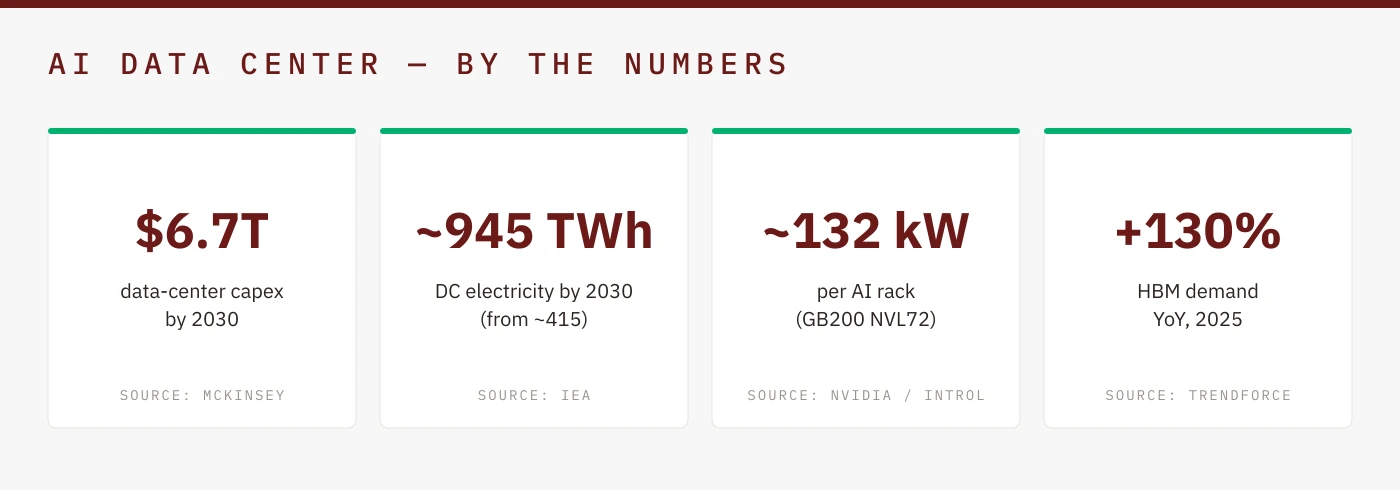 Sources: McKinsey “The cost of compute”; IEA “Energy and AI”; Introl/Vertiv; TrendForce. Figures are the cited firms’ estimates.
AI data centers in India: capacity and power demand
This is not a distant, Western story. India’s data-center capacity crossed ~1,700 MW in 2025 (≈440 MW added that year) and is expected to grow ~30% in 2026 on roughly 500 MW of fresh supply (CBRE, April 2026). India’s data-center electricity demand is projected to rise from ~10–15 TWh to ~40–45 TWh by 2030 (IEEFA, via Outlook Business). Every one of those megawatts sits on hardware that an Indian engineering team has to validate before it goes live.
What McKinsey, PwC and BCG see in the build-out
The strategy houses size the same wave from different angles. McKinsey projects global data-center power demand reaching ~219 GW by 2030: of which ~156 GW (around 70%) is AI: growing roughly 33% a year (McKinsey, “AI power”). BCG sees global data-center power climbing to ~130 GW by 2028 at a ~16% CAGR, with GenAI demand compounding ~65% a year and AI inference ~122% (BCG, “Breaking barriers to data center growth”). PwC’s global AI study puts AI’s contribution to the world economy at ~$15.7 trillion by 2030, and its 2025 Value in Motion work expects AI to add ~15 percentage points to global GDP by 2035 (PwC). And the build-out is landing in India: NASSCOM and BCG size India’s AI market at ~$17 billion by 2027, growing 25–35% a year (NASSCOM-BCG, via Business Standard).
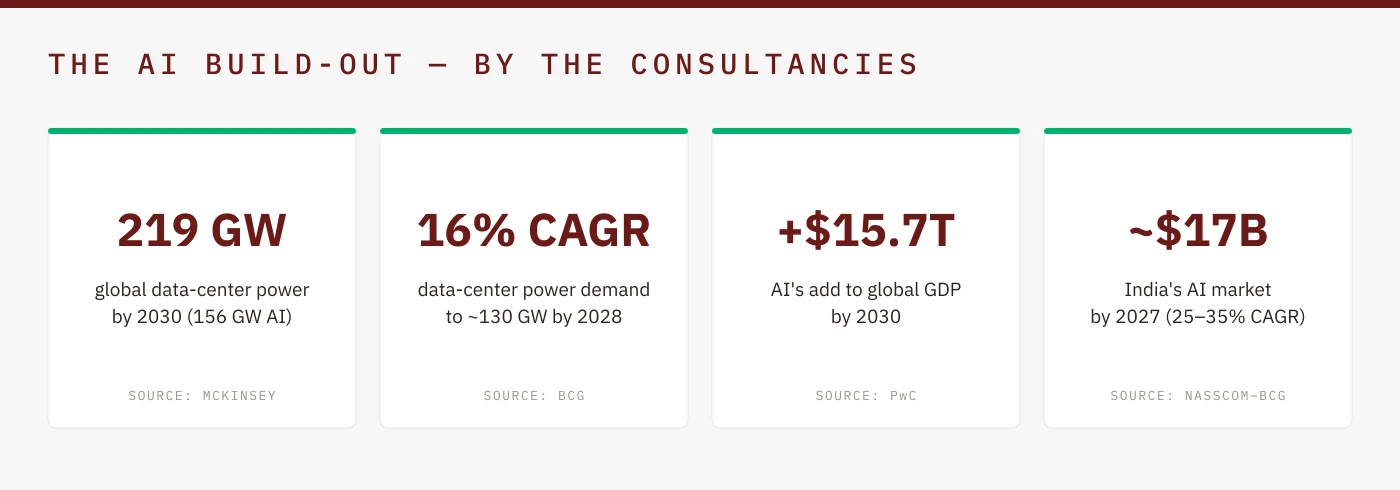 Sources: McKinsey “AI power”; BCG “Breaking barriers to data center growth”; PwC global AI study / Value in Motion 2025; NASSCOM-BCG (2024). Figures are the cited firms’ estimates.
The AI rack has a lifecycle: and every stage needs instrumentation
An AI server doesn’t arrive finished. It moves through a hardware lifecycle, and a different class of test, measurement or memory tooling owns each stage. This is the map that organizes the rest of this guide:
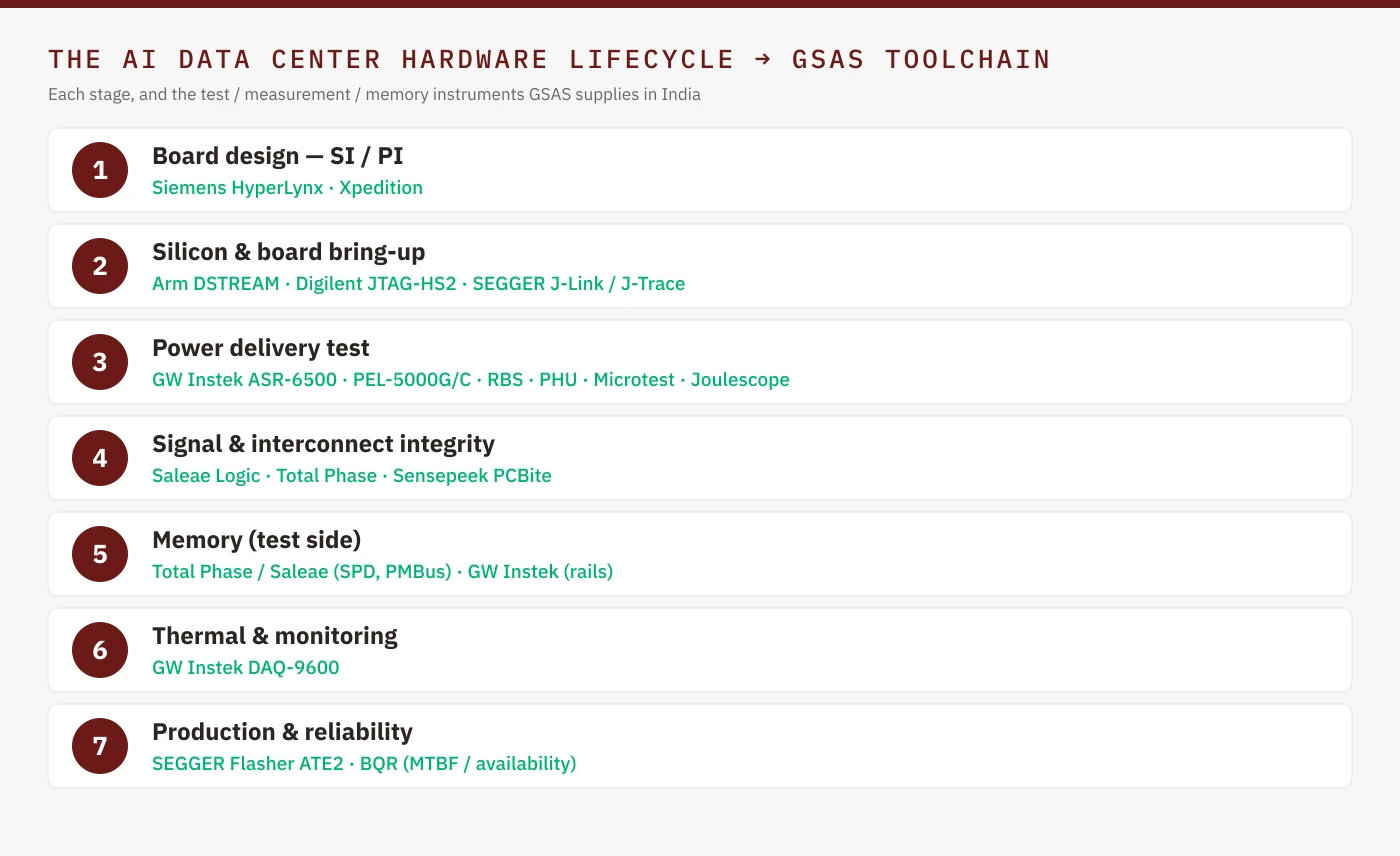 The AI-data-center hardware lifecycle and the GSAS instruments that serve each stage.
Stage 1: Board design: signal & power integrity sign-off
Before a single board is fabricated, the high-speed interfaces have to be proven in simulation. An AI host CPU like the Arm AGI CPU: Arm’s first in-house data-center silicon, announced 24 March 2026, with up to 136 Neoverse V3 cores, 96 PCIe Gen6 lanes, native CXL 3.0, and 12-channel DDR5 at up to 8,800 MT/s: pushes board designers to the edge of what copper can carry. (Note: Arm AGI CPU is a data-center host CPU for agentic-AI infrastructure, not an AI accelerator.)
Getting PCIe Gen6 and DDR5 right on those boards is a signal-integrity and power-integrity problem solved with Siemens EDA HyperLynx: SI/PI analysis, eye-diagram and channel simulation inside the Xpedition flow. Get the stack-up, vias and PDN right in simulation, and you avoid respins that cost months on a board carrying 96 Gen6 lanes.
Stage 2: Silicon & board bring-up: debug, trace and FPGA programming
Once boards exist, they have to be brought up and debugged: and AI infrastructure is built on Arm. The same Arm Neoverse cores in the AGI CPU and in Neoverse Compute Subsystems are debugged and traced with the Arm DSTREAM family:
- DSTREAM-ST: run-control debug over JTAG/SWD/cJTAG with streaming trace, for Cortex-A/R/M bring-up.
- DSTREAM-PT: up to 32-bit wide parallel trace into a large on-probe buffer, for capturing the behaviour of complex multi-core SoCs.
- DSTREAM-HT: high-speed serial trace (HSSTP) for the highest-bandwidth devices.
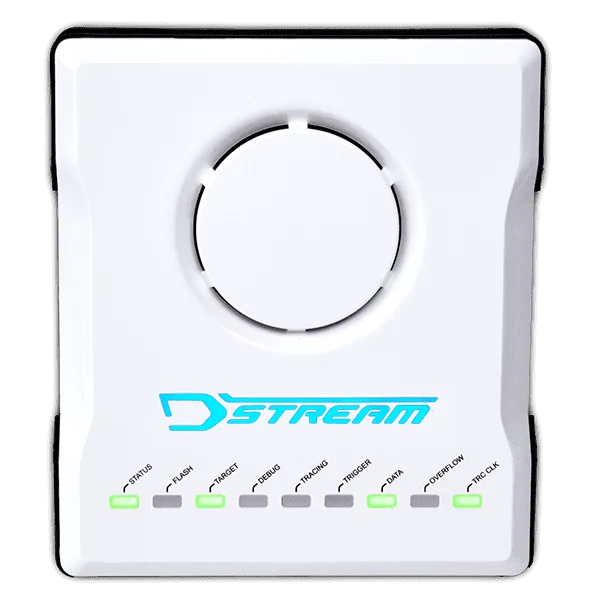 The Arm DSTREAM-ST, run-control debug and streaming trace for the Arm cores at the heart of AI server SoCs.
All integrate with Arm Development Studio, see our DSTREAM and Corstone deep-dive and the comparison.
AI servers are not only CPUs. FPGA accelerators, SmartNICs and DPUs need their own bring-up, and that starts with a JTAG programming cable. The Digilent JTAG-HS2 (1.8–5 V targets, up to 30 Mbit/s) is the workhorse for AMD/Xilinx FPGA configuration and flash programming during accelerator bring-up (HS2 vs HS3 guide).
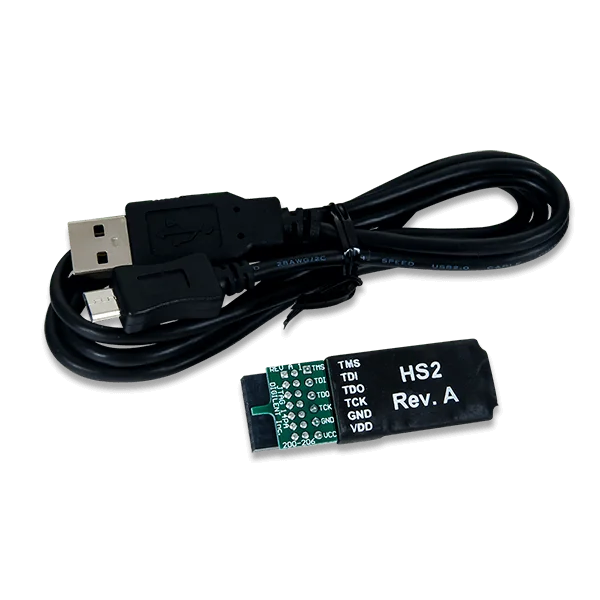 The Digilent JTAG-HS2, the FPGA configuration and flash-programming workhorse for accelerator, SmartNIC and DPU bring-up.
And every server carries a BMC and management microcontrollers: usually Arm Cortex-M, that need firmware bring-up and trace. That is SEGGER J-Link and J-Trace territory; when the debug target shares a ground with high-voltage power electronics, you isolate the port (SWD/JTAG isolation guide).
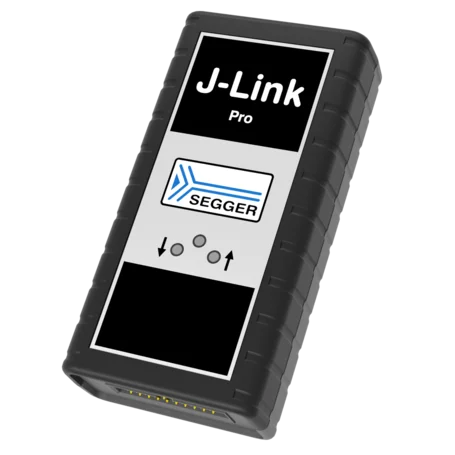 The SEGGER J-Link PRO, firmware bring-up and trace for the Arm Cortex-M BMC and management microcontrollers on every AI server board.
Stage 3: Power delivery: AC sources and electronic loads, from wall to core
This is where rack density bites. A 132 kW rack, heading toward a megawatt, has to be delivered, converted and tested at every step, and GW Instek’s high-power “6S” line (a GSAS grouping of GW Instek’s SiC-based high-power instruments) is built for exactly this:
- ASR-6500 / ASR-6660 AC/DC power sources, GW Instek positions these (launched 30 Sep 2025, SiC-based, 4U / 6.6 kVA density) explicitly for “next-generation AI servers and data center power systems,” including testing CRPS redundant server power modules (GW Instek news).
- PEL-5000G / PEL-5000C high-power DC electronic loads, for loading PSUs, VRMs and busbars (the PEL loads are dissipative; the RBS Series is the regenerative bidirectional option that feeds absorbed energy back to the grid for long-duration burn-in).
- PHU Series high-voltage DC source and the DAQ-9600 measurement backbone round out the bench, see the 6S catalog.
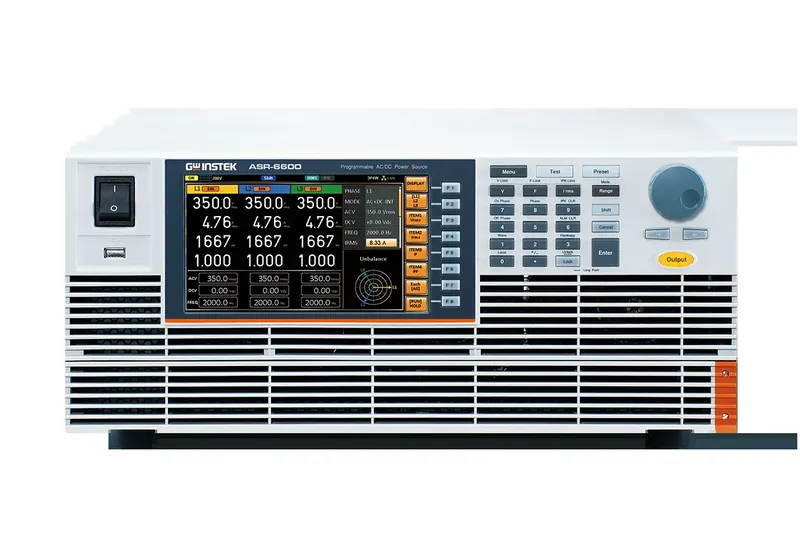 The GW Instek ASR-6500, a 4U, 6.6 kVA SiC AC/DC source built for AI-server and data-center power testing, including CRPS redundant power modules.
Down at the component level, the point-of-load converters feeding each accelerator use power inductors that saturate under tens of amps of DC bias. Qualifying them is a Microtest DC-bias inductor test job, a measurement most teams discover the hard way. For energy-efficiency and rail-level power characterisation, the Joulescope precision energy analyzer quantifies exactly where the watts go.
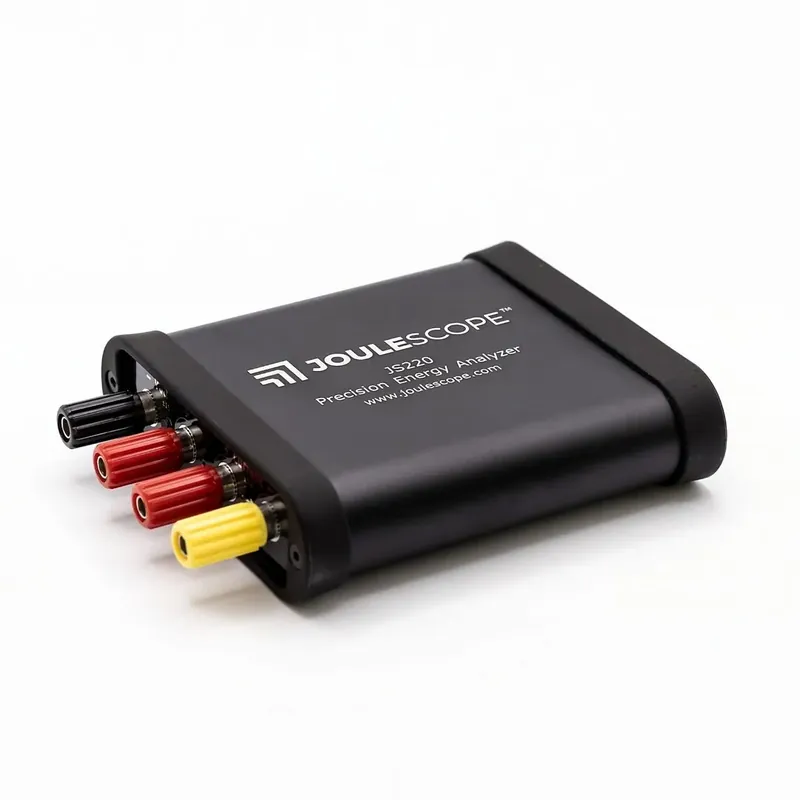 The Joulescope JS220, precision energy and power analysis to find exactly where the watts go on an AI server rail.
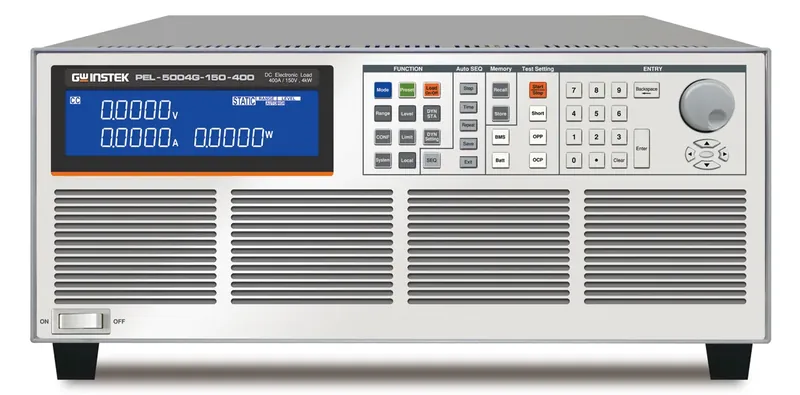 The GW Instek PEL-5000G high-power DC electronic load, for loading AI server PSUs, VRMs and busbars under realistic conditions.
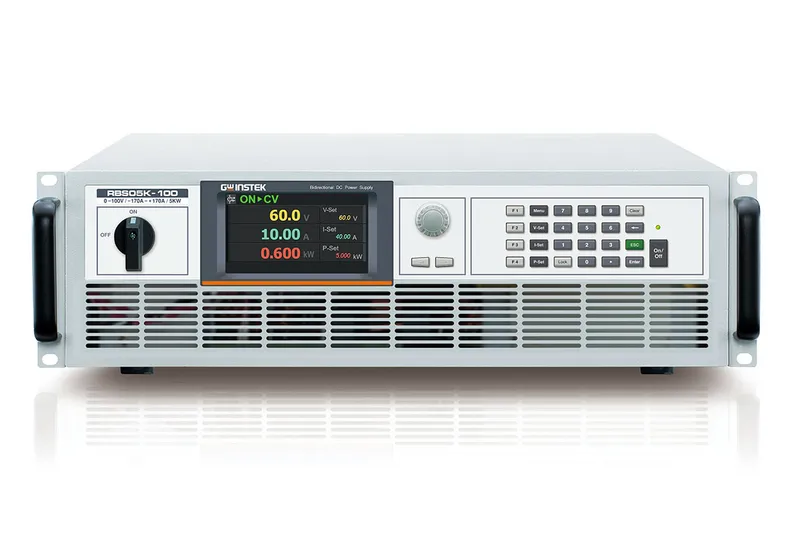 The GW Instek RBS Series, a regenerative load that returns absorbed energy to the grid, for sustainable long-duration AI-server PSU burn-in.
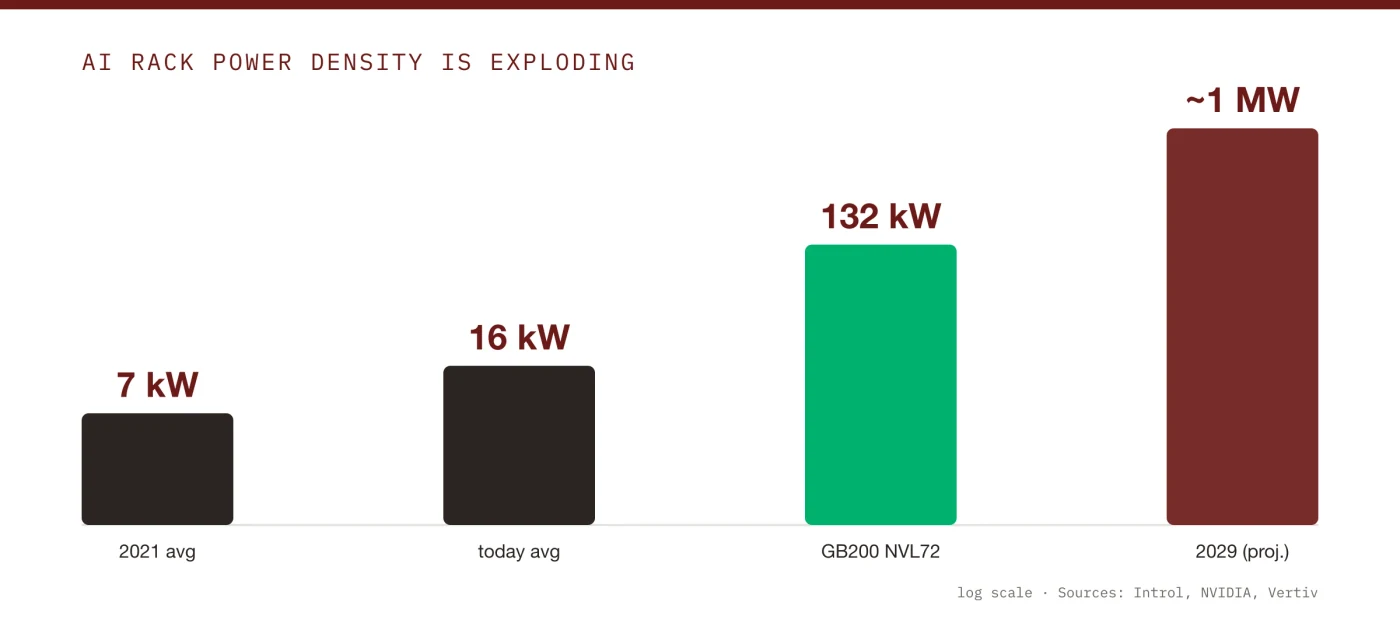 Rack power density. Sources: AFCOM 2025 (industry average); NVIDIA GB200 NVL72 (132 kW); Vertiv (~1 MW/rack, 2029+).
Stage 4: Signal & interconnect integrity: logic and protocol analysis
PCIe Gen6, CXL 3.0 and DDR5-8800 leave almost no margin, and riding alongside them is the management and power sideband (PMBus, I²C/SMBus, I3C), where servers report health and negotiate power. On dense AI boards, validating that high-speed digital and sideband traffic is a logic-analyzer and protocol-analyzer job.
Saleae Logic logic analyzers (such as the Logic Pro 16) capture those buses across many channels at once, with built-in PMBus / I²C / I3C protocol decode in Logic 2, so you can watch a server negotiate power and report rail health in real time. Total Phase (Beagle I²C/SPI, Promira) adds non-intrusive I²C/SMBus/SPI monitoring of power-management and memory-SPD traffic.
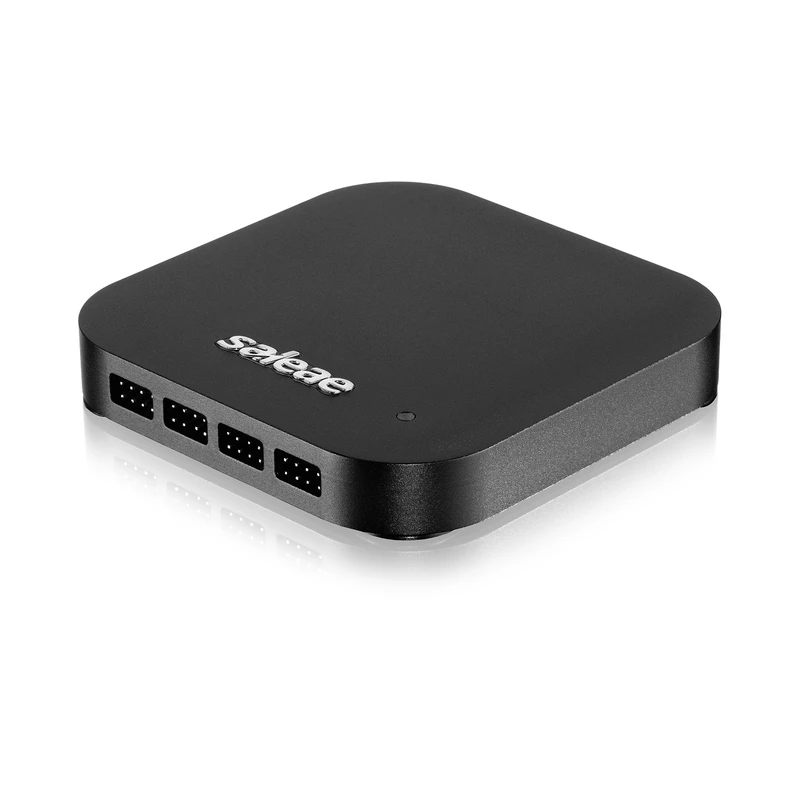 The Saleae Logic Pro 16 logic analyzer, high-speed multi-channel digital capture with protocol decode in Logic 2.
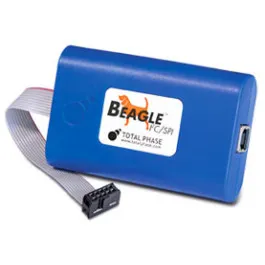 The Total Phase Beagle I²C/SPI analyzer, non-intrusive monitoring of PMBus/SMBus and memory-SPD traffic on AI server power and memory rails.
None of this happens without getting probes reliably onto the board, and AI server PCBs are dense, multi-rail and unforgiving. Sensepeek PCBite probe stations and holders (for example the PCBite SQ500 kit) keep logic-analyzer and meter tips precisely on fine-pitch test points hands-free, so a single engineer can drive a Saleae logic analyzer and a multimeter on the same board at once.
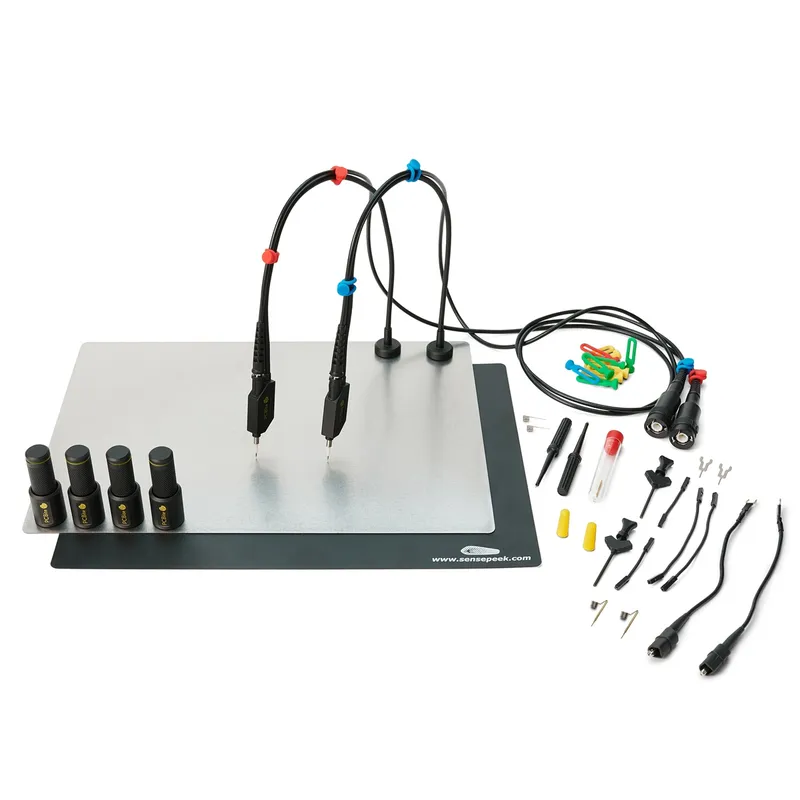 Sensepeek PCBite SQ500, hands-free probing of fine-pitch test points on dense AI server boards.
Stage 5: Memory: HBM, DDR5 and the other half of the AI bottleneck
AI is as memory-bound as it is compute-bound. HBM rides on the accelerators; DDR5 RDIMMs and emerging MRDIMMs feed the host CPUs. The demand curve is steep, SK Hynix’s 2026 outlook cites a Bank of America estimate of an ~$54.6B HBM market (+58% YoY), with the total memory market projected above $440B (SK Hynix), and Micron expects the HBM TAM to approach ~$100B by ~2028 (The Next Platform).
On the module side, vendors like APacer illustrate where AI-era server memory is going: JEDEC DDR5 RDIMMs (with on-die + side-band ECC and on-module thermal sensors), DDR5-8800 MRDIMMs, and enterprise PCIe Gen5 SSDs up to 30 TB, plus power-loss-protection and energy-efficiency technologies for always-on servers (Apacer’s stated specifications). (APacer is referenced here as an industry example of AI-era server memory, not as a GSAS-supplied product.) The GSAS angle on memory is the test side: SPD, PMBus and memory-management traffic decoded on Saleae and Total Phase, plus rail and thermal validation on the GW Instek power-and-DAQ bench.
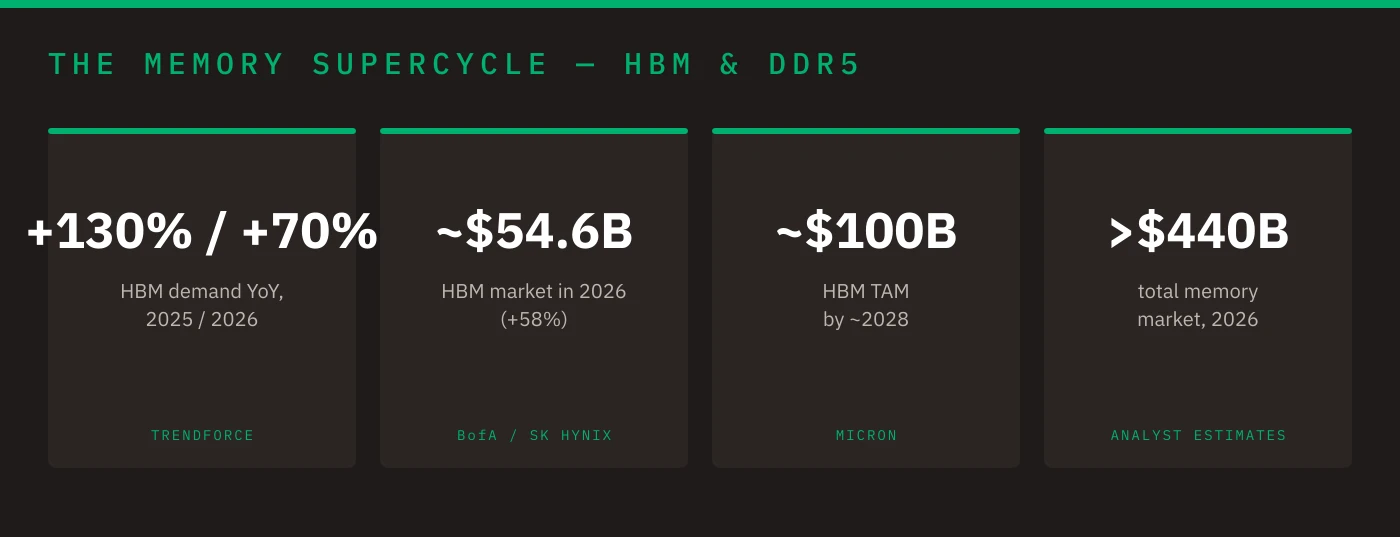 Memory demand. Sources: TrendForce (HBM YoY); SK Hynix 2026 outlook; Micron HBM TAM.
Stage 6: Thermal & monitoring: data logging to keep a megawatt alive
A 200 kW liquid-cooled rack lives or dies by its thermals. Continuous, multi-channel temperature and power telemetry is a data-acquisition job, and the GW Instek DAQ-9600 modular data-acquisition system owns it: a three-slot mainframe scaling to up to 120 single-ended (60 two-wire) channels of voltage, current, temperature and resistance, scanning thermocouples, RTDs and rail voltages across a whole rack at once. It is the wide-channel backbone for a full power-and-thermal characterisation run, feeding live dashboards that show inlet/outlet deltas, per-board hot spots and PSU efficiency as the rack ramps under load.
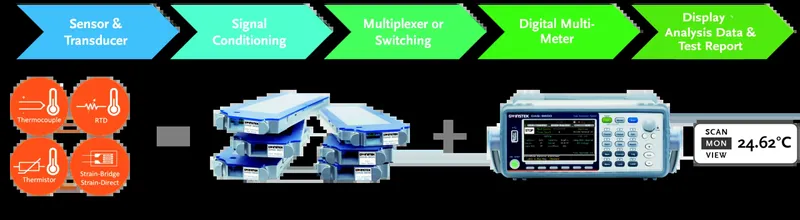 The GW Instek DAQ-9600, a three-slot, up-to-120-channel data-acquisition backbone for AI rack thermal and power validation.
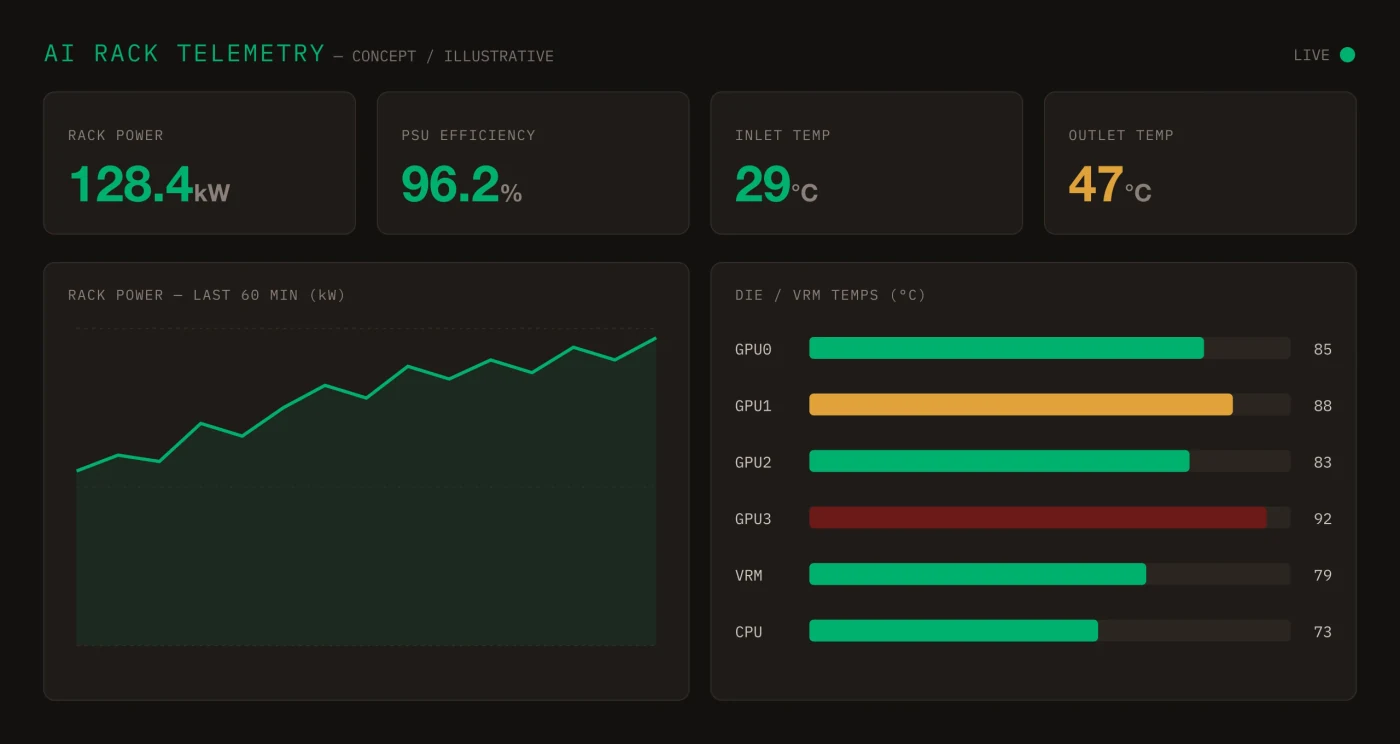 A DAQ-9600-driven telemetry dashboard: continuous thermal and power logging across an AI rack under test.
Stage 7: Production programming and reliability engineering
When a design graduates to volume, the management and power MCUs and flash on every sub-board have to be programmed in production. That is SEGGER Flasher territory, and on a high-volume AI-hardware line it is the SEGGER Flasher ATE2 that earns its place: a programmer built for automated test equipment and parallel gang programming, driving up to 8 targets at once (4- or 8-channel, 128 MB per channel) under full ATE control, alongside Flasher PRO/Compact and Secure for secure provisioning, the same SEGGER ecosystem used to bring the firmware up in the first place.
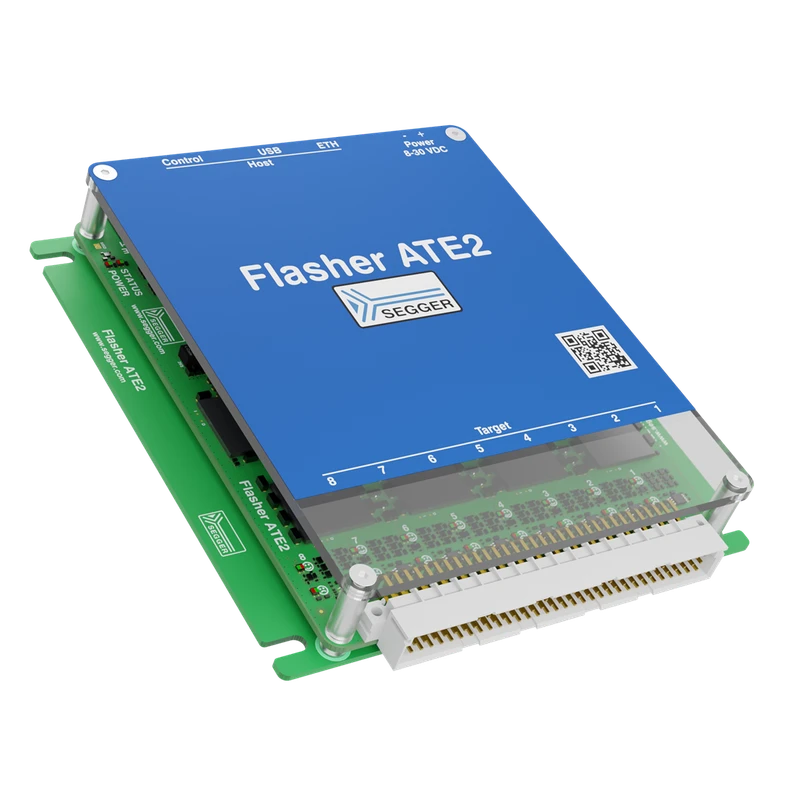 The SEGGER Flasher ATE2, built for automated, high-volume in-line programming of AI-hardware sub-boards, up to 8 targets in parallel.
And because AI infrastructure is sold on uptime, reliability engineering, MTBF, availability and FMEA modelling with BQR: turns a working prototype into a fleet that survives 24/7 duty.
The GSAS view: one partner across the whole AI-DC bench
The pattern across all seven stages is the same: the AI build-out converts into concrete, buyable test, measurement and memory work. GSAS Micro Systems brings that entire toolchain to Indian teams under one roof, design (Siemens EDA), bring-up and trace (Arm, SEGGER, Digilent), power (GW Instek, Microtest, Joulescope), signal and protocol integrity (Saleae, Total Phase, Sensepeek), power-and-thermal acquisition (GW Instek DAQ), and production and reliability (SEGGER Flasher ATE2, BQR), with INR invoicing, GST billing, and local application engineering from offices in Bengaluru, Hyderabad, Chennai, Pune, Mumbai and Delhi NCR.
Frequently asked questions
How big is the AI data center build-out in India?
India’s data-center capacity crossed ~1,700 MW in 2025 (roughly 440 MW added that year) and is expected to grow ~30% in 2026 on about 500 MW of fresh supply (CBRE). Data-center electricity demand is projected to rise from ~10–15 TWh today to ~40–45 TWh by 2030 (IEEFA). Every megawatt of that build-out runs on hardware an Indian engineering team has to validate, which is exactly the test, measurement and memory work GSAS supplies.
What is the “Arm AGI CPU” and is it an AI chip?
The Arm AGI CPU (announced 24 March 2026) is Arm’s first in-house data-center host CPU: up to 136 Neoverse V3 cores, built to orchestrate agentic-AI infrastructure that feeds GPU/accelerator clusters. “AGI” is Arm’s product branding; it is a server CPU, not an AI accelerator or an artificial-general-intelligence processor. Arm states it delivers “more than 2× the performance per rack versus the latest x86 systems” (an Arm estimate).
Which instruments test AI server power supplies in India?
For CRPS server PSUs, VRMs and rack power: GW Instek ASR-6500/6660 AC/DC sources and PEL-5000G/C DC electronic loads; the RBS Series for regenerative long-duration burn-in; Microtest for power-inductor DC-bias characterisation; and Joulescope for rail-level efficiency and power characterisation, all available in India from GSAS.
How do you debug the FPGAs and accelerators in AI servers?
FPGA accelerators, SmartNICs and DPUs are configured and flash-programmed with the Digilent JTAG-HS2 cable; Arm-based SoCs are debugged and traced with Arm DSTREAM; and BMC/management firmware is brought up with SEGGER J-Link/J-Trace.
Does GSAS supply memory for AI servers?
GSAS’s focus is the test and measurement side of memory, SPD and PMBus protocol analysis (Saleae, Total Phase) and rail and thermal validation on the GW Instek power-and-DAQ bench. APacer is referenced in this article as an industry example of AI-era server memory, not as a GSAS-supplied product.
Get the AI-data-center bench built right
Whether you are validating a CRPS PSU, bringing up an FPGA accelerator, signing off a PCIe Gen6 channel, or standing up a thermal-monitoring rig, GSAS Micro Systems can scope and supply the instruments, and the application engineering behind them, across Bengaluru, Hyderabad, Chennai, Pune, Mumbai and Delhi NCR. Request a quote or book a consultation.
Sources
- McKinsey, The cost of compute: A $7 trillion race to scale data centers; AI power: Expanding data center capacity to meet growing demand
- BCG, Breaking barriers to data center growth
- PwC, AI adoption could boost global GDP by an additional 15 percentage points by 2035 (Value in Motion); Sizing the Prize (global AI study)
- NASSCOM-BCG, India’s AI market to touch $17 billion by 2027 (via Business Standard)
- IEA, Energy and AI
- Introl, High-density racks: 100kW+ AI data centers (OCP 2025); Vertiv, long-term AI infrastructure predictions
- TrendForce, HBM demand research and DDR5 contract-price outlook
- SK Hynix, 2026 market outlook; Micron HBM TAM via The Next Platform
- CBRE, India data-centre capacity to jump 30% in 2026 (Business Today); IEEFA, India data-centre power demand (Outlook Business)
- Arm, Arm AGI CPU launch; Neoverse Compute Subsystems
- GW Instek, ASR-6500/6660 news release
- APacer, product specifications (apacer.com), referenced as industry context
Also appears in:
Interested in Arm tools?
Talk to our application engineers for personalized tool recommendations.
More from Arm
View all →
Meet the GSAS Team at electronica India 2026, Stall H3.I45
15 Sept · 3 min
Arm's Agentic AI Push: What Indian Embedded Teams Can Actually Use Today
13 Sept · 7 min
Arm User-Based Licensing in CI/CD: armlm, Proxy Activation and What Breaks
28 Jul · 11 min
Two Arm Keil MDK Webinars This Summer: DevOps and Edge AI for Indian Cortex-M Teams
17 Jun · 4 min
Emulating Processor Power for Thermal Testing: Why Constant Power
7 Oct · 7 min
CRPS and Rack Power Supply Testing: The Six Tests That Matter
7 Oct · 7 min