
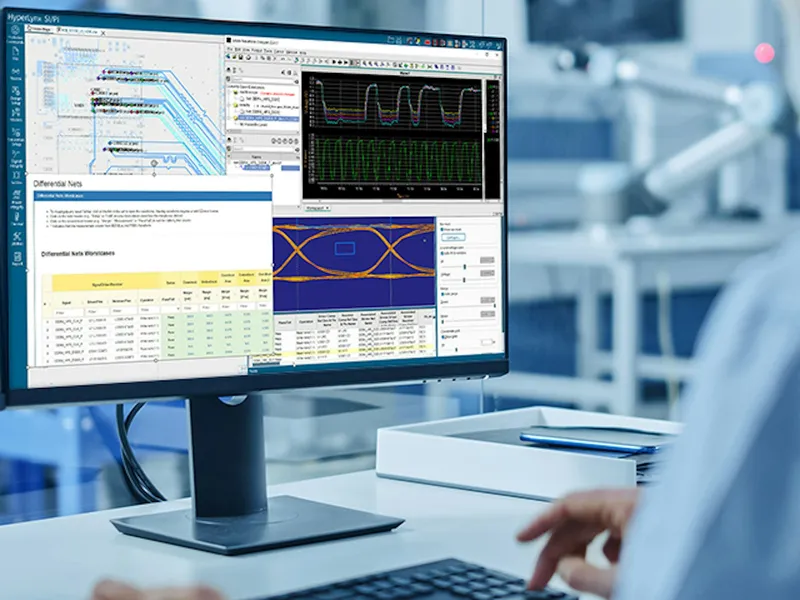
 Siemens EDA
 HyperLynx
Signal & Power IntegrityUnified PCB verification platform, signal integrity, power integrity, schematic analysis, electrical DRC, analog mixed-signal, stackup design, and integrated 2D/2.5D/3D electromagnetic solvers in a single toolchain. 256 built-in compliance protocols, DDR3-5/LPDDR3-5, IBIS-AMI channel sims. Buy in India from GSAS.
Protocols
256 built-in compliance protocols (Ethernet, PCIe, USB, HDMI, JESD, MIPI, OIF-CEI, Fibre Channel)
DDR Support
DDR3-5 + LPDDR3-5
DRC Rules
Extensive parameterizable domain-based rules (EMI, SI, PI, safety)
EM Solvers
Full-wave, hybrid, quasi-static, integrated 2D/2.5D/3D
Integration
Xpedition native, PADS native, ODB++ for third-party PCB tools
Automation
Python custom rules, batch analysis, Design Space Exploration (HL-DSE)
Overview
About HyperLynx
HyperLynx from Siemens EDA (formerly Mentor Graphics) is a unified PCB verification platform that combines signal integrity (SI), power integrity (PI), schematic analysis, electrical design-rule checking (DRC), analog mixed-signal simulation, stackup design, and integrated 2D/2.5D/3D electromagnetic solvers in a single product family. Teams building modern high-speed boards no longer need six disconnected tools with six separate data models, HyperLynx gives the PCB designer pre-layout exploration, post-layout verification, PDN sign-off, and shift-left electrical DRC from the same workflow, the same library, and the same stackup definition. The latest generation adds an intuitive, AI-infused and cloud-connected modern user experience (per Siemens).
GSAS Micro Systems delivers HyperLynx in India with INR invoicing, local FAE support, migration workshops, and compliance guidance for automotive ISO 26262, defence export control, and medical device PCB teams across Bengaluru, Hyderabad, Chennai, Pune, Mumbai, and Delhi NCR.
Signal Integrity (SI): LineSim + BoardSim
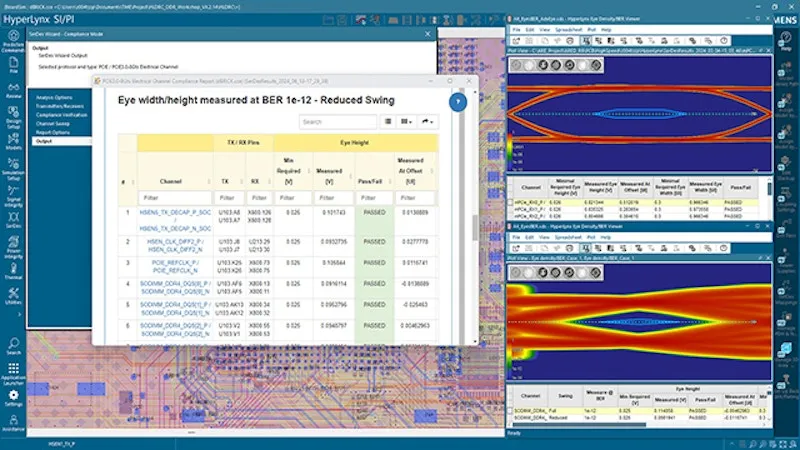
HyperLynx Signal Integrity provides pre-layout topology exploration and post-layout verification for PCB interconnects. Its progressive verification methodology lets designers catch problems earlier than traditional analysis flows, enabling compliance analysis throughout the design cycle rather than as a final-stage gate.
- 256 built-in compliance protocols: Ethernet, Fibre Channel, HDMI, JESD, MIPI D-PHY, OIF-CEI, PCIe, and USB families all covered out of the box
- DDR interface-level analysis: complete signal-quality and inter-group timing verification for DDR3-5 and LPDDR3-5 memories
- IBIS-AMI device-specific analysis: vendor IBIS-AMI models drive automated post-layout channel model extraction for multi-gigabit SerDes
- General-purpose SI prediction: signal quality and eye closure analysis accounting for impedance mismatches, topology, drive impedance, slew rate, termination, signal spacing, and crosstalk
- Integrated stackup editor (Z-planner Enterprise): plan and optimise the PCB stackup with an accurate field solver, loss planning and a dielectric materials library, validated across multiple fabricators
DDRx Interface Design (HyperLynx DDR)
HyperLynx DDR delivers automated full-interface post-layout verification for memory subsystems:
- DDR3-5 / LPDDR3-5 coverage: interface-level analysis for DDR3, DDR4, DDR5 and LPDDR3/4/5 memories
- Automated topology extraction + protocol-aware simulation: same automated flow reports the same results in the same format for pre-layout and post-layout, enabling direct comparison
- Power-aware modeling: effects of non-ideal signal return paths, return path current sharing, and simultaneous switching noise (SSN) can be selectively included
- DDR5 compliance: IBIS-AMI simulation helps designs meet DDR5’s stringent signalling requirements, including the JEDEC 1e-16 BER target
- Controller configuration: 1T/2T address timing, read and write leveling, dynamic termination setup, DQ/DQS deskewing
SerDes Channel Design
HyperLynx SerDes Channel Design handles pin-to-pin interconnect verification for modern high-speed serial protocols:
- Serial protocol compliance kits: Ethernet, Fibre Channel, HDMI, JESD, MIPI D-PHY, OIF-CEI, PCIe, USB
- Integrated 3D EM modeling: automated topology extraction for BGA breakouts, via transitions, and blocking capacitors at speeds beyond 5 GT/s
- Standards compliance analysis: interconnect verification against protocol specifications without requiring vendor component models; produces HTML reports with margin data
- IBIS-AMI simulation: Statistical, Time-Domain, and Dual model types determine actual equalization settings and operating margins
- Automated channel modeling: “cut and stitch” modeling identifies areas requiring 3D EM, eliminates duplicate solving, and builds end-to-end channel models
- Parallel solver execution: LAN-distributed processing for designs with hundreds of channels and thousands of modeling areas
Power Integrity (PI): PDN Sign-Off
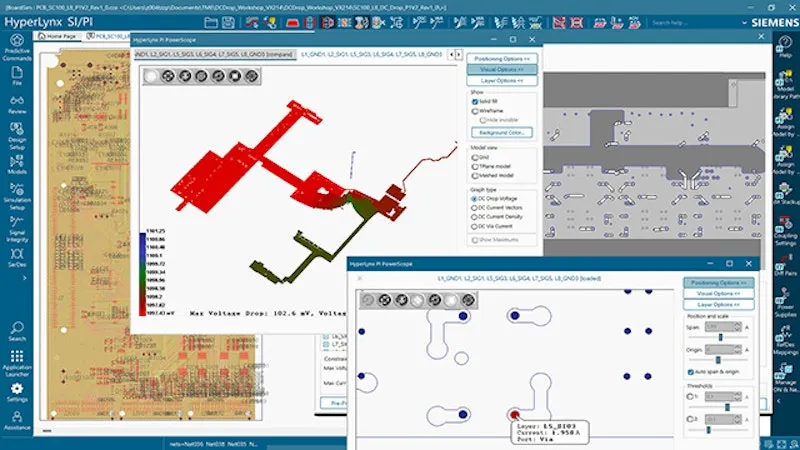
HyperLynx Power Integrity characterizes the complete power delivery network (PDN) of a PCB to ensure stable, low-noise power reaches every IC. As IC supply voltages keep falling and transient currents keep climbing, the margin for PDN design error has effectively disappeared, HyperLynx PI gives designers the analysis tools to validate the power path before committing to prototype.
- DC Power Integrity (DC Drop): analyses IR drop, current density and point-to-point resistance, including multi-board power delivery systems with multi-phase supplies and remote sense pins, so adequate voltage reaches every IC power pin
- AC Power Integrity Analysis: evaluates PDN behavior under transient conditions caused by fluctuations in power demanded by ICs
- Decoupling capacitor design: analyzes decoupling capacitor locations and values, capacitor fanout, and IC power pin locations
- PDN Decoupling Optimizer: post-layout optimization of decoupling capacitor values and locations using a combination of expert-based and genetic optimization algorithms
- Power-signal integrity interaction: examines how PI and SI interact and explores mitigation strategies for SSN and VRM-induced noise
Electrical DRC: Automated Electrical Rule Checks
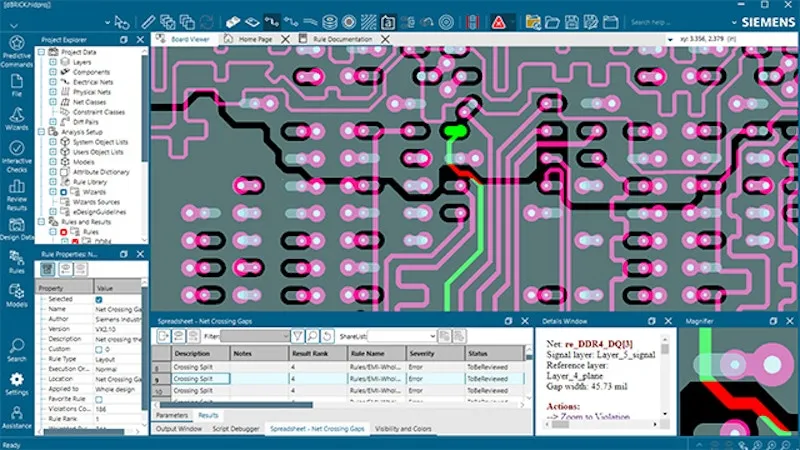
HyperLynx DRC is the first stage of Siemens’ progressive verification methodology. It replaces hours of manual electrical design review with automated rule-based checking that identifies problems in minutes that might take days to find with simulation.
- Extensive built-in domain-based rules: parameterizable, covering analog, EMI, packaging layout, power integrity, signal integrity, and compliance-based electrical safety issues
- Unique 3D geometry engine: checks complex physical and electrical design problems (signal traces crossing antipads and plane splits, signal return-path issues) that are difficult and expensive to find through simulation
- Custom rule development in Python: develop your own checking rules using a built-in set of design objects and automation functions
- Batch automation: DRC is externally automatable; once rules and parameters are configured, drive batch checking across multiple designs
- Cross-probe reporting: detailed issue lists with cross-probing to layout views; ShareLists automatically drive PCB tools to pan and zoom to the issue area
- Shift-left verification: catches electrical issues (plane splits, signal return path discontinuities, antipad crossings) before simulation or fabrication
Why Electrical DRC Closes the Gap Physical DRC Misses
Most PCB layout tools provide physical DRC, spacing, clearance, trace width. Physical DRC cannot catch electrical issues like impedance mismatches, return path discontinuities, crosstalk coupling, or decoupling placement problems. These electrical issues are the root cause of SI failures, EMC chamber failures, and expensive board re-spins that teams discover only after the first prototype arrives. HyperLynx DRC fills this gap, pays for itself with one avoided re-spin.
Schematic Analysis: Catch 50-70% of Respin Causes at the Schematic Stage
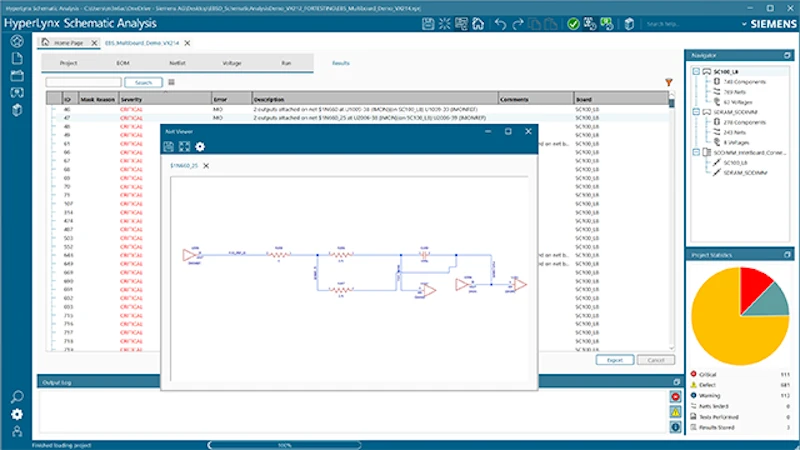
HyperLynx Schematic Analysis performs automated schematic verification in parallel with design capture, eliminating the need for manual schematic reviews and catching errors at the earliest possible design stage.
- Comprehensive net inspection: extensive intelligent model component library performs full inspection of all nets, referencing manufacturer part numbers and vendor datasheets
- Extensive rule coverage: IO compatibility, differential connectivity, pin function compatibility, symbol mismatches, capacitor derating failures, missing pull-ups, power/ground connections, unconnected mandatory pins
- Claimed design-error reduction: Siemens states the tool eliminates 50-70% of design respins caused by schematic errors and saves hundreds of hours of visual inspection and lab debug time
- Real-time feedback in-schematic: errors highlighted directly in the schematic for cross-probing and on-the-fly resolution
- Post-release analysis: can be applied to released designs to improve quality, increase yield, and decrease product returns
Analog Mixed-Signal (AMS): Circuit Simulation Meets PCB Physics
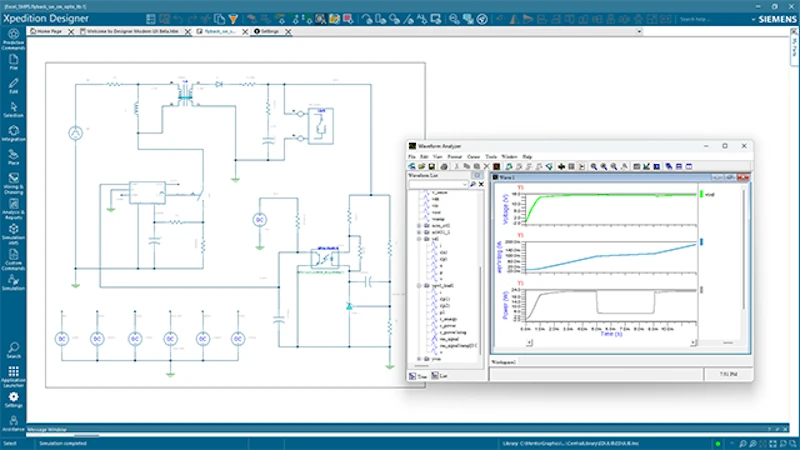
HyperLynx AMS expands standard SPICE-based circuit analysis by incorporating PCB modeling and simulation advances, accelerating circuit development and verification. Its key differentiator: unlike standard SPICE tools, HyperLynx bridges circuit simulation and physical PCB design within a single workflow, accounting for parasitics that typically only affect digital designs.
- SPICE + VHDL-AMS co-simulation: mixed-signal, mixed-domain analysis with both analog and digital waveform viewing against a unified timebase
- Xpedition integration: tightly integrated with Xpedition Designer and Layout (“one schematic drives everything”); eliminates redundant circuit drawing between simulation and layout
- PCB parasitic extraction and back-annotation: extract parasitic values from the PCB database and back-annotate into simulations to evaluate actual board layout effects on circuit performance
- Parametric analysis: corner-case behavior, worst-case performance, manufacturing yield analysis, and pre/post-layout simulation comparison
- High-performance waveform database: handles gigabytes of simulation data with mathematical operations, measurement tools, and automated comparison to reference waveforms
Advanced Solvers: 2D/2.5D/3D Electromagnetic Simulation
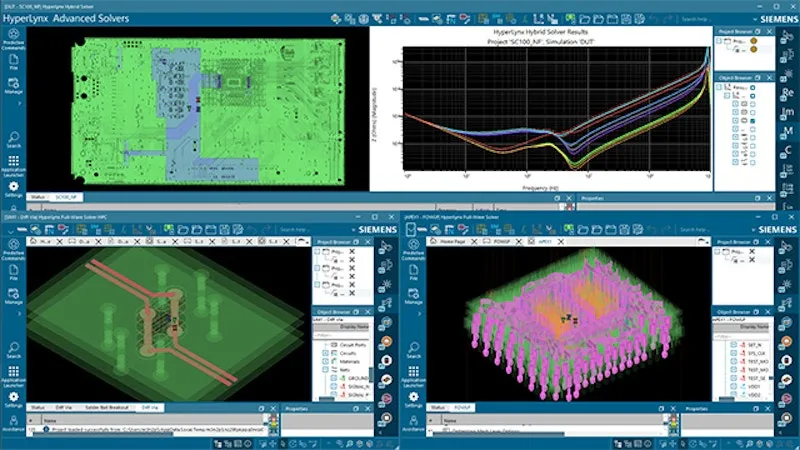
HyperLynx Advanced Solvers provide a complete family of EM simulation tools for PCB and IC packaging applications, spanning full-wave, hybrid, and quasi-static modeling, integrated 2D, 2.5D and 3D electromagnetic modeling within a unified framework.
- Three solver technologies in one framework: Full Wave Solver (boundary-element, for the highest accuracy on critical high-speed serial channels, IC packages and DDR5 sections), Hybrid Solver (decomposition solver for larger layered structures and power-aware DDR/AC-PI analysis), and Fast 3D Quasi-Static (frequency-dependent RLCG extraction for smaller structures, AMS and package work)
- Integrated with SI and PI workflows: tightly linked to HyperLynx Signal Integrity and HyperLynx Power Integrity for automated interconnect modeling within system-level analysis
- Job Distribution (HL-AS JD): parallel processing across multiple machines via distributed LAN-based execution for compute-intensive 3D simulations
- 3D Explorer: swept-parameter analysis for interconnect structure optimization
- Design Space Exploration (HL-DSE): finds optimal solutions across large design spaces with a fraction of the simulations, building a surrogate model to predict design behaviour and manufacturing yield
- Common framework across solvers: same database import, editing capabilities, post-processing, visualization, and model export across all three solver types
Technical Specifications
| Capability | Detail |
|---|---|
| Platform | Windows; Siemens perpetual, term, and Xpedition token-based licensing |
| SI Pre-Layout | LineSim topology explorer (IBIS/SPICE) |
| SI Post-Layout | BoardSim full-board SI with field-solver extraction |
| Protocol Library | 256 built-in compliance protocols (Ethernet, PCIe, USB, HDMI, JESD, MIPI, OIF-CEI, Fibre Channel) |
| DDR Support | DDR3-5, LPDDR3-5 |
| Eye Analysis | Statistical (IBIS-AMI) to the JEDEC DDR5 1e-16 BER target, time-domain, dual model |
| Crosstalk | NEXT, FEXT, multi-aggressor analysis |
| S-Parameters | Touchstone import/export, channel concatenation |
| DC PI | IR drop, current density, point-to-point resistance, multi-board |
| AC PI | PDN Z-profile vs. frequency, transient analysis |
| Decoupling | Value, quantity, placement, fanout, PDN Decoupling Optimizer |
| DRC Rules | Extensive parameterizable domain-based rules |
| Custom Rules | Python scripting with design object API |
| AMS Simulation | SPICE + VHDL-AMS, mixed-domain, parametric |
| EM Solvers | Full-wave, hybrid, quasi-static, integrated 2D/2.5D/3D |
| Stackup | Z-planner Enterprise, field solver, loss planning, materials library |
| DSE Engine | HyperLynx Design Space Exploration (surrogate-model optimization) |
| PCB Import | Xpedition (native), PADS (native), ODB++ (third-party tools) |
| Reporting | HTML with margin data, cross-probe ShareLists, waveform DB |
Target Applications
- Networking and Data Center: 100G/400G Ethernet switches, high-radix routers, server motherboards where SerDes channel compliance, DDR5 timing closure, and multi-rail PDN sign-off are design-critical
- Automotive ADAS: sensor fusion controllers, autonomous driving compute platforms, in-vehicle Ethernet TSN networking requiring SI/PI/EMC verification across wide temperature ranges
- Aerospace and Defence: radar processing boards, satellite communications, avionics with strict EMI/EMC requirements and multi-layer rigid-flex stackups
- Industrial Automation: PLCs, motor drives, industrial Ethernet switches with mixed high-speed digital and power electronics on the same board
- Consumer Electronics: smartphones, tablets, wearables where LPDDR5, MIPI, and USB4 interfaces must meet tight SI budgets in compact form factors
- Telecom Infrastructure: 5G small cells, base stations, networking hardware with many voltage rails and multi-gigabit backplane channels
- Medical Devices: patient monitors, imaging consoles, lab instruments where EMC pre-compliance and signal fidelity are regulatory requirements
Why Teams Choose HyperLynx in India
- Accessible to PCB designers, not just SI specialists: standalone EM solvers require months of training. HyperLynx provides guided workflows, visual topology editing, and automated constraint checking that enable layout engineers to perform rigorous SI/PI analysis without becoming EM simulation experts.
- Integrated with the design flow: HyperLynx reads the live Xpedition or PADS database natively. Constraint violations flow back to the layout tool in real time. No export/translate/re-import friction.
- Shift-left verification across six domains: schematic analysis → electrical DRC → SI simulation → PI analysis → AMS co-simulation → 3D EM solving, all sharing the same database and stackup definition. Disconnected point tools treat these as separate problems.
- Protocol-aware compliance checking: automated pass/fail verification against protocol specifications without manual interpretation of raw S-parameter data.
- 50-70% respin reduction at the schematic stage (per Siemens), Schematic Analysis catches errors before a single trace is routed.
- Works with any PCB tool: ODB++ import lets HyperLynx verify designs from any layout platform.
- Custom Python rules capture institutional knowledge: encode company-specific constraints and lessons learned into reusable rules.
- Pays for itself with one avoided re-spin: a single PCB re-spin costs lakhs of rupees and weeks of schedule.
HyperLynx vs Other Signal Integrity Tools in India
Indian PCB design teams evaluating signal integrity simulation and power integrity analysis tools compare HyperLynx against other SI/PI platforms. The differentiators come down to workflow integration, domain breadth, and accessibility for PCB designers who are not dedicated EM simulation specialists.
Six verification domains in one platform: HyperLynx combines signal integrity, power integrity, schematic analysis, electrical DRC, analog mixed-signal simulation, and 3D electromagnetic solvers sharing a single database and stackup definition. Competing SI/PI tools typically address one or two domains, requiring separate licences, separate data models, and manual data translation between tools. For teams running PCB simulation across DDR5 timing, PDN sign-off, and EMC compliance, a unified workflow eliminates the friction of moving designs between disconnected point tools.
Protocol-aware compliance checking covers 256 built-in compliance protocols, Ethernet, PCIe, USB, HDMI, MIPI, JESD, with automated pass/fail verification against published specifications. Teams validating high-speed design interfaces no longer need to manually interpret raw S-parameter data against protocol documents.
Electrical DRC with an extensive automated rule library catches SI, PI, and EMI issues, return path discontinuities, plane splits, antipad crossings, that physical DRC in PCB layout tools cannot detect. Custom Python rules let teams encode company-specific constraints and lessons learned into reusable checks.
Accessible to PCB designers: HyperLynx provides guided SI/PI analysis workflows, visual topology editing, and integrated stackup management that enable layout engineers to perform rigorous verification without months of EM simulation training. For Indian teams where dedicated SI specialists are scarce, this accessibility directly translates to shorter design cycles and fewer re-spins.
GSAS provides side-by-side evaluation licenses so Indian teams can compare HyperLynx against their current SI/PI tools on their own designs.
Buy HyperLynx in India: GSAS India-Wide Support
GSAS provides HyperLynx with INR invoicing, local FAE support, Siemens maintenance, and stackup/PDN design workshops across India:
- Bengaluru: semiconductor design centres validating DDR5 memory interfaces and PCIe Gen5 channels, 5G base station SerDes compliance, aerospace and defence avionics interconnects, high-current SoC PDN design
- Hyderabad: defence electronics organisations designing radar and EW processor boards with many voltage rails, semiconductor companies running IBIS-AMI channel simulations, telecom infrastructure teams
- Chennai: automotive Tier-1 suppliers and OEMs validating Ethernet TSN, CAN-FD, and ADAS interfaces on ECU boards, industrial automation companies designing motor-drive power stages
- Pune: automotive R&D centres running SI/PI on powertrain ECUs and BMS controllers, industrial IoT teams designing mixed high-speed digital boards
- Mumbai: telecom infrastructure, data-centre hardware teams validating 100G/400G Ethernet channels, financial-technology companies designing low-latency trading hardware
- Delhi NCR: defence establishments running SerDes compliance on radar/EW boards, telecom R&D, automotive OEMs validating ADAS sensor fusion interconnects
- Coimbatore: industrial motor-drive designers validating high-speed communication and checking creepage on high-voltage boards
- Visakhapatnam: naval defence electronics validating high-speed data links on sonar and radar systems, medical device companies
- Vadodara: power electronics and industrial automation companies optimising PDN and EMI compliance
- Kolkata: eastern India defence electronics, IT hardware teams, industrial engineering companies
Contact sales@gsasindia.com or call +91 80 6590 1783 for evaluation licenses, SI/PI bundles, custom Python rule-set development, and on-site stackup/PDN design workshops.
Blog
Siemens EDA Insights
HyperLynx 2604: Every New Feature for India's Signal & Power Integrity Teams
HyperLynx 2604 lands with parallelised DDRx batch simulation, PCIe Gen 7 PAM4 compliance, a Time-Domain PDN wizard, GDSII reassignment and an in-app Product Support Copilot, here is what each release video actually shows, and what it means for SI/PI teams in India.
Siemens EDA 2026-04 Release Recap: What Changed in Xpedition, HyperLynx, and Valor for India Teams
Siemens shipped Xpedition 2604, HyperLynx 2604, and Valor NPI 2604 together, a coordinated release that touches PCB layout, signal/power integrity, and manufacturing sign-off. Here is the single index to all three deep-dives, with a guide to which teams in India should read what.
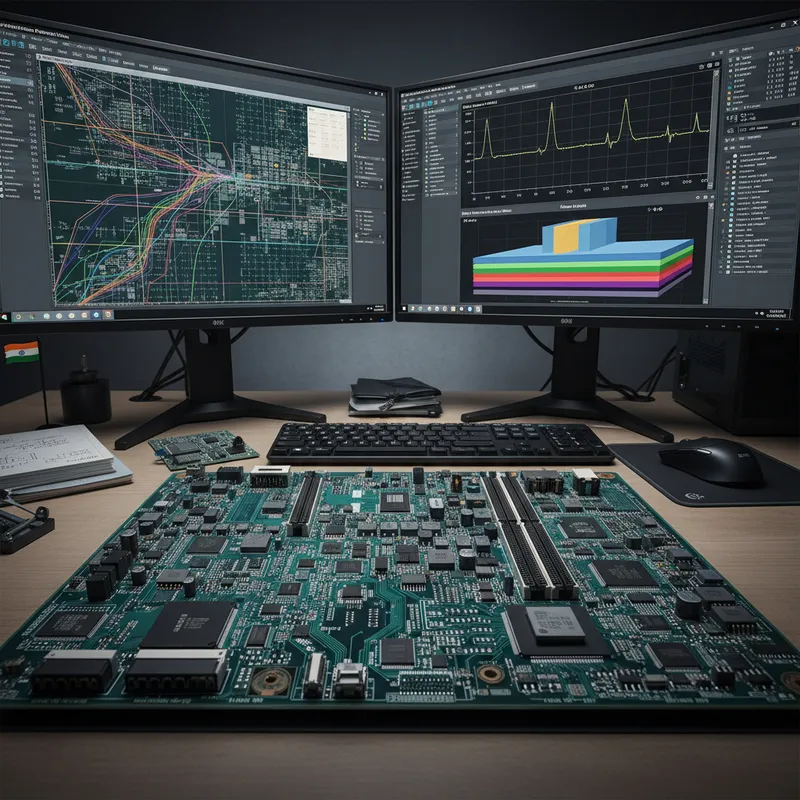
HyperLynx SI/PI: Signal and Power Integrity for Indian PCB Teams
A comprehensive guide to Siemens HyperLynx for Indian PCB teams, signal integrity, power integrity, 256-protocol compliance, electrical DRC, EM solvers, Design Space Exploration, and the Xpedition integration path.
Related products
More from Siemens EDA
All Siemens EDA products →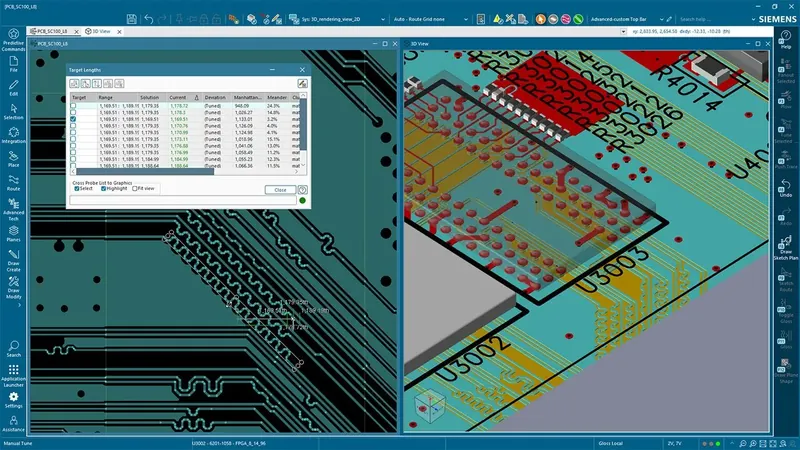
Xpedition Standard
AI-infused PCB design software with sketch routing, cloud DFM, and token-based SI add-ons, scale from prototype to production without switching tools. Buy in India from GSAS.
View Xpedition Standard →
Xpedition Enterprise
Next-generation enterprise PCB design platform from Siemens EDA, concurrent multi-user editing, AI-infused design support, cloud-connected collaboration, and Teamcenter PLM integration. Buy in India from GSAS.
View Xpedition Enterprise →
Valor NPI
One manufacturing re-spin costs more than a year of Valor NPI, DFM/DFA verification with the Valor Parts Library reduces re-spins by an average of 57% per Siemens. Buy in India from GSAS.
View Valor NPI →FAQ
Common questions about HyperLynx
Does HyperLynx simulate DDR5 and PCIe Gen5 signal integrity?
What is the difference between HyperLynx LineSim and BoardSim?
Does HyperLynx work with PCB tools other than Xpedition?
How much does HyperLynx cost in India?
Interested in HyperLynx?
Get pricing, an evaluation unit, or a technical consultation from our application engineers.