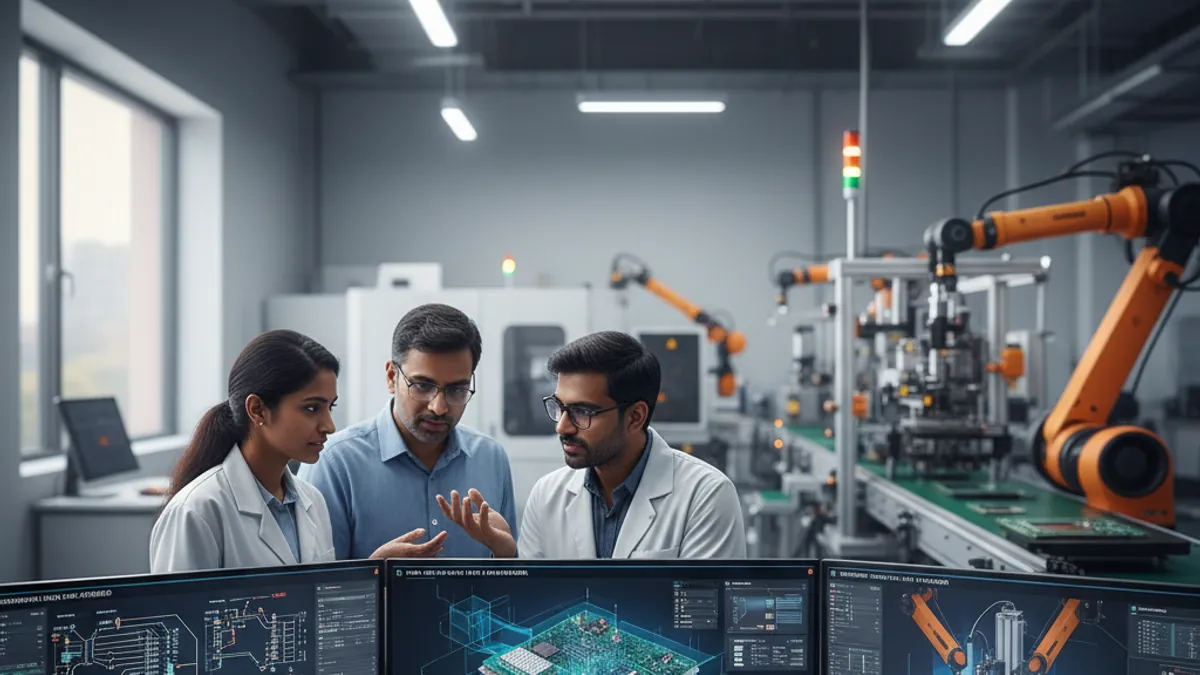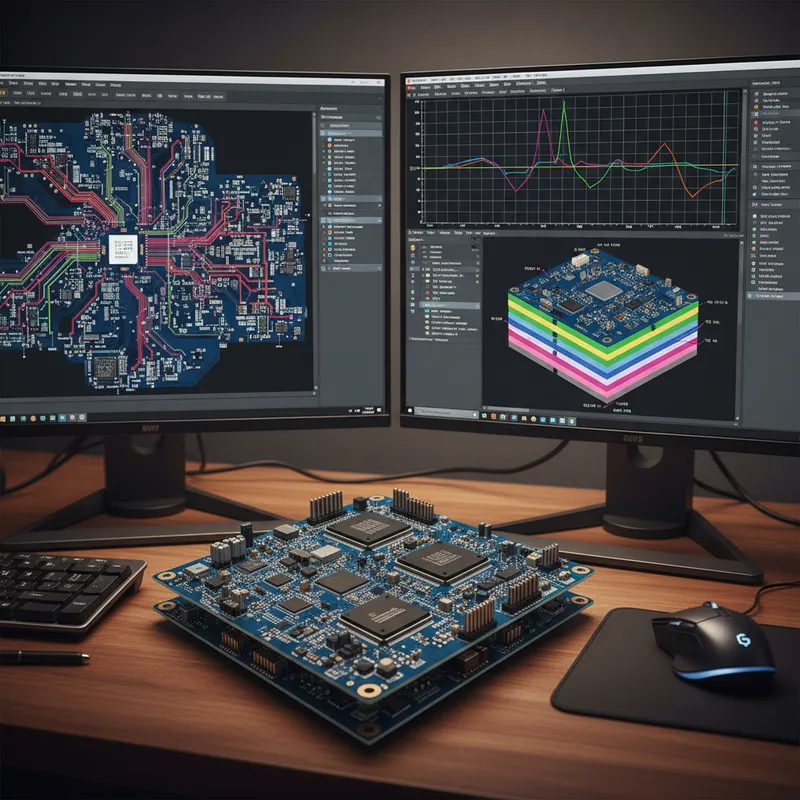
Siemens does not ship Xpedition, HyperLynx, and Valor NPI independently. The three tools share a database, a constraint model, and increasingly an AI layer, so when a release cycle lands, the right question is not “what is new in each tool” but “what changes across the flow.” The 2026-04 release (numbered 2604 in Siemens’ calendar-based scheme) is exactly that kind of release: twelve targeted Xpedition improvements, nine HyperLynx upgrades, and a tight Valor NPI update that closes the design-to-fab loop through native IPC-4761 via support.
This post is a single index to the three deep-dives we have published, with guidance on which post your team should read first depending on the work you do every day. Each linked post embeds every official Siemens demo video, walks through the feature with screenshots, and frames the change for the constraints Indian engineering teams actually run into, DDR5 / PCIe Gen 7 bring-up at semiconductor design houses in Bengaluru and Hyderabad, EV motor-control PDN work in Pune and Chennai, defence and aerospace high-reliability layout in Hyderabad and Delhi NCR, and DFM sign-off against Indian fabricators in Mumbai and Coimbatore.
The three release recaps
Xpedition 2604: for PCB layout, multi-board, and library teams
If your team designs the board, manages constraints, runs the library, or coordinates across schematic and layout, start here.
Read: Xpedition 2604, Every New Feature That Matters for India’s PCB Design Teams →
Twelve features covered, every one with its official demo video re-embedded:
- AI-assisted help (natural-language UI assistant baked into Xpedition)
- Multi-board signal matching across system designs
- Web-based check-in / check-out for distributed teams
- Integrated BluePrint documentation in the layout environment
- Creepage and clearance checks during layout, not after
- Native IPC-4761 via type support that flows to Valor NPI without translation
- Concurrent DFM during team layout (no more wait-for-sign-off)
- PCB library navigator with component explorer search
- Collaboration notes between schematic and layout
- Faster document creation for release packages
- Supply-chain awareness in the picker
- New constraint-driven authoring patterns
This release is genuinely the cross-cutting one: AI plus multi-board plus library work plus team collaboration plus IPC-4761 plus DFM integration, every Xpedition team will find something that shortens their week.
HyperLynx 2604: for signal integrity and power integrity teams
If you simulate DDRx and LPDDR, run PCIe Gen 5/6/7 compliance, design PDNs for high-current loads, or run DRC for high-speed serial links, this is your release.
Read: HyperLynx 2604, Every New Feature for India’s Signal & Power Integrity Teams →
Nine release videos covered, each tied to what the change means for an engineer’s day:
- DDR5 / LPDDR batch parallelisation across cores (clock forwarding and post-layout sweeps included)
- PCIe Gen 7 PAM4 compliance at 128 GT/s with CEI-224G alignment under COM 4.12
- Time-domain PDN transient wizard (beta) for fast PDN drop analysis
- Advanced solver pin-thickness modelling and GDSII reassignment for Calibre hand-offs
- Schematic Analysis: model creation, editing, port options, power network topology view
- DRC: creepage wizard, Copilot, rule updates
- AMS: FMI Boolean/Integer ports + DSE parallel processing
- SerDes: PCIe Gen 7 multi-port crosstalk, 32-port RC/NRC reference packages
- Touchstone Viewer, workspace grouping, in-app Product Support Copilot
The pieces that hit hardest for India SI/PI teams are DDR5 parallelisation (you get two parallel sims per licence, material throughput) and the Calibre-to-HyperLynx GDSII reassignment, which closes a hand-off gap that used to eat entire afternoons.
Valor NPI 2604: for DFM, manufacturing, and EMS NPI teams
If you sign off layouts before they go to the fab, run a fabrication line, or operate an EMS NPI desk, read this one.
Read: Valor NPI 2604, Every New Feature for India’s PCB Manufacturing and DFM Teams →
Tight release, but every change closes a real DFM gap:
- Native IPC-4761 via-type awareness in the pad-stack editor (tented, plugged, filled, capped, all combinations) that flows from Xpedition through ODB++ into Valor with no manual translation
- Photoresist sliver, copper surface sliver, and acid-trap detection moved into the Analysis Definition Manager (with two new configuration variables for base length and acute angle)
- Toeprint and SMD/BGA pad-perimeter copper coverage validation
- Through-hole lead-length checks (excessive and insufficient)
- Cadence Allegro degassing-pad rotation handling (for teams still on Allegro upstream)
Indian PCB fabricators and EMS NPI desks at Hosur–Bengaluru, Chennai, Pune, Visakhapatnam, and Delhi NCR that already enforce IPC-A-600 / IPC-A-610 will find the IPC-4761 via update particularly clean: what the designer specifies in Xpedition is exactly what gets verified in Valor and exported to your fabricator.
Three themes that connect all three releases
Reading the three deep-dives side by side, three patterns emerge that are bigger than any individual feature.
1. AI as a first-class UI surface, not a marketing wrapper. The Xpedition AI assistant is wired into the help system and the design environment. The HyperLynx Product Support Copilot covers every tool in the family. These are not chatbots glued on top, they are inference layers with access to documentation, examples, and (in Xpedition’s case) the design state itself.
2. Parallelisation that turns licence economics on its head. HyperLynx DDRx now runs two parallel sims per licence by default. Concurrent DFM in Xpedition lets designers and DFM engineers work on the same board at the same time. Valor’s IPC-4761 alignment removes a serial translation step from the release flow. The cumulative effect is a shorter design-to-fab loop without an exponential rise in licence cost, directly relevant to budget-constrained Indian engineering organisations.
3. IPC-4761 as the connective tissue. Three years after IPC-4761 standardised via construction types, Siemens has now wired the standard into the pad-stack editor, ODB++ export, and Valor verification. For boards going to fabricators that sign off against IPC standards (which is most defence, aerospace, and automotive work in India), this removes one of the most common round-trip causes between design and manufacturing.
What India teams should do next
If your team is on Xpedition Standard, this is a strong release-cycle to evaluate. The AI assistant and concurrent DFM features compound across every project. GSAS provides the Xpedition Standard free trial with engineering support included, get the trial keyed to your team, then book a working session with our Bengaluru or Pune office to walk through the 2604 additions against your current flow.
If your team runs HyperLynx for DDR or PCIe work, the DDRx parallelisation and the PCIe Gen 7 PAM4 simulation engine are immediate wins. The Time-Domain PDN wizard (beta) is worth pulling into your evaluation backlog if you do PDN design for high-current EV powertrain or AI accelerator boards.
If your team is a fabricator, EMS NPI desk, or in-house DFM cell, the Valor 2604 release deserves a planned migration. The IPC-4761 via support changes the data your fabricator receives from upstream designers, and the new ADM-resident sliver checks need to be re-tuned to your process windows.
For all three: GSAS is an authorised Siemens EDA engineering partner. We provide migration consulting, license optimisation, training (on-site at your facility or at our offices in Bengaluru, Hyderabad, Chennai, Coimbatore, Pune, Mumbai, Delhi NCR, Visakhapatnam, Vadodara, and Kolkata), and full procurement support including INR invoicing, GeM, SAP Ariba, Coupa, and TReDS.
FAQ: Siemens EDA 2604 release in India
What does “2604” mean in Siemens release versioning? Siemens uses calendar-based versioning: 2604 = released in the fourth quarter of fiscal 2026 (Siemens fiscal year runs October–September). The next planned release is 2701 in Q1 of fiscal 2027.
Are these three releases backward-compatible with existing Xpedition / HyperLynx / Valor designs? Yes. Siemens maintains forward-compatibility within the platform. Existing designs open in 2604 without conversion. Some new constraint types (IPC-4761 via attributes especially) need to be added explicitly to take advantage of the new flows.
How do we get evaluation access in India? GSAS provides 30-day evaluation licences for all three tools with engineering support included. Request a quote or book a demo with the office nearest you. Free trials are also available directly from Siemens for Xpedition Standard.
Does GSAS train on the 2604 release specifically? Yes. Our training catalog covers the new features in each tool, AI assistant workflows in Xpedition, DDRx parallelisation methodology in HyperLynx, and IPC-4761 / sliver-check tuning in Valor. On-site training delivered at your facility or our offices.
Which Indian fabricators are aligned with the new Valor 2604 IPC-4761 via types? Most IPC-compliant Indian fabricators (AT&S India, Shogini, Genus) already accept IPC-4761 via designators in ODB++ exports. GSAS can audit your current fabricator handoff format and confirm alignment with the new Valor 2604 outputs as part of a DFM review.
Related deep-dives
- Xpedition 2604, Every New Feature That Matters for India’s PCB Design Teams: 12 features, every demo video embedded
- HyperLynx 2604, Every New Feature for India’s Signal & Power Integrity Teams: 9 release videos covered
- Valor NPI 2604, Every New Feature for India’s PCB Manufacturing and DFM Teams: IPC-4761 plus ADM sliver checks
- Accelerating PCB Design with AI, Reuse, and Data Continuity for India PCB Teams: Siemens’ broader productivity narrative
- Choosing the right Siemens EDA tier, Xpedition Standard, Enterprise, or Standalone HyperLynx: if you are still on the buying decision
- Xpedition Standard for Indian teams, deep dive
- Flex / Rigid-Flex DFM with Valor + HyperLynx for India teams
Talk to GSAS about the 2604 release → · Browse Siemens EDA products → · Request an evaluation →
Also appears in:
Interested in Siemens EDA tools?
Talk to our application engineers for personalized tool recommendations.
More from Siemens EDA
View all →
India's EDA Moment: Why Design Tool Demand Is Growing, and the Engineering Careers It Creates
21 Sept · 9 min
AI and Complexity Are Redrawing EDA: Siemens on the Trillion-Transistor Era
13 Sept · 6 min
Calibre Vision AI: Bringing Order to DRC Debug at Advanced Nodes
24 Aug · 4 min
Siemens EDA EBS Expert Series: 6 Free PCB Design Webinars (Jul-Aug 2026)
20 Jul · 8 min
Emulating Processor Power for Thermal Testing: Why Constant Power
7 Oct · 7 min
CRPS and Rack Power Supply Testing: The Six Tests That Matter
7 Oct · 7 min