The AURIX Toolchain Ecosystem in India: TESSY + SafeTpack + UAD3+/UDE for Complete Development
Infineon’s AURIX TC3xx is the dominant microcontroller platform for safety-critical automotive electronics in India. Powertrain ECUs, electric vehicle battery management systems, ADAS domain controllers, steering assist modules, and braking systems, across OEMs and Tier-1 suppliers in Bengaluru, Pune, and Chennai, the AURIX is the silicon at the center of the design.
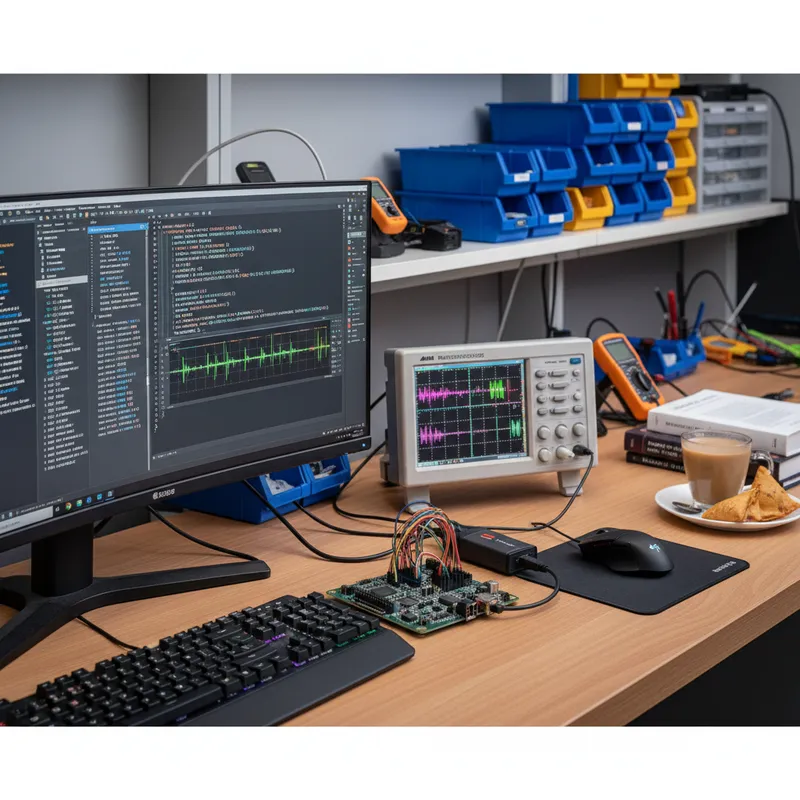
But the silicon is only the foundation. Building a safety-certified product on AURIX requires a development toolchain that covers three distinct engineering disciplines: dynamic testing with structural code coverage, hardware safety self-test, and multi-core debug with deep trace capture. Each discipline has its own standards requirements, its own workflow, and its own failure modes.
Three vendors between them address all three, and in India all three arrive through one supplier. Razorcat supplies TESSY for automated unit and integration testing. Hitex, an AURIX Preferred Design House, supplies SafeTpack, the safety manager inside its SafeTpal package, for hardware self-test. PLS supplies UAD3+ and the Universal Debug Engine (UDE) for multi-core debug and trace, distributed by Hitex. Different companies, but a coherent AURIX development stack: the tools are built for the same silicon, the same safety standards, and the same engineering workflows.
TESSY: Verification at the Unit Level
ISO 26262 Part 6 asks for structural coverage measurement at the unit level, and MC/DC (Modified Condition/Decision Coverage) carries its strongest recommendation at the higher ASILs. None of it is mandatory: the highest rating the standard applies to any method is highly recommended. Achieving MC/DC on embedded C code running on AURIX TriCore requires a testing tool that understands the target compiler’s calling conventions, memory layout, and optimization behavior.
TESSY automates the unit testing workflow: interface analysis, test driver generation, stub creation, test execution, and coverage measurement. It compiles test harnesses against the same toolchain used for the production build (HighTec, TASKING, or GCC for TriCore), ensuring that coverage results reflect the actual compiled code, not a host-compiled approximation.
For AURIX projects, TESSY’s ability to run tests on the actual target hardware (via a debug connection) or on a host simulation is particularly valuable. Early in development, when hardware is scarce, host-based testing provides rapid feedback. Later, target-based testing validates the code against the real silicon, including hardware-dependent behavior like register access patterns and interrupt timing.
The Classification Tree Editor provides the systematic test case derivation ISO 26262 Part 6 recommends, while ReqIF import/export connects TESSY to the requirements management tool (IBM DOORS, Polarion, codebeamer) for the bidirectional traceability that assessors expect.
SafeTpack: Hardware Diagnostic Coverage
While TESSY verifies that the software is correct, SafeTpack verifies that the hardware is healthy. ISO 26262 Part 5 sets diagnostic coverage targets for single-point faults and latent faults in the processing unit, memory, clock system, and peripherals, and at ASIL D those targets are the most demanding in the standard. GSAS does not reproduce the standard’s specific coverage percentages here; read them from your licensed copy of ISO 26262-5.
SafeTpack is a Hitex product, developed for the second generation of the AURIX family. Hitex describes it as managing the complex Logic Built-In Self-Tests (LBIST) and other safety features of AURIX, supplying functions such as program flow monitoring and cyclic control of special function registers, alongside a test handler and startup and runtime diagnostic tests. Optional packages add a watchdog interface, an internal watchdog driver, an external TLF35584 and TLF35585 watchdog driver, and an enhanced Program Flow Monitor. Teams on first-generation AURIX use Hitex’s PRO-SIL SafeTlib instead, and Hitex states the changeover between the two requires no rework of handling.
The library ships as source code, with the EB tresos tool included for configuration and AUTOSAR integration, and it can also be integrated directly into bare-metal and RTOS-based architectures. Hitex is explicit about compatibility: SafeTpack is 100% compatible with the Infineon MCAL but can still be used independently.
Be precise about the certification, because it is easy to state wrongly. Hitex states that SafeTpack has achieved SIL-3 IEC 61508 certification from TÜV SÜD, and that it is developed according to ISO 26262-2018. Hitex separately states that SafeTpack covers most safety use cases for applications according to ASIL A to ASIL D. That ASIL range is Hitex’s statement of use-case coverage, not the scope of the third-party certificate, and the two belong in different sentences of your safety case.
The relationship between TESSY and SafeTpack is complementary: TESSY tests the application software for functional correctness, while SafeTpack monitors the underlying hardware for integrity. Both are needed for a complete safety case. An application that passes all unit tests but runs on corrupted hardware is not safe. Hardware that passes all self-tests but executes incorrect software is equally unsafe.
UAD3+ and UDE: Debug and Trace for Multi-Core AURIX
AURIX TC3xx devices carry several TriCore CPUs on a single die. Debugging them requires a probe that can access all cores simultaneously, capture deep execution traces at full target speed, and present the results in a way that makes cross-core interactions visible.
The PLS UAD3+ provides this capability: up to eight cores and targets controlled simultaneously with different debug protocols, a trace memory of up to 4 GBytes, a maximum trace stream width of 32 bits, and trace signals up to 500 MHz and 3.125 Gbit/s in serial trace, across protocols including Aurora, CoreSight ETM, Nexus and OCDS L2. Paired with UDE, the UAD3+ supports synchronized multi-core debug, per-core breakpoints and cross-core memory inspection, with RTOS awareness for FreeRTOS, SAFERTOS, PXROS and PXROS-HR, OSEK, Sciopta and others, plus AUTOSAR awareness including ARTI and ORTI support for debugging and task trace.
For AURIX-based ECU development, the deep trace buffer is not a luxury, it is a debugging necessity. Timing-dependent bugs in multi-core systems often manifest only under specific load conditions. A multi-gigabyte trace buffer means engineers can reproduce the bug once and analyse the captured window offline, rather than repeatedly triggering a transient fault while hoping a shallow buffer was recording at the right moment.
UDE also includes an integrated flash programming tool, and its UDE Object Model exposes a scripting API (Python, PowerShell, JavaScript, Perl, C# and others) for debug and test automation, which is what lets an AURIX regression suite run unattended from a CI/CD pipeline.
The Integration Advantage
TESSY, SafeTpack and UAD3+/UDE come from three different companies, so the benefit is not single-vendor branding. It is that all three are built around the same silicon, and that in India they arrive through one commercial channel.
Consistent AURIX expertise. Hitex, an AURIX Preferred Design House, builds SafeTpack against the AURIX architecture, its safety manual and its errata. PLS builds the UAD3+ and UDE around the TriCore debug interfaces and the MCDS trace system. Razorcat builds TESSY around the TriCore compilers production teams actually ship with. The common denominator is the target, not the corporate parent.
Qualification evidence, per tool. Check each one on its own terms rather than assuming a shared package. Hitex states that TESSY is qualified according to IEC 61508, ISO 26262, EN 50128 and IEC 62304, that the certificate was initially issued by TÜV SÜD in December 2011 and is renewed regularly, and that a Tool Qualification Package (TQP) helps users validate the TESSY functionality relevant to safety-related development. Hitex states that SafeTpack holds SIL-3 IEC 61508 certification from TÜV SÜD. For UDE, ask PLS for the qualification status of the specific release you licence: a debugger used to produce verification evidence falls under the ISO 26262 Part 8 tool-qualification obligation like anything else in the chain.
Workflow coherence. TESSY test results feed into the safety case alongside SafeTpack diagnostic evidence. UAD3+/UDE trace data supports both functional debugging and safety analysis, for example verifying that program flow monitoring detects an injected fault. All three work against the same AURIX memory map, register definitions and debug infrastructure, which is what makes the evidence from one usable while investigating another.
Building the Ecosystem in India
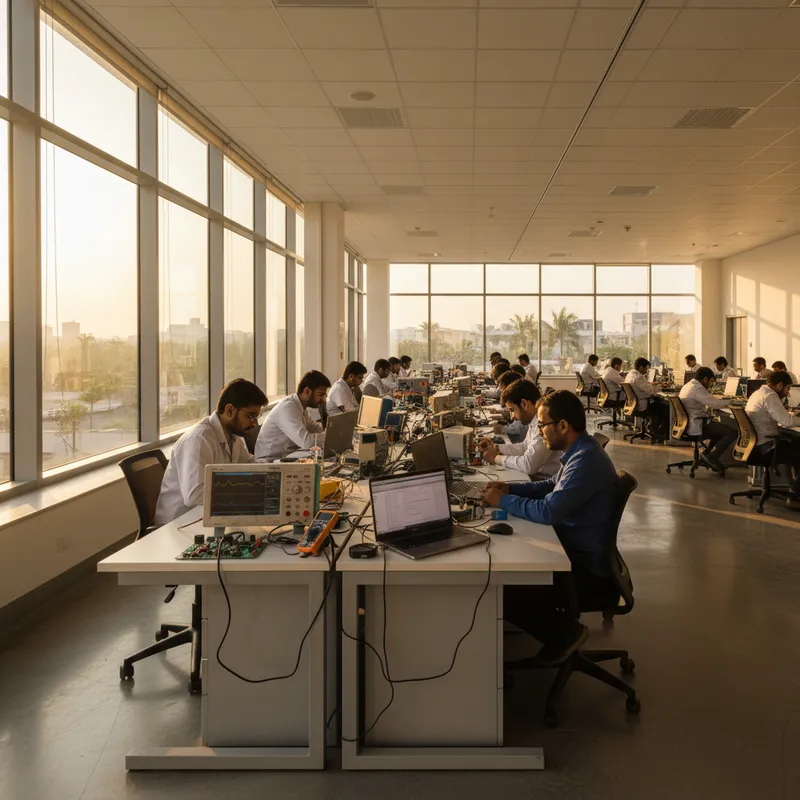
Indian automotive teams building AURIX-based ECUs face a specific challenge: sourcing, licensing, and integrating tools from European vendors through local channels with INR invoicing and responsive technical support. Global procurement cycles that take weeks in Germany can take months when routed through indirect channels in India.
GSAS Micro Systems addresses this directly. As an authorized Hitex partner, GSAS provides SafeTpack, UAD3+ and UDE. TESSY comes through a separate route: GSAS is the authorized Razorcat engineering partner. Between the two the complete AURIX toolchain arrives from one supplier, with INR invoicing, local procurement, and application engineering from safety engineers based in Bengaluru, Hyderabad, Chennai, Pune, Mumbai, and Delhi NCR.
Our team helps with the full deployment lifecycle: initial tool evaluation on your AURIX target, CI/CD pipeline integration for TESSY, SafeTpack integration into your BSP, UDE/UAD3+ debug environment setup, and ongoing technical support as your project moves from development through safety assessment to production release.
Whether you are starting a new AURIX-based ECU project or strengthening the toolchain on an existing one, GSAS provides a single point of contact for the complete AURIX toolchain in India.
Also appears in:
Interested in Hitex tools?
Talk to our application engineers for personalized tool recommendations.
More from Hitex
View all →
SafeTpack for Infineon AURIX TC3xx: LBIST, Program Flow Monitoring, and ASIL D Self-Test
6 Apr · 4 min
UAD3+ Debug Probe: 4 GB Trace Memory, 8 Cores, and 500 MHz Serial Trace for AURIX and Cortex-R/M
6 Apr · 4 min
Hitex SafeTpal vs In-House Self-Test for AURIX: Choosing the Right Safety Test Strategy
2 Apr · 6 min
Emulating Processor Power for Thermal Testing: Why Constant Power
7 Oct · 7 min
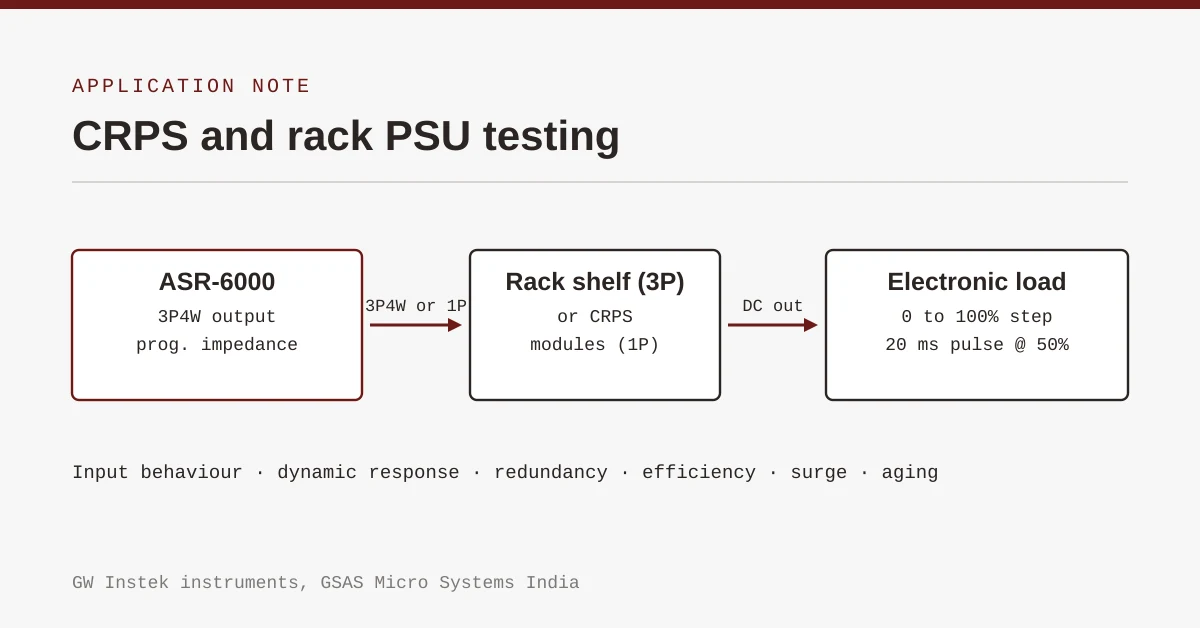
CRPS and Rack Power Supply Testing: The Six Tests That Matter
7 Oct · 7 min
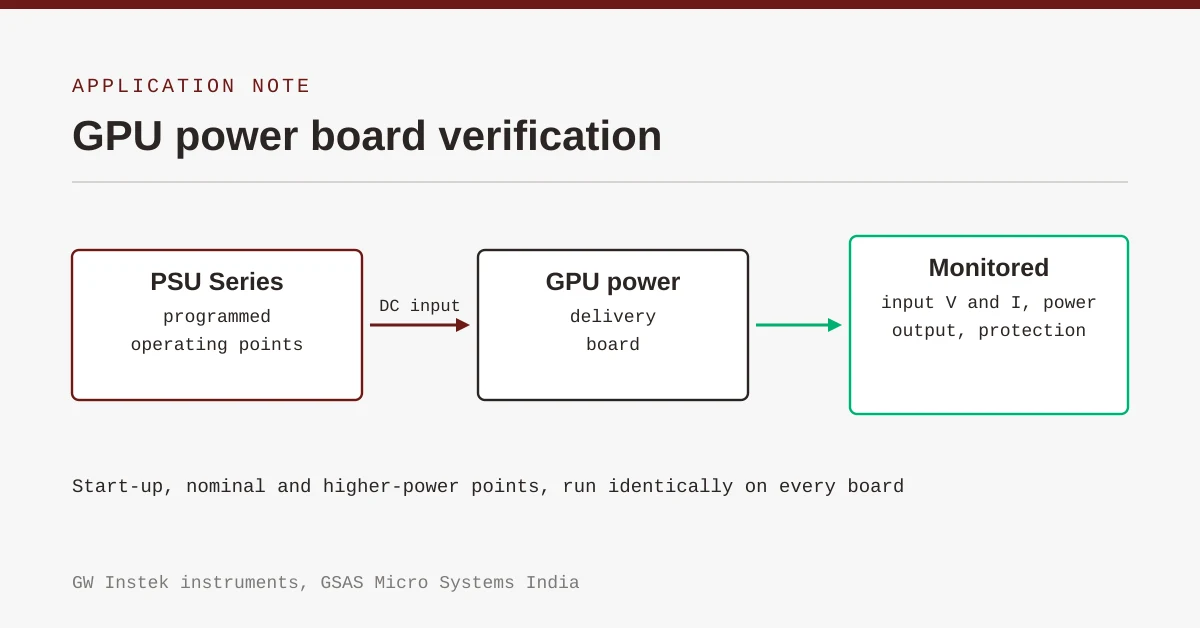
GPU Power Board Testing: DC Input Verification Before Integration
7 Oct · 6 min