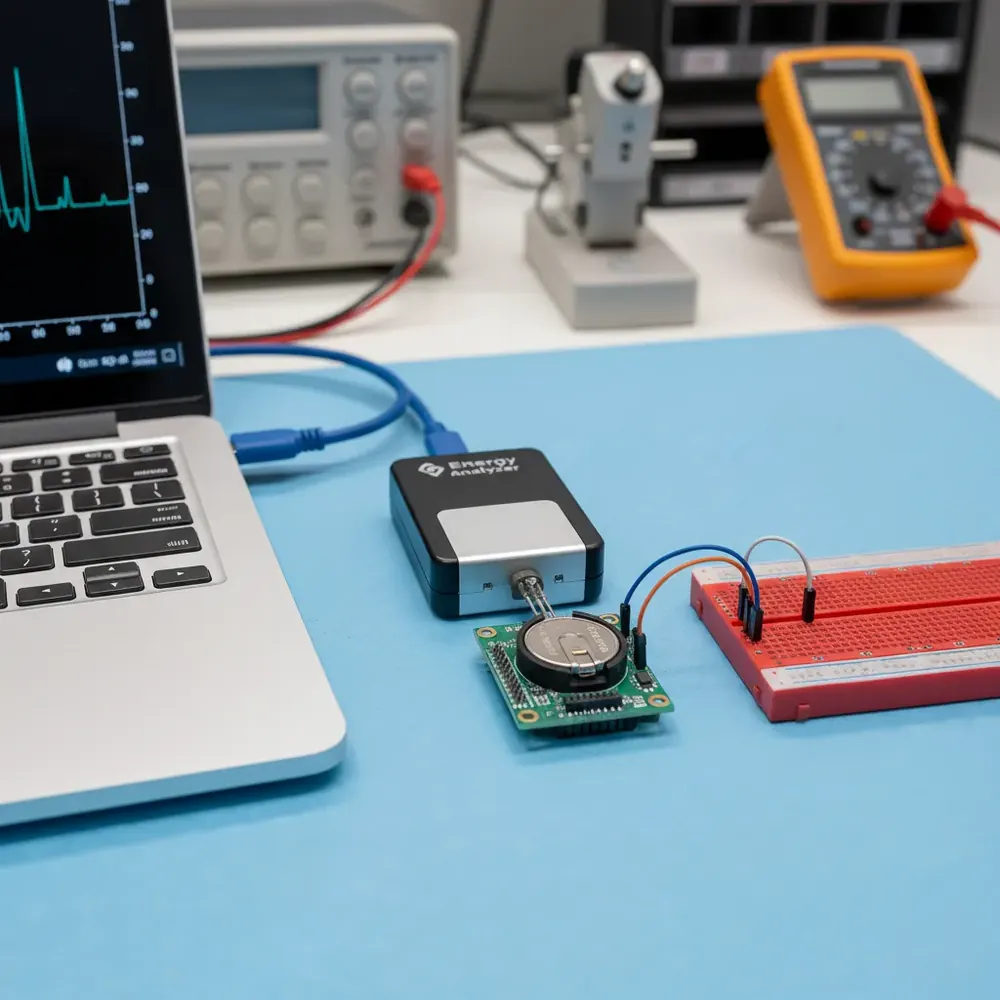
The difference between a product that lasts two years on a coin cell and one that dies in three months often comes down to a few hundred nanoamps of sleep current. That is not an exaggeration. A device drawing 500 nA in deep sleep consumes roughly 4.4 mAh per year.
The same device leaking 5 uA, just 10x more, and still invisible to a benchtop multimeter, burns 44 mAh per year. On a 220 mAh CR2032 coin cell, that is the difference between a 10-year battery life and a device that barely survives two years.
Measuring current at the nanoamp level is not a routine instrumentation task. It demands specialized techniques, purpose-built instruments, and an understanding of the parasitic effects that corrupt low-current measurements. This article explains why nanoamp measurement matters, what makes it difficult, how the Joulescope JS220 solves the core measurement challenges, and what the JS220+ variant adds for the most demanding applications.
Why Nanoamp Measurement Matters
Modern ultra-low-power MCUs and SoCs specify deep-sleep currents in the hundreds of nanoamps to low microamps. Nordic’s nRF5340 specifies 1.1 uA in System ON with full RAM retention. STMicroelectronics’ STM32U5 series specifies shutdown current as low as 110 nA. Texas Instruments’ MSP430FR series reaches below 100 nA in its lowest power mode.
These specifications create design budgets measured in nanoamps. When the MCU itself draws 110 nA, every other component on the board, voltage regulators, sensors, level shifters, pull-up resistors, protection diodes, must also be characterized at the nanoamp level. A single component with unexpected leakage can double or triple the system sleep current, destroying the battery life budget.
Sleep current verification is the most common reason engineers need nanoamp measurement capability, but it is not the only one. Leakage current characterization of capacitors (particularly ceramic and tantalum types), standby current of voltage regulators, reverse leakage of protection diodes, and input bias current of op-amps and comparators all require nanoamp-level measurement to evaluate properly.
The Challenges of Low-Current Measurement
Measuring nanoamp currents is not simply a matter of using a more sensitive ammeter. Several physical phenomena conspire to corrupt low-current measurements.
Instrument noise floor is the most obvious challenge. A benchtop multimeter on its lowest current range typically has a noise floor of 1-10 uA, three orders of magnitude above the nanoamp currents being measured. Even a precision source-measure unit (SMU) on its lowest range may have a noise floor of 10-100 nA, adequate for some applications but insufficient for sub-nanoamp characterization. PCB surface leakage is the subtlest and most pernicious problem. FR-4 PCB material has measurable surface leakage currents, especially in the presence of flux residue, humidity, and voltage gradients. At the board level, leakage paths through solder mask, between traces, and across component pads can easily exceed the device’s actual sleep current. The measurement instrument’s own PCB is subject to the same physics, if the instrument’s analog front end is built on standard FR-4, its board leakage contributes to the measurement noise floor. Electromagnetic interference couples into high-impedance measurement circuits, adding noise that obscures the true signal. At nanoamp current levels, the measurement circuit’s impedance is extremely high (megohms to gigohms), making it an efficient antenna for ambient EMI from switching power supplies, fluorescent lighting, motor drives, and other laboratory equipment. Thermoelectric voltages are generated at junctions of dissimilar metals in the measurement circuit. These thermoelectric EMFs drive small currents through the DUT path, adding a DC offset to the measurement. Temperature gradients across the test fixture, from a nearby soldering iron, a hot DUT, or even the engineer’s hand, can generate nanoamp-level error currents. Dielectric absorption in cable insulation and fixture materials stores charge during measurement and releases it slowly, creating time-varying leakage currents that appear as measurement drift. Triboelectric effects in cables generate charge when the cable moves, adding noise to the measurement.
How Joulescope Solves the Dynamic Range Problem
The fundamental challenge of embedded power profiling is that the current varies over an enormous range, from nanoamps in deep sleep to amps during radio transmission, and transitions between these extremes happen in microseconds. A conventional ammeter cannot track these transitions without either saturating on the high-current peaks or losing resolution in the low-current valleys.
The Joulescope JS220 addresses this with its proprietary Enwavify autoranging technology, which switches between optimized shunt resistors in 1 microsecond with zero gaps in the data stream. The instrument continuously selects the shunt resistor that provides the best resolution for the instantaneous current being measured, spanning 9+ decades of dynamic range (0.5 nA resolution to +/-10 A peak) without any dead time during range transitions.
This is fundamentally different from conventional autoranging, where the instrument detects a range overflow, switches to a higher range, and resettles, a process that takes milliseconds and produces a gap in the data. During that gap, critical information is lost: the exact peak current during a BLE advertisement burst, the inrush current when a voltage regulator enables, or the precise moment when a device enters deep sleep. Enwavify eliminates these gaps entirely.
The 2 Msps 16-bit simultaneous ADCs provide 300 kHz bandwidth, capturing fast transients that slower instruments blur into average values. The 20 mV maximum burden voltage ensures the target device operates normally, critical for accurate profiling of low-power devices where even small supply voltage variations can change firmware behavior and power consumption.
The JS220+ Advantage: Rogers PCB Material
The standard JS220 provides 0.5 nA current resolution, sufficient for the vast majority of embedded power profiling applications. But for applications requiring accuracy at or below the nanoamp level, the JS220+ Precision Energy Analyzer pushes the instrument’s noise floor significantly lower.
The key innovation is the PCB substrate material. The JS220+ replaces the standard FR-4 with Rogers high-frequency laminate, a material engineered for dramatically lower surface leakage and dielectric absorption. At nanoamp current levels, the instrument’s own board leakage is a significant contributor to measurement uncertainty.
By eliminating this leakage source at the materials level, the JS220+ achieves +/-1 nA accuracy at the +/-20 nA range, verified by ISO 17025:2017 NIST-traceable calibration from an ANAB-accredited laboratory.
The redesigned analog front-end layout complements the materials change with optimized guard ring routing and minimized parasitic leakage paths. The custom front panel provides improved shielding against electromagnetic pickup. The result is an instrument that can reliably distinguish between 50 nA and 100 nA, a measurement that determines whether a design achieves its 10-year battery life target.
Practical Measurement Setup Tips
Even with a capable instrument, nanoamp-level measurements require attention to the measurement setup.
Minimize cable length. Every centimeter of cable between the instrument and the DUT adds capacitance, leakage, and noise. Use the shortest practical connections and avoid coiled or bundled cables. Clean the DUT board. Flux residue is hygroscopic and conductive when moist. Clean the board with isopropanol or a dedicated flux cleaner and allow it to dry thoroughly before measuring sleep current. Control the environment. Humidity increases surface leakage on both the DUT and the measurement fixture. Temperature gradients generate thermoelectric voltages. A stable, low-humidity environment produces the most repeatable results. Allow settling time. After the DUT transitions to sleep mode, capacitor charging currents, dielectric absorption currents, and thermal settling can take seconds to minutes to decay. Do not read the sleep current immediately, wait for the reading to stabilize. Use the Python API for automated regression. The Joulescope Python API enables scripted measurement sequences that capture sleep current, active current, and energy-per-transaction metrics automatically. Integrating these measurements into CI/CD pipelines catches firmware regressions that increase power consumption before they reach production. The API supports triggering, windowed statistics, and data export to standard formats for automated analysis. Guard sensitive nodes. On the DUT board, surround high-impedance nodes with driven guard traces held at the same potential to intercept surface leakage currents before they reach the measurement path. This is a PCB design technique, not an instrument technique, but it significantly improves the measurability of nanoamp-level currents.
From Measurement to Battery Life
The ultimate purpose of nanoamp current measurement is predicting battery life accurately. The Joulescope UI and Python API compute average current, average power, and accumulated energy over any user-defined time window. By capturing the complete current profile, including all sleep modes, wake events, active processing, and communication bursts, and integrating over a representative operating cycle, engineers derive the average current that determines battery life.
Battery life (hours) = Battery capacity (mAh) / Average current (mA)
The accuracy of this calculation depends entirely on the accuracy of the average current measurement, which in turn depends on the instrument’s ability to resolve the lowest currents in the profile. If the instrument’s noise floor is 1 uA and the actual sleep current is 200 nA, the average current calculation will be biased high by the instrument’s noise, producing a pessimistic (best case) or optimistic (if the noise is asymmetric) battery life estimate. The JS220’s 0.5 nA resolution and the JS220+‘s +/-1 nA accuracy at 20 nA range ensure that the sleep current contribution to the average is measured, not assumed.
Get Joulescope from GSAS India
GSAS Micro Systems is the authorized Joulescope partner in India, providing the JS220, JS220+, evaluation kits, and front panel accessories with INR invoicing and local support. Our power profiling methodology workshops cover measurement setup, fixture design, and result interpretation for engineering teams getting started with precision power profiling. We provide Python API training for teams integrating Joulescope into automated test and CI/CD workflows.
Contact us from Bengaluru, Chennai, Hyderabad, Delhi NCR, Mumbai, or Pune for an evaluation unit, hands-on demo, or technical consultation.
Also appears in:
Interested in Joulescope tools?
Talk to our application engineers for personalized tool recommendations.
More from Joulescope
View all →
Battery Discharge Profiling for Coin Cell Devices: From CR2032 to 10-Year Life
5 Apr · 7 min
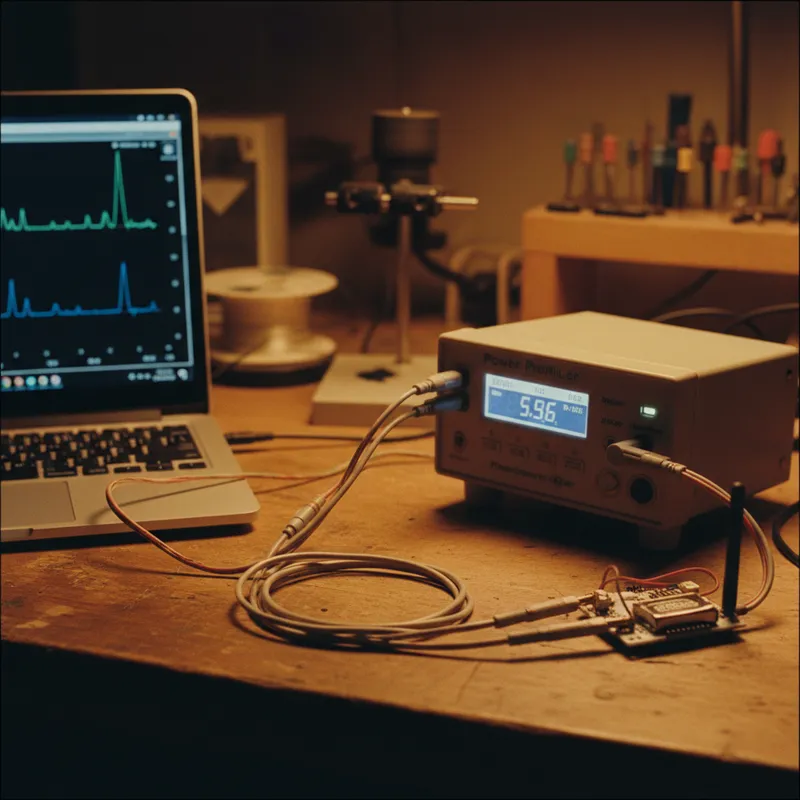
BLE Power Profiling: Measuring Bluetooth Low Energy Current With Joulescope
5 Apr · 7 min
Energy Harvesting and Power Measurement: Designing Self-Powered IoT Devices
5 Apr · 7 min

IoT Battery Life Testing: A Practical Methodology for Indian Product Teams
5 Apr · 7 min
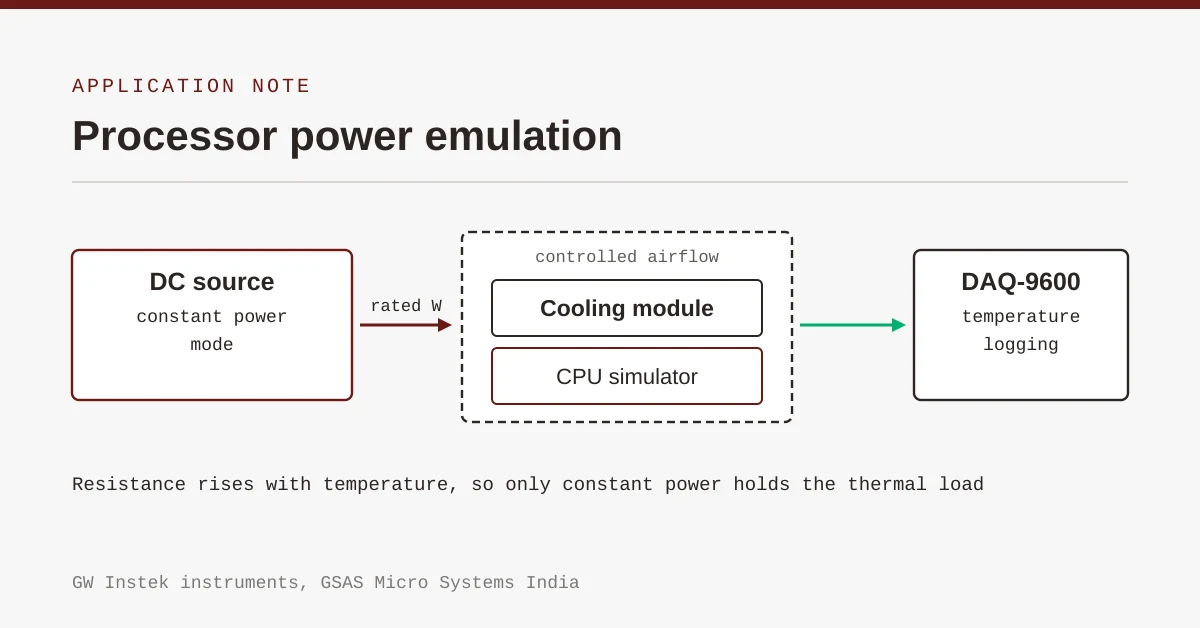
Emulating Processor Power for Thermal Testing: Why Constant Power
7 Oct · 7 min
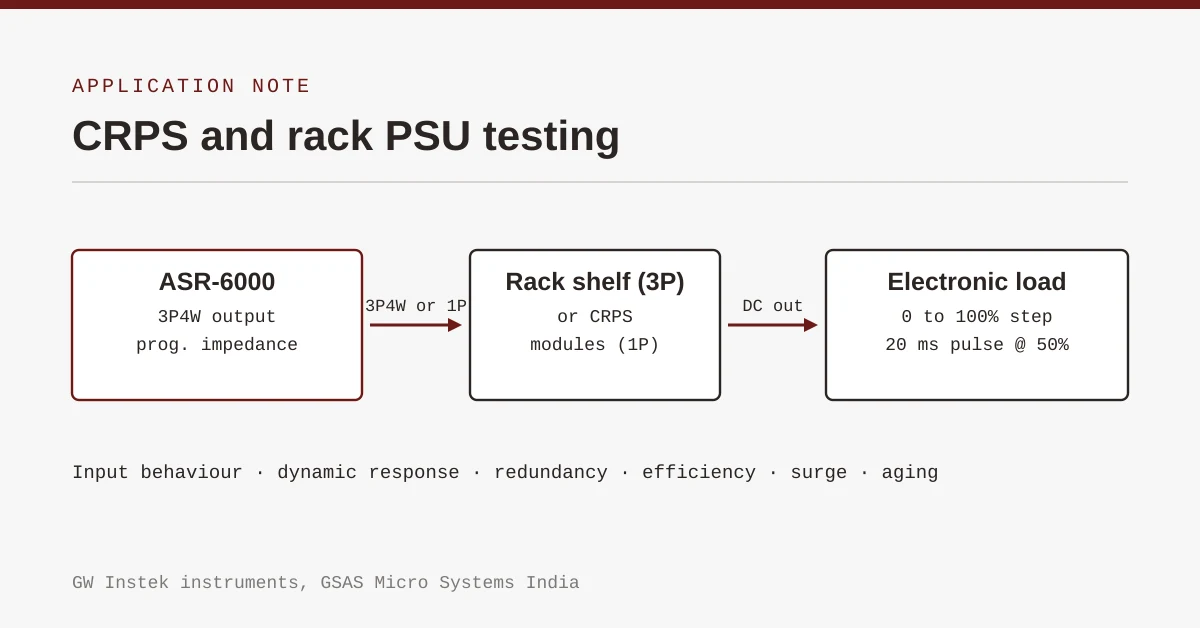
CRPS and Rack Power Supply Testing: The Six Tests That Matter
7 Oct · 7 min