apmOptimizer

apmOptimizer

GSAS Engineering · · 1 min read

apmOptimizer

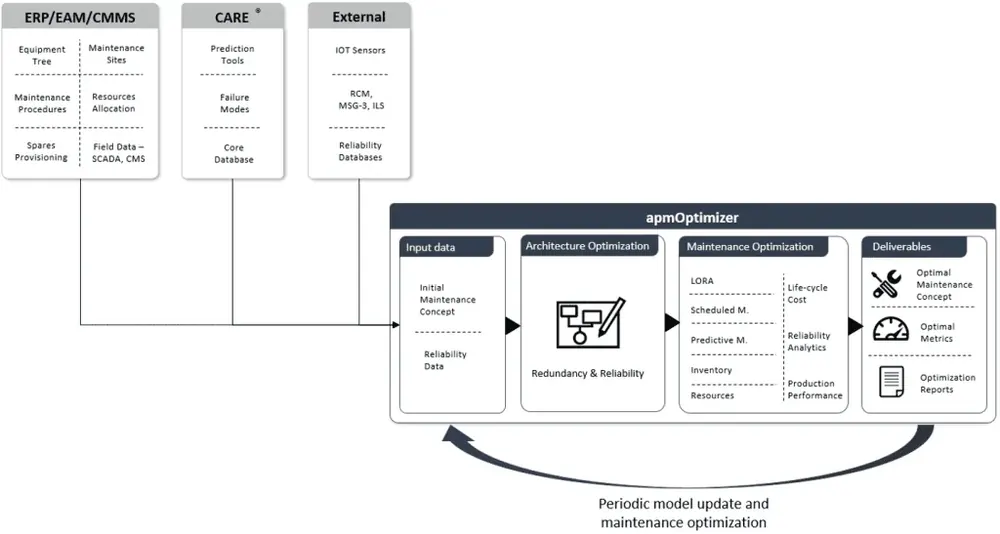
BQR’s apmOptimizer is an integrated solution for asset maintenance and logistics optimization, as well as for strategic decision making during asset design or overhaul.

apmOptimizer calculates the expected asset behavior based on a flexible model which accounts for operation profiles, failures, inspections, maintenance, spare parts, downtime, and cost.

apmOptimizer’s optimization modules find the optimal maintenance and logistics policy that minimize the Life Cycle Cost (LCC) while maintaining a high asset availability.

Main modules

  • Life Cycle Cost Analysis
  • Level Of Repair Analysis (repair or replace)
  • Spare Parts Inventory optimization
  • Scheduled Maintenance Optimization
  • Predictive Maintenance (PdM) Optimization
  • Performance analysis
  • RCM and MSG-3 management

Benefits

  • Reduce spare part, maintenance and down-time cost by an average of 35%

  • Balance CAPEX and OPEX

  • Optimize for asset availability, No need to define equipment criticality

Highlights

  • Decision Support System for selecting the optimal PdM system: what is the expected ROI for sensors and IIoT in your asset?
  • Fast analytic calculations, used for high quality optimizations

Also appears in:

Interested in BQR tools?

Talk to our application engineers for personalized tool recommendations.

Stay in the Loop

Get monthly compliance updates, product insights, and engineering best practices delivered to your inbox.

Related Articles

Master and slave roles on a 100BASE-T1 link: the master PHY times its transmitter from a local clock, the slave recovers the clock from the received signal, with the both-master and both-slave misconfigurations that leave the link down, from GSAS Micro Systems India
Automotive Ethernet Automotive & Mobility

100BASE-T1 Link Won't Come Up: A Vendor-Neutral Checklist

A 100BASE-T1 link that will not come up is almost never a mystery, but the answers on the web are written per silicon vendor and do not transfer. This is the ordered bring-up checklist that holds regardless of which PHY, switch or SoC you have: physical layer first, then the PHY over MDIO, then the master and slave pairing, then the causes of a link that comes up and drops. The standards and tooling claims trace to IEEE 802.3 task force records, the Linux ethtool and kernel documentation or published test material. Written by the GSAS Micro Systems engineering team in India.

29 Aug 2026 · 14 min read
Two test paths leaving the same device under test, one into a conformance suite that returns a passed report and one into a partner node that surfaces a field defect, showing why an ECU can clear a published suite and still fail in a vehicle, from GSAS Micro Systems India
Automotive Ethernet Automotive & Mobility

Automotive Ethernet Conformance: TC8 and Testing Above It

Summarising TC8 as a layer 1 to layer 4 suite is wrong in both directions. The public OPEN Alliance ECU test documents run from transmitter distortion up to a SOME/IP chapter with its own standardised test stub, and they contain exactly one time synchronisation test case. This is what those documents enumerate, chapter by chapter, what genuinely lives above their boundary, why a passing ECU can still fail against a partner node, and how much pre-compliance work a Tier-1 in India can honestly do in-house before a test house visit. Written by the GSAS Micro Systems engineering team in India.

29 Aug 2026 · 12 min read
Split panel diagram comparing one control message on a shared multidrop CAN bus with one sensor stream on a switched point to point Ethernet link, labelled shared bus arbitration, node, point to point link, switch, control message and sensor stream, from GSAS Micro Systems India
Automotive Ethernet Automotive & Mobility

CAN vs Automotive Ethernet: When to Use Each

CAN and automotive Ethernet answer different questions, so the useful comparison is a decision table rather than a winner. This guide from GSAS Micro Systems sets CAN and CAN FD figures from CAN in Automation next to the IEEE 802.3bw objectives for 100BASE-T1, covers arbitration against switch queues, cost and harness consequences, failure modes on both sides, and what changes on an India bench team's setup when a project adds Ethernet next to the CAN it already runs.

29 Aug 2026 · 14 min read