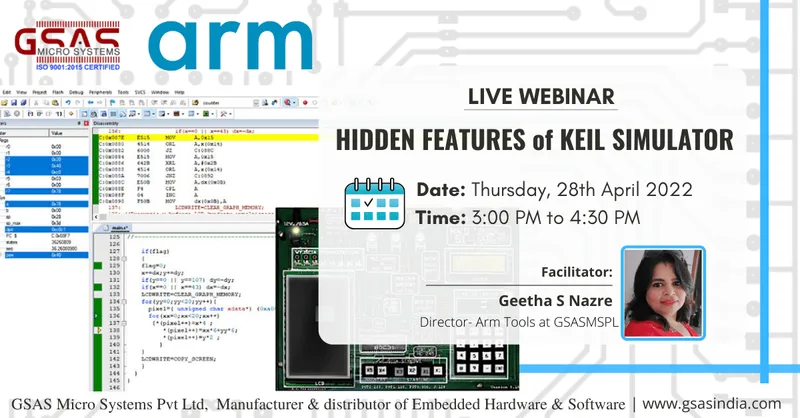
Wondering whether you can develop software in absence of hardware, then kick start your development and test it on virtual target and get your product to the market on time.
Curious to know the features of the Arm Keil simulator, then join the session.
In this webinar you will learn:
– Keil Simulator features
– Simulation of peripherals
– Analysis techniques
Timing:
Thursday, 28th April 2022 | 3:00 PM to 04:30 PM
Register Now!
GSASMSPL has partnered up with Arm to bring forward the Arm Keil Embedded Software Development Tools in India. To know about the Arm Keil Tools please click the link below.
Why simulation matters for India embedded teams
Hardware procurement and bench setup are still the longest pole on most Indian Cortex-M projects. Eval boards from STMicro, NXP, Renesas, or Nordic that take a few days in Europe routinely take two to four weeks to land at a Bengaluru, Chennai, or Pune lab, between import paperwork, distributor stock, and last-mile logistics. The Keil µVision simulator collapses that wait by giving the firmware engineer a virtual Cortex-M target as soon as the project file is created. The simulator is part of the Keil MDK installation, there is no separate license to track and no extra software to install. See the µVision simulator documentation on developer.arm.com for the full feature reference.
What the simulator covers
The Keil simulator runs the same compiled image you would flash to silicon. It models the Cortex-M core (CPU registers, memory, exceptions), simulates many on-chip peripherals (timers, NVIC, SysTick, USART, I²C, SPI, GPIO depending on the device pack), and supports user-written virtual peripheral models for cases where the device pack does not cover a custom block. Combined with SystemView and the trace facilities in Arm Development Studio, an Indian firmware team can bring up most application code, RTOS configuration, and protocol stacks before the physical board ever arrives.
What it cannot replace
Simulation is not a substitute for analog signal-integrity work, EMC testing, mechanical fit, or peripherals the simulator does not model (most modern parts have at least one, Bluetooth radio, ADC sequencer, motor-control PWM with deadtime). Plan a simulator-led front-loaded development schedule, then verify on the real board once it lands. The combination is what makes the four-to-six-week Cortex-M development sprint possible from an Indian lab.
About GSAS Webinar Series
GSAS Micro Systems regularly hosts webinars, workshops, and technical seminars to help India’s embedded engineering community stay current with the latest tools, techniques, and industry standards. Our events feature hands-on demonstrations and expert guidance from our applications engineering team.
Request a private session for your engineering team, or browse our complete event archive.
Interested in Arm tools?
Talk to our application engineers for personalized tool recommendations.
More from Arm
View all →
Meet the GSAS Team at electronica India 2026, Stall H3.I45
15 Sept · 3 min
Arm's Agentic AI Push: What Indian Embedded Teams Can Actually Use Today
13 Sept · 7 min
Arm User-Based Licensing in CI/CD: armlm, Proxy Activation and What Breaks
28 Jul · 11 min
Two Arm Keil MDK Webinars This Summer: DevOps and Edge AI for Indian Cortex-M Teams
17 Jun · 4 min
Emulating Processor Power for Thermal Testing: Why Constant Power
7 Oct · 7 min
CRPS and Rack Power Supply Testing: The Six Tests That Matter
7 Oct · 7 min