
 Arm
Arm Keil MDK
Compilers & IDEsA productivity, debugging, and reliability platform for professional Cortex-M development, MDK v6 brings dual IDE workflows, safety-certified compilers, Arm Fixed Virtual Platforms, and subscription licensing. Buy in India from GSAS.
Architecture
All Cortex-M (Pro adds legacy Cortex-R4, Arm7, Arm9 via armlm genlic)
IDEs
Keil Studio VS Code Extensions + µVision
Bundled Compilers
Arm Compiler for Embedded (AC6) + Arm Toolchain for Embedded (ATfE)
Supported Compilers
Arm GNU Toolchain (separate Arm download); third-party toolchains via CMSIS-Toolbox
Editions
Community (free, non-commercial), Essential, Professional (subscription)
Debug Probes
ULINKplus, ULINKpro, CMSIS-DAP, third-party
RTOS / Middleware
Keil RTX5, CMSIS-FreeRTOS, MDK-Middleware (all editions)
Safety Certifications (Pro tier)
IEC 61508 SIL 3, ISO 26262 ASIL D, Railway SIL 4, IEC 62304 Class C
Supported Devices
13,389 devices in Arm's public Keil CMSIS-Pack catalogue (read 30 July 2026)
Overview
About Keil MDK
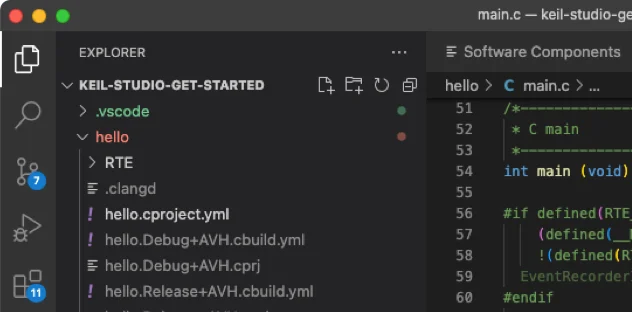
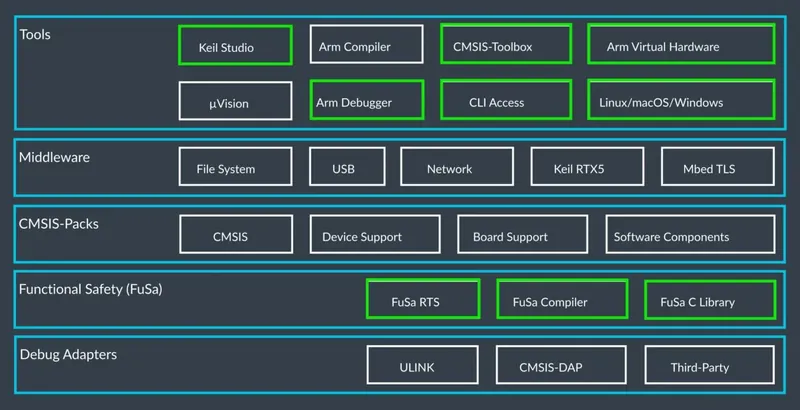
Arm Keil MDK is the productivity, debugging, and reliability platform used by professional embedded teams developing on Arm Cortex-M, from battery-powered IoT sensors to safety-critical automotive ECUs and railway signalling controllers. MDK v6 delivers a dual-IDE workflow: the Keil Studio VS Code Extensions for modern, cross-platform development on Windows, macOS, and Linux, alongside the proven µVision IDE on Windows for teams with established workflows. Both IDEs share the same project format, compilers, debugger, and CMSIS-Pack ecosystem, so teams can use either or both without project duplication. For a deeper view of how Indian product teams adopt the commercial edition, see our walkthrough of Keil MDK Professional for Cortex-M commercial development in India, and for teams moving to the modern VS Code experience, the Keil Studio cloud workflow for Indian embedded teams.
MDK v6 is now available as monthly or annual subscriptions through the Arm Developer Tools store, replacing legacy perpetual and node-locked licensing. The subscription model ensures teams always run the latest version with continuous updates, simplified procurement, and predictable budgeting. Licenses are user-based (UBL), one subscription per developer, usable on any machine.
Compilers and Toolchains
MDK v6 bundles two compilers and supports a third for projects that need it:
- Arm Compiler for Embedded (AC6): Arm’s commercial LLVM-based compiler with Arm-specific optimization passes, consistently producing among the smallest code sizes for Cortex-M. Available in both standard and Functional Safety (FuSa) variants (IEC 61508 SIL 3, ISO 26262 ASIL D, EN 50716 (Railways) SIL 4, IEC 62304 Class C certified), the FuSa variant ships with MDK Professional.
- Arm Toolchain for Embedded (ATfE): Arm’s next-generation LLVM-upstream-aligned compiler family, included alongside AC6 in the MDK subscription.
- Arm GNU Toolchain: the Arm-maintained
arm-none-eabi-gccdistribution is a separate free download from Arm (not bundled under the MDK subscription) but is fully supported as a target toolchain within MDK projects via CMSIS-Toolbox.
CMSIS-Toolbox and the csolution.yml project format let teams switch compilers per build target without restructuring their project.
Arm Fixed Virtual Platforms (FVPs)
MDK v6 includes Arm Fixed Virtual Platforms: software models of Cortex-M processors that enable firmware development, testing, and debugging without physical hardware. FVPs run on the developer’s machine and integrate directly into VS Code and µVision debug sessions. The Professional edition includes the full set of Cortex-M FVP models, enabling shift-left development and automated CI/CD testing where connecting physical boards is impractical.
CI/CD with CMSIS-Toolbox CLI
CMSIS-Toolbox provides a command-line build system (cbuild, csolution, cpackget) that drives reproducible builds in CI/CD pipelines, GitHub Actions, GitLab CI, Jenkins, or any automation system. Projects defined in csolution.yml build identically on developer desktops and headless build servers, eliminating “works on my machine” issues. MDK subscriptions include CI/CD usage rights for automated build and test workflows.
RTOS and Middleware
MDK v6 supports multiple real-time operating systems through the CMSIS-RTOS2 abstraction layer:
- Keil RTX5: Arm’s own RTOS, tightly integrated with MDK debugger and Event Recorder
- CMSIS-FreeRTOS: FreeRTOS with CMSIS-RTOS2 wrapper for portable application code
- MDK-Middleware: TCP/IP networking, USB Host/Device, File System, and Graphics components. Included in all editions (Community, Essential, and Professional), we unpack the MDK-Middleware + CMSIS industrial-IoT stack for India in a dedicated guide
- IoT Clients: MQTT, HTTP, and cloud connector libraries for connected Cortex-M applications
Debug Probes
MDK v6 supports a range of debug adapters: ULINKplus (with integrated power measurement), ULINKpro (ETM streaming trace for code coverage), CMSIS-DAP compliant probes, and third-party adapters including J-Link. Debug sessions work in both VS Code and µVision with identical breakpoint, watch, and peripheral register views. Teams that also run Cortex-A or Cortex-R silicon alongside a Cortex-M subsystem typically pair MDK with Arm Development Studio for Cortex-A, Cortex-R and Neoverse bring-up in India for the non-Cortex-M cores.
Arm Debugger: Unified Debug Across Desktop & CI/CD
Arm Debugger is the next-generation debug engine in MDK v6, replacing the legacy µVision debugger with a unified experience across VS Code and command-line workflows. Key capabilities:
- Multi-core debug: Simultaneous debug sessions across multiple Cortex-M cores in heterogeneous SoCs (e.g., Cortex-M33 secure + non-secure, Cortex-M7 + M4 in dual-core MCUs)
- CI/CD integration: Command-line debug and flash via
cbuildandcsolution, enabling automated test execution in Jenkins, GitHub Actions, and GitLab CI pipelines - CoreSight trace: ETM instruction trace, ITM printf, and SWV data trace with timeline visualization, identify performance bottlenecks and race conditions that printf debugging cannot reveal
- Security extensions: TrustZone-M debug with secure/non-secure world switching, essential for PSA Certified and SESIP implementations
Functional Safety Runtime System (FuSa RTS)
MDK Professional includes the FuSa RTS: a safety-certified C runtime library qualified to:
- IEC 61508 SIL 3: Industrial safety systems, PLCs, and safety controllers
- ISO 26262 ASIL D: Automotive ECUs, ADAS, and powertrain controllers
- Railway SIL 4: Railway signalling and train control systems. Arm names the standard revision on the certificate for each qualified release, so confirm the scope with GSAS
- IEC 62304 Class C: Medical device software (infusion pumps, patient monitors, diagnostic instruments)
FuSa RTS provides a pre-qualified C library (libc, libm, math functions, string operations) with full safety documentation packages, requirements traceability matrix, test reports, FMEA analysis, and integration manual. Teams building safety-critical firmware can use FuSa RTS to satisfy the “pre-developed software” qualification requirements of their target standard, significantly reducing certification timeline and cost.
Ethos-U NPU: Edge AI on Cortex-M
MDK v6 supports development for Arm Ethos-U55 and Ethos-U65 neural processing units through CMSIS-NN and CMSIS-DSP software packs. Teams deploying TinyML models on Cortex-M + Ethos-U SoCs can build, debug, and profile inference workloads entirely within the MDK workflow:
- CMSIS-NN kernels: Optimized neural network operators for Ethos-U, automatically selected by TensorFlow Lite Micro and other inference frameworks
- CMSIS-DSP: Signal processing primitives (FFT, filtering, matrix operations) for sensor preprocessing pipelines feeding into ML models
- FVP simulation: Run Ethos-U inference on Arm Fixed Virtual Platforms before silicon is available, enabling parallel hardware/software development
This is particularly relevant for Indian teams building edge AI products in predictive maintenance, smart metering, and industrial vision, where on-device inference eliminates cloud dependency and meets data sovereignty requirements.
Edition Comparison
| Feature | MDK Community | MDK Essential | MDK Professional |
|---|---|---|---|
| Use | Non-commercial only | Commercial | Commercial |
| Cortex-M Support | All Cortex-M | All Cortex-M | All Cortex-M (+ SecurCore per Arm’s published matrix) |
| Legacy device support | - | - | Cortex-R4, Arm7, Arm9 (via armlm genlic) |
| IDEs | VS Code + µVision | VS Code + µVision | VS Code + µVision |
| Arm Compiler for Embedded (AC6) | Standard | Standard | Standard + FuSa (safety-certified) |
| Arm Toolchain for Embedded (ATfE) | Included | Included | Included |
| Arm GNU Toolchain | Separate free Arm download | Separate free Arm download | Separate free Arm download |
| RTOS, Keil RTX5 / CMSIS-FreeRTOS | Included | Included | Included |
| MDK-Middleware (TCP/IP, USB, File System, IoT Clients) | Included | Included | Included |
| Arm FVPs / Fast Models | - | - | Included |
| CI/CD (CMSIS-Toolbox CLI) | Included | Included | Included |
| Safety Certification | - | - | IEC 61508 SIL 3, ISO 26262 ASIL D, EN 50716 (Railways) SIL 4, IEC 62304 Class C evidence kits |
armlm genlic legacy-NL for AC5 / PK51 / DK251 / PK166 | - | - | Included |
| Code-size limit | None | None | None |
| Commercial archive licence | - | Included | Included |
| Subscription | Free | Monthly or annual | Monthly or annual |
| Pricing | Free download | Request Quote | Request Quote |
Keil MDK vs Other IDEs for Cortex-M Development in India
Engineering teams selecting an embedded IDE for Cortex-M microcontroller development typically evaluate Keil MDK alongside alternatives such as IAR Embedded Workbench, STM32CubeIDE, and Eclipse-based toolchains. MDK v6’s distinguishing capability is its dual-IDE workflow, the Keil Studio VS Code Extensions provide a modern cross-platform experience (Windows, macOS, Linux), while the proven uVision IDE serves teams with established Windows workflows. Both share the same project format, compilers, and CMSIS-Pack ecosystem, eliminating the need to maintain separate build configurations.
MDK bundles two commercial compilers, Arm Compiler for Embedded (AC6, LLVM-based, producing among the smallest Cortex-M code sizes) and the next-generation Arm Toolchain for Embedded (ATfE), both integrated through the CMSIS-Toolbox CLI for reproducible CI/CD builds. Arm GNU Toolchain is supported as a target toolchain in MDK projects but is a separate free download from Arm rather than a bundled MDK component. The Professional edition adds a safety-certified embedded C compiler and FuSa Runtime System qualified to IEC 61508 SIL 3, ISO 26262 ASIL D, EN 50716 (Railways) SIL 4, and IEC 62304 Class C, plus Arm Fixed Virtual Platforms for firmware development without physical hardware. With device support drawn from the CMSIS-Pack ecosystem, whose public Arm Keil catalogue listed 13,389 devices when read on 30 July 2026, RTOS support (Keil RTX5, CMSIS-FreeRTOS), and MDK-Middleware (TCP/IP, USB, File System, IoT Clients), MDK provides a complete microcontroller development environment from prototyping through production.
Why GSAS for Keil MDK
GSAS is Arm’s authorized partner in India for Arm Development Tools, providing local procurement with INR invoicing, GST-compliant billing, and faster turnaround on subscription fulfillment. Our embedded tools team assists with MDK v5 to v6 migration, µVision-to-VS Code workflow transition, CMSIS-Pack configuration for custom boards, compiler qualification for safety-critical projects, and CI/CD pipeline setup with CMSIS-Toolbox. Whether you are evaluating MDK on a monthly subscription or deploying MDK Professional across a 50-seat engineering team on annual terms, GSAS provides the licensing flexibility and technical support to keep your Cortex-M development on track.
Blog
Arm Insights
Arm User-Based Licensing in CI/CD: armlm, Proxy Activation and What Breaks
A licensing failure in an Arm pipeline blocks the release branch and puts a firmware engineer on armlm output instead of driver code, up to seven days after the change that caused it. The reason: a UBL licence is a cached certificate valid for 7 days, not a checkout. Here is what that changes about pipeline design, and what to fix first.

Two Arm Keil MDK Webinars This Summer: DevOps and Edge AI for Indian Cortex-M Teams
Arm is running two free live Keil MDK webinars this summer: DevOps with Keil MDK on 23 June and edge AI with ModelNova Fusion Studio on 21 July. What Cortex-M teams in Bengaluru, Hyderabad, Pune, Chennai, Mumbai, and Delhi NCR should know, shared by GSAS, Arm's authorized partner in India for Arm Development Tools.

How Many Arm UBL Seats Do You Actually Need?: A Sizing Guide for Indian CI/CD Teams
How Arm User-Based Licensing actually sizes against your team: per developer identity, not per parallel CI job. A short guide for Indian engineering managers planning the UBL migration, talk to GSAS for the per-team sizing exercise.
Related products
More from Arm
All Arm products →
Keil MDK Community
Keil MDK Community is Arm's no-cost MDK v6 edition, licensed for students and non-commercial use only. For any commercial Cortex-M product work in India, GSAS supplies the licensed MDK Essential tier with INR procurement and local Arm engineering support.
View Keil MDK Community →
Keil MDK Essential
Entry commercial tier of Arm Keil MDK v6 for Cortex-M product teams in India, full Cortex-M toolchain, Arm Compiler 6, Keil Studio + µVision dual-IDE, MDK-Middleware free, and Arm support entitlement under User-Based Licensing. Buy in India from GSAS.
View Keil MDK Essential →
Keil MDK Professional
Flagship commercial tier of Arm Keil MDK v6 for Indian safety-critical Cortex-M product teams, adds FuSa Compiler (TÜV-certified for ASIL-D / SIL-3 / SIL-4 / Class-C), FuSa RTS, Fast Models / FVPs, and the armlm genlic legacy-NL recipe to everything in MDK Essential. Buy in India from GSAS.
View Keil MDK Professional →Interested in Keil MDK?
Get pricing, an evaluation unit, or a technical consultation from our application engineers.