fiXtress
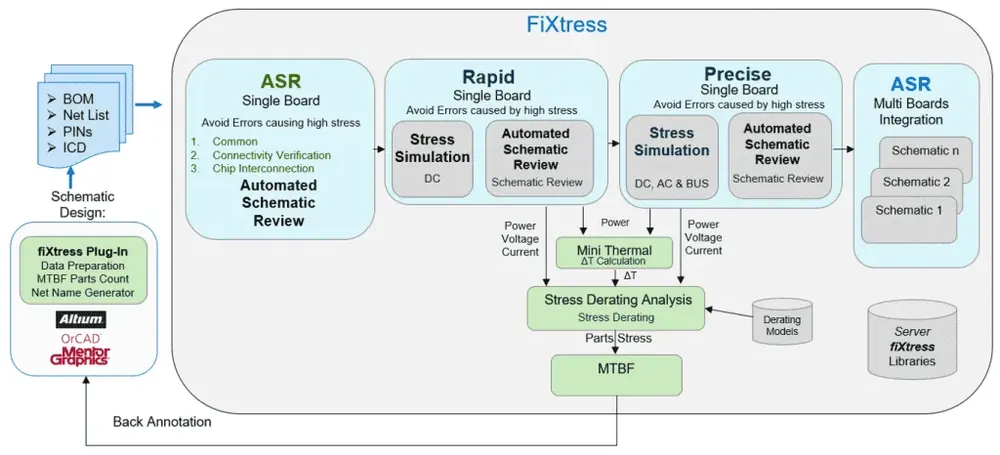
fiXtress is a superior Design for Reliability (DfR) suite, serving as an add-on for any Electronic Design Automation (EDA) tool. It is the only tool integrating design error detection with electrical stress, thermal, MTBF and service life prediction at the schematic level, before PCB layout and production. fiXtress modules can either operate standalone or complement other modules to provide a comprehensive DfR solution for electrical circuits and PCB design.
fiXtress includes the following modules
ASR – Automated Schematic Review
Rapid – Electrical Stress Calculation
Precise – Electrical Stress Simulation SDA – Stress Derating Analysis
MTBF – MTBF Prediction Mini Thermal – Average PCB heating Multi Board- System Level simulation G-Lib – Automated library preparation
Benefits
- Automated Schematic Review tool; Detect hidden design errors, driven by Electrical Stress, Reliability, Testability and Safety analysis
- fiXtress uses the ICD (interface Control Document) signals and their tolerance, this means we do a real stress analysis and schematic review based on the power supplies and loads
- Single and Multi-Boards analysis using the ICD between PCBs, if you do not use the ICD it is not a real analysis
- Ready to use 17 groups of design rules, each one about 15 sub-groups
- User can define easily new design rules for different applications such as Testability, ESD and Safety (ready 56 rules)
- Rules are not scripts which run individually one by one, fiXtress runs all rules together using the results effects between components
- Advanced level of rules that can check group of signals & BUSs between chips
- Check for every pin the applied actual voltage and current, that comes from a real stress analysis to fulfill the components standards
- Prevent hidden design errors, the cause of NFF (No Failure Found) during service
- Very fast and accurate results in minutes for hundreds of rules on a 100,000 pads PCB with 25,000 components
- Ready to use derating standards
- User can create his own derating standard
- Detect all EOS (Electrical Over Stress) violations with Pareto, overstress and overdesign reports
- Unique Thermal analysis that estimate the average temperature rise over the cold-plate, for accurate stress Derating
- Calculate the accurate MTBF based on real electrical and thermal stress
- MTBF prediction for all available standards
- Drive reliability data automatically to all RAMS analysis (FMECA, FTA, RBD, MTTR)
Conclusions
fiXtress is a new EDA plug-In software to any schematic capture which helps the designer to detect hidden errors early in the design process. fiXtress is using an Automated Schematic Review method which is driven by electrical circuits stress analysis and a database of rules. A Rule Wizard Editor is available to add new rules. The Tool uses C++ and not scripts and run very fast on very large boards.
Furthermore, the fiXtress uses the power signals and the loads (ICD: Interface Control Document) from the connectors to perform real simulation as it is powered in real use, in comparison to other tools that do not use the ICD.
Also appears in:
Interested in BQR tools?
Talk to our application engineers for personalized tool recommendations.
More from BQR
View all →
apmOptimizer Deep Dive: How BQR's Asset Maintenance Software Cuts Lifecycle Costs
5 Apr · 7 min

BQR CARE Deep Dive: Unified RAMS Analysis for Safety-Critical Systems
5 Apr · 7 min
fiXtress Deep Dive: PCB Reliability Prediction and Automated Schematic Review
5 Apr · 7 min
Design for Reliability: Catching PCB Failures Before They Happen
5 Apr · 7 min
Emulating Processor Power for Thermal Testing: Why Constant Power
7 Oct · 7 min
CRPS and Rack Power Supply Testing: The Six Tests That Matter
7 Oct · 7 min