The European Union’s Cyber Resilience Act represents the most significant regulatory shift in embedded product cybersecurity in a decade. Coming into full effect in 2027, the CRA imposes mandatory cybersecurity requirements on virtually all products with digital elements sold in the EU market, including embedded systems, IoT devices, and industrial controllers. For Indian embedded product companies that export to Europe, understanding and preparing for these requirements is no longer optional.
The CRA introduces product classification tiers, mandatory Software Bill of Materials (SBOM) generation, vulnerability disclosure obligations, and ongoing security update commitments throughout a product’s lifecycle. Companies must demonstrate conformity through self-assessment or third-party evaluation depending on product criticality. The implications extend beyond the final product to encompass development tools, supply chain components, and open-source dependencies.
Indian engineering teams can accelerate their CRA readiness by adopting a compliance-first toolchain that integrates static analysis, vulnerability scanning, and SBOM generation into their existing development workflows. Tools like Perforce Klocwork and Perforce QAC provide the automated code analysis and security checking that form the foundation of a CRA-compliant development process, while proper version control and traceability through Perforce Helix Core ensure the audit trail that regulators require.
Key CRA obligations for embedded products
The Cyber Resilience Act (Regulation (EU) 2024/2847, published in the Official Journal on 20 November 2024) imposes a concrete set of duties on manufacturers that ship products with digital elements into the EU. Four obligations matter most for embedded teams:
- Essential cybersecurity requirements (Annex I, Part I): products must be designed, developed and produced to ensure an appropriate level of cybersecurity based on the risks, delivered without known exploitable vulnerabilities, and configured with a secure-by-default posture.
- Software Bill of Materials (Annex I, Part II §1): manufacturers must “identify and document vulnerabilities and components contained in the product, including by drawing up a software bill of materials in a commonly used and machine-readable format covering at the very least the top-level dependencies of the product.” (OJ L, 2024/2847, Annex I)
- Vulnerability handling (Annex I, Part II): manufacturers must address and remediate vulnerabilities without delay, provide security updates free of charge, and publish a coordinated vulnerability disclosure policy.
- Reporting duties (Article 14): actively exploited vulnerabilities and severe incidents must be notified to ENISA and the relevant CSIRT via an early warning within 24 hours, a vulnerability/incident notification within 72 hours, and a final report within 14 days (Article 14(1)–(2)).
- Conformity assessment & CE marking (Article 32 and Annex VIII): most products use internal control (Module A); important and critical products require third-party assessment before the CE mark can be affixed.
Compliance timeline
Per the European Commission’s CRA policy page, the regulation entered into force on 10 December 2024. Most obligations apply from 11 December 2027 (36 months after entry into force). The reporting obligations under Article 14 apply earlier, from 11 September 2026 (21 months after entry into force), and the conformity-assessment-body notification rules from 11 June 2026. Indian exporters therefore have a hard deadline of late 2027 to ship CE-marked, CRA-conformant product.
Tooling that supports CRA compliance for Indian teams shipping to EU
GSAS partners cover the core control points the CRA expects:
- Static application security testing (SAST): Perforce Klocwork detects CWE-class vulnerabilities, taint-flow issues, and CERT C/C++ violations at desk-check and CI gates, generating the audit evidence Annex I expects for “no known exploitable vulnerabilities.”
- Secure-by-design RTOS: SEGGER embOS provides a deterministic, certified kernel that supports the secure-state and least-privilege design expectations in Annex I, Part I.
- Cryptographic primitives: SEGGER emCrypt supplies FIPS-aligned symmetric, asymmetric, and hashing primitives so secure-update and authentication mechanisms required by Annex I §3(e) are built on reviewed crypto rather than rolled in-house.
Pairing these with an SBOM generator and a coordinated vulnerability disclosure process closes the gap between Indian engineering practice and what an EU notified body will look for in 2027.
Also appears in:
Interested in Perforce tools?
Talk to our application engineers for personalized tool recommendations.
More from Perforce
View all →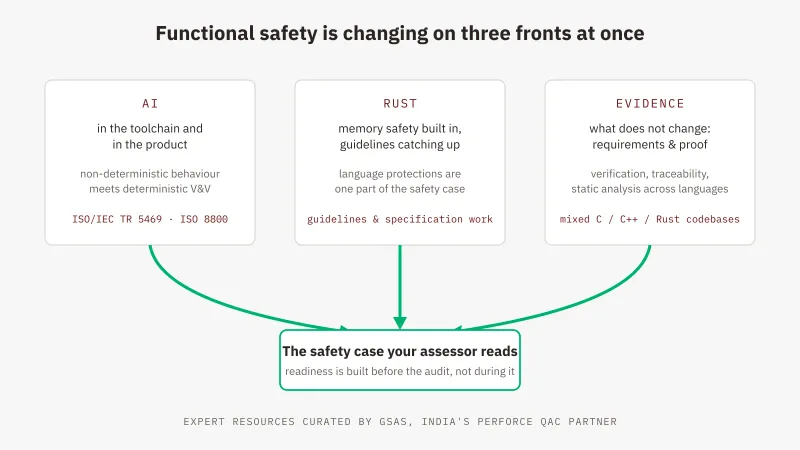
AI, Rust and the New Functional Safety Standards
2 Sept · 9 min

The Complete AUTOSAR Verification Chain: AUTOSAR C++14 Static Analysis with Perforce QAC, SWC and RTE Testing with TESSY 6
31 Jul · 9 min

DevSecOps Tools and Practices for Embedded Teams in India
18 Jul · 8 min
Static Analysis for Medical Device Software: IEC 62304 and FDA Compliance in India
18 Jul · 9 min
Emulating Processor Power for Thermal Testing: Why Constant Power
7 Oct · 7 min
CRPS and Rack Power Supply Testing: The Six Tests That Matter
7 Oct · 7 min