
SEGGER and Razorcat Partnership: What It Means for Indian Embedded Teams
Indian embedded teams build their development environments from multiple tools, an IDE for code editing and compilation, a debug probe for hardware interaction, and a testing tool for safety-mandated coverage measurement. When these tools come from different vendors with no integration between them, engineers spend significant time on configuration, troubleshooting tool interactions, and managing incompatible project formats.
The SEGGER and Razorcat partnership changes this equation. SEGGER, the German embedded tools company known for J-Link debug probes and Embedded Studio IDE, and Razorcat Development GmbH, the developer of the TESSY unit testing tool, have aligned their tools to work together, from code compilation through debug to automated unit testing with MC/DC coverage.
For Indian teams, GSAS Micro Systems provides both SEGGER and Razorcat product lines, making this integrated workflow available with local support across all 11 GSAS offices.
The Integrated Workflow
The SEGGER + Razorcat tool stack covers three phases of embedded development:
Phase 1: Development (SEGGER Embedded Studio)
SEGGER Embedded Studio is a cross-platform IDE for Arm Cortex-M/A/R, RISC-V, and other embedded architectures. It includes the SEGGER Compiler (based on Clang/LLVM), the SEGGER Linker, and project management, a complete build environment without external dependencies. Engineers write, compile, and debug their firmware within Embedded Studio.
For teams using Arm Compiler 6 via Keil MDK, SEGGER Embedded Studio serves as an alternative IDE with native J-Link integration and a licensing model that includes the compiler at no additional cost.
Phase 2: Debug and Hardware Validation (SEGGER J-Link)
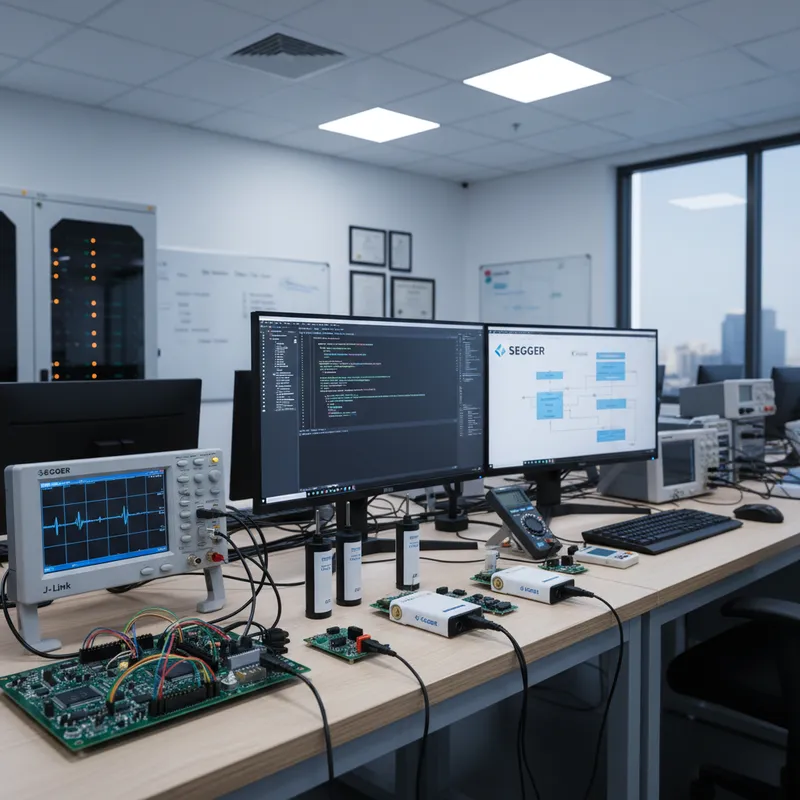
J-Link debug probes connect to the target microcontroller via SWD or JTAG. During development, engineers use J-Link for interactive debugging, breakpoints, watchpoints, memory inspection, and real-time trace. J-Link supports virtually every Arm device, plus Infineon AURIX TriCore, Renesas RH850, and RISC-V targets.
J-Link’s flash programming capabilities are used during development for iterative firmware loading and during production for initial device programming.
Phase 3: Automated Unit Testing (TESSY)
TESSY automates the unit, module, and integration testing that safety standards require. It parses function interfaces, generates test drivers and stubs, and measures MC/DC coverage. The key integration point: TESSY uses J-Link to download test binaries to the target and collect coverage data from real hardware execution.
This means coverage data comes from the actual microcontroller, compiled with the actual cross-compiler, executing the actual machine code that ships to production. Safety assessors accept this as evidence that structural coverage was achieved on the target platform.
What the Partnership Delivers
The alignment between SEGGER and Razorcat provides concrete benefits:
Streamlined on-target testing. TESSY’s J-Link integration is a first-class feature, not an afterthought. Configuration requires specifying the J-Link serial number and target device, TESSY handles the rest. Test download, execution, and data readback are automatic.
Consistent toolchain. Code compiled in SEGGER Embedded Studio (or with the SEGGER Compiler via command line) feeds directly into TESSY for testing. The build configuration, compiler flags, include paths, preprocessor defines, transfers cleanly between tools.
Combined CI/CD. In continuous integration pipelines, the SEGGER toolchain compiles the production firmware, TESSY compiles and executes the test harnesses, and J-Link (via J-Run) handles on-target execution, all orchestrated by Jenkins, GitLab CI, or Azure DevOps.
Common target support. Both tools share the same target device database. When SEGGER adds support for a new microcontroller family, that support is available for both debug and unit testing workflows.
India Market Context
Indian embedded development is concentrated in cities with distinct vertical specializations:
- Bengaluru: aerospace flight controllers, ADAS processing, semiconductor design services
- Pune: automotive powertrain ECUs, chassis controllers, AUTOSAR stack development
- Hyderabad: defence radar processing, industrial automation, telecom baseband
- Chennai: automotive body controllers, two-wheeler EV motor control, industrial safety
- Mumbai: medical device firmware, industrial IoT gateways
- Delhi NCR: defence communications, railway signalling, smart grid controllers
Across all these verticals, the common thread is the need for safety-qualified development tools with local support. The SEGGER + Razorcat combination addresses this need with tools that work together and a local partner (GSAS) that supports the entire workflow.
Licensing and Procurement
GSAS Micro Systems provides both SEGGER and Razorcat product lines under a single vendor relationship:
- SEGGER J-Link probes: hardware procurement with INR invoicing
- SEGGER Embedded Studio: IDE licensing (includes compiler, linker, runtime libraries)
- TESSY: unit testing licensing with MC/DC coverage, Classification Tree Editor, CI/CD batch execution
- Combined training: joint onboarding covering the full develop-debug-test workflow
One purchase order, one GST invoice, one support channel. For procurement teams managing vendor consolidation targets, this simplifies the acquisition process.
Why Buy from GSAS
GSAS Micro Systems is an authorized partner for both SEGGER and Razorcat, providing the complete SEGGER + TESSY workflow with local sales, training, and technical support. Our engineers in Bengaluru, Hyderabad, Chennai, Pune, Mumbai, and Delhi NCR configure the integrated toolchain on your project, train your team on on-target unit testing with J-Link, and provide ongoing support for safety certification projects. Contact GSAS for a combined SEGGER + TESSY evaluation.
Also appears in:
Interested in Razorcat tools?
Talk to our application engineers for personalized tool recommendations.
More from Razorcat
View all →
Test Case Design with the Classification Tree Method: Deriving Unit Tests You Can Defend in an Audit
1 Aug · 10 min
Fault Injection and Robustness Testing for Embedded Software: What ISO 26262, IEC 61508 and DO-178C Actually Ask For
1 Aug · 11 min
How to Evaluate a Unit Testing Tool for Embedded Software: A Buyer's Framework for Indian Teams
1 Aug · 10 min
Is 100% Code Coverage Enough? Statement, Branch, MC/DC and MCC, and What Each One Proves
1 Aug · 9 min
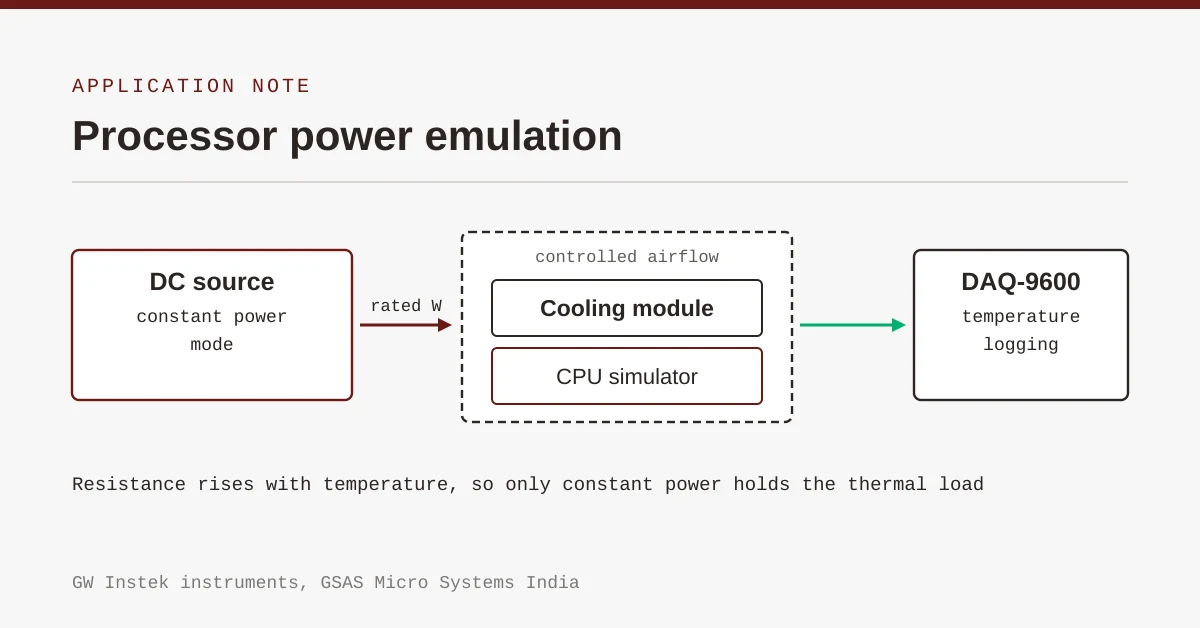
Emulating Processor Power for Thermal Testing: Why Constant Power
7 Oct · 7 min
CRPS and Rack Power Supply Testing: The Six Tests That Matter
7 Oct · 7 min