Binho Mission Control 3 (Public Preview): Point-and-Click I2C, SPI, I3C, and GPIO
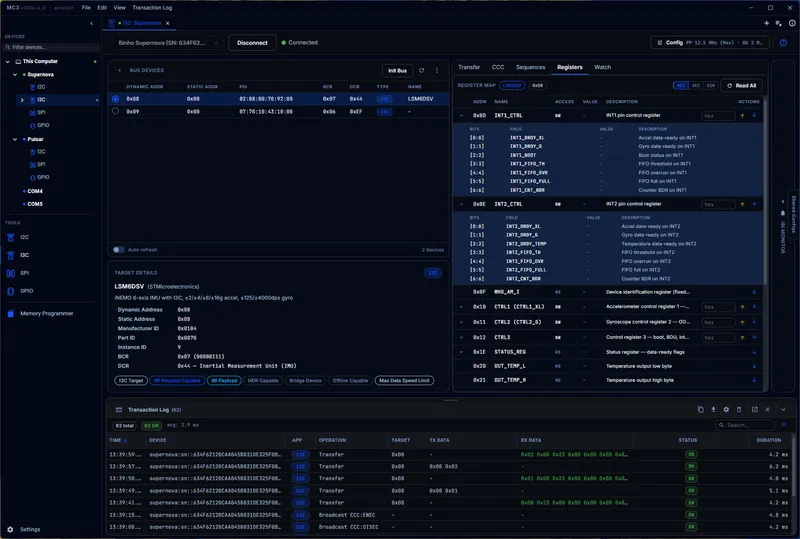
Binho has rebuilt Mission Control from the ground up. The result, Mission Control 3, is now in Public Preview at version 2026.6.0. Binho is targeting an official release for September/October 2026, with new preview builds arriving roughly every two weeks between now and then.
For engineers who already use Mission Control 2 with a Supernova or Pulsar, this is not a theoretical roadmap item. It is software you can install today, watch evolve every two weeks, and give feedback on before the shape of the tool locks in for its official release.
One Workbench for I2C, SPI, I3C, and GPIO
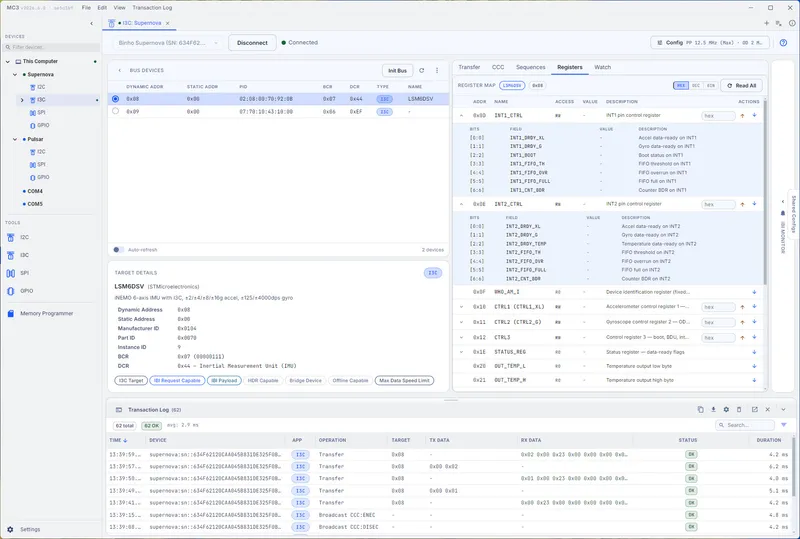
The core idea behind Mission Control 3 is consolidation. Instead of separate vendor utilities for each protocol, one interface drives I2C, SPI, I3C, and GPIO from the same workbench. An engineer bringing up a new board can scan an I2C bus, exercise an SPI flash device, and toggle a GPIO line without switching applications or reconfiguring a connection each time.
The workbench also lets engineers compose and sequence transactions without writing code. A sequence of reads, writes, and delays across multiple protocols can be built up visually and replayed, which is useful during board bring-up when the same verification sequence needs to run repeatedly as firmware or hardware revisions change.
The Memory Programmer: A Visual Hex Editor
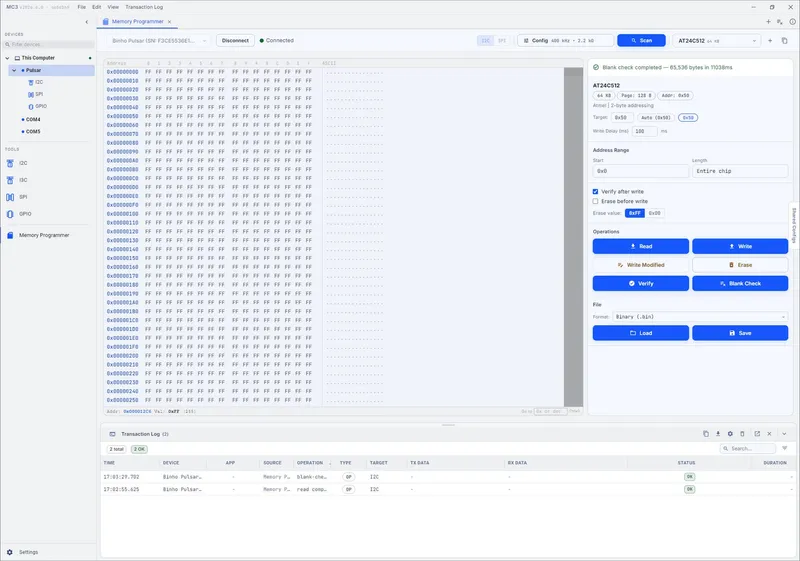
One of the more concrete additions in Mission Control 3 is the memory programmer, a visual hex editor purpose-built for I2C EEPROMs and SPI flash. It supports the full set of operations an engineer needs when working with non-volatile memory: read, write, verify, blank-check, and erase.
The programmer also handles binary file load and save, so a firmware image or configuration blob can be written to a device directly from a file on disk and read back for comparison. Every operation is captured in a transaction log, which matters when a write fails partway through and needs to be traced back to the exact command that caused it. Common parts are covered by device presets, including the AT24C512 EEPROM, so the engineer does not need to hand-enter page size and address parameters for well-known devices.
Runs in a Browser Tab or as a Native App
Mission Control 3 runs directly in a web browser with no installation step. For a quick bus check on a machine that does not have the tool installed, this removes the friction of downloading and setting up software before getting to work, what Binho describes as the ability to “program straight from a browser tab.”
For engineers who prefer a native application, Mission Control 3 is also available as a standalone install on Windows, macOS (Apple Silicon), and Linux, distributed as an AppImage on Linux. Both paths connect to the same Supernova or Pulsar hardware and the same feature set, so the choice comes down to workflow preference rather than capability.
I3C on the Supernova
I3C support in Mission Control 3 runs on the Binho Supernova and covers HDR modes up to 12.5 MHz, In-Band Interrupts, Hot-Join, and dynamic addressing. Binho describes this as “industry-leading I3C,” a characterization that is Binho’s own.
For teams building I3C sensor hubs or next-generation PMIC designs, having HDR mode support, interrupt handling, and dynamic addressing available through a point-and-click interface removes a substantial amount of driver-writing overhead during early bring-up. The Binho Supernova is the adapter Mission Control 3’s I3C features are built around.
Supported Hardware: Supernova and Pulsar
Mission Control 3 supports two adapters: the Binho Supernova and the Binho Pulsar. Existing Supernova and Pulsar customers get it free of charge, enabled through a firmware update applied via Mission Control 2.17.3, and it comes included with new units.
It is worth stating plainly: the Binho Nova is not part of this transition. The Nova continues to run on Mission Control 2, and Binho has not indicated a Mission Control 3 path for it.
From Mission Control 2 to Mission Control 3
Mission Control 2 does not disappear with this release. It remains the software for the Binho Nova, and it is also the vehicle for the firmware update that unlocks Mission Control 3 on an existing Supernova or Pulsar. Engineers who want the background on Mission Control 2’s interactive I2C, SPI, and UART workflow can read our Mission Control 2 deep dive, which covers bus scanning, register access, and protocol decoding in detail.
Get Mission Control 3 and Binho Adapters in India
GSAS Micro Systems is an authorized engineering partner in India. We supply the Supernova and Pulsar with INR invoicing and provide the local application-engineering support that gets teams from first bus scan to production-ready test sequences.
Our engineers in Bengaluru, Hyderabad, Chennai, Pune, Mumbai, and Delhi NCR can help you evaluate Mission Control 3 on a Supernova or Pulsar, walk through the firmware update path, and size the right adapter for your protocol mix. Visit the Binho partner page for the full product lineup, or request a quote for an evaluation unit.
Also appears in:
Interested in Binho tools?
Talk to our application engineers for personalized tool recommendations.
More from Binho
View all →
I3C FAQ for Firmware Teams: What the Bus Is, What Changes, and What You Need on the Bench
31 Jul · 8 min
Running the Binho Supernova as an I3C Target: Emulating a Device Against Your Own Controller
31 Jul · 7 min
Binho Mission Control: Point-and-Click I2C, SPI, and UART Without Writing Code
7 Apr · 5 min
From Dedicated Analyzers to Multi-Protocol USB Adapters: A Bench Tool Evolution
7 Apr · 5 min
Emulating Processor Power for Thermal Testing: Why Constant Power
7 Oct · 7 min
CRPS and Rack Power Supply Testing: The Six Tests That Matter
7 Oct · 7 min