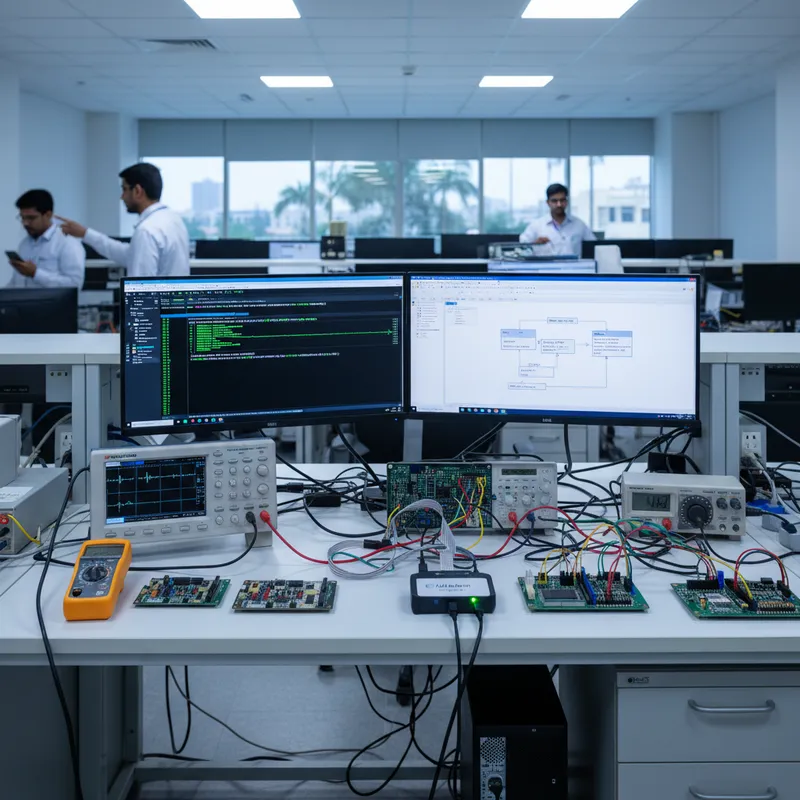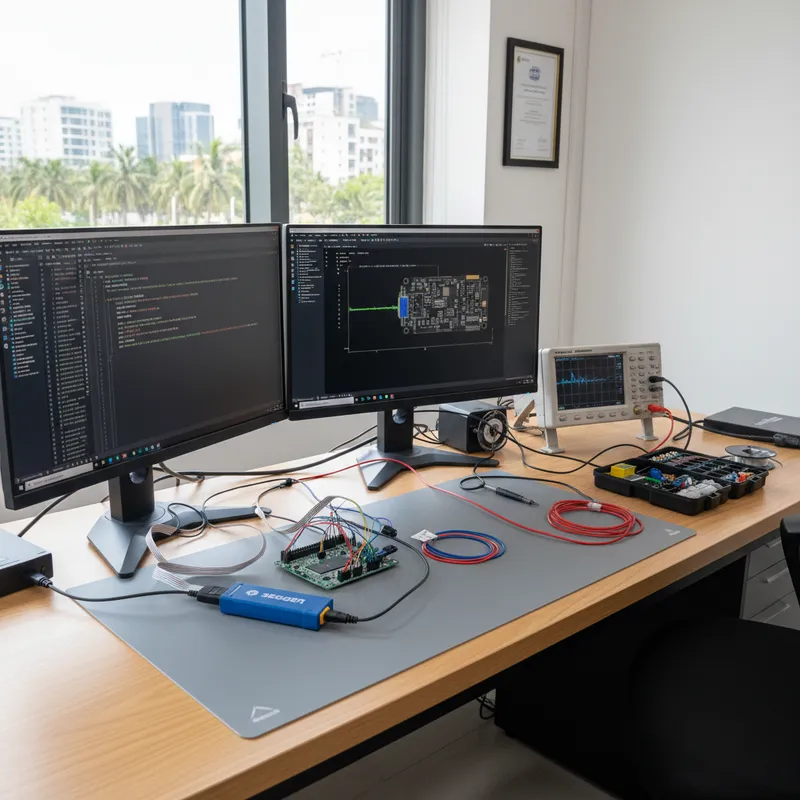
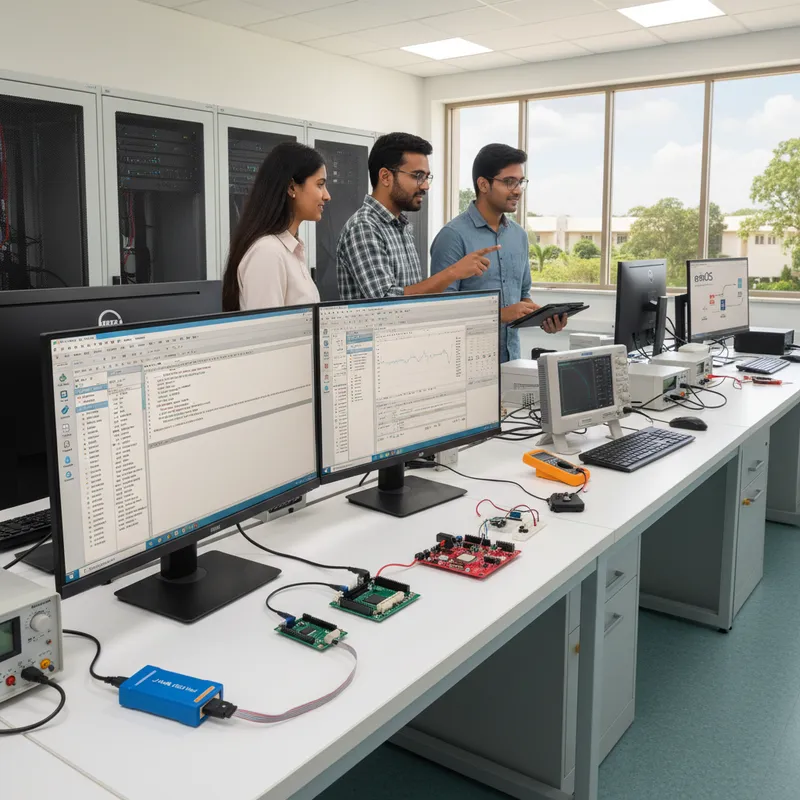
Every serious embedded engineering curriculum in India faces the same problem: the commercial-grade tooling that professional firmware teams use, debug probes, RTOS, middleware, IDE, is built for product development, not for teaching. Faculty want their students to graduate fluent in the toolchains Indian industry actually ships on. Students want hands-on time with the probes and IDEs they will encounter on their first job. And the budget officer wants a procurement path that actually exists for a public engineering college ordering through institutional processes.
SEGGER Microcontroller GmbH addresses this directly with the SEGGER Educational Partnership Program (SEPP), a structured framework for getting the full SEGGER embedded stack into universities, research labs, and student-project teams at terms designed for education rather than commercial product shipment. This post is for Indian university faculty, curriculum designers, and student-project leads at IITs, NITs, IIITs, BITS, VIT, SRM, Manipal, and every accredited engineering college building serious embedded programs.
What SEPP actually is
SEPP is SEGGER’s direct engagement program for universities and the formal home of what SEGGER calls its SEGGER Friendly License (SFL). Most of SEGGER’s tools are available under the SFL to students and teaching institutions free of charge, intended to support teaching, research, student projects, and non-commercial work rather than revenue-generating product development. The SFL terms and limits live at segger.com/purchase/licensing/license-sfl and should be read in full by any Indian faculty member planning to integrate SEGGER tools into a course.
Beyond the license framework, SEGGER lists concrete engagement channels on the SEPP page:
- Research project support: SEGGER supports bachelor, master, and PhD thesis work with technical assistance, software, and in some cases hardware loans. Published examples include a mobile-robot function library project at Ostbayerische Technische Hochschule Amberg-Weiden and a fuzz-testing research project (μAFL) at the University of Georgia presented at ICSE 2022 where SEGGER provided extensive support and a J-Trace PRO for PC-to-evaluation-board communication.
- Student project sponsorships: SEGGER has publicly backed Formula Student teams including Forze Hydrogen Racing at TU Delft (embOS running the hydrogen-powered race car) and the Solaride solar-powered car team in the Baltics (embOS for desert-condition reliability, emWin for the steering wheel control elements).
- Curriculum integration: SEGGER explicitly recommends product combinations for different course types: embOS + SystemView for RTOS teaching; Embedded Studio for system design and IDE courses; J-Link (including the discounted J-Link EDU Mini) and J-Link OB for debug instruction; Ozone for close-to-the-hardware system analysis; embOS + emUSB + emNet for robotics and Formula Student projects; emSecure, emSSL, and emMQTT for networked systems and IoT courses.
- Practical engagement: the program also offers student internships, working-student positions, guest lectures, specialized thesis supervision, product loans for workshops, and in some cases financial support for qualifying student projects.
Contact SEPP directly
SEGGER’s SEPP page routes all program inquiries to the dedicated education contact at education@segger.com, with the named program contact being Nino Vidovic (Software Engineer) at SEGGER Microcontroller GmbH, Ecolab-Allee 5, 40789 Monheim am Rhein, Germany. The SEPP landing page includes a contact form for universities interested in formal engagement.
Indian universities are encouraged to reach out to SEPP directly. The engagement is university-to-SEGGER, not routed through regional distributors. Faculty considering SEPP participation should contact SEGGER at education@segger.com with a description of the program (undergraduate course, graduate research, student project team, capstone project), the number of students involved, the target MCU platforms, and the specific SEGGER tools of interest.
Where GSAS fits: commercial hardware and logistics for Indian institutions
GSAS Micro Systems is an authorized engineering partner in India for the full commercial SEGGER range. What this means for Indian universities running an SEPP engagement in parallel:
- Commercial hardware procurement: when an Indian institution needs commercial J-Link, J-Trace, or Flasher hardware (for example, a departmental research lab buying units beyond what SEPP provides, or an industry-sponsored chair that needs the PRO-class hardware with Ethernet isolation), GSAS handles INR invoicing, GST compliance, GeM integration, SAP Ariba / Coupa / TReDS workflows, and local delivery to all GSAS office cities, Bengaluru, Chennai, Hyderabad, Delhi NCR, Mumbai, and Pune, plus institution-to-institution shipping across India.
- Applied workshops and bring-up support: GSAS engineers can run hands-on workshops at Indian institutions covering J-Link debugging fundamentals, Ozone walkthroughs, SystemView tracing, Embedded Studio project bring-up, and embOS task-scheduling exercises on student hardware. Faculty organizing week-long student training programs or capstone-project kickoff workshops can coordinate with GSAS directly.
- Compliance and certification guidance: for Indian research groups working on safety-critical systems under IEC 61508, ISO 26262, or IEC 62304 (common in medical-device and automotive research labs at IITs and defence-adjacent institutions), GSAS can route technical questions about embOS-Safe, Embedded Studio, and the certified middleware stack through our local team.
- Faculty toolchain demos: GSAS can arrange hands-on demo sessions at the GSAS Bengaluru, Chennai, Hyderabad, Pune, Mumbai, or Delhi NCR offices for faculty members evaluating SEGGER tools for inclusion in a new course. Demo hardware, evaluation setups, and worked example projects are available.
A short worked example: an NIT building a new embedded-systems elective wants to teach real-time scheduling using embOS, SystemView tracing, and Ozone visual debugging on a Cortex-M4 target. The faculty member contacts education@segger.com to discuss SEPP engagement for the RTOS, IDE, and SystemView licenses (the SFL path). In parallel, GSAS supplies commercial J-Link BASE or J-Link PLUS hardware for the student benches in INR with GST invoices and handles GeM paperwork if needed. GSAS also runs a half-day Ozone-and-SystemView workshop at the NIT campus during the first week of term to accelerate student onboarding.
The J-Link EDU Mini note (important)
The J-Link EDU Mini is SEGGER’s low-cost educational variant of J-Link, offered to students and educational institutions through the SEPP pathway under non-commercial terms. It is specifically designed for teaching and student projects, not for commercial product development. For non-commercial university contexts covered by SEPP, J-Link EDU Mini is the cost-effective entry point for student benches. For any context that could be construed as commercial, industry-sponsored research, consulting work, product bring-up inside a university lab, the commercial J-Link models (BASE, PLUS, ULTRA, PRO) are the correct choice, and GSAS can supply them under normal commercial terms.
If your institution is uncertain which license applies to a given project, the safe path is to ask SEGGER directly at education@segger.com before ordering. SEGGER takes the commercial-vs-education distinction seriously, and keeping the licensing clean from day one avoids uncomfortable conversations later in a project’s life.
Getting started
For Indian faculty and student-project leads considering SEGGER tools for teaching or research:
- Read the SEPP page in full. https://www.segger.com/segger-educational-partnership-program/ is authoritative for the program terms.
- Read the SFL terms. https://www.segger.com/purchase/licensing/license-sfl/ defines what is and is not permitted under the SEGGER Friendly License.
- Contact
education@segger.comwith your course description, student count, target MCU platforms, and desired SEGGER tools. This is the primary entry point for any SEPP engagement. - Contact GSAS in parallel for any commercial SEGGER hardware (J-Link PRO, J-Trace PRO, Flasher variants, Embedded Studio multi-seat commercial licenses) your program needs alongside SEPP, or to arrange an applied workshop or faculty demo at any GSAS office.
Further reading
- SEGGER Educational Partnership Program, official program page
- SEGGER Friendly License (SFL), authoritative license terms for student and teaching use
- J-Link EDU Mini product page
- J-Link OB (on-board), for custom teaching hardware
- GSAS SEGGER partnership overview, the full SEGGER range available in India through commercial channels
- Buying the right J-Link for professional development, for when university projects graduate into commercial product work
Also appears in:
Interested in SEGGER tools?
Talk to our application engineers for personalized tool recommendations.
More from SEGGER
View all →
Meet the GSAS Team at electronica India 2026, Stall H3.I45
15 Sept · 3 min
J-Link Is Now Validated by ST for StellarStudio
13 Sept · 2 min
An AI Agent That Drives the Debugger: SEGGER and Embedder Connect J-Link to the Loop
13 Sept · 6 min
SEGGER J-Link and J-Trace Now Support Andes Trace: Why This Matters for RISC-V
21 Jul · 6 min
Emulating Processor Power for Thermal Testing: Why Constant Power
7 Oct · 7 min
CRPS and Rack Power Supply Testing: The Six Tests That Matter
7 Oct · 7 min