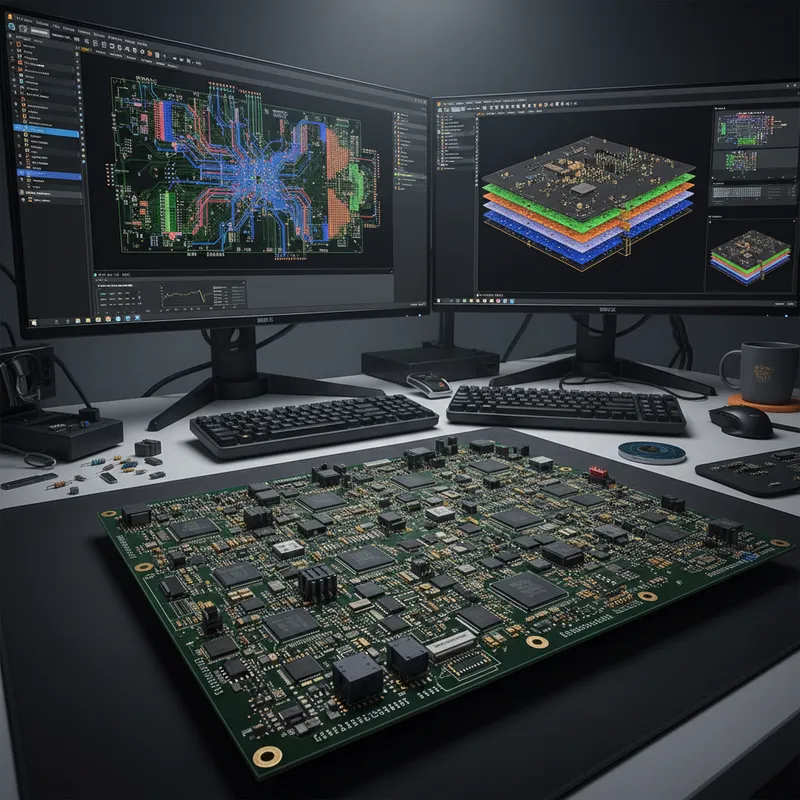
Altium Designer PCB editor with keyboard shortcut overlay highlighting net highlighting, layer cycle, and placement-navigation hotkeys

Tips & Tricks: Altium Designer Keyboard Shortcuts

GSAS Engineering · · 1 min read

When you’re working through a complex PCB layout, it always helps to know the shortcuts you can use to stay productive. Altium Designer® keyboard shortcuts, and keyboard + mouse shortcuts, can help you easily walk through your PCB layout during design and as part of final checks during a design review. The other very useful set of features in Altium Designer are the view options, which help you focus on essential structures in the design.

**In this webinar, you’ll learn about:
**
– Schematic Shortcut Keys
– Net Highlighting
– Layer Cycle
– Keyboard Shortcuts for Placement and Navigation

Timing:

Friday, 21st May 2021 | 02:30 PM to 03:30 PM

About the Topic!

Recorded webinar Session

Why shortcut productivity is a real metric for Indian PCB teams

A senior Indian PCB designer landing on a 12-layer 5G board, an automotive ECU motherboard, or an advanced packaging substrate spends most of their day in the layout editor, placing components, routing differential pairs, tuning skew, defining polygon priorities, cycling through layers to spot via-in-pad violations. The difference between a shortcut-fluent designer and someone clicking through menus is a real productivity multiplier across a full board layout. The same pattern shows up across every PCB design tool, not just Altium.

How Siemens Xpedition’s UX scales for shortcut-driven design

GSAS Micro Systems is an authorized engineering partner in India. Xpedition Standard and Xpedition Enterprise ship with a fully customizable shortcut framework, with two productivity surfaces beyond what Altium offers:

  • AI command prediction: Xpedition Standard’s AI assistant suggests the next likely command based on the current cursor context, the active layer, and the design state. For a designer cycling through routing modes on a high-density region, this is meaningfully faster than memorizing 50+ hotkeys.
  • Cross-tool consistency: for teams running HyperLynx for signal integrity, Valor NPI for DFM sign-off, and Xpedition for layout, the shortcut conventions stay consistent across the toolset rather than forcing context-switches.

For Indian teams evaluating workflow productivity end-to-end, the Altium Designer vs Siemens Xpedition Standard for Indian PCB teams comparison covers schematic capture, layout, constraint management, and the toolchain integration patterns that determine real day-to-day throughput.

Also appears in:

Need embedded development tools?

Talk to our application engineers for personalized tool recommendations.
Stay in the Loop

Get monthly compliance updates, product insights, and engineering best practices delivered to your inbox.

Related Articles

Master and slave roles on a 100BASE-T1 link: the master PHY times its transmitter from a local clock, the slave recovers the clock from the received signal, with the both-master and both-slave misconfigurations that leave the link down, from GSAS Micro Systems India
Automotive Ethernet Automotive & Mobility

100BASE-T1 Link Won't Come Up: A Vendor-Neutral Checklist

A 100BASE-T1 link that will not come up is almost never a mystery, but the answers on the web are written per silicon vendor and do not transfer. This is the ordered bring-up checklist that holds regardless of which PHY, switch or SoC you have: physical layer first, then the PHY over MDIO, then the master and slave pairing, then the causes of a link that comes up and drops. The standards and tooling claims trace to IEEE 802.3 task force records, the Linux ethtool and kernel documentation or published test material. Written by the GSAS Micro Systems engineering team in India.

29 Aug 2026 · 14 min read
Horizontal timeline of a CAN frame crossing a gateway, with four annotated segments showing bus arbitration, the point where the timestamp is applied, encapsulation into an IP packet, network transit and host receive, from GSAS Micro Systems India
Automotive Ethernet Automotive & Mobility

CAN-to-Ethernet Gateways and Tunnelling Legacy Buses

One word, two jobs. A CAN-to-Ethernet gateway either carries a frame across an IP network unchanged, for loggers and remote benches, or stops the frame and re-expresses its signals as service calls. The two have different failure modes, different timing costs and different questions to ask a supplier. This article separates the jobs, states what open documentation actually shows about encapsulation and configuration, and gives a checklist you can put to a vendor. Written by the GSAS Micro Systems engineering team in India.

29 Aug 2026 · 12 min read
Side by side vehicle outlines comparing a domain E/E architecture grouped by function against a zonal E/E architecture grouped by physical location, with zone controllers on an Ethernet backbone into central compute, from GSAS Micro Systems India
Automotive Ethernet Automotive & Mobility

Domain vs Zonal E/E Architectures Explained

Domain architectures group ECUs by function, zonal architectures group them by where they sit in the vehicle. This guide is the engineer's read on the difference: what physically moves, what the in-vehicle network has to become, and what happens to diagnostics, rest bus simulation and time sync. It also refuses to repeat the harness mass and ECU-count figures that circulate without a public source, and says exactly which claims are citable and which are not. Written by the GSAS Micro Systems engineering team in India.

29 Aug 2026 · 13 min read